10 minutes free every day
Continue audio lessons in the app
Word explanations appear automatically in sync with the audio.
No login required · synced translations · playback with the screen locked
Choose your learning language and open this lesson in the app.

About This Lesson
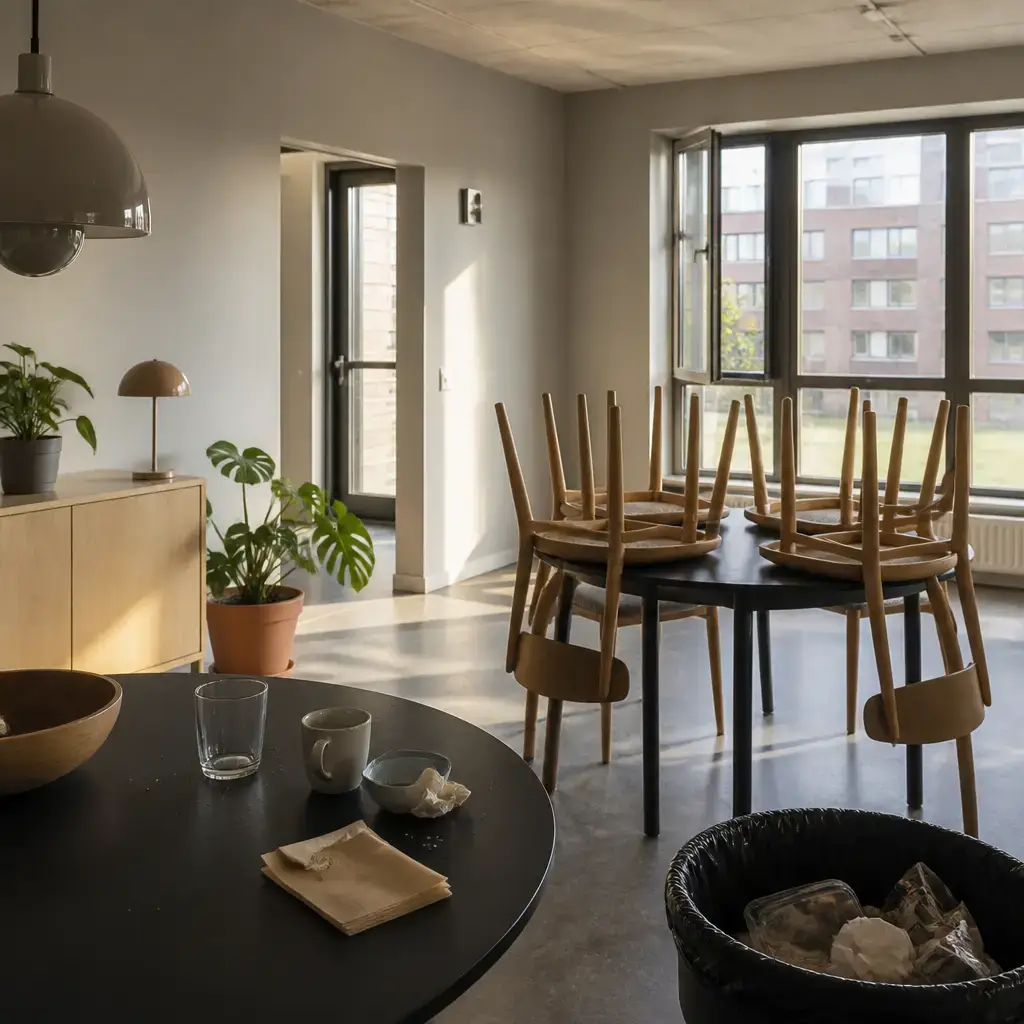
Use Cleaning Up a Common Room to practice German conversation, pronunciation, vocabulary, grammar, and quizzes.
Dialogue
Wir haben den Gemeinschaftsraum eine Weile benutzt.
veer HAH-ben dehn geh-MINE-shahfts-rowm EYE-nuh VY-luh beh-NOOTST. We used the common room for a while.Lass uns ihn aufräumen, bevor wir gehen.
lahs oons een OWF-roy-men, beh-FOHR veer GAY-en. Let's clean it up before we head out.Ich stelle die Stühle wieder an ihren Platz.
ikh SHTEL-luh dee SHTYOO-luh VEE-der ahn EE-ren PLAHTS. I'll put the chairs back where they were.Ich nehme den Müll von den Tischen.
ikh NAY-muh dehn myul fon dehn TISH-en. I'll clear the trash from the tables.Sollen wir auch die Lichter ausmachen?
ZOL-len veer OWKH dee LIKH-ter OWSS-mah-khen? Should we turn off the lights too?Mach die Lichter aus.
MAKH dee LIKH-ter OWSS. Turn off the lights.Schließ die Fenster, bevor wir abschließen.
shleess dee FEN-ster, beh-FOHR veer AHP-shlee-sen. Close the windows before we lock up.Der Raum ist bereit für die nächste Gruppe.
dair ROWM ist beh-RITE fyoor dee NEKH-stuh GROO-puh. The room looks ready for the next group.Dann können wir die Tür abschließen und gehen.
dahn KURN-en veer dee TYUR AHP-shlee-sen oont GAY-en. Then we can lock the door and leave.Sentence explanations
Wir haben den Gemeinschaftsraum eine Weile benutzt.
We used the common room for a while.
- Wir haben
- we have
- den Gemeinschaftsraum
- the common room
- eine Weile
- for a while
- benutzt
- used
More detail
Wir haben combines the subject wir (“we”) with present-tense haben (“have”). Here haben is an auxiliary, not the main meaning “possess”: it helps form the German perfect tense. The pattern is subject + haben + ... + past participle, commonly used for a completed past event. den Gemeinschaftsraum means “the common room.” Gemeinschaftsraum is a masculine compound noun: Gemeinschaft (“community”) + Raum (“room”). The article is den, the masculine accusative form of definite der, because this noun is the object of benutzt. For example, Wir betreten den Raum means “We enter the room.” eine Weile is a compact duration expression meaning “for a while.” The indefinite article eine does not itself state a numeric count; the whole expression describes an unspecified period of time. For example, Warte eine Weile means “Wait for a while.” benutzt is the past participle of benutzen, “to use.” The verb benutzen is a regular weak verb; its perfect participle is benutzt, without an inserted ge because of the unstressed prefix be-. In the fixed sentence, it is the main verb and appears at the end, as is normal for the participle in this perfect-tense pattern. Together, Wir haben + den Gemeinschaftsraum + eine Weile + benutzt gives “We used the common room for a while.” The completed-use meaning comes from the auxiliary haben and the participle benutzt; eine Weile specifies the duration.
Lass uns ihn aufräumen, bevor wir gehen.
Let's clean it up before we head out.
- Lass uns
- let’s
- ihn
- it
- aufräumen
- clean up
- bevor
- before
- gehen
- go
More detail
Lass uns is the fixed German pattern for making a joint proposal: “let’s …”. Lass is the informal singular imperative of lassen (“to let/allow”), and uns means “us”. The following infinitive supplies the proposed action. For example, Lass uns anfangen. means “Let’s start.” ihn means “it” here and refers compatibly to the masculine noun der Gemeinschaftsraum (“the common room”) from the preceding context. It is the masculine singular accusative form of er (“he/it”): er as subject, ihn as a direct object. The form is chosen because the thing being cleaned up is the object of aufräumen. aufräumen means “to tidy up” or “to clean up.” It is a separable verb: its infinitive is aufräumen, while a finite form can split as in Wir räumen auf. The sentence uses the infinitive after Lass uns, so the unsplit form appears here. Example: Ich räume mein Zimmer auf. — “I tidy up my room.” bevor means “before” and introduces a subordinate clause that gives the time relation between two actions. In German, the finite verb normally moves to the end of a clause introduced by bevor. gehen is the infinitive “to go.” In the subordinate clause, wir gehen means “we go” or, in this context, “we leave/head out.” The finite form is gehen with wir: wir gehen; the infinitive is also gehen. Example: Wir gehen, bevor es dunkel wird. — “We leave before it gets dark.” Together, Lass uns proposes a shared action, ihn aufräumen identifies the common room as what should be tidied, and bevor wir gehen places that action earlier than leaving. The whole utterance means: “Let’s clean it up before we head out.”
Ich stelle die Stühle wieder an ihren Platz.
I'll put the chairs back where they were.
- Ich
- I
- stelle
- put/place
- Stühle
- chairs
- wieder
- back/again
- an
- to/at
- ihren
- their
- Platz
- place
More detail
Ich means “I” and is the first-person singular subject. It identifies the person carrying out the action. The same subject form appears with many present-tense verbs, for example: Ich lerne. — “I am learning.” stelle is the first-person singular present form of stellen, “to put or place.” The form stellen is used for an action that moves or positions something; the related verb stehen describes something already being in an upright position. For example: Ich stelle die Tasse auf den Tisch. — “I put the cup on the table.” Stühle means “chairs.” It is the plural of der Stuhl, “chair.” Compare ein Stuhl — “a chair” and die Stühle — “the chairs.” Here the noun phrase is the object being placed. wieder means “back” or “again.” In this sentence it marks a return to a previous location: the chairs are being put back where they were. Here it comes after the object die Stühle and before the destination phrase; German word order can place it elsewhere when the emphasis changes. an means “to” here because it introduces the destination of the placing action. As a two-way preposition, an takes the accusative for movement toward a destination and the dative for a stationary location: an ihren Platz — “to their place,” but an ihrem Platz — “in their place.” ihren is the possessive determiner meaning “their” in this use. Its form agrees with the possessed noun phrase and marks the case required here: Platz is masculine singular, and movement with an makes the phrase accusative, so ihr becomes ihren. The form ihren can also occur in other grammatical combinations, so its exact form must be read together with the noun and case here. Platz means “place” or “spot.” Its base form is der Platz; in ihren Platz, it is masculine singular accusative. In this utterance, “their place” refers to the location associated with the chairs, matching the fixed translation “where they were.” Together, wieder and an ihren Platz express returning the chairs to their previous location. The structure etwas an einen Platz stellen means “to put something in/to a place”; with the first-person subject and present tense, Ich stelle die Stühle wieder an ihren Platz. means “I’ll put the chairs back where they were.” German present tense can express a planned or immediate future action when the context makes that clear.
Ich nehme den Müll von den Tischen.
I'll clear the trash from the tables.
- Ich
- I
- nehme
- remove; take
- Müll
- trash
- von
- from
- Tischen
- tables
More detail
Ich means “I” and identifies the speaker as the person carrying out the action. German subject pronouns include ich (“I”), du (“you,” singular informal), and wir (“we”). nehme is the first-person singular present form of nehmen (“to take”): ich nehme. In this sentence, the verb means “clear/remove,” because the object is trash and the fixed translation specifies that meaning. In other contexts, nehmen can mean “take,” as in Ich nehme den Bus. — “I take the bus.” Müll means “trash” or “rubbish.” It is a masculine mass noun: der Müll; German normally does not use a plural when referring generally to trash. Here, den Müll is the direct object of nehme, so the masculine article is den in the accusative: Ich nehme den Müll. von means “from” and introduces the place or source from which something is removed. In German, von governs the dative case. A reusable pattern is etwas von einem Ort nehmen — “take/remove something from a place.” Tischen means “tables” in the dative plural. The singular is der Tisch (“the table”), and its plural is die Tische; after von, the plural dative is den Tischen, with -n added to the noun. Thus von den Tischen means “from the tables.” The phrase identifies the tables as the source or location from which the trash is cleared. Putting the parts together, Ich nehme den Müll von den Tischen. means “I’ll clear the trash from the tables.” German present tense can express a planned or imminent action when the context makes that reading natural; the fixed translation presents this utterance that way. The sentence has the reusable structure Ich + present-tense verb + object + von + dative source/place.
Sollen wir auch die Lichter ausmachen?
Should we turn off the lights too?
- Sollen wir
- should we?
- auch
- too; also
- Lichter
- lights
- ausmachen
- turn off
More detail
Sollen wir is the first-person plural present form of sollen (“to be supposed to; should”). In a question, Sollen wir …? is a reusable way to ask whether “we” should do something, often functioning as a suggestion: Sollen wir anfangen? means “Shall we start?” The subject wir is included in this quoted construction, so the question is about an action carried out by the speaker together with others. auch means “also” or “too.” Here it adds this action to something else being done or considered; it does not mean “again” by itself. Its position directly before the noun phrase makes the lights the additional thing to turn off. Lichter is the plural of Licht (“light”). In this sentence it is the accusative plural object of ausmachen; the plural form is Lichter, and the definite article is die. German plural accusative has the same noun form as plural nominative here. Example: Ich sehe die Lichter. — “I see the lights.” ausmachen is a separable verb meaning “to switch off” or “to turn off” in this context. Its base verb is machen (“to do; make”), with the separable prefix aus-; this combination should be learned as the verb ausmachen, not as a general meaning of machen alone. In a finite main clause, the prefix separates: Wir machen die Lichter aus. — “We turn off the lights.” In the question, the infinitive remains together at the end: Sollen wir die Lichter ausmachen? Together, Sollen wir asks whether the group should act, auch marks the action as an additional one, die Lichter is what receives the action, and ausmachen supplies the proposed action. The whole utterance therefore means, “Should we turn off the lights too?”
Mach die Lichter aus.
Turn off the lights.
- Mach … aus
- turn off
- Lichter
- lights
More detail
Mach … aus is the separable-verb pattern from ausmachen, meaning “turn off” here. Mach is the imperative singular form of machen used with the separable prefix aus-; in a main-clause imperative, the prefix moves to the end: Mach das Licht aus. — “Turn off the light.” The object can appear between the verb parts, as in this sentence. In the earlier question, the same verb appears together as ausmachen because it follows the modal verb sollen: Sollen wir … ausmachen? — “Should we turn … off?” Lichter is the plural of Licht, “light.” The form Lichter refers to more than one light; the singular is Licht. The article die also marks the plural definite noun phrase here: “the lights.” Example: Die Lichter sind an. — “The lights are on.” Together, Mach + die Lichter + aus forms a direct command: “Turn off the lights.” The command is addressed to one person using the informal singular imperative. The object is placed between the two parts of the separable verb.
Schließ die Fenster, bevor wir abschließen.
Close the windows before we lock up.
- Schließ
- close
- Fenster
- windows
- bevor
- before
- wir
- we
- abschließen
- lock up
More detail
Schließ is the informal singular imperative of schließen (“to close”). The subject is understood as “you,” addressed to one person. The form comes from schließen; an imperative aimed at several people or a formal addressee uses a different form, so this form is useful when giving a direct instruction to one person. Example: Schließ die Tür! — “Close the door!” Fenster means “windows” here. Its singular is das Fenster, and its plural is die Fenster; the noun itself has the same form in singular and plural, so the article or another determiner normally shows the number. In the supplied sentence, the unquoted article die identifies the plural. Example: Die Fenster sind offen. — “The windows are open.” bevor introduces the event that happens later than the event in the main clause: “before.” It introduces a subordinate clause, and in this sentence the conjugated verb appears at the end of that clause. Example: Bevor wir gehen, schließen wir die Tür. — “Before we leave, we close the door.” wir is the first-person plural pronoun “we.” It is the subject of the subordinate clause and refers to the speaker together with at least one other person. Its corresponding singular form is ich (“I”); wir is not a form used for one speaker alone. abschließen means “to lock up” in this sentence. It is a different verb from schließen: schließen means “close,” while abschließen can mean “lock” or “lock up,” among other context-dependent uses. Here it is an infinitive at the end of the bevor clause. Example: Wir schließen ab. — “We lock up.” As a separable verb in a main clause, it appears as Wir schließen ab; after bevor, the infinitive remains together as abschließen at the clause end. Together, Schließ die Fenster gives the instruction “Close the windows.” bevor wir abschließen adds the time condition “before we lock up,” with wir as the people who will lock up. The complete utterance therefore means: “Close the windows before we lock up.”
Der Raum ist bereit für die nächste Gruppe.
The room looks ready for the next group.
- Raum
- room
- ist
- is
- bereit
- ready
- für
- for
- nächste
- next
- Gruppe
- group
More detail
Raum means “room” here. Its base form is der Raum; the plural is die Räume, with an umlaut and -e. The noun is masculine. In Der Raum, the masculine singular noun phrase is in the nominative case, so it takes the definite article der. ist is the third-person singular present form of sein (“to be”): ich bin, du bist, er/sie/es ist. Here it links the room to the adjective bereit; it is not a separate action. bereit means “ready” here. As a predicate after ist, it has no adjective ending: Der Raum ist bereit (“The room is ready”). A practical contrast is bereit / nicht bereit (“ready” / “not ready”). für means “for” in this use and takes the accusative case. The pattern bereit sein für + accusative means “to be ready for someone or something.” Example: Wir sind für den Beginn bereit. — “We are ready for the beginning.” nächste means “next” here. It is the feminine singular form modifying Gruppe in die nächste Gruppe. The adjective form is nächst-; the ending -e marks this form in a feminine singular noun phrase after the definite article die. Compare der nächste Raum (“the next room”) and die nächste Gruppe (“the next group”). Gruppe means “group.” Its base form is singular die Gruppe; the plural is die Gruppen. In this sentence, Gruppe is feminine singular, and after für the phrase is accusative: für die nächste Gruppe. Because the feminine definite article die has the same form in nominative and accusative singular, the case is not visible in that article. With a plural meaning, German would use für die nächsten Gruppen (“for the next groups”). Together, Der Raum ist bereit says that the room is ready, and für die nächste Gruppe specifies what it is ready for. The complete utterance means “The room is ready for the next group,” matching the fixed translation’s intended meaning “The room looks ready for the next group.”
Dann können wir die Tür abschließen und gehen.
Then we can lock the door and leave.
- Dann
- then
- können wir
- we can
- Tür
- door
- abschließen
- lock
- gehen
- leave
More detail
Dann means “then” and places the action after the relevant earlier situation or event. It is an adverb and does not change form. können wir expresses “we can.” können is the modal verb können (“can, be able to”); here it is present-tense, first-person plural, matching wir. In a main clause, the finite modal is in the second position, while the other verb can remain in the infinitive: Wir können gehen. — “We can leave.” Tür means “door.” The full noun phrase is die Tür: Tür is a feminine noun, and die marks the definite accusative singular form here because the door is the object of abschließen. The noun’s plural is Türen; in the definite plural, the article is also die: die Tür — “the door,” die Türen — “the doors.” abschließen means “to lock” here. It is a separable verb: without a modal, its parts separate in a main clause, as in Wir schließen die Tür ab. — “We lock the door.” After the modal können, the verb stays together as the infinitive abschließen. gehen means “to leave” in this sentence. Its basic meaning can also be “to go” or “to walk,” but the fixed translation identifies the intended meaning here. With können, it is another infinitive: Wir können gehen. — “We can leave.” Together, können wir die Tür abschließen means “we can lock the door.” The following und gehen adds a second action, “and leave”; the modal können is understood with gehen as well. Thus Dann können wir die Tür abschließen und gehen. means “Then we can lock the door and leave.”
Grammar Points
Trennbare Verben: ausmachen → ... aus
Ich mache das Licht aus.
ikh MAKH-uh dahs LIKHT OWSS.I turn off the light.
Bei trennbaren Verben steht das Präfix im Hauptsatz am Satzende: ausmachen → mache ... aus.
German Vocabulary
Quiz
Word Order
Arrange the words in the correct order.
Should we turn off the lights too?
Show Answer
Sollen wir auch die Lichter ausmachen?Turn off the lights.
Show Answer
Mach die Lichter aus.Close the windows before we lock up.
Show Answer
Schließ die Fenster, bevor wir abschließen.Spelling
Tap the letters to spell the word.
trash
Show Answer
Müllwhile
Show Answer
Weileto put or place
Show Answer
stelleto use