10 minutes free every day
Continue audio lessons in the app
Word explanations appear automatically in sync with the audio.
No login required · synced translations · playback with the screen locked
Choose your learning language and open this lesson in the app.

About This Lesson
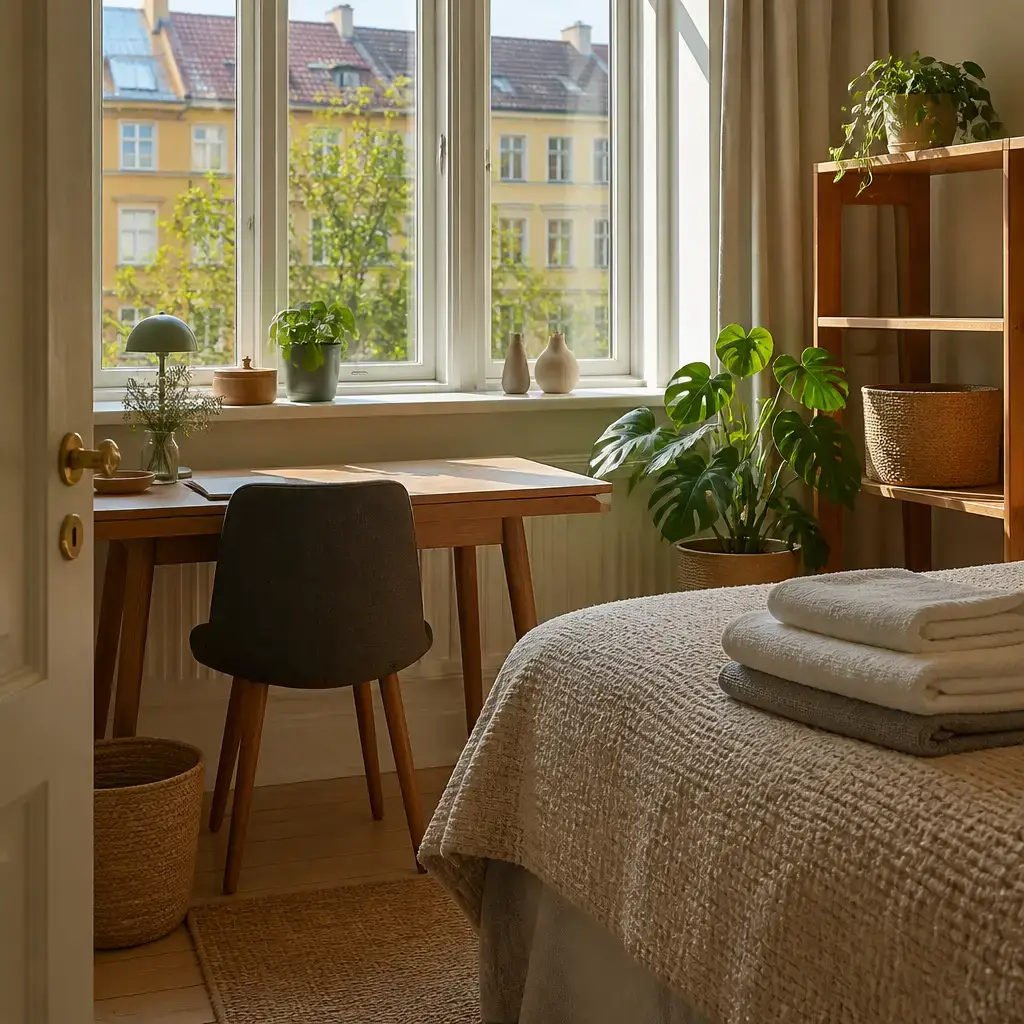
Use Thoughtfully preparing a guest room to practice German conversation, pronunciation, vocabulary, grammar, and quizzes.
Dialogue
Meine Cousine kommt für einen kurzen Besuch zu uns.
MY-nuh koo-ZEE-nuh kohmt fyoor EYE-nen KOORTS-en beh-ZOOKH tsoo oons. My cousin is coming to stay with us for a short visit.Wir sollten das Gästezimmer gemütlicher machen, bevor sie ankommt.
VEER ZOLL-ten dahs GEHS-tuh-TSIM-mer geh-MYOOT-lich-er MAKH-en, beh-FOHR zee AHN-komt. We should make the spare room more comfortable before she arrives.Lass mich den Schreibtisch freimachen, damit sie Platz für ihren Laptop hat.
Lahs mish den SHRYBE-tish FRY-mah-khen, dah-MIT zee plahts fyoor EE-ren LAP-top haht. Let me clear the desk so she has space for her laptop.Lass die Anweisungen für den Internetzugang dort liegen, wo sie sie leicht finden kann.
Lahs dee AHN-vy-zung-en fyoor den IN-ter-net-TSOO-gahng dort LEE-gen, voh zee zee LYE-kht FIND-en kahn. Leave the internet instructions where she can find them easily.Sollen wir zusätzliche Handtücher ins Zimmer legen oder ihr den Schrank zeigen?
ZOLL-en veer TSOO-zaets-lich-uh HAHNT-tyoo-kher ins TSIM-mer LAY-gen OH-der eer den SHRAHNK TSOY-gen? Should we put extra towels in the room, or show her the cupboard?Leg sie ins Zimmer. So haben Gäste mehr Privatsphäre.
LEHK zee ins TSIM-mer. Zoh HAH-ben GEHS-tuh mehr pree-VAHT-sfeh-reh. Put them in the room. It gives guests more privacy.Ich möchte ein entspannter Gastgeber sein, nicht jemand, der jedes Detail erklärt.
Ikh MOERKH-tuh eye-n ent-SHPAN-ter GAHST-gay-ber zine, nikht YAY-mahnt, dare YAY-des deh-TAIL eh-KLEHRT. I want to be a relaxed host, not someone who explains every detail.Ein kurzer Zettel reicht, besonders für Schlüssel, Licht und Frühstück.
Eye-n KOORTS-er TSET-tel RYE-kht, beh-ZON-ders fyoor SHLIH-sel, likht oont FRYOO-shtook. A short note is enough, especially for keys, lights, and breakfast.Wenn wir das vorher vorbereiten, müssen wir später nicht hetzen.
Ven veer dahs FOHR-hair fohr-beh-RYE-ten, MYOOS-en veer SHPAY-ter nikht HET-sen. Preparing it ahead of time would keep us from rushing later.Dadurch wird sie sich willkommen fühlen, ohne dass der Besuch zu förmlich wirkt.
DAH-doorkh veert zee zikh vil-KOM-en FYOOL-en, OH-nuh dahs dare beh-ZOOKH tsoo FOERM-lich virkt. That will make her feel welcome without making the visit too formal.Sentence explanations
Meine Cousine kommt für einen kurzen Besuch zu uns.
My cousin is coming to stay with us for a short visit.
- Meine
- my
- Cousine
- cousin (female)
- kommt
- is coming
- kurzen
- short
- Besuch
- visit
- zu uns
- to us
More detail
Meine means “my” here. It is a possessive determiner, and its ending agrees with Cousine: feminine singular nominative. The base form is mein; compare meine Schwester (“my sister”) with mein Bruder (“my brother”). Cousine means “female cousin.” It is a feminine noun; its masculine counterpart is Cousin. Example: Meine Cousine besucht uns. — “My cousin visits us.” kommt is the third-person singular present form of kommen (“to come”): sie kommt — “she comes” or, in a suitable context, “she is coming.” German present tense can describe a planned or expected future event. Example: Sie kommt morgen. — “She is coming tomorrow.” kurzen is the inflected form of the adjective kurz (“short”). It describes Besuch here. Because Besuch is masculine and the preposition für requires the accusative, the phrase uses einen kurzen Besuch: kurz becomes kurzen after the indefinite article einen. Besuch means “visit.” In einen kurzen Besuch, it refers to a visit of short duration. Example: Wir machen einen kurzen Besuch. — “We are making a short visit.” zu uns means “to us” or, with this verb, “to our place/with us.” zu takes the dative, and uns is the first-person plural dative form of wir (“we”). Example: Komm zu uns! — “Come to us!” The sentence assembles as Meine Cousine (“my female cousin”) + kommt (“is coming”) + für einen kurzen Besuch (“for a short visit”) + zu uns (“to us/our place”). Together: “My cousin is coming to stay with us for a short visit.”
Wir sollten das Gästezimmer gemütlicher machen, bevor sie ankommt.
We should make the spare room more comfortable before she arrives.
- Wir sollten
- we should
- Gästezimmer
- spare room
- gemütlicher
- more comfortable
- machen
- make
- bevor
- before
- sie
- she
- ankommt
- arrives
More detail
Wir sollten combines wir (“we”) with sollten, the form of sollen used here for “should.” It expresses a recommendation or obligation for the speakers together. The infinitive after a modal verb stays at the end of its main clause: Wir sollten ... machen. Gästezimmer is a neuter noun meaning “guest room” or, in this context, “spare room.” It is written as one compound noun: Gäste + Zimmer. The form here is accusative singular after machen, because the room is the thing being changed. German nouns are capitalized. gemütlicher is the comparative of the adjective gemütlich (“comfortable,” “cosy,” or “pleasant”). gemütlich → gemütlicher means “more comfortable.” Here it describes the result that the speakers want for the room. A basic comparison is Das Zimmer ist gemütlich (“The room is comfortable”) versus Das Zimmer ist gemütlicher (“The room is more comfortable”). machen means “make” or “cause to become.” With an adjective, etwas gemütlicher machen means “make something more comfortable.” After sollten, it appears as the infinitive machen, not a conjugated form. bevor introduces a subordinate clause meaning “before.” German places the conjugated verb at the end of a clause introduced by bevor, as in bevor sie ankommt. sie is the feminine singular pronoun “she” in this sentence, matching the fixed translation and the context about the female cousin. Its exact grammatical role here is the subject of ankommt. In other contexts, sie can have other functions or referents, so the surrounding sentence determines its meaning. ankommt comes from the separable verb ankommen, “arrive.” It is the present-tense third-person singular form: sie kommt an in a main clause, but bevor sie ankommt in this subordinate clause. The prefix remains attached at the end because the subordinate-clause structure places the conjugated verb there. Together, Wir sollten das Gästezimmer gemütlicher machen means “We should make the spare room more comfortable.” The clause bevor sie ankommt adds the time condition “before she arrives.” The complete utterance therefore means: “We should make the spare room more comfortable before she arrives.”
Lass mich den Schreibtisch freimachen, damit sie Platz für ihren Laptop hat.
Let me clear the desk so she has space for her laptop.
- Lass mich
- let me
- Schreibtisch
- desk
- freimachen
- clear
- damit
- so that
- sie
- she
- Platz
- space
- ihren
- her
- Laptop
- laptop
- hat
- has
More detail
Lass mich is a reusable informal-singular request meaning “let me …”. Lass is the imperative of lassen for du; mich is the accusative form of ich and identifies the person who will perform the following action. Example: Lass mich helfen. — “Let me help.” Schreibtisch means “desk”. It is a masculine noun: der Schreibtisch. The compound word refers specifically to a writing or work desk, rather than to a table in general. Example: Der Schreibtisch ist groß. — “The desk is large.” freimachen is the infinitive meaning “to clear” or “to free up”. It is a separable verb: in a main clause, Ich mache den Tisch frei. means “I clear the table,” but after Lass mich, the infinitive remains together at the end: Lass mich den Tisch freimachen. — “Let me clear the table.” damit introduces a purpose clause, equivalent here to “so that”. In this clause, the finite verb goes to the end. The translation identifies sie as the person who will have the space. sie here is the feminine singular subject pronoun “she”. Its form is nominative in this clause because she is the person who has the space. Example: Sie arbeitet. — “She is working.” Platz means “space” or “room” in the sense of available space. It is masculine: der Platz. In Platz haben, it forms the useful expression “to have space”. Example: Wir haben noch Platz. — “We still have space.” ihren means “her” here and is the possessive determiner modifying Laptop. Its form is masculine accusative singular: the masculine noun is der Laptop, and after für German uses the accusative, giving für ihren Laptop. The form agrees with the possessed noun, while its meaning identifies the female possessor in this sentence. Compare ihr Laptop in the nominative with für ihren Laptop after für. Laptop means “laptop”. It is masculine: der Laptop; after für, it appears in the accusative phrase für ihren Laptop. Example: Sie braucht ihren Laptop. — “She needs her laptop.” hat is the third-person singular present form of haben, “to have”: haben → sie hat. Example: Sie hat Zeit. — “She has time.” The sentence builds as Lass mich + the object den Schreibtisch + the infinitive freimachen: “Let me clear the desk.” The damit clause gives the purpose: damit sie Platz für ihren Laptop hat, literally “so that she has space for her laptop.” Together, the utterance means: “Let me clear the desk so she has space for her laptop.”
Lass die Anweisungen für den Internetzugang dort liegen, wo sie sie leicht finden kann.
Leave the internet instructions where she can find them easily.
- Lass
- leave
- Anweisungen
- instructions
- Internetzugang
- internet access
- dort
- there
- liegen
- lie; be placed
- sie
- she
- leicht
- easily
- finden
- find
- kann
- can
- sie
- them
More detail
Lass is the informal singular imperative of lassen (“to let; to leave”). Here it introduces a command: Lass + object + liegen means “leave the object in place.” The form is addressed to one person informally; the formal command would use Lassen Sie .... Anweisungen is the plural of die Anweisung, “instruction.” The plural ending is part of this noun’s form. In this sentence, it is the thing being left. Internetzugang is a compound noun meaning “internet access”: Internet + Zugang (“access”). It appears in für den Internetzugang, meaning “for internet access.” The article den shows the masculine accusative form after für; the noun itself is der Internetzugang. dort means “there,” referring to a place understood from the situation. liegen means “to lie” or “to be situated/placed.” Together, dort liegen describes the instructions remaining at that place. The infinitive liegen is used after Lass in the pattern Lass etwas liegen (“leave something where it is”). wo introduces a place clause: wo ... means “where ...”. In wo sie sie leicht finden kann, the first sie is the feminine singular subject “she,” while the second sie is the plural accusative object “them,” referring here to the instructions. Their forms happen to look identical, but their grammatical roles are different. leicht is an adjective whose form is unchanged here because it is used adverbially, modifying finden: “easily.” As an adjective before a noun, it can show endings, as in ein leichter Zugang (“an easy access”); that is a different use. finden means “to find.” Its infinitive follows the modal verb kann in the subordinate clause. A reusable contrast is finden (“find”) versus suchen (“search/look for”): finding is reaching or locating something, while searching is the activity of trying to locate it. kann is the third-person singular present form of können, “can; be able to.” In the clause wo sie sie leicht finden kann, it expresses that she is able to find the instructions easily. In a German subordinate clause introduced by wo, the finite modal verb comes at the end, while the other verb remains an infinitive before it: ..., wo sie etwas finden kann (“..., where she can find something”). The sentence assembles as Lass [die Anweisungen für den Internetzugang] [dort liegen], [wo sie sie leicht finden kann]: “Leave the instructions for internet access there, where she can find them easily.” The command places the instructions somewhere and adds a location clause describing a place that allows her to find them easily.
Sollen wir zusätzliche Handtücher ins Zimmer legen oder ihr den Schrank zeigen?
Should we put extra towels in the room, or show her the cupboard?
- Sollen wir
- should we
- zusätzliche
- extra; additional
- Handtücher
- towels
- ins
- into the
- Zimmer
- room
- legen
- put; place
- ihr
- her
- Schrank
- cupboard
- zeigen
- show
More detail
Sollen wir uses sollen, whose base form is sollen, with wir as its first-person plural subject. Here the question proposes an action: “Should we …?” In a German main question, the finite modal verb comes first, while the subject follows it. The infinitive belonging to sollen appears at the end of its clause. Example: Sollen wir warten? — “Should we wait?” zusätzliche means “additional” in this sentence. It describes Handtücher and has the plural attributive form zusätzliche; the ending reflects the noun phrase’s grammatical context, not a change in the adjective’s basic meaning. The base form is zusätzlich. Example: Wir brauchen zusätzliche Kissen. — “We need extra pillows.” Handtücher is the plural of Handtuch, “towel.” The plural form is useful here because the sentence refers to extra towels in the plural. Example: Die Handtücher sind sauber. — “The towels are clean.” ins is the contraction of in das. With a movement or placement into an enclosed place, in takes the accusative here: in das Zimmer becomes ins Zimmer. Zimmer is a neuter noun, with the definite article das in this form. Example: Wir stellen den Koffer ins Zimmer. — “We put the suitcase in the room.” legen is the infinitive “to lay” or “to put/place” something in a lying position. It follows the modal verb sollen, so it stays in the infinitive and moves to the end of the first alternative. Contrast legen for putting something somewhere with liegen for already being in a lying position: Ich lege das Handtuch aufs Bett. — “I put the towel on the bed.” ihr is the third-person singular feminine personal pronoun in the dative case, meaning “to her” or “her” as the recipient of an action. The fixed translation and the preceding context identify this recipient as a female person. In ihr den Schrank zeigen, the person shown something is marked by dative, while the thing shown is marked by accusative. Example: Ich zeige ihr den Weg. — “I show her the way.” Schrank means “cupboard” or “wardrobe.” It is masculine; as the thing being shown, it appears in the accusative as den Schrank. Example: Der Schrank ist groß. — “The cupboard is large.” zeigen is the infinitive “to show.” It follows the same modal sollen in the second alternative. Oder connects the two proposed actions: putting extra towels in the room, or showing her the cupboard. Example: Sollen wir ihr das Zimmer zeigen? — “Should we show her the room?” As a whole, Sollen wir zusätzliche Handtücher ins Zimmer legen oder ihr den Schrank zeigen? asks whether “we” should carry out one of two actions: place extra towels in the room, or show the cupboard to her. The shared Sollen wir applies to both infinitives, legen and zeigen, so the second alternative does not repeat the modal verb or subject.
Leg sie ins Zimmer. So haben Gäste mehr Privatsphäre.
Put them in the room. It gives guests more privacy.
- Leg
- put
- sie
- them
- ins Zimmer
- into the room
- So
- that way
- haben
- have
- Gäste
- guests
- mehr
- more
- Privatsphäre
- privacy
More detail
Leg is the imperative singular form of legen (“to put/place”). It addresses one person and tells that person to place something. Compare Leg das Handtuch ins Zimmer. — “Put the towel in the room.” The form for addressing several people or using a formal address is different, so singular Leg should not be generalized to every addressee. sie means “them” here: a third-person plural accusative pronoun for the items being placed. In the preceding context, the extra towels are a compatible referent. The pronoun itself marks the items as the object of legen; it does not identify their type on its own. Compare singular forms such as ihn (“him/it,” masculine) and sie (“her/it,” feminine), while plural “them” is also sie. ins Zimmer gives the destination. ins is the contraction of in das, and Zimmer is a neuter noun: das Zimmer. With movement toward an interior destination, German uses in with the accusative, hence in das Zimmer or contracted ins Zimmer. A useful pattern is etwas ins Zimmer legen — “put something in the room.” So means “that way” or “by doing so.” It links the placement instruction to its beneficial result. In this sentence it refers to the arrangement just instructed, rather than naming a separate object. So kannst du helfen. means “That way, you can help.” haben is the present-tense form of haben (“to have”) for sie meaning “they” and for the plural noun Gäste (“guests”). Here it states that the guests possess or enjoy a greater degree of privacy. The singular forms are ich habe, du hast, and er/sie/es hat; the plural form with wir, ihr, and sie/Sie is haben (with ihr: habt). Gäste means “guests.” It is the plural of der Gast (“the guest”); the umlaut and ending are part of this plural form. Die Gäste haben mehr Ruhe. means “The guests have more peace and quiet.” mehr means “more” and compares an amount or degree with a smaller amount or degree. It is the comparative form associated with viel (“much/many”): viel → mehr → am meisten (“the most”). In mehr Privatsphäre, it means a greater degree of privacy, not a separate count of guests. Privatsphäre means “privacy,” especially personal or private space. It is a feminine noun: die Privatsphäre; the noun remains singular here even though the sentence says that the guests have a greater amount of it. Die Tür gibt ihr mehr Privatsphäre. means “The door gives her more privacy.” Together, Leg sie ins Zimmer means “Put them in the room.” So connects that action with the result: haben Gäste mehr Privatsphäre means “guests have more privacy.” The complete utterance therefore means “Put them in the room. That way, guests have more privacy.”
Ich möchte ein entspannter Gastgeber sein, nicht jemand, der jedes Detail erklärt.
I want to be a relaxed host, not someone who explains every detail.
- Ich möchte
- I want to
- entspannter
- relaxed
- Gastgeber
- host
- sein
- be
- nicht
- not
- jemand
- someone
- Detail
- detail
- erklärt
- explains
More detail
Ich möchte expresses “I want” in this sentence. möchte is the commonly used polite wanting form of mögen; it is followed here by the infinitive sein, which is placed at the end of the clause. For example: Ich möchte lernen. — “I want to learn.” entspannter means “relaxed” here. The ending -er is the adjective ending used with the masculine nominative noun phrase ein entspannter Gastgeber; it is not a comparative form meaning “more relaxed.” The base adjective is entspannt. A true comparison would normally be entspannter als ... — “more relaxed than ...” — with the comparative meaning made clear by context or by als. Gastgeber is the noun “host.” It is masculine in German, and its form is the same in the singular nominative and accusative; the article or adjective can show the case more clearly. Ein Gastgeber means “a host”; the indefinite article does not by itself assert a numerical count as the main point here. sein is the infinitive “to be.” After möchte, it names the desired state or role: Ich möchte Gastgeber sein. — “I want to be a host.” nicht negates the alternative introduced after the comma. It means “not” here; the full contrast is between being a relaxed host and being someone who explains every detail. jemand means “someone” and introduces an unspecified person. It is grammatically singular, which is why the following relative clause uses the singular form erklärt. The word does not identify that person beyond the description supplied by the relative clause. Detail is the noun “detail.” In jedes Detail, jedes agrees with this neuter singular noun in the accusative, because the detail is what gets explained. The phrase means “every detail.” erklärt means “explains” here. It is the third-person singular present form of erklären (“to explain”): ich erkläre, du erklärst, er/sie erklärt. In the relative clause, it describes what the unspecified jemand does: jemand, der jedes Detail erklärt — “someone who explains every detail.” The sentence first gives the desired role and manner: Ich möchte ein entspannter Gastgeber sein — “I want to be a relaxed host.” nicht jemand then introduces a contrasting description, and der jedes Detail erklärt specifies that description. Together, the utterance means: “I want to be a relaxed host, not someone who explains every detail.”
Ein kurzer Zettel reicht, besonders für Schlüssel, Licht und Frühstück.
A short note is enough, especially for keys, lights, and breakfast.
- kurzer
- short
- Zettel
- note
- reicht
- is enough
- besonders für
- especially for
- Schlüssel
- keys
- Licht
- light
- Frühstück
- breakfast
More detail
kurzer means “short” here. Its base form is kurz. In Ein kurzer Zettel, the adjective describes the masculine singular noun Zettel in the nominative, and the ending -er appears after the indefinite article ein: ein kurzer Zettel. This ending belongs to the adjective, not to the noun. Example: ein kurzer Brief — “a short letter.” Zettel is a note or slip of paper. It is masculine: der Zettel. Its plural is also Zettel, so the singular meaning here is shown by ein and kurzer, not by a different noun ending. Example: Ich schreibe einen Zettel. — “I am writing a note.” reicht is the third-person singular present form of reichen. In this sentence, reichen means “to be enough” or “to suffice,” not “to reach” someone. The subject is Ein kurzer Zettel, so the verb is singular: Ein kurzer Zettel reicht. Example: Das reicht. — “That is enough.” besonders für means “especially for.” für introduces what something is intended for or applies to; it takes the accusative case. The case is not visibly marked on the nouns here because their forms do not show a different ending in this phrase. Example: Das ist besonders für Kinder hilfreich. — “That is especially helpful for children.” Schlüssel means “keys” here. The singular is der Schlüssel, and the plural is also Schlüssel; the plural meaning is supported by the fixed translation and the list context. Example: Ich brauche zwei Schlüssel. — “I need two keys.” Licht means “light” here. das Licht is a neuter noun and commonly refers to light as a substance or to lighting generally. In the fixed translation, “lights” expresses the intended practical category, but the target form itself is the singular/mass noun Licht, not a plural form. Example: Das Licht ist an. — “The light is on.” Frühstück means “breakfast.” It is the neuter noun das Frühstück, normally used as an uncounted meal name. Example: Das Frühstück ist fertig. — “Breakfast is ready.” Putting the parts together, Ein kurzer Zettel reicht says “A short note is enough.” besonders für then introduces the areas for which it is especially enough or useful: Schlüssel, Licht und Frühstück — “keys, lights, and breakfast.” The complete meaning is therefore: “A short note is enough, especially for keys, lights, and breakfast.”
Wenn wir das vorher vorbereiten, müssen wir später nicht hetzen.
Preparing it ahead of time would keep us from rushing later.
- Wenn wir
- if we
- das
- it
- vorher
- beforehand
- vorbereiten
- prepare
- müssen wir
- we must
- später
- later
- hetzen
- rush
More detail
Wenn wir introduces a condition: wenn means “if” here, not “when,” and wir is the first-person plural subject, “we.” In a wenn-clause, the finite verb normally comes at the end. Example: Wenn wir Zeit haben, kochen wir. — “If we have time, we cook.” das is an accusative neuter pronoun meaning “it” here. Its grammatical form is neuter singular accusative; the supplied sentence does not identify a more specific referent. The form das can also be a demonstrative or an article in other contexts, but here it stands on its own as a pronoun. vorher means “beforehand” or “earlier,” relative to the preparation and the later situation. It is an adverb, so it does not change for number or gender. vorbereiten means “prepare.” In Wenn wir das vorher vorbereiten, this form is the present-tense finite form for wir; it happens to look identical to the infinitive. The prefix vor- is separable in some finite main-clause uses: Wir bereiten das vorher vor. In the subordinate clause here, the complete verb remains together at the end: ... das vorher vorbereiten. müssen wir means “we must” or, with the following negation, “we have to ... not.” Because the wenn-clause comes first, the main clause begins with the verb and then the subject: müssen wir. müssen expresses necessity. In this sentence, nicht later makes the intended meaning “we will not have to rush,” rather than “we must not rush.” später means “later,” referring to a later time than the preparation. It is another time adverb and does not inflect. hetzen means “rush” or “hurry.” With the modal verb müssen, it appears as an infinitive at the end of the main clause: müssen ... hetzen. Example: Ich muss heute hetzen. — “I have to rush today.” Together, Wenn wir das vorher vorbereiten sets up the condition “If we prepare it beforehand.” The main clause müssen wir später nicht hetzen says that, as a result, “we do not have to rush later.” The whole utterance is therefore: “If we prepare it beforehand, we won’t have to rush later.”
Dadurch wird sie sich willkommen fühlen, ohne dass der Besuch zu förmlich wirkt.
That will make her feel welcome without making the visit too formal.
- Dadurch
- thereby; as a result of that
- wird sie
- she will
- willkommen
- welcome
- fühlen
- feel
- ohne dass
- without ...
- der Besuch
- the visit
- zu förmlich
- too formal
- wirkt
- seems; comes across
More detail
Dadurch means “through that” or “as a result of that.” In this exchange, it points back to the preparation mentioned previously. It links that prior measure to its result: Dadurch wird ... can mean “As a result, ...” or “That will ...”. wird sie: wird is the third-person singular present form of werden. With a later infinitive, werden forms the future: sie wird ... fühlen means “she will ... feel.” sie is the subject, “she”; wird is the future auxiliary, not the verb meaning “feel.” Example: Sie wird kommen. — “She will come.” willkommen is an adjective meaning “welcome.” In sich willkommen fühlen, it describes the person’s experience: “feel welcome.” It can also be used after sein: Du bist willkommen. — “You are welcome.” fühlen is the infinitive “to feel.” The reusable expression here is sich willkommen fühlen, literally “to feel oneself welcome,” with sich as the reflexive pronoun belonging to fühlen. Example: Ich fühle mich sicher. — “I feel safe.” The infinitive fühlen follows the future auxiliary wird. ohne dass introduces a subordinate clause meaning “without ...” when that clause has its own subject. Here, der Besuch is the subject of ohne dass der Besuch zu förmlich wirkt. The finite verb comes at the end of this subordinate clause. Compare this with ohne zu plus an infinitive, normally used when the understood subject is the same as in the surrounding clause. der Besuch means “the visit.” Besuch is a masculine noun, so its nominative singular definite article is der. Its plural is die Besuche — “the visits.” zu förmlich: förmlich means “formal,” and zu is a degree adverb meaning “too”; it does not form a comparative. Together they mean “too formal,” expressing an excessive degree for the situation. Example: Der Besuch ist zu förmlich. — “The visit is too formal.” wirkt is the third-person singular present form of wirken, meaning “seems” or “comes across.” Here, the visit is described as coming across as too formal. Example: Die Antwort wirkt freundlich. — “The answer comes across as friendly.” Together, Dadurch wird sie sich willkommen fühlen means “That will make her feel welcome”: werden places the result in the future, and sich willkommen fühlen describes her experience. ohne dass der Besuch zu förmlich wirkt adds that the visit does not come across as too formal. The whole utterance means: “That will make her feel welcome without making the visit too formal.”
Grammar Points
Komparativ mit -er: gemütlich → gemütlicher
Das Gästezimmer ist gemütlicher.
dahs GEHS-tuh-TSIM-mer ist geh-MYOOT-lich-er.The guest room is cozier.
Adjektive bekommen im Vergleich oft die Endung -er: gemütlich wird zu gemütlicher.
ankommen im Nebensatz: ankommt
Die Cousine kommt an.
dee koo-ZEE-nuh kohmt AHN.The female cousin arrives.
Das trennbare Verb ankommen steht im Hauptsatz getrennt: Die Cousine kommt an.
German Vocabulary
Quiz
Spelling
Tap the letters to spell the word.
space; room
Show Answer
Platzvisit
Show Answer
Besuchdesk
Show Answer
Schreibtischcomfortable; cozy