10 minutes free every day
Continue audio lessons in the app
Word explanations appear automatically in sync with the audio.
No login required · synced translations · playback with the screen locked
Choose your learning language and open this lesson in the app.

About This Lesson
Use Requesting a replacement for a faulty product to practice German conversation, pronunciation, vocabulary, grammar, and quizzes.
Dialogue
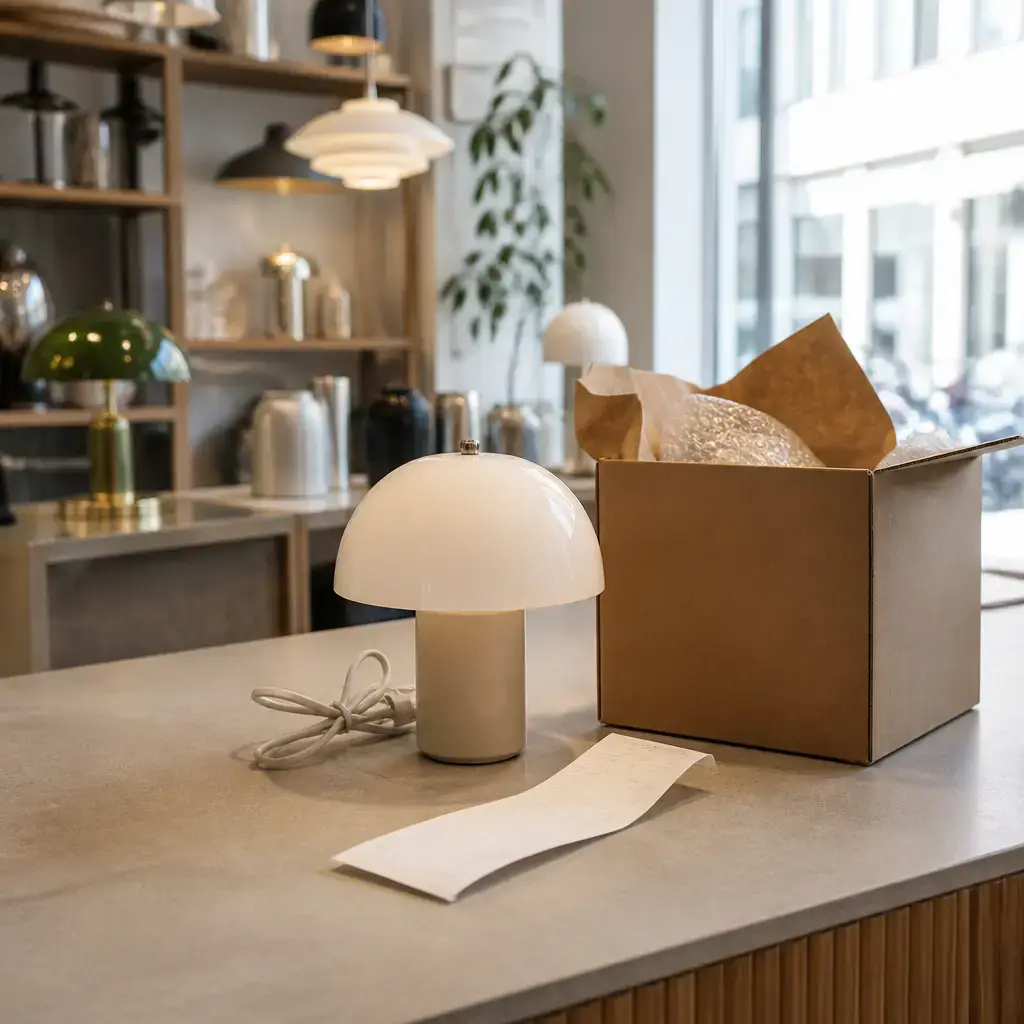
Diese Lampe hat nach kurzer Zeit nicht mehr funktioniert.
DEE-zuh LAHM-puh haht nahkh KUR-tsuh TSite nikht mehr foonk-tsee-oh-NEERT. This lamp stopped working after a short time.Haben Sie einen Kaufbeleg dabei?
HAH-ben zee EYE-nen KOWF-beh-LAYK dah-BYE? Do you have proof of purchase with you?Ich habe den Kassenbon und die Originalverpackung dabei.
ikh HAH-buh den KAH-sen-bohn oont dee oh-ree-ghee-NAHL-fair-PAH-koong dah-BYE. I have the receipt and the original packaging.Dann können wir prüfen, ob ein Ersatz möglich ist.
dahn KUR-nen veer PRUE-fen, ohp eye-n ER-ZAHTS MOEG-likh ist. Then we can check whether a replacement is possible.Ich hätte lieber einen Ersatz.
ikh HET-tuh LEE-ber EYE-nen ER-ZAHTS. I would prefer a replacement.Ich brauche weiterhin denselben Lampentyp.
ikh BROW-khuh VY-ter-HEER den-ZAYL-ben LAHM-pen-TUEP. I still need the same type of lamp.Das klingt vernünftig. Wir sollten den Artikel zuerst testen.
dahs klinkt fair-NUENF-tikh. veer ZOL-ten den AR-ti-kel tsoo-AIRST TES-ten. That sounds reasonable. We should test the item first.Ich habe auch das Kabel mitgebracht, falls das hilft.
ikh HAH-buh owkh dahs KAH-bel MIT-geh-brahkht, fahls dahs hilft. I brought the cable as well, in case that helps.Damit haben wir alles, was wir brauchen, um das Problem zu bestätigen und den Umtausch abzuwickeln.
DAH-mit HAH-ben veer AH-les, vahs veer BROW-khen, oom dahs proh-BLAYM buh-SHTAY-ti-gen oont den OOM-towsh AHP-tsoo-VIK-keln. That gives us what we need to confirm the problem and handle the exchange.Sentence explanations
Diese Lampe hat nach kurzer Zeit nicht mehr funktioniert.
This lamp stopped working after a short time.
- Diese
- this
- Lampe
- lamp
- nach
- after
- kurzer
- short
- Zeit
- time
- nicht mehr
- no longer
- funktioniert
- worked
More detail
Diese means “this” here and points to a singular feminine noun. It has the form diese because it agrees with Lampe in feminine singular nominative, since Lampe is the subject. The same demonstrative changes with the noun’s grammatical case and number, for example dieser Mann (“this man”) but diese Frau (“this woman”). Lampe means “lamp.” Its base form is the noun die Lampe; the article shows its feminine grammatical gender. In this sentence, Lampe is the subject: it is the thing that stopped working. nach means “after” in this time expression. It is a preposition that takes the dative here, so the following phrase is kurzer Zeit, not the nominative form kurze Zeit. kurzer means “short” and describes Zeit. Its base form is the adjective kurz; kurzer is the inflected form used with feminine singular dative Zeit in this phrase. Example: nach langer Pause means “after a long break.” Zeit means “time.” The noun is die Zeit, and here it is feminine singular dative after nach. kurze Zeit means “a short time” in other grammatical positions, while nach kurzer Zeit means “after a short time.” nicht mehr means “no longer” or “not anymore.” Together, these words mark that the situation stopped being true: the lamp worked at first, but later it did not work anymore. This is different from simple nicht, which only negates without expressing a change from an earlier state. Example: Das Gerät funktioniert nicht mehr. — “The device no longer works.” funktioniert comes from the verb funktionieren, “to function” or “to work.” In a simple present-tense sentence, funktioniert is the third-person singular form, as in Die Lampe funktioniert (“The lamp works”). In the fixed sentence, however, the same form is the past participle used with the auxiliary hat: hat nicht mehr funktioniert. The auxiliary hat is finite and carries the person and number; together with the participle, it forms the perfect construction, which here describes the lamp’s having stopped working. Putting the parts together, Diese Lampe identifies the subject, hat ... funktioniert describes its functioning in the perfect, nicht mehr says that this functioning ceased, and nach kurzer Zeit gives the time point. The complete meaning is: “This lamp stopped working after a short time.”
Haben Sie einen Kaufbeleg dabei?
Do you have proof of purchase with you?
- Haben Sie
- Do you have
- einen Kaufbeleg
- a proof of purchase
- dabei
- with you
More detail
Haben Sie uses haben (“to have”) with formal Sie (“you”). In this question, the verb comes before the subject, a common German yes/no question pattern: Haben Sie ...? = “Do you have ...?” The same formal Sie can address one person or several people; the form itself does not identify the number. Example: Haben Sie Zeit? — “Do you have time?” einen Kaufbeleg means “a proof of purchase.” Kaufbeleg is a masculine noun; its useful base form is the dictionary form der Kaufbeleg. Here, einen is the masculine singular accusative form of the indefinite article because the noun is the object of haben. This article does not by itself establish a numerical count beyond the singular noun phrase. The compound combines Kauf (“purchase”) and Beleg (“receipt/proof”), but Kaufbeleg is the reusable noun for a document proving a purchase. Example: Ich brauche einen Kaufbeleg. — “I need a proof of purchase.” dabei is an adverb meaning “with you” in this sentence: it asks whether the proof of purchase is currently in the person’s possession or accompanying them. It is not part of the noun Kaufbeleg; it adds the idea of having the item present. Example: Haben Sie Ihren Ausweis dabei? — “Do you have your ID with you?” Together, the inverted question pattern Haben Sie ...?, the object einen Kaufbeleg, and the adverb dabei produce: “Do you have proof of purchase with you?”
Ich habe den Kassenbon und die Originalverpackung dabei.
I have the receipt and the original packaging.
- Ich habe
- I have
- Kassenbon
- receipt
- Originalverpackung
- original packaging
- dabei
- with me
More detail
Ich habe is the first-person singular present form of haben (“to have”): ich habe = “I have.” Here it states possession or availability, not necessarily permanent ownership. Example: Ich habe Zeit. — “I have time.” Kassenbon means “receipt,” specifically the receipt from a purchase. Its base form is the masculine noun der Kassenbon. In this sentence it appears as den Kassenbon, because it is the direct object of habe; the masculine singular accusative article is den. Example: Ich habe den Kassenbon. — “I have the receipt.” Originalverpackung means “original packaging.” It is the feminine noun die Originalverpackung; in the sentence, die is also the feminine singular accusative form. The article does not show a numerical quantity here; it identifies the packaging as the relevant original packaging. Example: Die Originalverpackung ist noch da. — “The original packaging is still there.” dabei is an adverb meaning “with me” or “on hand” in this context. It specifies that the speaker has the receipt and packaging present with them, rather than merely having them somewhere. Example: Haben Sie den Beleg dabei? — “Do you have the receipt with you?” Together, Ich habe den Kassenbon und die Originalverpackung dabei. means “I have the receipt and the original packaging with me.” den Kassenbon and die Originalverpackung are coordinated direct objects of habe, and dabei adds the idea that both items are currently on hand. This is a natural, practical statement when presenting purchase documents or packaging.
Dann können wir prüfen, ob ein Ersatz möglich ist.
Then we can check whether a replacement is possible.
- Dann
- then
- können wir
- we can
- prüfen
- check; examine
- ob
- whether
- Ersatz
- replacement
- möglich
- possible
- ist
- is
More detail
Dann means “then” here, linking this step to what has just been said. It can introduce a time or a consequence; the surrounding exchange supports the step-like “then” reading. Example: Dann gehen wir. — “Then we’ll go.” können wir expresses “we can.” können is the present-tense plural form of können with wir; the finite modal verb is in second position after Dann, while the subject follows it. With another infinitive, können places that infinitive at the end: Wir können warten. — “We can wait.” prüfen means “to check” or “to examine” carefully. It is an infinitive here because it depends on the modal können. The thing being checked can be a noun: Wir prüfen den Antrag. — “We are checking the application.” It can also be an entire question introduced by ob, as in this sentence. ob introduces an indirect yes-or-no question, meaning “whether.” In such a subordinate clause, the finite verb goes to the end: Ich weiß nicht, ob es möglich ist. — “I don’t know whether it is possible.” This is different from a direct question such as Ist es möglich? — “Is it possible?” Ersatz is the noun “replacement.” It is masculine: der Ersatz; in the sentence, ein Ersatz is the subject of the subordinate clause. The indefinite article marks an unspecified replacement, not a stated numerical count. The related phrase from the nearby context, einen Ersatz, has the same noun in the accusative after Ich hätte lieber; the form of the article changes because its grammatical role changes. möglich means “possible.” It is a predicate adjective after sein, so it does not take an ending here: Der Ersatz ist möglich. — “The replacement is possible.” Its opposite is unmöglich, “impossible.” ist is the third-person singular present form of sein, “to be.” It agrees with the singular subject ein Ersatz: Ein Ersatz ist möglich. — “A replacement is possible.” Together, Dann können wir prüfen gives “Then we can check.” The ob clause identifies what will be checked: ob ein Ersatz möglich ist, literally “whether a replacement is possible,” with the finite verb ist at the end. The complete utterance therefore means: “Then we can check whether a replacement is possible.”
Ich hätte lieber einen Ersatz.
I would prefer a replacement.
- hätte lieber
- would prefer
- Ersatz
- replacement
More detail
hätte lieber expresses a preference: “would prefer” or “would rather have.” hätte is the first-person singular Konjunktiv II form of haben (“to have”); the form ich habe is present indicative, while ich hätte presents the situation as desired or hypothetical. lieber is the comparative form of gern (“gladly”); in this construction it means “rather.” A reusable pattern is Ich hätte lieber + [accusative thing], for example: Ich hätte lieber Tee. — “I would rather have tea.” Ersatz means “replacement” here. It is a masculine noun: der Ersatz. In einen Ersatz, the masculine indefinite article has the accusative form einen, marking the thing preferred after hätte. The noun can also be used without an article when speaking more generally, depending on the sentence. Together, Ich hätte lieber (“I would prefer”) and einen Ersatz (“a replacement”) form Ich hätte lieber einen Ersatz. The complete meaning is “I would prefer a replacement.”
Ich brauche weiterhin denselben Lampentyp.
I still need the same type of lamp.
- Ich
- I
- brauche
- need
- weiterhin
- still
- denselben
- the same
- Lampentyp
- type of lamp
More detail
Ich is the first-person singular pronoun in the nominative case: “I.” It identifies the speaker as the subject. In other persons, German uses forms such as du (“you,” singular informal) and wir (“we”); the verb must agree with the chosen subject. brauche is the present-tense first-person singular form of brauchen, “to need.” German uses brauchen with an accusative object: Ich brauche den Artikel. means “I need the item.” The base form is brauchen; ich brauche is its “I need” form. weiterhin means “still” or “continuing to.” Here it says that the need remains in place. It does not itself say when the need began. Example: Ich arbeite weiterhin hier. — “I still work here.” denselben means “the same” in this sentence. It is the masculine singular accusative form of derselbe (“the same”), because brauchen makes its object accusative and Lampentyp is masculine singular. The form changes with grammatical conditions: derselbe Lampentyp is nominative, while Ich brauche denselben Lampentyp is accusative. This form expresses identity with a previously established type, not merely similarity. Lampentyp is a masculine compound noun meaning “type of lamp.” It is formed from Lampe (“lamp”) with a linking -n plus Typ (“type”); the compound as a whole is masculine: der Lampentyp. Its plural is Lampentypen: verschiedene Lampentypen — “different types of lamp.” Together, Ich brauche gives “I need,” weiterhin adds the continuing meaning “still,” and denselben Lampentyp identifies the needed object as the same lamp type. The complete utterance therefore means: “I still need the same type of lamp.”
Das klingt vernünftig. Wir sollten den Artikel zuerst testen.
That sounds reasonable. We should test the item first.
- Das
- that / it
- klingt
- sounds
- vernünftig
- reasonable
- Wir sollten
- we should
- Artikel
- item
- zuerst
- first
- testen
- test
More detail
Das is a demonstrative pronoun meaning “that” here. Its form is neuter singular, but the sentence uses it for the situation or idea being assessed rather than for a specifically identified noun. klingt is the third-person singular present form of klingen, “to sound.” A reusable pattern is etwas klingt + adjective: Das klingt gut. — “That sounds good.” vernünftig means “reasonable” or “sensible.” With klingen, it describes the impression something gives: Der Plan klingt vernünftig. — “The plan sounds reasonable.” Wir sollten combines wir, “we,” with sollten, the first-person plural Konjunktiv II form of sollen, used here to express a recommendation: “we should.” Sollen can also express obligation in other contexts, while this form presents testing as advisable. Artikel means “item” here. It is a masculine noun, and den Artikel uses the masculine singular accusative form of the definite article because the item is the object of testen. Artikel can also mean a written article or a grammatical article; the fixed translation identifies the intended sense here. zuerst means “first” in the sense of doing one action before another. It is an adverb and does not change form: Wir prüfen das zuerst. — “We check that first.” testen is the infinitive “to test.” After the modal verb sollten, the lexical verb remains in the infinitive and appears at the end of this main clause. A reusable pattern is Wir sollten + object + zuerst + infinitive. Together, Das klingt vernünftig says that the proposal or situation gives a reasonable impression. Wir sollten den Artikel zuerst testen says that testing the item first is the recommended action. The complete meaning is: “That sounds reasonable. We should test the item first.”
Ich habe auch das Kabel mitgebracht, falls das hilft.
I brought the cable as well, in case that helps.
- Ich habe
- I have
- auch
- also; as well
- Kabel
- cable
- mitgebracht
- brought along
- falls
- in case
- hilft
- helps
More detail
Ich habe: This is the first-person singular present form of haben, “to have.” Here it is the auxiliary in the perfect tense, not the main meaning “possess”: ich habe ... mitgebracht means “I brought ...”. The same auxiliary pattern is reusable with many past participles, for example Ich habe angerufen. — “I called.” auch: This adds something to an existing set or action: “also” or “as well.” Its position can affect what it emphasizes, but here it adds the cable to what has already been brought. Example: Ich habe auch den Adapter mitgebracht. — “I brought the adapter as well.” Kabel: This noun means “cable.” Its full form here is das Kabel: Kabel is neuter, and the neuter accusative form after mitbringen is still das Kabel. The plural is die Kabel; the singular and plural have the same noun form, while the article shows the number. mitgebracht: This is the past participle of the separable verb mitbringen, “to bring along” or “to bring with one.” The parts are mitbringen → mitgebracht; it is not derived from the separate verb bringen alone for this meaning. With haben, it forms the perfect: Ich habe das Kabel mitgebracht. — “I brought the cable along.” In a present-tense main clause, the separable form appears as Ich bringe das Kabel mit. — “I am bringing the cable along.” falls: This introduces a condition or precaution meaning “in case” or “if.” It begins a subordinate clause, so the conjugated verb goes to the end of that clause. A reusable pattern is falls + subordinate clause: Ruf mich an, falls du Hilfe brauchst. — “Call me if you need help.” hilft: This is the third-person singular present form of helfen, “to help”: helfen → er/sie/es hilft. The vowel changes in the present tense for the second- and third-person singular forms (du hilfst, er/sie/es hilft), but not for ich or wir (ich helfe, wir helfen). Here das hilft means “that helps”; das is a neuter demonstrative pronoun whose specific reference is supplied by the situation, rather than a noun explicitly identified in this sentence. The sentence combines the perfect pattern Ich habe ... mitgebracht with auch and the object das Kabel: “I also brought the cable along.” The subordinate clause falls das hilft adds the condition “in case that helps.” Together, the fixed utterance means: “I brought the cable as well, in case that helps.”
Damit haben wir alles, was wir brauchen, um das Problem zu bestätigen und den Umtausch abzuwickeln.
That gives us what we need to confirm the problem and handle the exchange.
- Damit
- with that; by that
- haben wir
- we have
- alles
- everything; all of it
- brauchen
- need
- Problem
- problem
- bestätigen
- confirm
- Umtausch
- exchange
- um … zu
- in order to
- abzuwickeln
- handle; process
More detail
Damit means “with that” here and refers to the cable mentioned in the preceding sentence. In the fixed translation, this contributes to “That gives us …”. German damit can also introduce a purpose clause meaning “so that”, but that is not its function here. haben wir means “we have.” With Damit in the first position, the finite verb haben comes before the subject wir, following the common German main-clause pattern of a finite verb in second position. alles is the pronoun “everything” or “all of it.” The relative clause was wir brauchen specifies what this means: was refers back to the broad pronoun alles, and wir brauchen means “we need.” brauchen has the same written form as its infinitive and, here, is the present-tense form used with wir. A reusable pattern is alles, was ich brauche — “everything I need.” das Problem means “the problem.” Problem is a neuter noun, so its definite article is das in both nominative and accusative; in this sentence the noun phrase is accusative because it is the object of bestätigen. The verb bestätigen means “to confirm” and appears as an infinitive after zu. um ... zu introduces a purpose: “in order to …”. Here, um das Problem zu bestätigen means “in order to confirm the problem.” In this construction, the object das Problem comes before the infinitive zu bestätigen. den Umtausch means “the exchange” or “the replacement transaction.” Umtausch is a masculine noun, and den is the masculine accusative form of the definite article because this noun phrase is the object of abzuwickeln. Umtausch is related to the verb umtauschen, “to exchange” something. abzuwickeln means “to handle” or “to process.” Its base verb is the separable verb abwickeln. With zu, a separable verb places zu between its parts: abzuwickeln, not zu abwickeln. Together, Damit haben wir alles, was wir brauchen means “That gives us everything we need.” The purpose construction then coordinates two actions: um das Problem zu bestätigen und den Umtausch abzuwickeln — “in order to confirm the problem and handle the exchange.” The whole utterance means: “That gives us what we need to confirm the problem and handle the exchange.”
Grammar Points
mitgebracht
mitgebracht
MIT-geh-brahkhtbrought along
This is the past participle of the separable verb mitbringen.
abzuwickeln
abzuwickeln
AHP-tsoo-VIK-kelnto handle; to process
In a zu-infinitive, the separable prefix is joined with zu: ab + zu + wickeln.
German Vocabulary
Haben Sie einen Kaufbeleg dabei?
Dann können wir prüfen, ob ein Ersatz möglich ist.
Diese Lampe hat nach kurzer Zeit nicht mehr funktioniert.
Ich habe den Kassenbon und die Originalverpackung dabei.
Haben Sie einen Kaufbeleg dabei?
Diese Lampe hat nach kurzer Zeit nicht mehr funktioniert.
Diese Lampe hat nach kurzer Zeit nicht mehr funktioniert.
Ich hätte lieber einen Ersatz.
Dann können wir prüfen, ob ein Ersatz möglich ist.
Ich habe den Kassenbon und die Originalverpackung dabei.
Dann können wir prüfen, ob ein Ersatz möglich ist.
Diese Lampe hat nach kurzer Zeit nicht mehr funktioniert.
Quiz
Word Order
Arrange the words in the correct order.
Do you have proof of purchase with you?
Show Answer
Haben Sie einen Kaufbeleg dabei?I would prefer a replacement.
Show Answer
Ich hätte lieber einen Ersatz.I still need the same type of lamp.
Show Answer
Ich brauche weiterhin denselben Lampentyp.Spelling
Tap the letters to spell the word.
short
Show Answer
kurzertime
Show Answer
Zeitwith you; on hand
Show Answer
dabeilamp