10 minutes free every day
Continue audio lessons in the app
Word explanations appear automatically in sync with the audio.
No login required · synced translations · playback with the screen locked
Choose your learning language and open this lesson in the app.

About This Lesson
Use Checking stock and arranging delivery to practice German conversation, pronunciation, vocabulary, grammar, and quizzes.
Dialogue
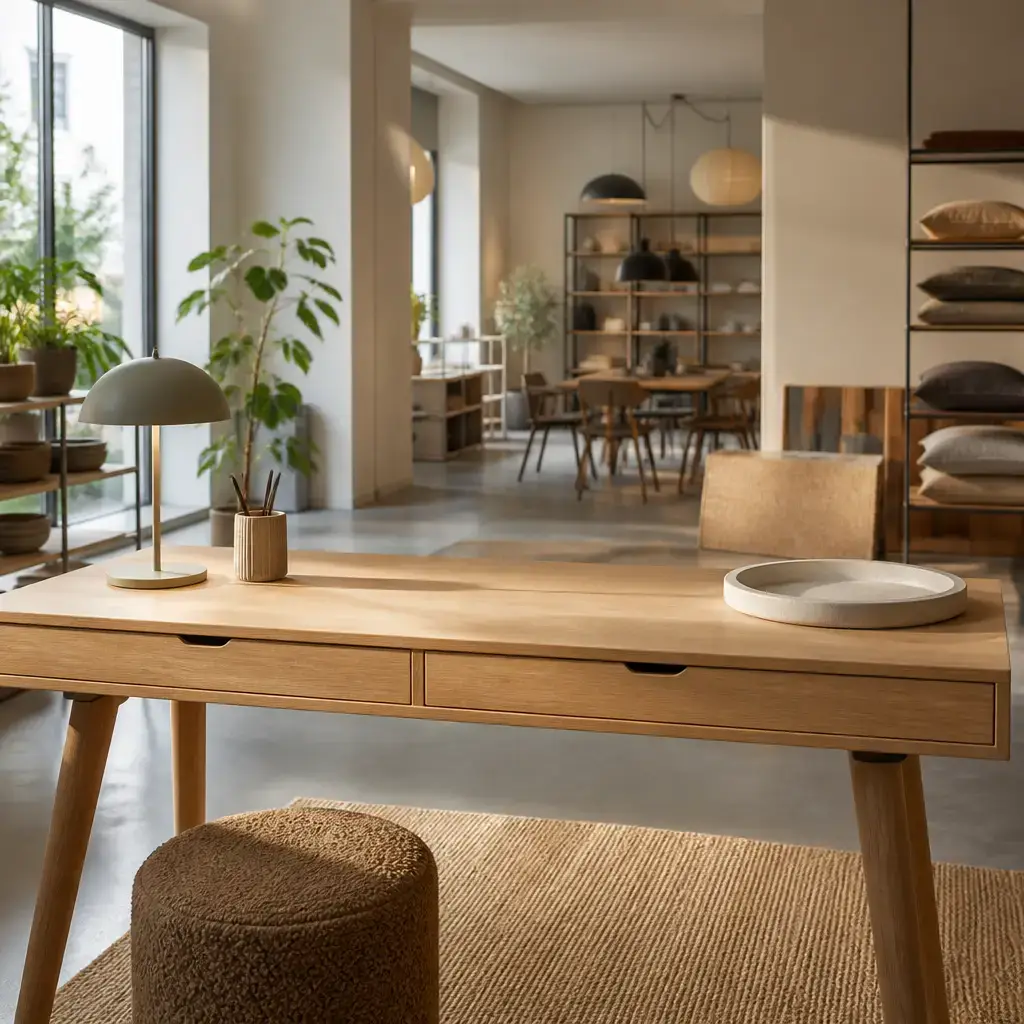
Ich mag diesen Schreibtisch, aber ich kann ihn nicht allein nach Hause tragen.
ikh mahk DEE-zən SHRYPE-tish, AH-bər ikh kahn een nikht uh-LINE nahkh HOW-zuh TRAH-gən. I like this desk, but I can't carry it home by myself.Wir können eine Lieferung organisieren, wenn er noch auf Lager ist.
veer KURN-ən EYE-nuh LEE-fuh-roong or-gah-nee-ZEER-ən, ven air nokh owf LAH-guh ist. We can arrange delivery if it's still in stock.Könnten Sie prüfen, ob im Lager noch einer verfügbar ist?
KURNT-ən zee PRYOO-fən, ohp im LAH-guh nokh EYE-nər fair-FYOO-kbahr ist? Could you check whether the warehouse has one available?Ich prüfe jetzt den Lagerbestand.
ikh PRYOO-fuh yetst dehn LAH-guh-buh-SHTAHNT. I'll check the stock record now.Wenn er verfügbar ist, welche Liefermöglichkeiten bieten Sie an?
ven air fair-FYOO-kbahr ist, VEL-khuh LEE-fuh-MUR-glikh-kite-ən BEE-tən zee AHN? If it is available, what delivery options do you offer?Mit der Standardlieferung wird er zu Ihnen nach Hause geliefert.
mit dair shtahn-DAHRT-LEE-fuh-roong veert air tsoo EE-nən nahkh HOW-zuh guh-LEE-fairt. Standard delivery would bring it to your home.Gehört die Montage dazu, oder wird er nur bis zur Tür geliefert?
guh-HURT dee mon-TAH-zhuh dah-TSOO, OH-dər veert air noor bis tsoor TOOR guh-LEE-fairt? Does that include assembly, or only delivery to the door?Die Montage muss separat angefragt werden, aber das Tragen nach oben ist inbegriffen.
dee mon-TAH-zhuh mooss zay-pah-RAHT ahn-guh-FRAHKT VAYR-dən, AH-bər dahs TRAH-gən nahkh OH-bən ist in-buh-GREE-fən. Assembly is a separate request, but carrying it upstairs is included.Bitte fügen Sie die Lieferung hinzu. Ich kann ihn selbst aufbauen.
BIT-tuh FYOOG-ən zee dee LEE-fuh-roong HIN-tsoo. ikh kahn een zelbst OWF-bow-ən. Please add delivery. I can assemble it myself.Ich bestätige den Lagerbestand und füge die Lieferanfrage hinzu, bevor ich die Bestellung bearbeite.
ikh beh-SHTEH-ti-guh dehn LAH-guh-buh-SHTAHNT oont FYOOG-uh dee LEE-fuh-ahn-FRAH-guh HIN-tsoo, beh-FOHR ikh dee beh-SHTEL-loong beh-AR-bye-tuh. I'll confirm the stock and add the delivery request before processing the order.Sentence explanations
Ich mag diesen Schreibtisch, aber ich kann ihn nicht allein nach Hause tragen.
I like this desk, but I can't carry it home by myself.
- Ich
- I
- mag
- like
- diesen
- this
- Schreibtisch
- desk
- aber
- but
- kann
- can
- ihn
- it
- nicht
- not
- allein
- by oneself
- nach Hause
- home
- tragen
- carry
More detail
Ich is the first-person singular pronoun, meaning “I.” Its form is used for the speaker, regardless of the speaker’s gender. In this sentence it is the subject of mag and kann. mag is the present-tense first-person singular form of mögen (“to like”). The useful chain is mögen → ich mag; the vowel changes in this form. Here it expresses the speaker’s liking for the desk. For example: Ich mag diesen Film. — “I like this film.” diesen means “this” here and identifies the desk as a particular nearby or contextually identified item. It is the masculine accusative singular form of the demonstrative determiner dieser. The form is diesen because it modifies masculine Schreibtisch, which is the direct object of mag; singularity alone does not determine this form. For example: Ich kaufe diesen Stuhl. — “I am buying this chair.” Schreibtisch means “desk.” It is a masculine noun: der Schreibtisch. The compound consists of Schreib- (“writing”) and Tisch (“table”), but the complete word means “desk,” not simply any table. German nouns are capitalized. aber connects contrasting clauses and means “but.” It does not change the word order of the first clause; in the second main clause, the conjugated verb still occupies the second position. kann is the present-tense first-person singular form of the modal verb können (“can, be able to”): können → ich kann. A modal is followed by another verb in the infinitive, and that infinitive goes to the end of the clause. Here kann ... tragen means “can carry.” ihn is the masculine accusative singular pronoun “him” or, as here, “it.” The fixed translation identifies its referent as the desk. Its accusative form marks it as the object of tragen; the masculine form agrees with der Schreibtisch. The pronoun’s grammatical form is separate from the desk’s role as the thing being carried. nicht supplies the negation. Together with kann, it makes the meaning “cannot” in this sentence: the speaker is not able to carry the desk home alone. Its scope here covers the carrying situation, including allein nach Hause. allein means “alone” or “by oneself.” It describes how the carrying would be done: without another person’s help. It is distinct from einsam, which usually describes feeling lonely rather than the practical condition of being alone. nach Hause is the fixed directional expression “home” or “to home.” nach marks movement toward a place in this expression. Compare zu Hause (“at home”), which describes location rather than movement toward home. For example: Wir gehen nach Hause. — “We are going home.” tragen means “to carry.” It is the infinitive selected by the modal kann; its own base form is tragen, not kann. A useful form chain is tragen → trägt (third-person singular present) → trug (simple past) → hat getragen (perfect). Here the infinitive stays at the end because it follows the modal. The first clause assembles as Ich mag diesen Schreibtisch: “I like this desk.” aber contrasts it with the second clause. In ich kann ihn nicht allein nach Hause tragen, kann carries the first-person ability meaning, ihn refers back to the desk, nicht allein negates the possibility of doing it by oneself, and nach Hause tragen means carrying it home. The complete meaning is: “I like this desk, but I can’t carry it home by myself.”
Wir können eine Lieferung organisieren, wenn er noch auf Lager ist.
We can arrange delivery if it's still in stock.
- Wir können
- we can
- Lieferung
- delivery
- organisieren
- arrange
- wenn
- if
- er
- it
- noch
- still
- auf Lager
- in stock
- ist
- is
More detail
Wir können means “we can.” können is the base form; können is also its present-tense form for wir, and it expresses ability or possibility here. In a main clause, the conjugated modal comes in the second position, while the other verb normally goes to the end: Wir können warten. — “We can wait.” Lieferung means “delivery.” Its base form is the noun die Lieferung; the article eine shows that it is indefinite, but does not by itself state a numerical count. The plural is Lieferungen. organisieren means “arrange” here. This is the infinitive used with the modal können; the modal carries the tense and the infinitive remains at the end of its clause. Example: Wir können einen Termin organisieren. — “We can arrange an appointment.” wenn introduces a condition and corresponds here to “if.” In the following subordinate clause, the conjugated verb moves to the end: wenn er verfügbar ist — “if it is available.” er is a masculine singular personal pronoun. In this sentence, the fixed translation renders it as “it,” referring to the item understood in context. The form er itself marks the pronoun’s grammatical class and number; the translation does not make the item a person. noch means “still” here. It indicates that the condition continues to hold at the relevant time. Example: Ist es noch verfügbar? — “Is it still available?” auf Lager is the reusable expression “in stock.” Literally, it uses auf with Lager in this fixed expression; it describes availability in stock rather than location in a general sense. Example: Der Artikel ist auf Lager. — “The item is in stock.” ist is the present-tense form of sein (“to be”) for a third-person singular subject. In er ... ist, it completes the predicate auf Lager ist, “is in stock.” Together, Wir können eine Lieferung organisieren says “We can arrange delivery.” The conditional clause wenn er noch auf Lager ist says “if it is still in stock.” The whole utterance therefore means: “We can arrange delivery if it’s still in stock.”
Könnten Sie prüfen, ob im Lager noch einer verfügbar ist?
Could you check whether the warehouse has one available?
- Könnten Sie
- Could you
- prüfen
- check
- Lager
- warehouse; stock
- noch
- still
- einer
- one
- verfügbar
- available
- ist
- is
More detail
Könnten Sie is a polite formal request: könnten is the Konjunktiv II form of können (“can,” “be able to”), and Sie is the formal second-person pronoun. In a question, this combination softens the request. Compare the more direct Können Sie prüfen? (“Can you check?”). The form könnten is used with formal Sie here; the ending is not a marker of a feminine or masculine person. prüfen means “to check” or “to verify.” It is the infinitive because it follows the modal verb könnten. In a main clause, the same verb can be finite: Sie prüfen den Bestand. — “You are checking the stock.” Lager is a neuter noun, das Lager, meaning “warehouse” here and “stock/inventory” in the related expression auf Lager (“in stock”). The phrase im Lager combines in dem into im and places the available item in the warehouse or stock location. noch means “still” in this sentence. It indicates that availability may continue to hold at the relevant time. For example, Ist das Modell noch verfügbar? means “Is the model still available?” einer is a masculine singular form of the indefinite pronoun meaning “one.” It stands for one available item, while the particular item is not named in the sentence. Its form is nominative because it is the subject of ist; einen would be the masculine accusative form in a direct-object position. The form is not an assertion that the item is male; grammatical gender belongs to the noun or pronoun form. verfügbar is an adjective meaning “available.” It is used predicatively here after ist, so it does not take an adjective ending: einer ist verfügbar — “one is available.” A useful contrast is nicht verfügbar (“unavailable”). ist is the third-person singular present form of sein (“to be”). Here it agrees with singular einer. In the embedded question introduced by ob, the finite verb comes at the end: ob ... einer verfügbar ist (“whether ... one is available”). Together, Könnten Sie prüfen politely asks the formal addressee to check something. ob introduces the yes-or-no subordinate question, and im Lager noch einer verfügbar ist asks whether one item is still available in the warehouse or stock. The complete meaning is: “Could you check whether the warehouse has one available?”
Ich prüfe jetzt den Lagerbestand.
I'll check the stock record now.
- Ich
- I
- prüfe
- check
- jetzt
- now
- Lagerbestand
- stock inventory
More detail
Ich means “I” and is the first-person singular pronoun. It identifies the speaker as the person doing the checking. In German, the subject form is ich; the object form is mich, as in Er sieht mich — “He sees me.” prüfe is the form of prüfen, “to check” or “to inspect,” used here for an action the speaker is carrying out now. The ending -e marks first-person singular in the present tense: ich prüfe, du prüfst, er/sie prüft. Example: Ich prüfe die Angaben. — “I am checking the information.” jetzt means “now.” It places the checking at the present time. Example: Ich rufe jetzt an. — “I’ll call now.” Lagerbestand is a masculine compound noun meaning “stock” or “inventory,” here understood as the stock record/inventory being checked. It is built from Lager (“warehouse” or “storage”) and Bestand (“stock” or “inventory”), but the compound functions as one noun. German nouns are capitalized. In this sentence, the accusative form is den Lagerbestand, because it is the direct object of prüfen; the masculine article changes from nominative der Lagerbestand to accusative den Lagerbestand. Together, Ich prüfe jetzt den Lagerbestand. means “I’ll check the stock record now.” The subject is the speaker, prüfe expresses the speaker’s present checking action, jetzt gives its time, and den Lagerbestand names what is being checked. The sentence is a direct, neutral way to announce that action.
Wenn er verfügbar ist, welche Liefermöglichkeiten bieten Sie an?
If it is available, what delivery options do you offer?
- verfügbar
- available
- welche
- which / what
- Liefermöglichkeiten
- delivery options
- bieten … an
- offer
More detail
verfügbar describes whether something can be obtained or used. Here it is a predicate adjective after ist: verfügbar sein = “to be available.” Adjectives used this way do not take an ending: Der Artikel ist verfügbar. = “The item is available.” er is the masculine-singular pronoun translated here as “it.” The fixed wording does not require naming a more specific referent. ist is the third-person singular present form of sein: er ist = “he/it is.” welche asks for a choice from a set: “which” or, in this question, naturally “what.” It agrees with Liefermöglichkeiten in the plural. The plural form is also used for both nominative and accusative, so its visible form does not by itself show the case. Example: Welche Optionen wählen Sie? = “Which options do you choose?” Liefermöglichkeiten is the plural of Liefermöglichkeit, meaning “delivery option.” The noun is feminine in the singular (die Liefermöglichkeit), while the plural has the article die: die Liefermöglichkeiten. The compound refers to available ways of arranging delivery, not to the delivery itself. bieten ... an is the separable verb anbieten, “to offer.” In this wh-question, welche Liefermöglichkeiten is first, the finite verb bieten is second, and the subject Sie follows it; the particle an goes to the end: Welche Optionen bieten Sie an? = “What options do you offer?” The subject Sie is formal “you”; its form is also identical to the third-person plural pronoun, but here the fixed translation identifies it as the addressee. Sie bieten ... an is the present-tense formal-you form of anbieten. The sentence first sets a condition with Wenn er verfügbar ist (“If it is available”). The question then asks welche Liefermöglichkeiten bieten Sie an? (“what delivery options do you offer?”). Together, these parts mean: “If it is available, what delivery options do you offer?”
Mit der Standardlieferung wird er zu Ihnen nach Hause geliefert.
Standard delivery would bring it to your home.
- Standardlieferung
- standard delivery
- er
- it
- zu Ihnen
- to you (formal)
- nach Hause
- home
- wird … geliefert
- is delivered
More detail
Standardlieferung means “standard delivery” here. It is a feminine compound noun: die Lieferung means “delivery,” while Standard- specifies the type. German compounds are written as one word. Example: Die Standardlieferung ist kostenlos. — “Standard delivery is free.” er is the third-person singular masculine pronoun used here for the item being delivered, matching the fixed translation “it.” Its masculine singular form does not by itself identify the referent. Example: Er wird morgen geliefert. — “It will be delivered tomorrow.” zu Ihnen means “to you” in the formal form. Ihnen is the dative form used after zu; the same form is also used when formally addressing more than one person. Example: Wir kommen zu Ihnen. — “We are coming to you.” nach Hause is the established expression for movement to someone’s home. It contrasts with zu Hause, meaning “at home.” Example: Ich fahre nach Hause. — “I am going home.” wird ... geliefert is a present passive construction. wird is the third-person singular present form of werden, and geliefert is the past participle of liefern (“to deliver”). The item is presented as what is delivered, while the person or service carrying out the delivery is not stated. German uses the present passive here; the fixed English translation uses “would bring” to express the delivery situation in its own wording. Together, Mit der Standardlieferung means “with standard delivery.” wird er ... geliefert says that the item is delivered, and zu Ihnen nach Hause gives the destination. The complete meaning is: “Standard delivery would bring it to your home.”
Gehört die Montage dazu, oder wird er nur bis zur Tür geliefert?
Does that include assembly, or only delivery to the door?
- Gehört … dazu
- is included
- Montage
- assembly
- nur
- only
- wird … geliefert
- is delivered
- Tür
- door
More detail
Gehört … dazu is a reusable way to ask whether something is included as part of an offer or package. gehört is the third-person singular present form of gehören; dazu means “to it” or “as part of it.” The construction surrounds the subject here: Gehört die Montage dazu? — “Is assembly included?” Montage means “assembly” or “installation.” It is a feminine noun: die Montage. In this sentence it is the subject of gehört, so the verb is singular. Example: Die Lieferung gehört dazu. — “The delivery is included.” nur narrows the statement to the one limitation being asked about: “only.” In nur bis zur Tür, it means that delivery reaches only as far as the door, without stating what happens beyond that. wird … geliefert is a passive construction. wird is the third-person singular present form of werden, and geliefert is the past participle of liefern (“to deliver”). The passive focuses on the item being delivered rather than naming the person or company delivering it. Example: Das Paket wird morgen geliefert. — “The parcel will be delivered tomorrow.” Tür means “door.” It is feminine: die Tür. The phrase bis zur Tür means “up to the door”: zur is the contraction of zu der. In this utterance, the item is delivered only as far as that point. Together, Gehört die Montage dazu asks whether assembly is included, while oder wird er nur bis zur Tür geliefert presents the alternative: whether the item is delivered only to the door. Thus the whole utterance means, “Does that include assembly, or is it only delivered to the door?”
Die Montage muss separat angefragt werden, aber das Tragen nach oben ist inbegriffen.
Assembly is a separate request, but carrying it upstairs is included.
- Montage
- assembly
- muss
- must
- separat
- separately
- angefragt werden
- be requested
- Tragen
- carrying
- nach oben
- upstairs
- inbegriffen
- included
More detail
Montage means assembly or installation here. It is a feminine noun: die Montage. In this sentence, Die Montage is the subject in the nominative case; the article die marks the noun phrase as feminine singular nominative. Do not confuse it with Montag (“Monday”). muss is the third-person singular present form of the modal verb müssen (“must, have to”): ich muss, du musst, er/sie/es muss. With a modal verb, the other verb goes to the end in its infinitive form or, here, in a passive infinitive construction. separat is an adverb meaning “separately” in this sentence. It modifies the requesting process, so the assembly has to be requested separately rather than being part of the included service. angefragt werden is a passive infinitive: angefragt is the past participle of anfragen (“to request or inquire about”), and werden forms the passive. The pattern etwas muss angefragt werden means “something must be requested.” The requester is not specified. Example: Der Termin muss angefragt werden. — “The appointment must be requested.” Tragen is a capitalized nominalized infinitive of tragen (“to carry”), so it functions as a noun and means “carrying” here. The capitalization marks this use: das Tragen. The verb tragen can also appear in ordinary verb forms, for example Ich trage die Kiste. — “I am carrying the box.” nach oben is a direction phrase meaning “upward” or “upstairs.” nach marks movement toward a direction, and oben means “above/up there.” It describes where the carrying goes, not who performs it. inbegriffen means “included” here. It is an adjective-like form used with sein, as in inbegriffen sein, to state that something is included. Example: Die Lieferung ist im Preis inbegriffen. — “Delivery is included in the price.” Together, Die Montage muss separat angefragt werden says that assembly must be requested separately. aber introduces the contrast: das Tragen nach oben ist inbegriffen says that carrying it upstairs is included. The full utterance therefore means: “Assembly is a separate request, but carrying it upstairs is included.”
Bitte fügen Sie die Lieferung hinzu. Ich kann ihn selbst aufbauen.
Please add delivery. I can assemble it myself.
- Bitte
- please
- fügen Sie … hinzu
- add …
- die Lieferung
- the delivery
- Ich kann
- I can
- ihn
- it
- selbst
- myself
- aufbauen
- assemble
More detail
Bitte is the standard polite word for “please.” It can introduce a request or command: Bitte warten Sie. — “Please wait.” fügen Sie … hinzu is the polite imperative of the separable verb hinzufügen (“to add”). In this command, Sie is the formal “you,” and the prefix hinzu appears at the end: Fügen Sie den Artikel hinzu. — “Add the item.” The verb is split here, so keep both parts when reusing the pattern Fügen Sie … hinzu. die Lieferung means “the delivery” here. Lieferung is a feminine noun; its base form is the noun itself, and the article die is the same in the nominative and accusative singular. In this sentence it is the object being added, so it is in the accusative: Ich bestelle die Lieferung. — “I order the delivery.” Ich kann combines ich (“I”) with kann, the first-person singular form of the modal verb können (“can, be able to”). With a modal verb, the other verb normally goes to the end as an infinitive: Ich kann helfen. — “I can help.” ihn is an accusative masculine singular pronoun, meaning “him” or “it” when the referred-to noun is grammatically masculine. The fixed translation identifies its intended meaning here as “it,” but the supplied texts do not identify the specific masculine noun that it refers to. Do not replace it with ihn merely because an object is nearby: the form must also match the noun’s grammatical gender. For a feminine noun, German uses sie in the accusative instead. selbst means “myself” here and emphasizes that the speaker will do the action personally. It can also follow a noun or pronoun for emphasis: Ich mache es selbst. — “I’ll do it myself.” aufbauen means “to assemble” or “to set up.” It is a separable verb, but after the modal kann it stays as the infinitive at the end: Ich kann den Schrank selbst aufbauen. — “I can assemble the cabinet myself.” Its observed form is the infinitive aufbauen; the present-tense main-clause form would split, for example Ich baue den Schrank auf. — “I assemble the cabinet.” Together, Bitte fügen Sie die Lieferung hinzu is a polite formal request to add the delivery. Ich kann ihn selbst aufbauen says that the speaker is able to assemble the masculine-referenced item personally. The modal construction places aufbauen at the end, while selbst emphasizes the speaker’s own involvement.
Ich bestätige den Lagerbestand und füge die Lieferanfrage hinzu, bevor ich die Bestellung bearbeite.
I'll confirm the stock and add the delivery request before processing the order.
- bestätige
- confirm
- Lagerbestand
- stock; inventory
- füge … hinzu
- add
- Lieferanfrage
- delivery request
- bevor
- before
- Bestellung
- order
- bearbeite
- process; handle
More detail
bestätige is the first-person singular present form of bestätigen (“to confirm”). The subject is Ich, so the verb ends in -e: Ich bestätige ... = “I confirm ...”. Example: Ich bestätige die Buchung. — “I confirm the booking.” Lagerbestand means the available stock or inventory. It is a masculine compound noun: der Lagerbestand; here it is the accusative object after bestätige, so the masculine article appears as den: den Lagerbestand. füge ... hinzu is the separable verb hinzufügen (“to add”). In a main clause, its parts separate: the first-person form füge is in the normal verb position, while hinzu goes to the end of this clause. The pattern is Ich füge X hinzu. — “I add X.” This is different from the inseparable-looking placement used in a subordinate clause, where the complete verb stays at the end. Lieferanfrage means “delivery request.” It is a feminine compound noun: die Lieferanfrage; as the accusative object of hinzufügen, its form remains die: Ich füge die Lieferanfrage hinzu. bevor introduces a clause meaning “before”. In the clause after bevor, the finite verb goes to the end. The clause here is bevor ich die Bestellung bearbeite: bearbeite is therefore final. Example: Ich prüfe die Adresse, bevor ich die Nachricht sende. — “I check the address before I send the message.” Bestellung means “order.” It is feminine: die Bestellung; here it is the accusative object of bearbeite, so the form is again die Bestellung. bearbeite is the first-person singular present form of bearbeiten, meaning “to process” or “to handle” here. Ich bearbeite die Bestellung means “I process the order.” The -e ending agrees with the subject ich; in the bevor clause, the verb is placed at the end. Together, Ich bestätige den Lagerbestand und füge die Lieferanfrage hinzu means “I’ll confirm the stock and add the delivery request.” bevor ich die Bestellung bearbeite adds the time relation “before processing the order.” The full utterance therefore means: “I’ll confirm the stock and add the delivery request before processing the order.”
Grammar Points
Trennbare Verben im Fragesatz: Verb + ... + Präfix
Bieten Sie Liefermöglichkeiten an?
BEE-tən zee LEE-fuh-MUR-glikh-kite-ən AHN?Do you offer delivery options?
Bei anbieten steht an am Satzende: Bieten ... an.
Nominalisierter Infinitiv mit „das“
Das Tragen ist separat.
dahs TRAH-gən ist zay-pah-RAHT.Carrying is separate.
Ein Verb kann als Nomen verwendet werden. Es wird großgeschrieben und steht mit „das“.
German Vocabulary
Ich kann ihn nicht allein nach Hause tragen.
Wenn er noch auf Lager ist.
Ob im Lager noch einer verfügbar ist.
Ich prüfe jetzt den Lagerbestand.
Welche Liefermöglichkeiten bieten Sie an?
Wir können eine Lieferung organisieren.
Ich kann ihn nicht allein nach Hause tragen.
Wir können eine Lieferung organisieren.
Könnten Sie prüfen, ob im Lager noch einer verfügbar ist?
Ich mag diesen Schreibtisch.
Ich kann ihn nicht allein nach Hause tragen.
Ob im Lager noch einer verfügbar ist.
Quiz
Word Order
Arrange the words in the correct order.
I'll check the stock record now.
Show Answer
Ich prüfe jetzt den Lagerbestand.Spelling
Tap the letters to spell the word.
to check
Show Answer
prüfento carry
Show Answer
tragento arrange; to organize
Show Answer
organisierenalone; by oneself