10 minutes free every day
Continue audio lessons in the app
Word explanations appear automatically in sync with the audio.
No login required · synced translations · playback with the screen locked
Choose your learning language and open this lesson in the app.

About This Lesson
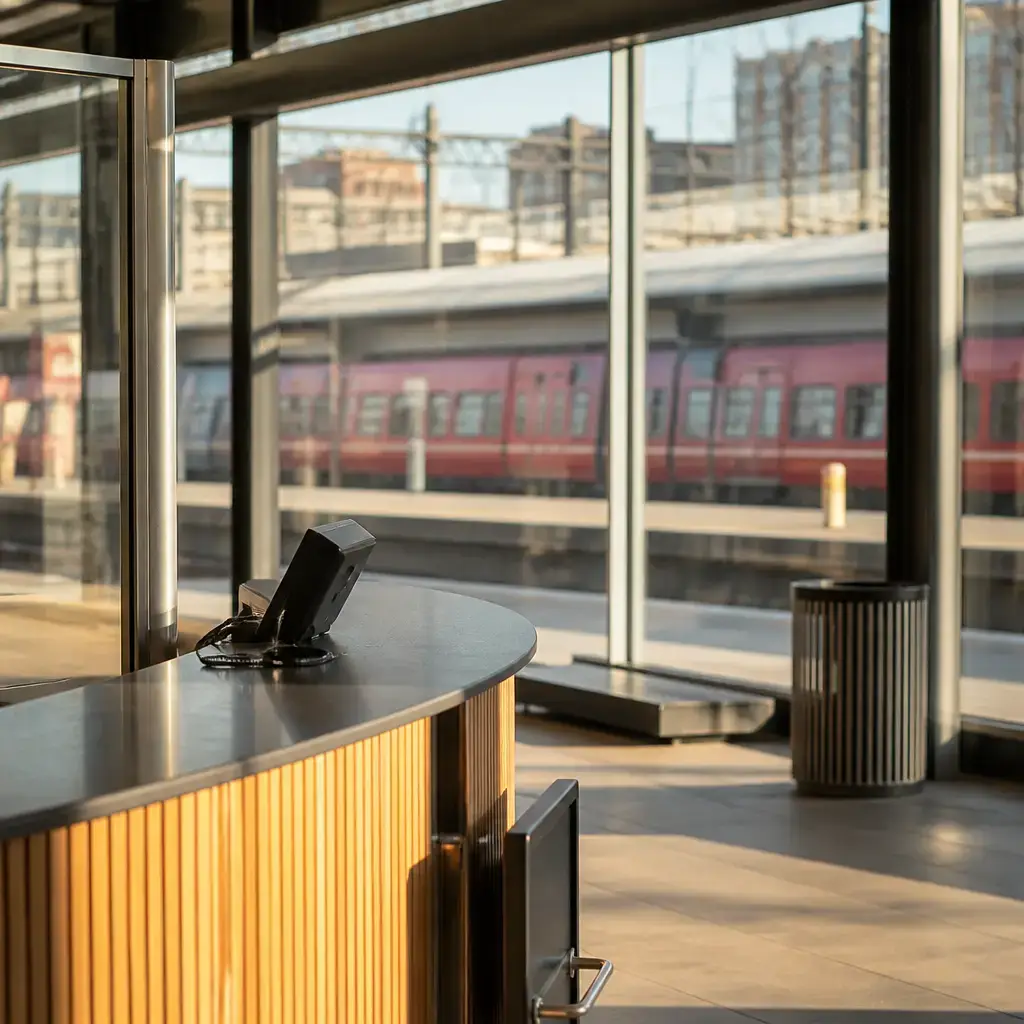
Use Finding another route after a cancelled train to practice German conversation, pronunciation, vocabulary, grammar, and quizzes.
Dialogue
Mein Zug ist ausgefallen.
mine TSOOK ist OWS-guh-FAH-len. My train has been cancelled.Ich muss bald einen Anschlusszug erreichen.
ikh moos bahlt EYE-nen AHN-shlooss-tsoog er-RYE-khen. I need to catch a connecting train soon.Ich kann Ihnen helfen, eine andere Verbindung zu finden.
ikh kahn EE-nen HEL-fen, EYE-nuh AHN-duh-reh fer-BIN-doong tsoo FIN-den. I can help you find another route.Auf der Anzeigetafel steht, dass ein Schnellzug von einem anderen Bahnsteig abfährt.
owf dair AHN-tsye-guh-tah-fel shtayt, dahss eye-n SHNELL-tsoog fon EYE-nem AHN-duh-ren BAHN-shtyeeg AHP-fairt. The board shows an express train leaving from a different platform.Das könnte klappen, aber ich prüfe, ob Ihre Fahrkarte dafür gültig ist.
dahss KURN-tuh KLAHP-en, AH-ber ikh PROO-fuh, op EE-reh FAHR-kar-tuh dah-FYOOR GUEL-tikh ist. That could work, but I'll check whether your ticket is valid for it.Soll ich diese Fahrkarte weiter benutzen oder eine neue kaufen?
zoll ikh DEE-zuh FAHR-kar-tuh VY-ter beh-NOOT-sen OH-der EYE-nuh NOY-uh KOW-fen? Should I stay with this ticket or get a new one?Sie können diese Fahrkarte benutzen, weil Ihr ursprünglicher Zug ausgefallen ist.
zee KURN-en DEE-zuh FAHR-kar-tuh beh-NOOT-sen, vile EER OOR-shproong-likh-er TSOOK OWS-guh-FAH-len ist. You can use this ticket because your original train was cancelled.Werde ich meinen Anschluss am nächsten Bahnhof noch erreichen?
VAIR-duh ikh MY-nen AHN-shlooss ahm NAYKH-sten BAHN-hohf nokh er-RYE-khen? Will I still make my connection at the next station?Das sollten Sie schaffen, aber gehen Sie jetzt zum Bahnsteig und prüfen Sie das noch einmal, wenn Sie ankommen.
dahss ZOLL-ten zee SHAH-fen, AH-ber GAY-en zee yetst tsoom BAHN-shtyeeg oont PROO-fen zee dahss nokh EYE-nmahl, ven zee AHN-kom-en. You should, but head to the platform now and check again when you arrive.Sentence explanations
Mein Zug ist ausgefallen.
My train has been cancelled.
- Mein
- my
- Zug
- train
- ausgefallen
- was cancelled
More detail
Mein means “my” here. It is the possessive determiner used with the masculine singular nominative noun Zug: mein Zug = “my train.” The form agrees with the noun phrase’s case and gender; the possessive meaning does not necessarily describe ownership. Zug means “train.” Its plural is Züge, with an umlaut: der Zug → die Züge. In this sentence it is the subject of the statement. ausgefallen is the past participle of ausfallen, “to fail to run” or, for scheduled transport, “to be cancelled.” With a transport service, this verb describes the service not operating; it is not the usual word for someone personally cancelling something. The perfect construction is ist ausgefallen: sein in the present tense (ist) plus the participle ausgefallen. Compare the reusable pattern Der Bus ist ausgefallen. — “The bus was cancelled / did not run.” Together, Mein Zug ist ausgefallen. means “My train has been cancelled.” The possessive determiner mein identifies the train, and ist ausgefallen states that it did not run. The following context about catching a connecting train supports this transport-related reading.
Ich muss bald einen Anschlusszug erreichen.
I need to catch a connecting train soon.
- Ich muss
- I need to / I must
- bald
- soon
- Anschlusszug
- connecting train
- erreichen
- catch / reach
More detail
Ich muss combines the subject Ich (“I”) with muss, the first-person singular present form of müssen (“must; need to”). With an infinitive, müssen expresses necessity: Ich muss gehen. — “I need to go.” The infinitive goes to the end of this clause. bald means “soon,” referring to a near future time. It is an adverb, so it does not change form: Wir kommen bald. — “We are coming soon.” Anschlusszug means “connecting train.” It is a compound noun: Anschluss conveys the connection, and Zug means “train”; the whole compound is masculine: der Anschlusszug. Here, einen Anschlusszug is the accusative form required as the direct object of erreichen. The indefinite article einen marks that masculine accusative form; it does not by itself state a numeric count. erreichen means “to reach” or, with a train or other scheduled transport, “to catch” it. It is a regular verb whose infinitive is erreichen; in the sentence, it remains an infinitive because it follows the modal verb muss. For example, Sie will den Zug erreichen. — “She wants to catch the train.” Together, Ich muss + bald + einen Anschlusszug erreichen means: “I need to catch a connecting train soon.” The necessity is expressed by muss, the time by bald, and the required action by the infinitive phrase einen Anschlusszug erreichen.
Ich kann Ihnen helfen, eine andere Verbindung zu finden.
I can help you find another route.
- Ich kann
- I can
- Ihnen
- you (formal)
- helfen
- help
- eine
- a
- andere
- another
- Verbindung
- route
- zu finden
- to find
More detail
Ich kann means “I can” here. kann is the present-tense form of können for ich; it expresses ability or an offer of help in this sentence. With a following infinitive, German places the modal verb in the conjugated position and sends the other verb to the end: Ich kann helfen = “I can help.” Ihnen is the formal “you” in the dative case. The verb helfen requires the person being helped to be in the dative, so German uses Ihnen, not the accusative formal form Sie. The capitalization is part of the standard written form for formal address. helfen means “to help.” Its base form is helfen; with ich, the present-tense form is ich helfe, but after the modal kann it remains the infinitive helfen. Example: Ich helfe Ihnen. — “I am helping you.” eine andere Verbindung means “another route” in this travel context. Verbindung is a feminine noun meaning a connection or route, especially a transport connection. eine marks an indefinite feminine noun in the accusative here, and andere is the adjective agreeing with it. The adjective has the attributive stem ander-; andere is its form in this noun phrase. Example: Wir suchen eine andere Verbindung. — “We are looking for another route.” zu finden means “to find.” finden is the base form, and zu finden is its infinitive with zu. The phrase helfen, etwas zu finden means “to help [someone] find something”; the comma separates the main clause from this infinitive construction. Example: Sie hilft mir, den Bahnhof zu finden. — “She helps me find the station.” Together, Ich kann Ihnen helfen says “I can help you,” and eine andere Verbindung zu finden specifies what help concerns: finding another route. The complete utterance is therefore “I can help you find another route.”
Auf der Anzeigetafel steht, dass ein Schnellzug von einem anderen Bahnsteig abfährt.
The board shows an express train leaving from a different platform.
- Anzeigetafel
- display board
- steht
- shows
- Schnellzug
- express train
- anderen
- different; another
- Bahnsteig
- platform
- abfährt
- leaves; departs
More detail
Anzeigetafel means “display board” here. It is a feminine noun: die Anzeigetafel, plural die Anzeigetafeln. In Auf der Anzeigetafel, auf describes a fixed location and therefore takes the dative: der is the feminine dative form of die. The compound combines Anzeige (“display”) and Tafel (“board”), but it is learned as one noun. steht is the third-person singular present form of stehen (“to stand”). With information on a sign or board, German commonly uses stehen to say that something is written or shown there; it does not mean that the board is physically standing in this sentence. The pattern Auf ... steht, dass ... means “... shows/states that ...”. Schnellzug means “express train”. It is a masculine compound noun: der Schnellzug, plural die Schnellzüge. Schnell- identifies the train as fast or express, while the complete compound is the normal noun for the train type. anderen is the inflected form of the adjective andere (“other; another”). In von einem anderen Bahnsteig, von requires the dative, and Bahnsteig is masculine, so the dative phrase is einem anderen Bahnsteig. The adjective ending reflects this article-and-case combination. Compare the nominative form in ein anderer Bahnsteig (“another platform”) with the dative form here, einem anderen Bahnsteig. Bahnsteig means “platform”. It is masculine: der Bahnsteig, plural die Bahnsteige. The full phrase von einem anderen Bahnsteig means “from a different/another platform”; von marks the point of departure. abfährt is the third-person singular present form of the separable verb abfahren (“to leave; to depart”). Its parts are fährt from fahren plus the separable prefix ab. In a subordinate clause introduced by dass, the finite verb is placed at the end, so the prefix remains attached: dass ein Zug abfährt. In a main clause, the parts separate: Der Zug fährt ab (“The train departs”). Together, Auf der Anzeigetafel steht identifies the source of the information, and dass ein Schnellzug von einem anderen Bahnsteig abfährt states what the board shows. The complete meaning is: “The board shows an express train leaving from a different platform.”
Das könnte klappen, aber ich prüfe, ob Ihre Fahrkarte dafür gültig ist.
That could work, but I'll check whether your ticket is valid for it.
- könnte klappen
- could work
- aber
- but
- ich prüfe
- I check
- ob
- whether
- Ihre
- your
- Fahrkarte
- ticket
- dafür
- for it
- gültig
- valid
More detail
könnte klappen expresses a tentative possibility: “could work” or “might work.” könnte is the Konjunktiv II form of können; here it marks a cautious or hypothetical assessment, not past time. klappen is an infinitive meaning “work out” or “succeed.” Example: Das könnte klappen. — “That could work.” aber links this possibility with a contrasting point and means “but.” ich prüfe is the first-person singular present form of prüfen, “to check” or “to verify.” German present tense can refer to an immediate intended action, which fits “I’ll check” here. Example: Ich prüfe die Angaben. — “I’ll check the information.” ob introduces an indirect yes-or-no question, meaning “whether.” In this subordinate clause, the finite verb comes at the end: ob ... gültig ist — “whether ... is valid.” This differs from a direct question such as Ist die Fahrkarte gültig? — “Is the ticket valid?” Ihre is the capitalized formal possessive determiner meaning “your.” In this sentence it agrees with the feminine singular nominative noun Fahrkarte, giving the ending -e: Ihre Fahrkarte. The capital letter distinguishes formal “your” from lowercase ihre, which can mean “her” or “their,” depending on context. Ihre itself does not identify whether the formal addressee is one person or several. Fahrkarte is a feminine noun meaning “ticket,” specifically a ticket for travel. Its basic singular form is die Fahrkarte; the plural is die Fahrkarten. Example: Die Fahrkarte ist neu. — “The ticket is new.” dafür is a da-compound meaning “for that” or “for it.” Here it expresses what the ticket must be valid for, matching the translation’s “for it.” Such forms combine da- with a preposition: dafür = da + für. Example: Ist diese Karte dafür gültig? — “Is this ticket valid for it?” gültig means “valid” or “legally/officially usable.” It is a predicative adjective here, so it has no adjective ending after ist: Die Fahrkarte ist gültig. — “The ticket is valid.” Its useful opposite is ungültig, “invalid.” Together, ich prüfe, ob Ihre Fahrkarte dafür gültig ist means “I’ll check whether your ticket is valid for it.” The complete utterance first gives the cautious assessment Das könnte klappen (“That could work”), then contrasts it with aber and states that the speaker will verify the ticket’s validity.
Soll ich diese Fahrkarte weiter benutzen oder eine neue kaufen?
Should I stay with this ticket or get a new one?
- Soll ich
- Should I…?
- diese
- this
- Fahrkarte
- ticket
- weiter benutzen
- continue using
- neue
- new
- kaufen
- buy
More detail
Soll ich combines sollen (“should/be supposed to”) with ich (“I”). Here soll is the present-tense first-person singular form, used to ask for guidance about the speaker’s action. In a yes/no question, the conjugated verb comes first: Soll ich ...? = “Should I ...?” diese means “this” and refers here to the ticket. Its form is the feminine singular accusative form required for the direct object Fahrkarte; the same form can also occur with feminine singular nominative nouns and plural nouns, so the ending alone does not identify every possible use. Fahrkarte means “ticket,” specifically the travel ticket intended in this exchange. Its plural is Fahrkarten. In diese Fahrkarte, the noun is the object of the action. weiter benutzen means “continue using.” benutzen is the infinitive “to use,” while weiter adds the idea that the use continues. For example: Ich benutze die Karte weiter. — “I continue using the card.” neue is the adjective neu (“new”) in the form used with the implied feminine singular noun Fahrkarte: eine neue Fahrkarte. The ending -e follows the indefinite article eine in this phrase. In the fixed sentence, eine neue omits the repeated noun because it is understood from Fahrkarte; eine is an indefinite article here, not a claim about a numerical count. kaufen is the infinitive “to buy.” In the alternative oder eine neue kaufen, the earlier question frame is understood: Soll ich ... oder [soll ich] eine neue kaufen? German commonly leaves the repeated modal and subject unspoken in the second coordinated option. Together, Soll ich diese Fahrkarte weiter benutzen oder eine neue kaufen? asks whether the speaker should continue using this ticket or buy a new one. The two alternatives are diese Fahrkarte weiter benutzen and eine neue [Fahrkarte] kaufen; the second option contrasts continued use with obtaining a replacement.
Sie können diese Fahrkarte benutzen, weil Ihr ursprünglicher Zug ausgefallen ist.
You can use this ticket because your original train was cancelled.
- Sie können
- you can
- diese
- this
- Fahrkarte
- ticket
- benutzen
- use
- weil
- because
- Ihr
- your
- ursprünglicher
- original
- Zug
- train
- ausgefallen ist
- was cancelled
More detail
Sie können means “you can.” können is the modal verb for ability or permission; here it is finite and agrees with Sie, while the following verb stays in the infinitive. With capitalized Sie, the form can address one person formally or several people. diese means “this” here. It is the accusative feminine singular form of the demonstrative because it modifies Fahrkarte, a feminine noun, as the object of benutzen. Compare the nominative form diese and the masculine accusative form diesen`. Fahrkarte means “ticket,” specifically a travel ticket. It is a feminine noun: die Fahrkarte; its plural is die Fahrkarten. Example: Ich kaufe eine Fahrkarte. — “I am buying a ticket.” benutzen means “use.” It is the base-form infinitive selected by the modal können. Example: Sie können den Automaten benutzen. — “You can use the machine.” weil means “because” and introduces the reason. In a clause beginning with weil, the finite verb normally goes to the end. Ihr means “your” here. Its capitalization marks the formal singular or plural possessive form, not the informal plural euer. It modifies ursprünglicher Zug in this sentence. ursprünglicher means “original” here. Its base form is ursprünglich; the ending -er is an adjective ending, not a comparative marker. It agrees with the masculine singular nominative noun Zug after the possessive determiner Ihr. Zug means “train.” It is a masculine noun: der Zug; its plural is die Züge. Example: Der Zug kommt später. — “The train is arriving later.” ausgefallen ist expresses “was cancelled” here. The base verb is ausfallen, literally “to fail to run” in this transport context. Its perfect form uses sein: ist ausgefallen; in the weil clause, the finite auxiliary ist comes last. Example: Der Flug ist ausgefallen. — “The flight was cancelled.” Together, Sie können diese Fahrkarte benutzen says “You can use this ticket.” weil Ihr ursprünglicher Zug ausgefallen ist gives the reason: “because your original train was cancelled.” The complete utterance is therefore: “You can use this ticket because your original train was cancelled.”
Werde ich meinen Anschluss am nächsten Bahnhof noch erreichen?
Will I still make my connection at the next station?
- Werde ich
- will I
- meinen
- my
- Anschluss
- connection
- am
- at the
- nächsten
- next
- Bahnhof
- station
- noch
- still
- erreichen
- reach
More detail
Werde ich begins a yes/no question. werde is the first-person singular present form of werden, with ich after it because German places the finite verb first in this question pattern. With the infinitive at the end, werden forms the future: Ich werde ... erreichen = “I will ... reach”; Werde ich ... erreichen? = “Will I ... reach?” meinen is the masculine accusative singular form of the possessive determiner mein (“my”). It agrees with Anschluss here and marks the direct object of erreichen: mein Anschluss in the basic form, but meinen Anschluss in the accusative. This is a form of mein, not an inflection of the noun. Anschluss means a connection, especially a transport connection in this context. The useful collocation einen Anschluss erreichen means to catch or make a connection. Example: Ich muss den Anschluss erreichen. — “I have to catch the connection.” am is the contraction of an dem, meaning “at the” here. It is followed by nächsten Bahnhof, a masculine singular dative phrase: an dem Bahnhof → am Bahnhof. nächsten is the inflected form of nächst-, meaning “next” here. Its ending reflects the dative masculine phrase after am: der nächste Bahnhof is the basic form, while am nächsten Bahnhof is the form used here. Nächste can also refer to the next item in an order, not only physical distance. Bahnhof means “station” in the railway sense. It is a masculine noun: der Bahnhof; after an dem, it appears as dem Bahnhof, contracted to am Bahnhof. noch means “still” in this question. It presents reaching the connection as possibly remaining feasible at that time. Example: Kann ich den Zug noch erreichen? — “Can I still catch the train?” erreichen is the infinitive “reach” or, with a connection or vehicle, “catch/make.” The finite verb would be ich erreiche; the perfect form is ich habe erreicht. In this sentence it remains an infinitive because werden carries the finite future form and the infinitive goes at the end. Together, Werde ich sets up a future yes/no question, meinen Anschluss is the connection being reached, am nächsten Bahnhof identifies the place, and noch adds the sense of “still.” The complete meaning is: “Will I still make my connection at the next station?”
Das sollten Sie schaffen, aber gehen Sie jetzt zum Bahnsteig und prüfen Sie das noch einmal, wenn Sie ankommen.
You should, but head to the platform now and check again when you arrive.
- Das
- that / it
- sollten Sie
- you should
- schaffen
- manage / make it
- aber
- but
- gehen
- go / head
- jetzt
- now
- zum
- to the
- Bahnsteig
- platform
- prüfen
- check
- das
- it / that
- noch einmal
- again
- wenn
- when
- ankommen
- arrive
More detail
Das is a demonstrative pronoun meaning “that” or “it.” It refers to the relevant task or situation, rather than naming a new noun; in the supplied context, the task is connected with making the connection. The form das is neuter singular in this use, but the pronoun’s grammatical form does not by itself identify the real-world referent. sollten Sie expresses “you should.” sollten is the form of sollen used here for a recommendation or expectation, and Sie is the formal “you” pronoun. The formal pronoun is written with a capital letter. A useful contrast is Sie sollen ... for a more direct “you are supposed to ...” or “you must ...,” while Sie sollten ... is generally less forceful. schaffen means “manage” or “succeed in doing something.” It is the infinitive after the modal verb sollten: Sie sollten das schaffen means “You should manage that.” The word can also mean “create” in other contexts, so its meaning here comes from the surrounding task. aber means “but” and connects the first recommendation with a second instruction. It does not itself express the instruction “go”; that meaning belongs to gehen Sie. gehen means “go” or “head.” In gehen Sie, the infinitive-shaped verb comes before the formal subject in an imperative addressed to one person: “Go” or “Head.” A normal present-tense statement has the order Sie gehen ... (“You go ...” / “You are going ...”). jetzt means “now” and places the instruction at the present time. In this sentence it modifies the action of heading to the platform, not the later checking action. zum is the contraction of zu dem, meaning “to the.” zu takes the dative, and dem is the dative masculine/neuter form of the definite article. Contractions such as zum are standard and should not be treated as a separate lexical noun. Bahnsteig means “platform,” especially a railway platform. Its plural is Bahnsteige. In zum Bahnsteig, the article information is contained in zum; the noun itself is the destination of movement. prüfen means “check” or “examine.” Here it is the second imperative: prüfen Sie ... means “check ...” The same verb can be used for checking information, an object, or a condition; the following das supplies the object here. das is the object pronoun “it” or “that” in this sentence. It is separate from the earlier Das: both are spelled das, but the first is the thing or situation being managed, while the second is the thing being checked. A pronoun’s form alone does not specify an exact real-world object. noch einmal is the reusable expression “again” or literally “once more.” noch by itself often means “still” or “yet,” but together with einmal here it indicates repetition: Lesen Sie das noch einmal means “Read that again.” wenn introduces a time clause meaning “when.” The clause wenn Sie ankommen gives the time at which the checking should happen. In a wenn clause, the finite verb goes to the end. ankommen means “arrive.” It is a separable verb whose parts are joined in the infinitive and in a subordinate-clause form such as wenn Sie ankommen; in a main-clause present-tense statement, it separates: Sie kommen an (“You arrive”). Here Sie is the formal subject and ankommen is in the present tense. Taken together, Das sollten Sie schaffen says that the relevant task should be manageable for the listener. aber gehen Sie jetzt zum Bahnsteig adds the immediate instruction to head to the platform. und prüfen Sie das noch einmal adds another instruction to check the relevant item again, and wenn Sie ankommen specifies that this checking is to happen when the listener arrives. The full meaning is: “You should manage that, but head to the platform now and check it again when you arrive.”
Grammar Points
helfen + Dativ
Ihnen helfen
EE-nen HEL-fento help you
The person receiving help is in the dative case: Ihnen means “to you” in formal address.
ausfallen → ausgefallen
ausgefallen
OWS-guh-FAH-lencancelled; suspended
Separable-prefix verbs place ge between the prefix and the verb stem in the past participle.
German Vocabulary
eine andere Verbindung
einen Anschlusszug
Auf der Anzeigetafel
ist ausgefallen
einen Anschlusszug erreichen
zu finden
Ihnen helfen
steht, dass
eine andere Verbindung
Mein Zug
Quiz
Word Order
Arrange the words in the correct order.
My train has been cancelled.
Show Answer
Mein Zug ist ausgefallen.I need to catch a connecting train soon.
Show Answer
Ich muss bald einen Anschlusszug erreichen.Spelling
Tap the letters to spell the word.
to find
Show Answer
findenconnection; route
Show Answer
Verbindungto help
Show Answer
helfento you; for you