10 minutes free every day
Continue audio lessons in the app
Word explanations appear automatically in sync with the audio.
No login required · synced translations · playback with the screen locked
Choose your learning language and open this lesson in the app.

About This Lesson
Use Reporting a Lost Umbrella on Public Transport to practice German conversation, pronunciation, vocabulary, grammar, and quizzes.
Dialogue
Ich habe meinen Regenschirm heute Morgen im Bus liegen lassen.
ikh HAH-buh MY-nun RAY-gen-shirm HOY-tuh MOR-gen im boos LEE-gen LAH-sun. I left my umbrella on the bus this morning.Du solltest mit den Angaben zur Fahrt eine Verlustmeldung aufgeben.
doo ZOL-test mit dayn AHN-gah-bun tsoor fahrt EYE-nuh fer-LOOST-mel-doong OWF-gay-bun. You should file a lost item report with the trip details.Er war in dem Bus, der während des morgendlichen Berufsverkehrs hier gehalten hat.
air vahr in daym boos, dair VAY-rent dayz MOR-gen-likh-un buh-ROOFS-fer-kair heer guh-HAL-tun hat. It was on the bus that stopped here during the morning rush.Kannst du den Regenschirm genau beschreiben?
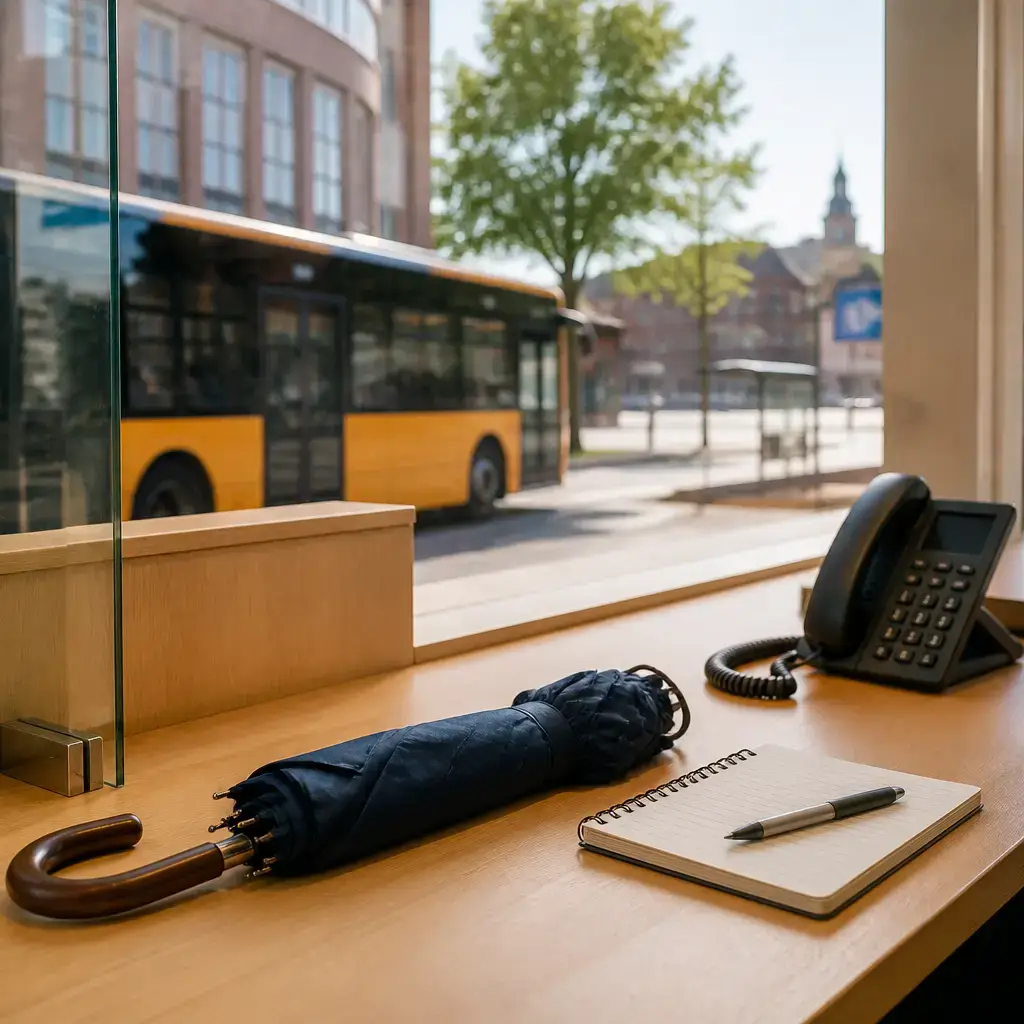
kahnst doo dayn RAY-gen-shirm guh-NOW buh-SHRY-bun? Can you describe the umbrella clearly?Er ist dunkelblau, zusammengeklappt und hat einen Holzgriff.
air ist DOON-kul-blow, tsoo-ZAH-men-guh-KLAPT oont hat EYE-nun HOHLTS-grif. It's navy blue and folded, with a wooden handle.Füge eine Telefonnummer hinzu, damit das Personal dich kontaktieren kann, falls er gefunden wird.
FYOO-guh EYE-nuh tay-leh-FOHN-noom-er hin-TSOO, dah-MIT das pair-soh-NAHL dikh kon-tak-TEE-run kahn, fahls air guh-FOON-dun virt. Add a phone number so staff can contact you if it turns up.Wie lange dauert es normalerweise, bis ich eine Rückmeldung bekomme?
vee LAHNG-uh DOW-ert es nor-mah-LAIR-vy-zuh, bis ikh EYE-nuh ROOK-mel-doong buh-KOM-uh? How long does it usually take to hear back?Das hängt davon ab, aber gefundene Gegenstände werden oft bis zum Abend abgeholt.
dahs HENGT dah-FOHN ahp, AH-ber guh-FOON-duh guh-GENG-shtend-uh VAYR-dun oft bis tsoom AH-bunt AHP-guh-HOHLT. It depends, but found items are often collected by evening.Ich reiche das Formular jetzt ein und erkundige mich morgen noch einmal.
ikh RY-khuh das for-moo-LAHR yetst ayn oont air-KOON-di-guh mikh MOR-gen nokh EYE-n mahl. I'll submit the form now and check again tomorrow.Eine genaue Beschreibung macht es dem Personal leichter, ihn zuzuordnen.
EYE-nuh guh-NOW-uh buh-SHRY-boong makht es daym pair-soh-NAHL LYKH-ter, een tsoo-TSOO-ord-nun. A specific description will make it easier for staff to match it.Sentence explanations
Ich habe meinen Regenschirm heute Morgen im Bus liegen lassen.
I left my umbrella on the bus this morning.
- Ich habe
- I have
- meinen
- my
- Regenschirm
- umbrella
- heute Morgen
- this morning
- im
- in the
- Bus
- bus
- liegen lassen
- leave behind
More detail
Ich habe is the first-person singular present form of haben, used here as the auxiliary for the perfect past. The subject is Ich (“I”); habe agrees with that subject. In a reusable pattern, German often uses Ich habe ... plus a past participle or an infinitive construction to describe a completed event. meinen means “my” here. Its form is masculine accusative singular because it modifies Regenschirm, the direct object of the leaving-behind event. The base possessive form is mein; related forms change with the noun’s grammatical gender, number, and case, for example mein with a masculine nominative noun and meine with a feminine or plural noun in several common cases. The possessive form itself does not mean a numeric quantity. Regenschirm means “umbrella.” It is a masculine noun: der Regenschirm. In this sentence, meinen Regenschirm is the object being left behind, so the masculine accusative form of the possessive is meinen. heute Morgen means “this morning.” heute means “today,” and Morgen means “morning” in this time expression. Together they specify when the completed event happened. This is different from morgen with a lowercase initial letter, which commonly means “tomorrow.” im is the contraction of in dem, meaning “in the” here. With a location that answers “where?”, in takes the dative, hence dem in the expanded form. The contraction is used before the masculine or neuter singular article dem; it is not a separate preposition. Bus means “bus.” The phrase im Bus gives the location: the umbrella was left inside the bus. The noun is masculine, der Bus, and dem in in dem Bus is the dative article required by this locational use of in. liegen lassen is a construction meaning “leave something lying” or, in this context, “leave something behind.” liegen means “lie” or “be lying,” while lassen means “let” or “leave.” With a completed event expressed using haben, this construction appears as habe ... liegen lassen; the infinitive lassen remains at the end rather than changing to the participle gelassen. The object comes between the auxiliary and the construction: Ich habe den Schlüssel liegen lassen = “I left the key behind.” The sentence assembles as Ich habe + the object meinen Regenschirm + the time heute Morgen + the location im Bus + liegen lassen. Its complete meaning is: “I left my umbrella on the bus this morning.”
Du solltest mit den Angaben zur Fahrt eine Verlustmeldung aufgeben.
You should file a lost item report with the trip details.
- Du solltest
- you should
- Angaben
- details; information
- Fahrt
- trip; journey
- Verlustmeldung
- lost-item report
- aufgeben
- file; submit
More detail
Du solltest combines the pronoun du (“you,” singular informal) with solltest, the second-person singular form of sollen used here for a recommendation. Sollen expresses what someone is expected or advised to do; Du solltest ... is a reusable way to say “You should ...”. For example: Du solltest jetzt gehen. — “You should leave now.” Angaben is the plural of the feminine noun die Angabe, meaning a piece of information or a detail. Here it is in the dative plural, because mit requires the dative: mit den Angaben means “with the details/information.” The definite article also shows the plural dative form: die becomes den. Fahrt is the feminine noun die Fahrt, a trip or journey, often understood as a particular ride or trip. In zur Fahrt, zur is the contraction of zu der; it marks Fahrt as a feminine dative noun. Angaben zur Fahrt is a reusable pattern meaning “details about the trip.” Verlustmeldung is a feminine compound noun: die Verlustmeldung, a report that something has been lost. The compound combines Verlust (“loss”) and Meldung (“report” or “notification”). In eine Verlustmeldung aufgeben, the indefinite article introduces a report to be filed; it does not by itself state a numerical count. aufgeben means “to submit” or “to file” in this context. It is also used in other contexts with meanings such as “to give up,” so the noun eine Verlustmeldung determines the filing meaning here. As an infinitive, the separable verb appears together at the end of the sentence. For example: Sie gibt eine Meldung auf. — “She files a report.” Taken together, Du solltest gives the recommendation, eine Verlustmeldung aufgeben names the recommended action, and mit den Angaben zur Fahrt specifies that the report should be filed with the trip details. The whole utterance means: “You should file a lost item report with the trip details.”
Er war in dem Bus, der während des morgendlichen Berufsverkehrs hier gehalten hat.
It was on the bus that stopped here during the morning rush.
- Er
- it
- war
- was
- in dem
- in the
- Bus
- bus
- der
- that
- während
- during
- morgendlichen
- morning
- Berufsverkehrs
- rush-hour traffic
- hier
- here
- gehalten hat
- stopped
More detail
Er is the third-person singular nominative pronoun. In this sentence, the fixed translation uses “it” for the thing whose location is being described; the German form is masculine in grammatical gender. The referent is not identified by the pronoun’s form alone. war is the simple past form of sein (“to be”) for third-person singular: sein → war. Here it places that thing in the bus in the past. Example: Der Schirm war hier. — “The umbrella was here.” in dem means “in the” and marks a location here. in takes the dative for a stationary location; dem is the dative singular form of the definite article for a masculine or neuter noun. In everyday German, in dem can often contract to im, but the source uses the full form. Bus is a masculine noun: der Bus. With the dative phrase in dem Bus, the article shows the location rather than movement into it. Example: Sie ist im Bus. — “She is on the bus.” der is the relative pronoun “that” here. It refers to Bus and is masculine singular nominative because it is the subject of the following relative clause. Its form is determined by its role in that clause, while its antecedent is Bus. während introduces the time setting “during.” In this sentence it introduces the noun phrase des morgendlichen Berufsverkehrs, which is in the genitive. morgendlichen is the adjective morgendlich (“morning” or “morning-time”) in a genitive masculine singular phrase. The ending -en agrees with the grammatical form required after des; it belongs to the adjective, not to Berufsverkehrs. Berufsverkehrs is the genitive singular of the masculine noun Berufsverkehr (“commuter or rush-hour traffic”): der Berufsverkehr → des Berufsverkehrs. The final -s marks this genitive form. Example: Während des Berufsverkehrs sind die Straßen voll. — “During rush hour, the roads are busy.” hier means “here,” referring to the location relevant to the speaker or discourse. It modifies the stopping event, not the time phrase. gehalten hat is the perfect-tense form of halten in the sense “to stop”: halten → gehalten + hat. In this relative clause, hat is the auxiliary and gehalten is the past participle; both appear at the end because German subordinate clauses place the finite verb at the end. Here halten is being used intransitively, so the clause means “that stopped,” not “that held something.” Together, Er war in dem Bus says that the identified thing was on or in the bus. The relative clause der während des morgendlichen Berufsverkehrs hier gehalten hat identifies the bus by saying that it stopped here during the morning rush. The whole utterance therefore means: “It was on the bus that stopped here during the morning rush.”
Kannst du den Regenschirm genau beschreiben?
Can you describe the umbrella clearly?
- Kannst du
- Can you
- Regenschirm
- umbrella
- genau
- clearly
- beschreiben
- describe
More detail
Kannst du combines the inflected modal verb kannst with du and means “can you” here. können is the base form; kannst is its present-tense second-person singular form. In a question, the finite verb comes first: Kannst du ...? The following lexical verb stays in the infinitive. Regenschirm means “umbrella” here. Its base form is der Regenschirm, a masculine noun. The article den before it shows the accusative form required because the umbrella is the direct object of beschreiben; the noun itself does not change in this form. For example: Ich beschreibe den Regenschirm. — “I describe the umbrella.” genau means “clearly” in this sentence, specifying that the description should be precise. It is an adverb here, so it describes how the action is carried out rather than changing to agree with Regenschirm. beschreiben is the infinitive meaning “to describe.” Its base form is already visible here. The verb is separable neither in this infinitive form nor in this question; with the modal verb, it remains at the end: Kannst du den Regenschirm beschreiben? — “Can you describe the umbrella?” Together, Kannst du asks about ability, den Regenschirm identifies the object being described, genau asks for precision, and beschreiben names the requested action. The complete meaning is: “Can you describe the umbrella clearly?”
Er ist dunkelblau, zusammengeklappt und hat einen Holzgriff.
It's navy blue and folded, with a wooden handle.
- ist
- is
- dunkelblau
- navy blue
- zusammengeklappt
- folded up
- hat
- has
- Holzgriff
- wooden handle
More detail
ist is the present-tense third-person singular form of sein (“to be”). The subject is Er; with the supplied context and translation, this refers to the umbrella. Example: Der Schirm ist nass. — “The umbrella is wet.” dunkelblau means “dark blue” or, here, “navy blue.” It is a compound color adjective (dunkel + blau). Because it follows sein as a predicative adjective, it has no adjective ending: Der Schirm ist dunkelblau. — “The umbrella is navy blue.” zusammengeklappt is the past participle of zusammenklappen, “to fold up” or “to close up.” Here it describes the resulting state of the umbrella, not an action being performed at this moment. Example: Der Schirm ist zusammengeklappt. — “The umbrella is folded up.” hat is the present-tense third-person singular form of haben (“to have”). Example: Der Schirm hat einen Griff. — “The umbrella has a handle.” Holzgriff is a compound noun made from Holz (“wood”) and Griff (“handle”), so it means “wooden handle.” In einen Holzgriff, the masculine noun is the direct object of hat, so the indefinite article appears in the accusative form einen; the noun itself remains Holzgriff. Example: Die Tasche hat einen Holzgriff. — “The bag has a wooden handle.” Together, Er ist dunkelblau identifies the umbrella’s color, zusammengeklappt adds its folded-up state, and hat einen Holzgriff states that it has a wooden handle. The complete meaning is: “It’s navy blue and folded, with a wooden handle.”
Füge eine Telefonnummer hinzu, damit das Personal dich kontaktieren kann, falls er gefunden wird.
Add a phone number so staff can contact you if it turns up.
- Füge … hinzu
- add
- Telefonnummer
- phone number
- damit
- so that
- Personal
- staff
- dich
- you
- kontaktieren
- contact
- falls
- if
- er
- it
- gefunden wird
- is found; turns up
More detail
Füge ... hinzu is the informal singular imperative of the separable verb hinzufügen, “to add.” In this sentence, Füge comes first and the separable part hinzu appears at the end of the main clause. A reusable pattern is Füge X hinzu — “Add X.” Telefonnummer means “phone number.” The phrase eine Telefonnummer is the direct object of hinzufügen; Telefonnummer is feminine, so its indefinite accusative article is eine. The article does not by itself state a particular numeric count. damit introduces a purpose clause, meaning “so that.” In a damit clause, the finite verb goes to the end. Here, the purpose is that staff can contact you. Personal means “staff” or “personnel.” It is a collective noun, normally used with the neuter article das: das Personal. Here it is the subject of kontaktieren kann, the group able to make contact. dich is the accusative form of the informal singular pronoun du, “you.” It marks the person being contacted. Compare du for a subject and dich for a direct object: Du kontaktierst mich — “You contact me.” kontaktieren is the infinitive “to contact.” With the modal verb kann, it remains an infinitive at the end of the subordinate clause: Das Personal kann dich kontaktieren — “The staff can contact you.” In the full damit clause, kann is finite and comes after the infinitive because the clause is subordinate. falls introduces a condition, “if” or “in case.” It is followed by a subordinate clause, so the finite verb is placed at the end of that clause. er is the masculine singular nominative pronoun used here for “it,” referring to the item described in the surrounding context. German er reflects the grammatical masculine gender of its referent; English uses “it” for this referent. gefunden wird is a passive construction: gefunden is the participle of finden (“to find”), and wird is the present-tense form of werden used to form the passive. Er wird gefunden means “It is found.” In this conditional context, “if it is found” naturally corresponds to “if it turns up.” Together, damit das Personal dich kontaktieren kann means “so that the staff can contact you,” and falls er gefunden wird means “if it is found.” The complete utterance is: “Add a phone number so that the staff can contact you if it turns up.”
Wie lange dauert es normalerweise, bis ich eine Rückmeldung bekomme?
How long does it usually take to hear back?
- Wie lange
- how long
- dauert
- takes; lasts
- normalerweise
- usually
- bis
- until
- Rückmeldung
- response; feedback
- bekomme
- get; receive
More detail
Wie lange asks about a duration: “how long.” It is a reusable question pattern for an amount of time, not a question about when something happens. For example: Wie lange dauert der Kurs? — “How long does the course last?” dauert is the third-person singular present form of dauern, “to last” or “to take.” The pattern Wie lange dauert es ...? asks how much time an event or process requires. Here, es is the formal subject of this time-expression pattern; it does not identify a particular person or object. Compare Der Kurs dauert zwei Stunden. — “The course lasts two hours.” normalerweise means “usually” or “normally.” It describes what generally happens, rather than asserting that every instance has the same duration. bis introduces the endpoint of a time period, here the point at which the speaker receives a response. With a full subordinate clause, the finite verb goes to the end: bis ich eine Antwort bekomme — “until I get an answer.” This is different from a simple time phrase such as bis morgen — “until tomorrow.” Rückmeldung is a feminine noun meaning “response,” “feedback,” or “reply.” In this sentence it means a response from the relevant service or person—something the speaker is waiting to hear back about. Its plural is Rückmeldungen. The form eine Rückmeldung is accusative because bekommen takes the thing received as its direct object; for this feminine noun, the indefinite article is eine in both nominative and accusative. bekomme is the first-person singular present form of bekommen, “to get” or “to receive”: ich bekomme, du bekommst, er/sie/es bekommt. The subject ich makes the first-person form appropriate. In the subordinate clause after bis, bekomme appears at the end. For example: Ich bekomme morgen eine Antwort. — “I will receive an answer tomorrow.” Together, Wie lange dauert es normalerweise asks for the usual amount of time, and bis ich eine Rückmeldung bekomme sets receiving a response as the endpoint. The complete meaning is: “How long does it usually take to hear back?” The wording is neutral and suitable for asking about an expected response time.
Das hängt davon ab, aber gefundene Gegenstände werden oft bis zum Abend abgeholt.
It depends, but found items are often collected by evening.
- Das
- that / it
- hängt … davon … ab
- depends on that / it
- aber
- but
- gefundene
- found
- Gegenstände
- items / objects
- werden … abgeholt
- are collected
- oft
- often
- bis zum Abend
- by evening
More detail
Das is a neuter demonstrative pronoun meaning “that” or, as here, “it.” Its exact referent is not specified in the sentence; the following construction says that the answer depends on it. Demonstratives can also accompany a noun, as in das Formular (“that/the form”), but Das stands alone here. hängt ... davon ... ab comes from the separable verb abhängen (“to depend”). In a main clause, the finite part hängt appears in second position and the prefix ab moves to the end: Das hängt davon ab. The form hängt is present tense, third-person singular, agreeing with Das. davon means “on that/it” and completes this use of abhängen; together, davon abhängen means “to depend on that/it.” Example: Das hängt vom Wetter ab. — “That depends on the weather.” aber means “but” and contrasts the dependence statement with the information that follows. It does not itself add a time or frequency meaning. gefundene is an adjective meaning “found” in this sentence. It comes from the verb finden (“to find”); the related participle is gefunden. In gefundene Gegenstände, the adjective is placed before a plural noun without an article and has the ending -e. Example: gefundene Schlüssel — “found keys.” Gegenstände means “items” or “objects.” Its singular base form is der Gegenstand; Gegenstände is its nominative plural form, with the umlaut and plural ending. The noun is the grammatical subject of the passive clause. werden ... abgeholt forms the present passive: “are collected/picked up.” werden is the present-tense form used here with the plural subject Gegenstände; abgeholt is the past participle of separable abholen (“to collect” or “pick up”). In a German main-clause passive, werden is finite and the participle appears at the end: Die Pakete werden abgeholt. — “The packages are collected.” This construction presents the items as receiving the action, without specifying who collects them. oft means “often.” It modifies the passive event, so the collection happens frequently or is a common occurrence, not necessarily every time. bis zum Abend means “by evening.” bis marks the latest time by which something happens. zum is the contraction of zu dem; here it occurs with masculine der Abend in the dative form dem Abend. Compare bis morgen (“by tomorrow”), where no article is used. Together, Das hängt davon ab says “It depends on that/it,” and aber gefundene Gegenstände werden oft bis zum Abend abgeholt says “but found items are often collected by evening.” The complete utterance is therefore: “It depends, but found items are often collected by evening.”
Ich reiche das Formular jetzt ein und erkundige mich morgen noch einmal.
I'll submit the form now and check again tomorrow.
- reiche … ein
- submit
- Formular
- form
- jetzt
- now
- erkundige mich
- check / inquire
- morgen
- tomorrow
- noch einmal
- again
More detail
reiche … ein is the first-person singular present form of the separable verb einreichen (“to submit”). In a main clause, the prefix ein moves to the end: Ich reiche das Formular ein. Example: Ich reiche den Antrag heute ein. — “I am submitting the application today.” Formular means “form.” Its form here is das Formular, showing that this noun is neuter in German. The article and noun together form the accusative object of reiche … ein: the thing being submitted. jetzt means “now” and places the submission at the present time. Example: Ich beginne jetzt. — “I am starting now.” erkundige mich is the first-person singular present form of the reflexive verb sich erkundigen, meaning “to inquire” or “to check.” The reflexive element appears as mich with ich: Ich erkundige mich …. A common pattern is sich nach etwas erkundigen, “to inquire about something”: Ich erkundige mich nach dem Termin. — “I’ll check about the appointment.” Here, the object of the inquiry is not stated in the fixed sentence. morgen means “tomorrow,” so it places the second action on the following day. noch einmal is a reusable expression meaning “again” or “once more.” noch by itself can have other meanings, but together with einmal here it marks repetition. Example: Bitte lesen Sie den Satz noch einmal. — “Please read the sentence again.” The sentence coordinates two actions with und: Ich reiche das Formular jetzt ein (“I’ll submit the form now”) and erkundige mich morgen noch einmal (“I’ll check again tomorrow”). The first action uses the separable verb einreichen; the second uses reflexive sich erkundigen. Together, they give the fixed meaning: “I’ll submit the form now and check again tomorrow.”
Eine genaue Beschreibung macht es dem Personal leichter, ihn zuzuordnen.
A specific description will make it easier for staff to match it.
- genaue
- specific; precise
- Beschreibung
- description
- macht
- makes
- Personal
- staff
- leichter
- easier
- ihn
- it
- zuzuordnen
- to assign; to match
More detail
genaue means “specific” here and describes Beschreibung. It is the feminine singular attributive form of genau, agreeing with the feminine noun Beschreibung in this noun phrase. The adjective refers to precision or specificity, not merely to size. The form of an attributive adjective also depends on the noun phrase’s case, gender, number, and determiner; for example, genau is the predicative form in Die Beschreibung ist genau, while genaue occurs in this phrase. Beschreibung is a feminine noun meaning “description”; its plural is Beschreibungen. Here Eine genaue Beschreibung is the subject. The article eine presents a description without by itself asserting a numerical count. macht is the third-person singular present form of machen (“to make; to do”). Here machen occurs in the pattern etwas macht es leichter, ...: something makes a task easier. German present tense can refer to a future result when the context supports that reading, matching “will make” in the fixed translation. Personal means “staff” or “personnel.” It is a neuter collective noun: das Personal. In dem Personal, the dative article marks the staff as the people for whom the task becomes easier. Compare das Personal with dem Personal (“to/for the staff”). leichter is the comparative form of leicht (“easy; light”). The useful chain is leicht → leichter → am leichtesten (“easiest”). Here the comparison presents the task as easier, and leichter is the adjective carrying that comparison, not Personal. ihn is a masculine singular accusative pronoun. It is the object of zuzuordnen, while the fixed translation represents its intended meaning as “it.” The supplied texts do not identify a specific referent for “it,” so the grammatical form can be explained without assigning it to a particular noun. Compare ihn (masculine accusative) with ihm (masculine or neuter dative) and sie (feminine singular or plural accusative, depending on context). zuzuordnen is the infinitive form used after zu of the separable verb zuordnen, meaning “to assign” or “to match” something with an appropriate person, group, or category. The verb’s prefix is zu-; with the infinitive marker, the written form is zuzuordnen. The pattern etwas leichter zuzuordnen means “to make it easier to assign or match something.” Together, Eine genaue Beschreibung is the subject, and macht ... leichter says that it produces an easier result for dem Personal. The infinitive group ihn zuzuordnen states the task that becomes easier. The whole utterance means: “A specific description will make it easier for staff to match it.”
Grammar Points
sich erkundigen nach + Dativ
Sie erkundigt sich nach dem Formular.
zee air-KOON-dikt zikh nahkh daym for-moo-LAHR.She inquires about the form.
The reflexive verb sich erkundigen is commonly followed by nach and the dative case.
abhängen von + Dativ
Das hängt von den Angaben ab.
dahs HENGT fon dayn AHN-gah-bun ahp.That depends on the details.
abhängen uses von with the dative; the separable prefix ab moves to the end in a main clause.
German Vocabulary
mit den Angaben zur Fahrt
eine Verlustmeldung aufgeben
während des morgendlichen Berufsverkehrs
den Regenschirm genau beschreiben
Er ist dunkelblau
zur Fahrt
genau beschreiben
hat einen Holzgriff
habe ... liegen lassen
meinen Regenschirm
eine Verlustmeldung aufgeben
zusammengeklappt
Quiz
Word Order
Arrange the words in the correct order.
Can you describe the umbrella clearly?
Show Answer
Kannst du den Regenschirm genau beschreiben?Spelling
Tap the letters to spell the word.
exactly; precisely
Show Answer
genauto describe
Show Answer
beschreibenumbrella
Show Answer
Regenschirmdetails; information