10 minutes free every day
Continue audio lessons in the app
Word explanations appear automatically in sync with the audio.
No login required · synced translations · playback with the screen locked
Choose your learning language and open this lesson in the app.

About This Lesson
Use Planning a Group Dinner to practice German conversation, pronunciation, vocabulary, grammar, and quizzes.
Dialogue
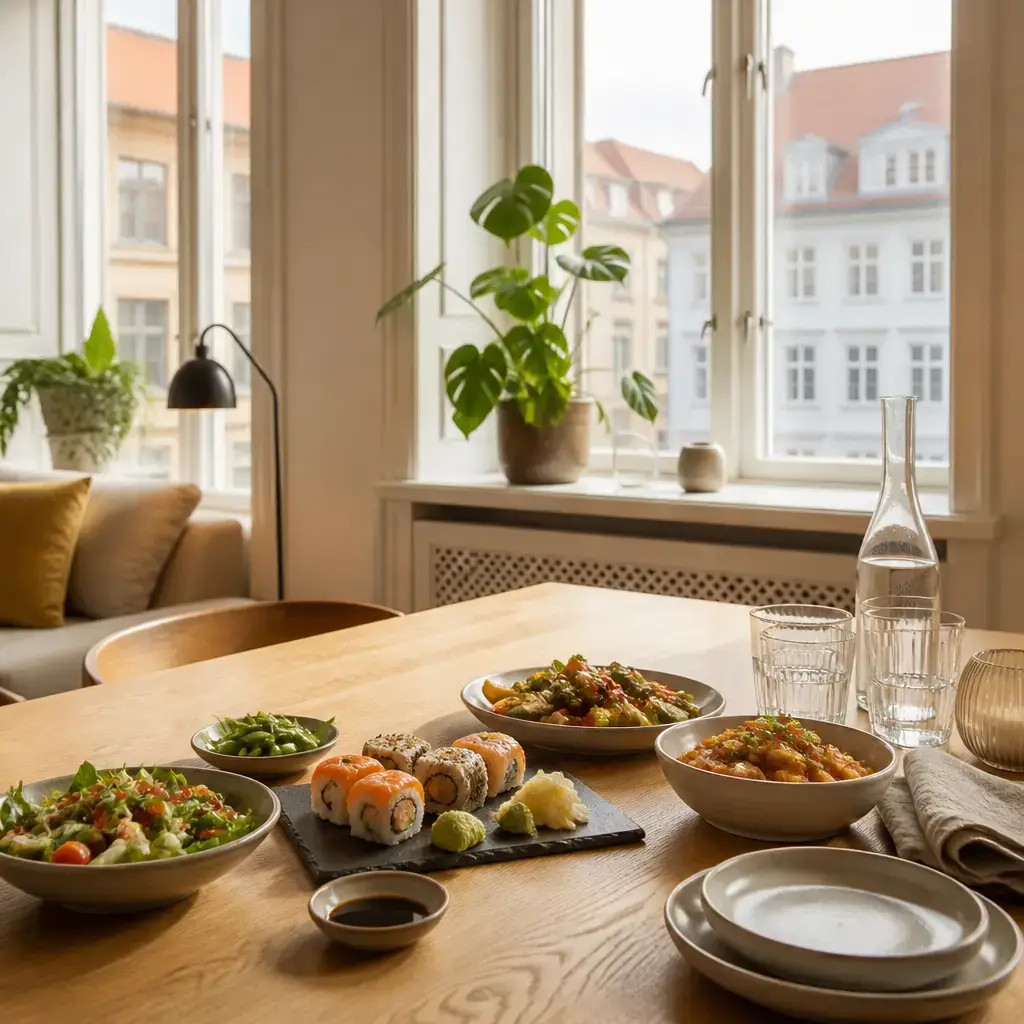
Wir müssen für unsere Gruppe am Samstag ein Restaurant auswählen.
VEER MYUS-un fyr OON-zuh-ruh GROOP-uh ahm ZAHM-stahk ayn res-toh-RAHN OWS-vay-lun. We need to choose a restaurant for our group on Saturday.Dann sollten wir vor der Reservierung die Essensvorlieben aller prüfen.
DAHN ZOLL-ten veer fohr dayr reh-zer-VEER-oong dee ESS-ens-for-LEE-bun ALL-uh PROO-fun. Then we should check everyone's food preferences before making a reservation.Manche wollen Sushi, aber andere bevorzugen ein warmes Essen.
MAHN-khuh VOLL-un SOO-shee, AH-buh AHN-duh-ruh beh-FOOR-khun ayn VAR-mes ESS-un. Some people want sushi, but others prefer a hot meal.Ein Restaurant mit einer abwechslungsreichen Speisekarte wäre flexibler.
AYN res-toh-RAHN mit EYE-nuh AHP-VEKS-loongs-RYKH-un SHPY-zuh-KAR-tuh VAY-ruh flek-SEE-bluh. A place with a varied menu would be more flexible.Ich habe ein ungezwungenes Restaurant mit vegetarischen Optionen und großen Tischen gefunden.
IKH HAH-buh ayn OON-guh-TSVUNG-uh-nes res-toh-RAHN mit veh-guh-TAH-rish-un op-tsyOHN-un oont GROH-sun TISH-un geh-FOON-den. I found a casual restaurant with vegetarian options and big tables.Das klingt nach einer sichereren Wahl für eine gemischte Gruppe.
DAHS klinkt nahkh EYE-nuh ZIKH-uh-ruh-run vahl fyr EYE-nuh guh-MISH-tuh GROOP-uh. That sounds like a safer choice for a mixed group.Soll ich die Gruppe vor der Buchung fragen oder es jetzt auswählen?
ZOLL ikh dee GROOP-uh fohr dayr BOO-khoong FRAH-gun OH-duh ess yetst OWS-vay-lun? Should I ask the group before booking, or choose it now?Gib ihnen zwei Möglichkeiten und bitte um eine schnelle Antwort.
GIP EE-nun tsvy MOYK-likh-kite-un oont BIT-tuh oom EYE-nuh SHNELL-uh AHNT-vort. Give them two options and ask for a quick response.Ich schicke eine kurze Umfrage, damit wir heute Abend entscheiden können.
IKH SHIK-uh EYE-nuh KOORTS-uh OOM-frah-guh, dah-MIT veer HOY-tuh AH-bunt ent-SHY-dun KURN-un. I will send a short poll so we can decide tonight.Das sollte den Plan voranbringen, ohne zu viele Leute nach ihrer Meinung zu fragen.
DAHS ZOLL-tuh dayn plahn fohr-AHN-bring-un, OH-nuh tsoo FEE-luh LOY-tuh nahkh EE-ruh MY-noong tsoo FRAH-gun. That should keep the plan moving without asking too many people for opinions.Sentence explanations
Wir müssen für unsere Gruppe am Samstag ein Restaurant auswählen.
We need to choose a restaurant for our group on Saturday.
- Wir müssen
- we need to / must
- für
- for
- unsere
- our
- Gruppe
- group
- Samstag
- Saturday
- Restaurant
- restaurant
- auswählen
- choose
More detail
Wir müssen means “we need to / must.” Wir is the first-person plural subject (“we”), and müssen is the present-tense form of müssen for that subject. With a second verb, the modal is conjugated and the other verb stays in the infinitive at the end: Wir müssen warten. — “We need to wait.” Here, the following infinitive is auswählen. für introduces the person or group something is intended for and takes the accusative case. In für unsere Gruppe, it marks the group as the intended beneficiary: “for our group.” This is different from mit (“with”), which expresses accompaniment. unsere means “our” here. It is the possessive determiner agreeing with the feminine singular noun Gruppe in the accusative phrase für unsere Gruppe. The form also appears with a feminine singular nominative noun, but other noun genders and numbers use different forms; for example, unser Restaurant is “our restaurant,” while unsere Restaurants is “our restaurants.” Gruppe means “group.” Its base form is the feminine noun die Gruppe; after für, the phrase is accusative: für eine Gruppe — “for a group.” The noun itself has no visible ending change in this singular form. Samstag means “Saturday.” It is a masculine noun, der Samstag, and here it appears in the time phrase am Samstag, meaning “on Saturday.” For a recurring event, German can use samstags: Wir arbeiten samstags. — “We work on Saturdays.” Restaurant means “restaurant.” It is the neuter noun das Restaurant. In the source, ein Restaurant is the thing being chosen; the indefinite article ein marks a singular indefinite noun phrase, not a stated numerical count. auswählen means “to choose” or “to select.” It is a separable verb: the base verb is wählen, and the prefix aus- adds the sense of selecting from possibilities. In an ordinary finite main clause, the parts separate: Wir wählen ein Restaurant aus. — “We choose a restaurant.” After the modal müssen, the infinitive remains together at the end: Wir müssen ein Restaurant auswählen. — “We need to choose a restaurant.” Together, Wir müssen ... auswählen gives “we need to choose ...”; ein Restaurant is the selected object, für unsere Gruppe says whom it is intended for, and am Samstag—the contraction of an dem Samstag—sets the time. The complete utterance therefore means: “We need to choose a restaurant for our group on Saturday.”
Dann sollten wir vor der Reservierung die Essensvorlieben aller prüfen.
Then we should check everyone's food preferences before making a reservation.
- Dann
- then
- sollten wir
- we should
- vor
- before
- Reservierung
- reservation
- Essensvorlieben
- food preferences
- aller
- everyone’s
- prüfen
- check
More detail
Dann means “then” here: it links this proposed next step to the preceding situation. It is a temporal adverb and can also introduce a consequence in other contexts. sollten wir expresses “we should.” sollten is the Konjunktiv II form of sollen used here for a recommendation or sensible course of action; wir is the first-person plural subject, “we.” The lexical verb comes later in the infinitive: sollten wir ... prüfen. vor means “before” in this time expression. With the noun phrase der Reservierung, it forms vor der Reservierung, “before the reservation.” In this temporal use, vor takes the dative: feminine singular die Reservierung becomes der Reservierung after vor. With a clause, German can instead use bevor, as in bevor wir reservieren (“before we make a reservation”). Reservierung is the feminine noun “reservation.” Its base form is commonly used with the article: die Reservierung; after this use of vor, the form is der Reservierung. The noun refers here to the act or arrangement of making a reservation, as reflected by the natural English translation “making a reservation.” Essensvorlieben means “food preferences.” It is a plural compound noun: Essen (“food”) + Vorlieben (“preferences”). The singular is die Essensvorliebe, and the plural form in the sentence is die Essensvorlieben. German compounds place the main noun at the end, so Vorlieben determines the noun’s grammatical gender and plural behavior. aller means “everyone’s” or “of everyone” here. It is the genitive plural form of all, agreeing with the plural group understood by the phrase: die Essensvorlieben aller = “everyone’s food preferences.” It does not itself specify a numerical count. prüfen means “to check” or “to examine.” It is the infinitive selected by sollten; the complete pattern is sollten ... prüfen (“should check”). For example: Wir sollten die Liste prüfen. — “We should check the list.” Together, Dann sollten wir gives the recommendation “Then we should,” die Essensvorlieben aller prüfen means “check everyone’s food preferences,” and vor der Reservierung places that action before making the reservation. The whole utterance therefore means: “Then we should check everyone’s food preferences before making a reservation.”
Manche wollen Sushi, aber andere bevorzugen ein warmes Essen.
Some people want sushi, but others prefer a hot meal.
- Manche
- some people
- wollen
- want
- Sushi
- sushi
- aber
- but
- andere
- others
- bevorzugen
- prefer
- warmes
- hot, warm
- Essen
- meal, food
More detail
Manche means “some people” here. It is a plural form used independently, so it does not name a specific group. Used before a noun, the related pattern is manche + plural noun, as in manche Gäste (“some guests”). wollen is the present-tense plural form of wollen (“to want”): ich will, du willst, er/sie/es will, wir/sie/Sie wollen, ihr wollt. In this sentence, Manche wollen Sushi means that some people want sushi. With another verb, wollen normally combines with an infinitive, for example: Wir wollen gehen. — “We want to leave.” Sushi is the food being wanted. In German it is normally used as a noun and written with a capital letter, as with German nouns. Its form does not change in this sentence. aber connects two contrasting statements and means “but.” It does not change the word order in the clauses here: Manche wollen Sushi, aber andere bevorzugen .... andere means “others” here. It is the plural form of ander- used independently, referring to people other than the ones represented by Manche. A related pattern is andere + plural noun, as in andere Gäste (“other guests”). The form can change with case and use; the observed andere is plural nominative because it is the subject of bevorzugen. bevorzugen means “to prefer.” The form is third-person plural present, matching the plural subject andere; the base form is also bevorzugen. It takes the preferred thing as its object: Viele bevorzugen Tee. — “Many people prefer tea.” warmes describes Essen as warm. The base adjective is warm; wärmer means “warmer,” and am wärmsten means “the warmest.” In ein warmes Essen, the adjective has the ending -es because it modifies the neuter singular noun Essen after the indefinite article ein. The phrase says “a warm meal”; warm does not necessarily mean very hot. Essen is the neuter noun meaning “meal” or “food” in this phrase. It is different from lowercase essen, the verb “to eat.” In ein warmes Essen, the noun is the accusative object of bevorzugen; the indefinite article ein does not by itself state a numerical count. Together, Manche wollen Sushi says that some people want sushi. aber contrasts this with andere bevorzugen ein warmes Essen, in which other people prefer a warm meal. The complete meaning is: “Some people want sushi, but others prefer a hot meal.”
Ein Restaurant mit einer abwechslungsreichen Speisekarte wäre flexibler.
A place with a varied menu would be more flexible.
- Restaurant
- restaurant
- abwechslungsreichen
- varied
- Speisekarte
- menu
- wäre
- would be
- flexibler
- more flexible
More detail
Restaurant means “restaurant” here. The noun is neuter: das Restaurant; in this sentence, Ein Restaurant is the subject, so the indefinite article is nominative neuter. The sentence does not assert a particular numerical count merely because it uses ein. abwechslungsreichen means “varied” in this context. Its base form is abwechslungsreich. In mit einer abwechslungsreichen Speisekarte, the preposition mit requires the dative, and Speisekarte is feminine (die Speisekarte, einer Speisekarte); the adjective therefore has the dative feminine ending -en. The adjective describes the menu, not the restaurant. Speisekarte means “menu.” It is a feminine noun: die Speisekarte. The pattern mit + dative is reusable for describing something that comes with, contains, or is associated with something: mit einer Speisekarte means “with a menu.” wäre is the singular Konjunktiv II form of sein (“to be”). The useful form chain is sein → ist (“is”) → wäre (“would be”). Here it presents the restaurant’s flexibility as a hypothetical or conditional assessment rather than a plain assertion that it is flexible. flexibler means “more flexible.” It is the comparative form of the adjective flexibel: flexibel → flexibler → am flexibelsten (“flexible” → “more flexible” → “most flexible”). The comparative ending belongs to flexibel, not to Restaurant. In this sentence, the comparison is left open: the restaurant would be more flexible than some understood alternative or standard. Together, Ein Restaurant is the subject, and mit einer abwechslungsreichen Speisekarte specifies what kind of restaurant is meant. wäre flexibler says that such a restaurant would be more flexible. Thus the whole utterance means: “A place with a varied menu would be more flexible.”
Ich habe ein ungezwungenes Restaurant mit vegetarischen Optionen und großen Tischen gefunden.
I found a casual restaurant with vegetarian options and big tables.
- Ich habe
- I have
- ungezwungenes
- casual
- Restaurant
- restaurant
- vegetarischen
- vegetarian
- Optionen
- options
- großen
- big
- Tischen
- tables
- gefunden
- found
More detail
Ich habe gives the subject Ich and the present-tense form habe of haben. Here it is the auxiliary for the German perfect tense, not a statement of possession by itself. The reusable pattern is Ich habe ... gefunden = “I found ...”; in this tense, the conjugated auxiliary comes near the beginning and the past participle comes at the end. ungezwungenes means “casual” here, describing Restaurant. Its base form is ungezwungen; the ending -es marks the neuter accusative form after ein, because Restaurant is neuter and is the object of gefunden. The indefinite article ein does not by itself assert a numerical count; it introduces the restaurant as an unspecified one. Example: Ich finde ein ruhiges Café. — “I find a quiet café.” Restaurant is a neuter noun: das Restaurant. In this sentence it is the direct object of finden, so it appears in the accusative, though the form itself does not visibly change. A useful contrast is das Restaurant in the nominative and ein Restaurant in the accusative; the article and any adjective can show the case more clearly than this noun. vegetarischen means “vegetarian” and describes Optionen. The base form is vegetarisch. Because mit requires the dative and Optionen is plural, the adjective takes the ending -en: mit vegetarischen Optionen. Example: Wir suchen vegetarische Gerichte. — “We are looking for vegetarian dishes.” There, the adjective has a different ending because the noun phrase has a different case and determiner pattern. Optionen is the plural of Option, meaning “options” here. It is part of the prepositional phrase introduced by mit, so the phrase is dative plural. The singular is eine Option; the plural is Optionen. großen means “big” and describes Tischen. Its base form is groß; the comparative is größer, “bigger,” and the superlative is am größten or der größte, depending on the construction. Here mit again requires the dative, and the plural adjective form is großen. Example: Das ist ein großer Tisch. — “That is a big table.” Tischen is the dative plural of Tisch, “table.” The plural is Tische, and dative plural adds -n: mit Tischen. Thus mit vegetarischen Optionen und großen Tischen links two things available at or associated with the restaurant: vegetarian options and big tables. gefunden is the past participle of finden, “to find.” The useful form chain is finden – fand – gefunden. With haben, it forms the perfect: habe gefunden, meaning “have found” and, in this context, naturally “found.” It is the final verbal element in the utterance, while habe is the conjugated auxiliary. As a whole, Ich habe ein ungezwungenes Restaurant mit vegetarischen Optionen und großen Tischen gefunden. means “I found a casual restaurant with vegetarian options and big tables.” The object is ein ungezwungenes Restaurant; the following mit phrase adds its relevant features, and habe ... gefunden presents the discovery as a completed event connected to the present.
Das klingt nach einer sichereren Wahl für eine gemischte Gruppe.
That sounds like a safer choice for a mixed group.
- Das
- that
- klingt nach
- sounds like
- sichereren
- safer
- Wahl
- choice
- für
- for
- gemischte
- mixed
- Gruppe
- group
More detail
Das is the demonstrative pronoun meaning “that” here. It is the subject of klingt and refers to the matter being evaluated, without itself identifying a particular noun. As a pronoun, das is neuter singular; the form does not show whether the intended referent is a thing, a proposal, or a situation. klingt nach is the third-person singular present form of klingen (“to sound”) together with nach (“after/to” in other uses, but “like” in this construction). In this meaning, klingen nach + dative presents something as having the character or impression of something: Das klingt nach einem guten Plan. — “That sounds like a good plan.” The verb’s base form is klingen; klingt agrees with the singular subject Das. sichereren is the comparative form of the adjective sicher (“safe” or “secure”), meaning “safer” here. The comparison chain is sicher → sicherer → am sichersten (“safest”). In the observed phrase, the adjective appears as sichereren because it modifies feminine singular Wahl inside the dative phrase nach einer sichereren Wahl: einer marks the dative feminine form, and the adjective takes the corresponding ending. The comparison is relative; it says this choice is safer than a relevant alternative, without specifying that alternative. Wahl is a feminine noun meaning “choice” here. Its plural is Wahlen, although that plural can also refer to elections in other contexts. In this sentence, the phrase eine sicherere Wahl means “a safer choice”; the article eine does not by itself assert a numeric count. für introduces the intended group that the choice is suitable for or concerns. In this use it governs the accusative: für eine gemischte Gruppe. This differs from the dative required by nach in nach einer sichereren Wahl. gemischte is the inflected form of gemischt, meaning “mixed” here. It describes a group whose members are not all of the same relevant type. In eine gemischte Gruppe, the adjective has the feminine singular accusative ending required after eine because of für. Example: Wir brauchen eine gemischte Gruppe. — “We need a mixed group.” Gruppe is a feminine noun meaning “group.” Its plural is Gruppen. The noun phrase eine gemischte Gruppe is the object of für, so the entire phrase means “for a mixed group.” Together, Das klingt nach einer sichereren Wahl means “That sounds like a safer choice,” and für eine gemischte Gruppe specifies who the choice is intended for: “for a mixed group.” The complete utterance therefore means, “That sounds like a safer choice for a mixed group.”
Soll ich die Gruppe vor der Buchung fragen oder es jetzt auswählen?
Should I ask the group before booking, or choose it now?
- Soll ich
- Should I?
- Gruppe
- group
- vor der
- before the
- Buchung
- booking
- fragen
- ask
- oder
- or
- es
- it
- jetzt
- now
- auswählen
- choose
More detail
Soll ich combines sollen (“should/be supposed to”) with ich (“I”). In a yes–no question, the finite verb comes first: Soll ich ...? means “Should I ...?” The first-person singular form is soll; the infinitive sollen is used as the base form. With a modal verb, the other verb normally stays in the infinitive at the end of its clause. Gruppe means “group.” Its plural is Gruppen. In die Gruppe, die marks a singular feminine noun in the accusative here, because the group is the object of fragen. The article also distinguishes it from plural die Gruppen; the noun form and context determine the reading. vor der means “before the.” vor is the preposition “before,” and der is the dative feminine singular form of the definite article. Here vor der Buchung refers to the time before the booking. For example, vor der Reise means “before the trip.” Buchung means “booking.” It is a noun related to the verb buchen (“to book”); its plural is Buchungen. The phrase vor der Buchung uses the noun to name the booking event rather than expressing it with a finite verb. fragen means “ask.” In this sentence, die Gruppe fragen is the reusable pattern “ask the group”: the person or group being asked is expressed as the accusative object. The infinitive fragen remains at the end of the first alternative because soll is the finite modal verb. Example: Ich frage meine Kollegin. — “I ask my colleague.” oder connects alternatives and means “or.” It introduces the second option in the question: asking before the booking versus choosing now. es is an accusative neuter pronoun meaning “it” in the supplied translation. Its grammatical form is neuter singular accusative; the fixed sentence and translation support the intended “it,” without requiring a new noun to be supplied here. Example: Ich wähle es aus. — “I choose it.” jetzt means “now.” It places the choosing at the current time. Unlike a verb, it does not change for person or number. auswählen means “choose” or “select.” It is a separable verb: in a finite clause, auswählen commonly appears as wählt ... aus, while after a modal it remains the infinitive auswählen at the end. Example: Ich wähle eine Option aus. — “I choose an option.” Together, Soll ich die Gruppe vor der Buchung fragen asks whether the speaker should ask the group before the booking. oder es jetzt auswählen gives the alternative of choosing it now. The modal soll governs both alternatives, so the whole utterance means: “Should I ask the group before booking, or choose it now?”
Gib ihnen zwei Möglichkeiten und bitte um eine schnelle Antwort.
Give them two options and ask for a quick response.
- Gib
- give
- ihnen
- to them
- zwei
- two
- Möglichkeiten
- options
- bitte um
- ask for
- schnelle
- quick
- Antwort
- response
More detail
Gib is the informal singular imperative of geben (“to give”). The form addresses one person directly; the regular present-tense form is du gibst, but the imperative is gib. Example: Gib mir das Buch. — “Give me the book.” ihnen means “to them” here. It is the third-person plural personal pronoun in the dative case, marking the recipients of geben. The same spelling can also be a formal “to you” pronoun when capitalized as Ihnen; lowercase ihnen in this sentence means “to them.” zwei means “two” and states the number of Möglichkeiten. German cardinal numbers generally do not take an ending here. Möglichkeiten is the plural of Möglichkeit, “option” or “possibility.” The umlaut and -en are part of this noun’s plural form. Example: Wir haben mehrere Möglichkeiten. — “We have several options.” bitte um contains the informal singular imperative bitte of bitten (“to ask/request”) plus um, which introduces what is requested. The reusable pattern is jemanden um etwas bitten: “to ask someone for something.” Here, the person being addressed is understood from the imperative, and the requested thing follows um. schnelle is the feminine singular accusative form of the adjective schnell, “quick” or “fast.” It agrees with Antwort, not with the preceding number or noun. In eine schnelle Antwort, the adjective takes the -e ending after the indefinite article eine. The comparative is schneller (“quicker/faster”): eine schnellere Antwort — “a quicker response.” Antwort is a feminine noun meaning “answer” or “response.” In this sentence it is the accusative object of um: the thing being requested. eine Antwort is “an answer”; die Antwort is “the answer.” Together, Gib ihnen zwei Möglichkeiten means “Give them two options”: ihnen identifies the recipients, while zwei Möglichkeiten identifies what is given. und bitte um eine schnelle Antwort adds the second imperative, “and ask for a quick response.” The whole utterance is therefore a direct instruction to one person: “Give them two options and ask for a quick response.”
Ich schicke eine kurze Umfrage, damit wir heute Abend entscheiden können.
I will send a short poll so we can decide tonight.
- Ich
- I
- schicke
- send
- kurze
- short
- Umfrage
- poll
- damit wir
- so that we
- entscheiden
- decide
- können
- can
- heute Abend
- tonight
More detail
Ich is the first-person singular pronoun, meaning the speaker. German uses ich for the subject who performs the action; the form is not a general marker of politeness or of the speaker's gender. schicke is the present-tense first-person singular form of schicken, “to send.” The ending -e here agrees with the subject ich: ich schicke, du schickst, wir schicken. German present tense can also describe a planned or imminent future action, so this form supports the translation “I will send” in this context. kurze means “short” here. Its base form is the adjective kurz. The ending appears on the adjective, not on the noun: kurze Umfrage. Because Umfrage is feminine and is the direct object after schicken, the adjective has the form used with a feminine accusative noun after the indefinite article eine. For comparison, kurz means “short,” kürzer means “shorter,” and am kürzesten means “shortest.” Umfrage is a feminine noun meaning “poll” or “survey.” Its plural is Umfragen. In this sentence, eine Umfrage is the thing being sent. The indefinite article identifies one instance of a poll, but it does not by itself state a numerical total beyond that singular grammatical form. damit wir introduces a purpose clause: “so that we …”. damit connects an intended purpose, and wir is the first-person plural pronoun “we.” In a damit clause, German normally places the finite verb at the end of the clause. The subject wir refers to the group that includes the speaker; the sentence does not specify who else belongs to that group. entscheiden means “decide.” Its base form is also entscheiden; here it is an infinitive because it follows the modal verb können. Example: Wir müssen entscheiden. — “We have to decide.” können means “can” or “be able to.” It is the infinitive form of the modal verb whose present-tense forms include ich kann, du kannst, and wir können. In the fixed sentence, wir können entscheiden means “we can decide,” expressing ability or possibility. With a modal verb, the other verb remains in the infinitive and appears before the modal in this subordinate clause: damit wir heute Abend entscheiden können. heute Abend means “tonight” or literally “this evening.” heute means “today,” while Abend means “evening”; together they specify the time of the deciding. This time phrase is separate from the purpose marker damit and does not mean that the poll itself is necessarily sent tonight. As a whole, Ich schicke eine kurze Umfrage says “I will send a short poll.” damit wir heute Abend entscheiden können gives the purpose: “so that we can decide tonight.” The complete utterance is therefore: “I will send a short poll so we can decide tonight.”
Das sollte den Plan voranbringen, ohne zu viele Leute nach ihrer Meinung zu fragen.
That should keep the plan moving without asking too many people for opinions.
- Das sollte
- that should
- den Plan
- the plan
- voranbringen
- move forward
- ohne … zu
- without
- zu viele
- too many
- Leute
- people
- nach ihrer Meinung
- for their opinion
- fragen
- ask
More detail
Das sollte: Das is a demonstrative pronoun meaning “that.” Its grammatical form is neuter singular; the supplied sentence and translation do not require naming a more specific referent. Sollte is the form of sollen used here with the meaning “should,” not necessarily a past-time statement. With this modal verb, voranbringen remains an infinitive at the end of the main clause. den Plan: Plan is a masculine noun. Here den marks the accusative form because the plan is the object being advanced: der Plan (subject form), den Plan (object form). Example: Der Plan funktioniert. — “The plan works.” voranbringen: The infinitive voranbringen means “to advance” or “to move forward.” A useful pattern is etwas voranbringen; in a main clause, the separable prefix appears apart: Wir bringen das Projekt voran. — “We are moving the project forward.” After sollte, the infinitive stays together: sollte ... voranbringen. ohne ... zu: ohne together with zu and an infinitive expresses “without doing something.” The sentence does not explicitly identify a separate subject for fragen; its understood subject is supplied by the context of the whole clause, rather than being safely identified here with the neuter pronoun Das. Example: Sie ging, ohne sich zu verabschieden. — “She left without saying goodbye.” zu viele: zu viele means “too many.” Viele is the plural form of viel, and zu adds the idea that the amount exceeds what is appropriate or desired. This does not state an exact number. Example: Das sind zu viele Fragen. — “Those are too many questions.” Leute: Leute is a plural noun meaning “people.” It is the accusative object of fragen here, referring to the people who would be asked. For one person, German commonly uses a singular noun such as eine Person or ein Mensch instead. nach ihrer Meinung: The pattern jemanden nach seiner/ihrer Meinung fragen means “to ask someone for his/her/their opinion.” In this use, nach takes the dative. Meinung is feminine and singular, while ihrer is the dative feminine singular form of the possessive word; it conveys “their” in this sentence. Example: Ich frage ihn nach seiner Meinung. — “I ask him for his opinion.” fragen: Fragen is the infinitive of fragen, meaning “to ask.” A useful pattern is jemanden nach etwas fragen: the person asked is the accusative object, and what is requested or asked about is introduced by nach. The zu before fragen belongs to the ohne ... zu construction. Together, Das sollte den Plan voranbringen says that this should move the plan forward. Ohne zu viele Leute nach ihrer Meinung zu fragen adds that this is to happen without asking too many people for their opinion. The complete meaning is: “That should keep the plan moving without asking too many people for opinions.”
Grammar Points
voranbringen: trennbares Verb
Wir bringen die Buchung voran.
VEER BRING-un dee BOO-khoong fohr-AHN.We are moving the booking forward.
Bei voranbringen steht voran am Satzende; im Hauptsatz steht bringen an Position 2.
German Vocabulary
ein Restaurant auswählen
ein warmes Essen bevorzugen
Manche wollen Sushi
die Essensvorlieben prüfen
Quiz
Spelling
Tap the letters to spell the word.
some
Show Answer
manchegroup
Show Answer
Gruppehot, warm
Show Answer
warmreservation