10 minutes free every day
Continue audio lessons in the app
Word explanations appear automatically in sync with the audio.
No login required · synced translations · playback with the screen locked
Choose your learning language and open this lesson in the app.

About This Lesson
Use Pack efficiently for a business trip to practice German conversation, pronunciation, vocabulary, grammar, and quizzes.
Dialogue
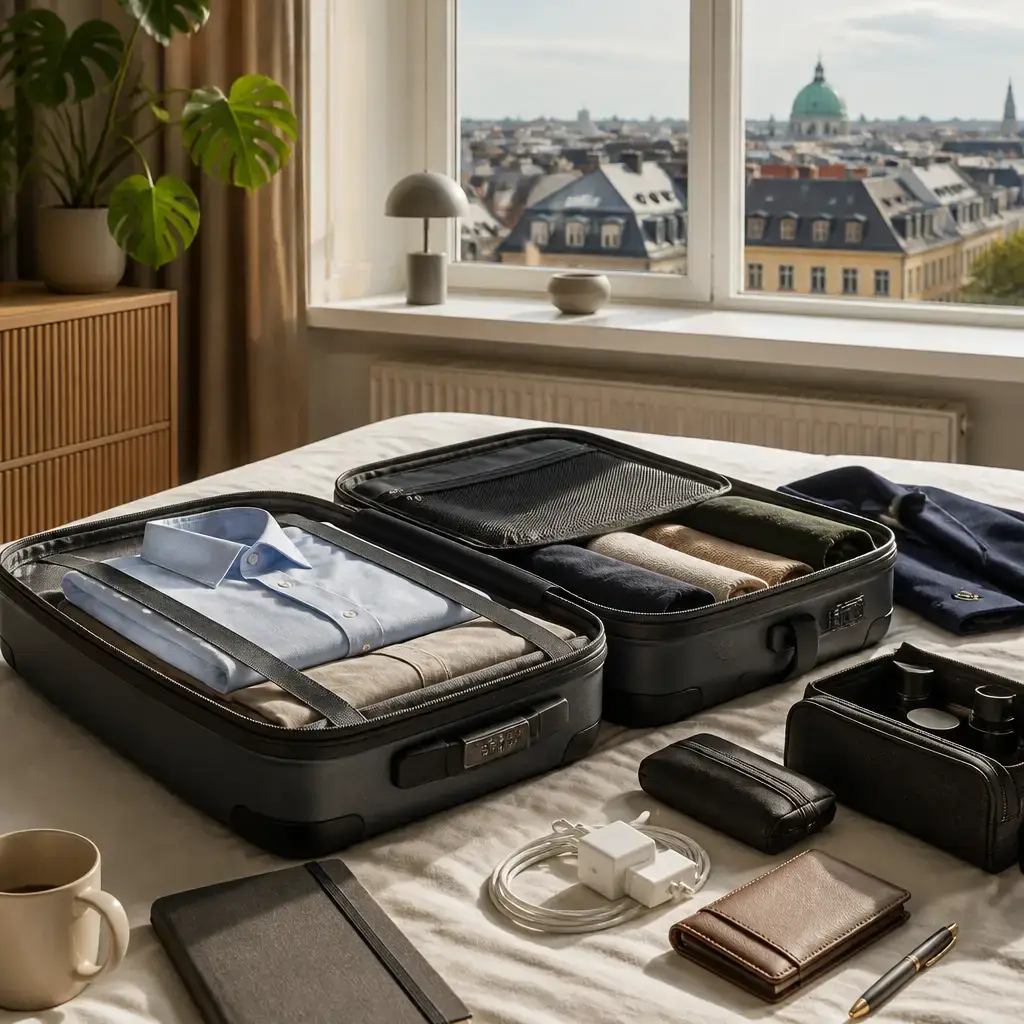
Ich möchte für die Geschäftsreise nur eine Handgepäcktasche mitnehmen.
ikh MURKH-tuh fyr dee guh-SHEFTS-ry-zuh noor EYE-nuh HAHNT-guh-PEKT-tah-shuh MIT-nay-muhn. I want to take only a carry-on bag for the business trip.Dann plane rund um das Outfit für das Meeting und beschränke die Extras auf ein Minimum.
dahn PLAH-nuh roont oom dahs OWT-fit fyr dahs MEE-ting oont buh-SHREN-kuh dee EK-stras owf eye-n MEE-nee-moom. Then plan around the meeting outfit and keep extras to a minimum.Ich habe ein Meeting und ein ungezwungenes Abendessen im Reiseplan.
ikh HAH-buh eye-n MEE-ting oont eye-n oon-guh-TSVANG-uh-nes AH-bunt-es-en im RY-zuh-plahn. I have one meeting and one casual dinner on the itinerary.Pack Sachen ein, die für beides passen.
PAHK ZAH-khen eye-n, dee fyr BY-dus PAHS-en. Pack pieces that can work for both.Sonst ist die Tasche schnell voll.
zonst ist dee TAH-shuh shnell FOL. Or the bag will fill up fast.Ich mache mir Sorgen, dass mein Hemd vor dem Meeting zerknittert.
ikh MAKH-uh meer ZOR-gen, dahs myne HEMT fohr dahs MEE-ting tser-KNIT-ert. I'm worried my shirt will wrinkle before the meeting.Roll es vorsichtig zusammen und pack es aus, sobald du im Hotel ankommst.
ROHL es FOR-zikh-tikh tsoo-ZAH-men oont PAHK es OWS, zoh-BAHL doo im hoh-TELL AHN-komst. Roll it carefully, then unpack it as soon as you reach the hotel.Soll ich Ladegeräte und Dokumente in die Vordertasche legen?
zohl ikh LAH-duh-guh-RAY-tuh oont doh-koo-MEN-tuh in dee FOR-der-TAH-shuh LAY-gen? Should chargers and documents go in the front pocket?Bewahre dort Dinge auf, die du schnell zur Hand haben musst, zusammen mit einer zusätzlichen Kopie der Tagesordnung.
buh-VAH-ruh dort DING-uh owf, dee doo shnell tsoor HAHNT HAH-ben moost, tsoo-ZET-slikh-en mit EYE-ner koh-PEE der TAH-guhs-ORD-noong. Keep quick-access items there, along with a backup copy of the agenda.Dann muss ich am Flughafen nicht die ganze Tasche öffnen.
dahn moos ikh ahm FLOO-khah-fen nikht dee GAHN-tsuh TAH-shuh URFF-nen. Then I won't have to open the whole bag at the airport.Die Sicherheitskontrolle wird einfacher, wenn diese Dinge griffbereit sind.
dee ZIKH-er-hyts-kon-TROH-luh veert EYEHN-fah-kher, ven DEE-zuh DING-uh GRIF-buh-RYTE zint. Security will be easier when those things are close at hand.Sentence explanations
Ich möchte für die Geschäftsreise nur eine Handgepäcktasche mitnehmen.
I want to take only a carry-on bag for the business trip.
- Ich möchte
- I want to
- für
- for
- Geschäftsreise
- business trip
- nur
- only
- Handgepäcktasche
- carry-on bag
- mitnehmen
- take along
More detail
Ich möchte means “I want to” here. möchte is the commonly used desire form related to mögen; with ich, the form is möchte. It is followed by an infinitive when stating what one wants to do. Example: Ich möchte bleiben. — “I want to stay.” für introduces what something is intended for or connected with. In this sentence it introduces the purpose or occasion: the business trip. für normally takes the accusative case. Example: Das ist für morgen. — “That is for tomorrow.” Geschäftsreise means “business trip.” It is a feminine compound noun: die Geschäftsreise. After für, the feminine article would be accusative die, as in the full phrase für die Geschäftsreise. The compound combines Geschäft (“business”) and Reise (“trip/journey”), but its meaning is learned as the established noun “business trip.” nur means “only” and limits the item being taken: the speaker intends to take no more than the specified carry-on bag. Its exact scope comes from its position next to the relevant noun phrase. Example: Ich nehme nur einen Rucksack mit. — “I am taking only one backpack.” Handgepäcktasche means “carry-on bag.” It is a feminine compound noun: die Handgepäcktasche; in the sentence, eine Handgepäcktasche is the accusative object of mitnehmen. The noun combines Handgepäck (“carry-on luggage”) and Tasche (“bag”). mitnehmen means “to take along” or “to bring with oneself.” It is a separable verb: in a finite main clause, mit moves to the end, as in Ich nehme eine Tasche mit. — “I am taking a bag along.” After the modal-like form möchte, the infinitive remains together at the end: Ich möchte eine Tasche mitnehmen. Together, Ich möchte ... mitnehmen expresses the speaker’s wish to take something along. für die Geschäftsreise identifies the occasion, nur restricts the choice, and eine Handgepäcktasche names the sole item. The complete meaning is: “I want to take only a carry-on bag for the business trip.”
Dann plane rund um das Outfit für das Meeting und beschränke die Extras auf ein Minimum.
Then plan around the meeting outfit and keep extras to a minimum.
- plane
- plan
- rund um
- around
- Outfit
- outfit
- Meeting
- meeting
- beschränke
- limit
- Extras
- extras
- Minimum
- minimum
More detail
plane is the imperative singular of planen (“to plan”). It addresses one person and gives a direct instruction. The present-tense form for “I plan” is ich plane, while the imperative is plane!; the final -e is part of this imperative form. rund um means “around” in the sense of organizing or choosing things in relation to something. It is a fixed prepositional expression and is followed here by das Outfit: rund um das Outfit = “around the outfit.” Example: Wir planen rund um den Termin. — “We plan around the appointment.” Outfit is a neuter noun: das Outfit. Here it means the set of clothes being planned. Its plural is Outfits. In das Outfit für das Meeting, für das Meeting specifies which occasion the outfit is for; für takes the accusative case, and the neuter form remains das. Meeting is a neuter borrowed noun: das Meeting. Its plural is Meetings. In this sentence, für das Meeting means “for the meeting,” identifying the occasion associated with the outfit. beschränke is the imperative singular of beschränken (“to limit” or “to restrict”). It addresses one person, just as plane does. The ordinary present-tense form is ich beschränke; the imperative is beschränke!. Example: Beschränke die Auswahl auf drei Optionen. — “Limit the selection to three options.” Extras is the plural of das Extra, meaning additional items or additions. The plural article is die: die Extras. Here it refers generally to extra things beyond what is necessary; the sentence does not specify particular items. Minimum is a neuter noun: das Minimum, “the minimum.” In auf ein Minimum, the preposition auf expresses the target level or limit, and the neuter indefinite article is ein in the accusative. The phrase auf ein Minimum beschränken is a reusable pattern meaning “limit something to a minimum.” Example: Wir halten den Aufwand auf ein Minimum. — “We keep the effort to a minimum.” Together, plane rund um das Outfit für das Meeting means “plan around the outfit for the meeting,” and beschränke die Extras auf ein Minimum means “limit the extras to a minimum.” The two imperative clauses form direct instructions: plan the meeting outfit as the organizing focus, and keep additional items very limited. The whole utterance is therefore: “Then plan around the meeting outfit and keep extras to a minimum.”
Ich habe ein Meeting und ein ungezwungenes Abendessen im Reiseplan.
I have one meeting and one casual dinner on the itinerary.
- Ich habe
- I have
- Meeting
- meeting
- ungezwungenes
- casual; informal
- Abendessen
- dinner; evening meal
- Reiseplan
- itinerary; travel plan
More detail
Ich habe is the first-person singular present form of haben: ich habe = “I have.” In this sentence, it introduces the activities included in the speaker’s itinerary. Example: Ich habe morgen ein Meeting. — “I have a meeting tomorrow.” Meeting is a neuter loanword in German: das Meeting. After haben, it appears as the direct object; for this noun, nominative and accusative have the same visible form. The fixed translation specifies one meeting, but the article ein itself should not be treated as a numerical word in every context. ungezwungenes means “casual” or “informal” here. Its base form is the adjective ungezwungen. The ending -es belongs to this adjective: ein ungezwungenes Abendessen uses the neuter form because Abendessen is neuter (das Abendessen) and the phrase is a direct object after haben. Example: ein ungezwungenes Gespräch — “a casual conversation.” Abendessen means “dinner” or “evening meal.” It is a neuter noun: das Abendessen. The adjective and noun stay together as ein ungezwungenes Abendessen, meaning “one casual dinner” in the supplied translation. Reiseplan means “itinerary” or “travel plan.” It is a masculine noun: der Reiseplan. The form im Reiseplan contains im, a contraction of in dem; with this location expression, the noun is in the dative. Example: Der Termin steht im Reiseplan. — “The appointment is in the itinerary.” Together, Ich habe introduces two items, joined by und: ein Meeting and ein ungezwungenes Abendessen. im Reiseplan locates both items in the itinerary. Thus the whole utterance means: “I have one meeting and one casual dinner on the itinerary.”
Pack Sachen ein, die für beides passen.
Pack pieces that can work for both.
- Pack … ein
- pack ... up
- Sachen
- things
- für beides
- for both
- passen
- fit / work
More detail
Pack … ein is the separable verb einpacken, “to pack.” Here Pack is the informal singular imperative addressed to one person: the subject du is understood, and the prefix ein appears at the end. In a normal statement, the parts come together again: Du packst die Sachen ein. — “You pack the things.” Sachen means “things” or, in this context, “items.” It is the plural of die Sache; the plural form is useful when referring to several packed items. Example: Ich brauche noch ein paar Sachen. — “I still need a few things.” für beides means “for both.” für takes the accusative, and beides is the neuter pronoun meaning “both” when the two relevant options or situations are treated together. In this context, it refers to the meeting and the casual dinner mentioned in the preceding sentence. It does not itself specify a numerical quantity of items. passen means “to fit” or “to be suitable/work.” Here it is the present-tense form in the relative clause die für beides passen. Its subject is die, referring back to the plural Sachen, so passen is plural. Example: Diese Schuhe passen für beide Anlässe. — “These shoes work for both occasions.” The relative pronoun die links the items to the description “that work for both”: Sachen, die … passen means “things that … work.” Together, Pack Sachen ein, die für beides passen. means “Pack things that can work for both.” The sentence is an informal singular instruction to choose items usable for both situations, which also helps avoid filling the bag too quickly.
Sonst ist die Tasche schnell voll.
Or the bag will fill up fast.
- Sonst
- otherwise
- ist
- is
- Tasche
- bag
- schnell
- quickly; fast
- voll
- full
More detail
Sonst means “otherwise” or “or else.” It introduces the consequence of not following the preceding condition or instruction. Example: Sonst ist die Tür zu. — “Otherwise, the door is closed.” ist is the present-tense form of sein (“to be”) for er, sie, and es, and also for a singular noun such as die Tasche. Here it links the subject to its condition: die Tasche ist voll — “the bag is full.” German present tense can also describe a situation expected soon, so the fixed translation naturally presents this as “the bag will fill up fast.” die Tasche means “the bag.” Tasche is a feminine noun; die marks nominative singular here because the bag is the subject. Its plural is die Taschen. Example: Die Tasche ist schwer. — “The bag is heavy.” schnell means “fast” or “quickly.” In this sentence it indicates that the bag reaches the full state in a short time. It can also describe fast movement: Der Zug fährt schnell. — “The train travels fast.” voll means “full.” It is a descriptive adjective used after ist, so it remains in its basic form rather than taking an adjective ending. The useful contrast is leer (“empty”): Die Tasche ist leer. — “The bag is empty.” Together, Sonst sets up the consequence, die Tasche is the subject, and ist ... voll describes the bag’s full state. schnell adds that this state is reached quickly: “Otherwise, the bag will fill up fast.”
Ich mache mir Sorgen, dass mein Hemd vor dem Meeting zerknittert.
I'm worried my shirt will wrinkle before the meeting.
- mache mir Sorgen
- am worried
- Hemd
- shirt
- vor
- before
- Meeting
- meeting
- zerknittert
- will wrinkle
More detail
mache mir Sorgen expresses being worried. The reusable German pattern is sich Sorgen machen: machen is the verb, and the person is shown by a reflexive pronoun in the dative, here mir for “to me.” For example: Ich mache mir Sorgen. — “I am worried.” Other persons use forms such as du machst dir Sorgen and sie macht sich Sorgen. Hemd means “shirt.” Its base form is the noun das Hemd, a neuter noun. In the sentence, mein agrees with this noun in the nominative singular: mein Hemd — “my shirt.” For example: Mein Hemd ist sauber. — “My shirt is clean.” vor means “before” here because it introduces a time. With a definite article, the temporal phrase is vor dem Meeting; dem is the dative form of the neuter article das after vor in this time expression. For example: Ich komme vor dem Essen. — “I’ll come before the meal.” Meeting is a noun meaning “meeting.” The observed form is das Meeting, a neuter loanword; after vor here, it appears as dem Meeting. For example: Das Meeting beginnt um neun. — “The meeting begins at nine.” zerknittert is the third-person singular present form of the verb zerknittern, meaning “to wrinkle” or “to become creased.” The subject is mein Hemd, so the verb has the singular form zerknittert. In a dass clause, the finite verb comes at the end: ..., dass mein Hemd zerknittert. The present form can describe a future result when the surrounding meaning concerns what will happen before a future point; it is therefore rendered as “will wrinkle” in the fixed translation. For example: Das Papier zerknittert schnell. — “The paper wrinkles quickly.” Together, Ich mache mir Sorgen gives “I am worried,” and the dass clause states the content of the worry: mein Hemd vor dem Meeting zerknittert — “my shirt will wrinkle before the meeting.” The complete utterance means: “I’m worried my shirt will wrinkle before the meeting.”
Roll es vorsichtig zusammen und pack es aus, sobald du im Hotel ankommst.
Roll it carefully, then unpack it as soon as you reach the hotel.
- Roll … zusammen
- roll up
- es
- it
- vorsichtig
- carefully
- pack … aus
- unpack
- sobald
- as soon as
- du
- you
- Hotel
- hotel
- ankommst
- arrive
More detail
Roll ... zusammen is the informal singular imperative of zusammenrollen, “to roll up.” The separable prefix zusammen- appears at the end of the clause: Roll es zusammen. Example: Roll den Schlafsack zusammen. — “Roll up the sleeping bag.” es is the accusative singular pronoun “it.” Here it refers to an item understood from the situation, but the supplied sentence does not identify that item more specifically. The pronoun itself is neuter singular; its grammatical form does not identify the referent. vorsichtig is an adverb meaning “carefully.” It describes how the rolling is to be done. The related adjective is vorsichtig as well: Sei vorsichtig. — “Be careful.” pack ... aus is the informal singular imperative of the separable verb auspacken, “to unpack.” As with zusammenrollen, the prefix aus- moves to the end of the clause: Pack es aus. — “Unpack it.” sobald introduces a time clause meaning “as soon as.” It connects an action with the earliest point when another action happens: Ruf mich an, sobald du ankommst. — “Call me as soon as you arrive.” du is the informal singular subject pronoun “you.” It is the subject of ankommst, not of the preceding imperative clauses, whose subject is understood as “you.” Hotel is the noun “hotel.” In im Hotel, im is the contraction of in dem, meaning “in the hotel.” German nouns are capitalized, so Hotel keeps its capital letter. ankommst is the second-person singular present form of the separable verb ankommen, “to arrive.” The base form is ankommen; with du, the form is du kommst an in an independent clause, but in the subordinate clause introduced by sobald, the verb appears at the end: sobald du im Hotel ankommst. Together, Roll es vorsichtig zusammen gives the first instruction, “Roll it up carefully.” und pack es aus adds the next instruction, “and unpack it.” The time clause sobald du im Hotel ankommst specifies when to unpack it: “as soon as you arrive at the hotel.” The complete meaning is: “Roll it carefully, then unpack it as soon as you reach the hotel.”
Soll ich Ladegeräte und Dokumente in die Vordertasche legen?
Should chargers and documents go in the front pocket?
- Soll ich
- Should I …?
- Ladegeräte
- chargers
- Dokumente
- documents
- Vordertasche
- front pocket
- legen
- put
More detail
Soll ich combines the present-tense form soll of sollen with the subject pronoun ich. In this question, it asks whether the speaker should perform the action: “Should I …?” The verb sollen can also express an instruction or obligation in other contexts, but here the fixed translation supports a question about what the speaker is expected or asked to do. Compare Sollst du …? = “Are you supposed to …?” Ladegeräte means “chargers” here. Its singular base form is das Ladegerät; the plural is die Ladegeräte, with the umlaut and plural ending visible in the observed form. Example: Ich brauche zwei Ladegeräte. — “I need two chargers.” Dokumente means “documents.” Its singular form is das Dokument, and Dokumente is the plural. The two noun phrases Ladegeräte und Dokumente are coordinated, so both are included as things affected by the same action. Example: Die Dokumente sind in der Tasche. — “The documents are in the bag.” Vordertasche is a compound noun meaning “front pocket,” formed from Vorder- (“front”) and Tasche (“pocket/bag”). In in die Vordertasche, the definite article die marks the feminine noun phrase in the accusative. German uses in with the accusative for movement into a place. With a stationary location, German uses the dative instead: in der Vordertasche = “in the front pocket.” legen is the infinitive meaning “to put” or “to lay” something down. Its base form is also legen; with sollen, the lexical verb stays in the infinitive and appears at the end of this question. legen presents a placement action, often contrasted with liegen, which describes something already being in a lying position: Ich lege das Dokument in die Tasche. — “I put the document in the bag.” Together, Soll ich ... legen? forms a reusable yes-or-no question asking whether the speaker should put something somewhere. The coordinated objects are Ladegeräte und Dokumente, and in die Vordertasche specifies the destination. Thus the complete utterance means: “Should I put the chargers and documents in the front pocket?”
Bewahre dort Dinge auf, die du schnell zur Hand haben musst, zusammen mit einer zusätzlichen Kopie der Tagesordnung.
Keep quick-access items there, along with a backup copy of the agenda.
- Bewahre … auf
- keep/store
- dort
- there
- Dinge
- things/items
- schnell
- quickly
- zur Hand haben
- have readily available
- musst
- must/have to
- zusammen mit
- together with
- zusätzlichen
- additional/extra
- Kopie
- copy
- Tagesordnung
- agenda
More detail
Bewahre ... auf is the singular informal imperative of the separable verb aufbewahren (“to store” or “to keep”). In this command, bewahre appears at the beginning and auf is placed at the end. Example: Bewahre den Schlüssel hier auf. — “Keep the key here.” dort means “there” and points to a location already understood from the situation. It does not itself identify what that location is. Dinge is the plural of das Ding (“thing”); in this context, “items” is the most natural meaning. Example: Die Dinge liegen dort. — “The items are there.” The following relative clause describes which items are meant: die is a plural relative pronoun referring to Dinge and functions as the object of haben in that clause. schnell normally means “quickly.” Here it contributes the idea of quick access: these are items that need to be readily available. zur Hand haben is a reusable expression meaning “to have readily available” or “to have at hand.” zur is the contraction of zu der, but the expression is best learned as a whole. Example: Ich möchte mein Handy zur Hand haben. — “I want to have my phone readily available.” musst is the second-person singular present form of müssen (“must” or “have to”). It expresses necessity for du; the infinitive haben remains at the end of the relative clause. Example: Du musst den Ausweis dabeihaben. — “You have to have your ID with you.” zusammen mit means “together with” or “along with.” The preposition mit governs the dative, which is why the accompanying noun phrase has the form einer zusätzlichen Kopie. zusätzlichen is the inflected form of the adjective zusätzlich (“additional” or “extra”). It describes Kopie and has the dative feminine ending -en after einer. The adjective itself, not the noun, carries this inflection. Kopie is the feminine noun die Kopie, meaning “copy”; its plural is Kopien. In this utterance, the additional copy is the extra stored item. Example: Ich brauche eine Kopie. — “I need a copy.” Tagesordnung is the feminine noun die Tagesordnung, meaning “agenda.” In eine Kopie der Tagesordnung, der Tagesordnung expresses what is being copied: “of the agenda.” The form der here is feminine genitive singular. Taken together, the command says to store there the items that must be readily available, along with an extra copy of the agenda. The separable verb supplies the main instruction, the relative clause identifies the relevant items, and zusammen mit adds the accompanying copy.
Dann muss ich am Flughafen nicht die ganze Tasche öffnen.
Then I won't have to open the whole bag at the airport.
- Dann
- then
- muss ich
- I must
- am Flughafen
- at the airport
- nicht
- not
- ganze
- whole
- Tasche
- bag
- öffnen
- open
More detail
Dann means “then” here and places this result after the situation already mentioned. It can also introduce a consequence: Dann gehe ich nach Hause. — “Then I’ll go home.” muss ich uses müssen (“must, have to”) in the first-person singular present form muss; ich is the subject. German modal verbs such as müssen normally send the other verb to the end of the clause: Ich muss warten. — “I have to wait.” am Flughafen means “at the airport.” am is the contraction of an dem; Flughafen is a masculine noun. The same location pattern appears in am Bahnhof — “at the train station.” nicht negates the obligation expressed by muss ich in this sentence. Thus ich muss ... nicht means “I do not have to ...,” not “I must not ...”. The latter meaning is normally expressed with ich darf ... nicht, for example: Ich darf hier nicht parken. — “I must not park here.” ganze is the inflected form of the adjective ganz, “whole” or “entire.” In die ganze Tasche, it describes the feminine accusative singular noun Tasche; the ending reflects the noun phrase’s grammatical form. Compare die ganze Tasche — “the whole bag” and die ganzen Taschen — “the whole bags” or “all the bags,” where the adjective changes for plural. Tasche means “bag” here. It is a feminine noun, and the form is unchanged between nominative and accusative singular: die Tasche can be “the bag” as subject or object. For example, Ich nehme die Tasche. — “I take the bag.” öffnen means “to open.” This is the infinitive, used after the modal verb muss; it therefore stays at the end rather than taking a first-person ending. Ich öffne die Tür. — “I open the door.” Together, Dann marks the resulting time or consequence, muss ich ... nicht expresses that the speaker will not be required to do something, am Flughafen specifies the place, and die ganze Tasche öffnen means “open the whole bag.” The complete utterance is: “Then I won't have to open the whole bag at the airport.”
Die Sicherheitskontrolle wird einfacher, wenn diese Dinge griffbereit sind.
Security will be easier when those things are close at hand.
- Sicherheitskontrolle
- security check
- wird
- becomes
- einfacher
- easier
- diese
- these
- Dinge
- things
- griffbereit
- close at hand
More detail
Sicherheitskontrolle means “security check” here. It is a feminine compound noun: die Sicherheitskontrolle. German compounds are written as one word, and the final element, Kontrolle, determines the grammatical gender. Example: Die Sicherheitskontrolle dauert lange. — “The security check takes a long time.” wird is the third-person singular present form of werden, “to become.” Here werden links the subject to the adjective einfacher: etwas wird einfacher means “something becomes easier.” This is not the future construction wird ... machen; with an adjective complement, it describes a change of state. Example: Der Weg wird kürzer. — “The route becomes shorter.” einfacher is the comparative form of the adjective einfach, “easy” or “simple.” Its base/comparative/superlative chain is einfach — einfacher — am einfachsten (“easy” — “easier” — “easiest”). In this sentence it describes the security check as becoming easier, without explicitly naming a comparison target. diese is a plural demonstrative meaning “these” in its form and, in this translation, referring to the things described as “those things.” It agrees with plural Dinge; the plural form is also used for both masculine/feminine/neuter plural nouns. The demonstrative appears in the noun phrase diese Dinge, rather than standing alone here. Example: Diese Bücher sind neu. — “These books are new.” Dinge is the plural of the noun Ding, “thing.” The plural ending is -e: das Ding — die Dinge. In diese Dinge, it is the subject of the subordinate clause, so the verb later appears in the plural form sind. griffbereit describes something that is ready to be reached or readily available, so griffbereit sein means “to be close at hand.” It is built on der Griff, “grip” or “reach,” but griffbereit should be learned as a useful adjective meaning ready to hand. Example: Die Unterlagen liegen griffbereit. — “The documents are close at hand.” The main clause is Die Sicherheitskontrolle wird einfacher: “The security check becomes easier.” The subordinate clause begins with wenn, “when” or “if,” and contains diese Dinge ... griffbereit sind: “those things are close at hand.” In this subordinate clause, sind is the plural present form of sein, and the finite verb comes at the end. Together, the sentence means: “Security will be easier when those things are close at hand.”
Grammar Points
Trennbare Verben im Hauptsatz: Präfix am Satzende
Bewahre die Dokumente in der Vordertasche auf.
buh-VAH-ruh dee doh-koo-MEN-tuh in dair FOR-der-TAH-shuh owf.Keep the documents in the front pocket.
Bei trennbaren Verben steht der Präfix im Hauptsatz am Ende: aufbewahren → Bewahre ... auf.
sich Sorgen machen + Dativpronomen
Ich mache mir Sorgen.
ikh MAKH-uh meer ZOR-gen.I am worried.
Die feste Wendung verwendet ein Reflexivpronomen im Dativ: ich mache mir Sorgen.
German Vocabulary
Quiz
Word Order
Arrange the words in the correct order.
Or the bag will fill up fast.
Show Answer
Sonst ist die Tasche schnell voll.Spelling
Tap the letters to spell the word.
to limit
Show Answer
beschränkedinner
Show Answer
Abendessento plan
Show Answer
planeoutfit