10 minutes free every day
Continue audio lessons in the app
Word explanations appear automatically in sync with the audio.
No login required · synced translations · playback with the screen locked
Choose your learning language and open this lesson in the app.

About This Lesson
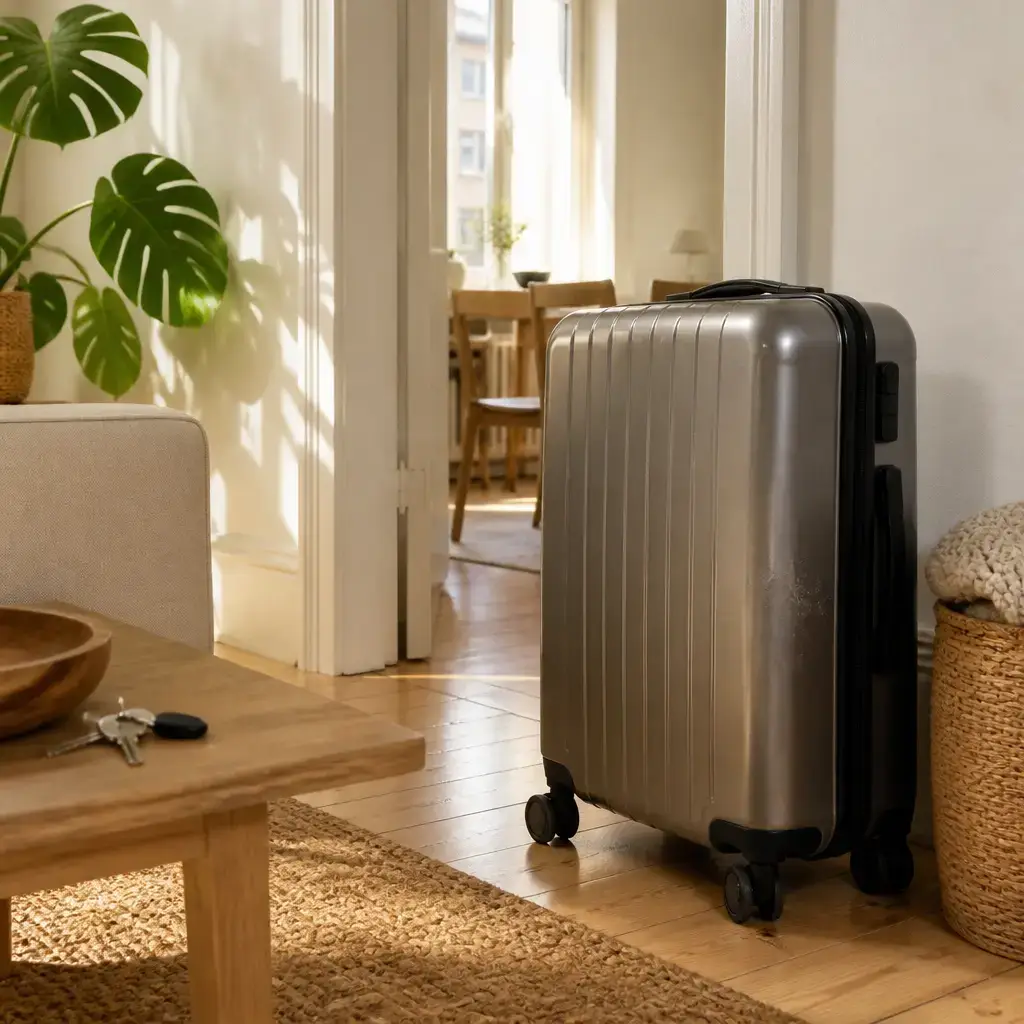
Use Borrowing a suitcase and agreeing on its care to practice German conversation, pronunciation, vocabulary, grammar, and quizzes.
Dialogue
Könnte ich deinen mittelgroßen Koffer für meine Reise nächste Woche ausleihen?
KURN-tuh ikh DYE-nen MIT-tul-GROH-sen KOFF-er fewr MY-nuh RY-zuh NEK-stuh VOH-khuh OWS-lye-en Could I borrow your medium suitcase for my trip next week?Das kannst du, aber sei vorsichtig mit dem Griff, weil er etwas empfindlich ist.
DAHS kahnst doo, AH-ber zye FOHR-zikh-tikh mit dehm GRIFF, vyle air ET-vahs em-PFINT-likh ist You can, but be careful with the handle because it's a little fragile.Ich werde das im Hinterkopf behalten und ihn nicht zu voll packen.
ikh VAIR-duh dahs im HIN-ter-kopf beh-HAHL-ten oont een nikht tsoo FOLL PAHK-en I'll keep that in mind and avoid overpacking it.Außerdem ist an der Seite ein Kratzer.
OW-ser-daym ist ahn dair ZYE-tuh ayn KRAHT-ser It also has a scratch on the side.Möchtest du, dass ich vor der Benutzung ein Foto mache?
MURKH-test doo, dahss ikh fohr dair beh-NOOT-tsoong ayn FOH-toh MAH-khuh Would you like me to take a photo before I use it?Ein Foto würde den Zustand für uns beide deutlich machen.
ayn FOH-toh VUR-duh dehn TSOO-shtahnt fewr oons BY-duh DOYT-likh MAH-khen A photo would make the condition clear for both of us.Ich bringe ihn am Tag nach meiner Rückkehr zurück.
ikh BRING-uh een ahm tahk nahkh MY-nuh REWK-kair tsoo-REWK I'll return it the day after I get back.Bitte wisch die Rollen ab, bevor du ihn ins Haus bringst.
BIT-tuh vish dee ROHL-en ahp, beh-FOHR doo een ins HOWS bringst Please wipe the wheels before bringing it inside.Das mache ich draußen, bevor ich ihn zurückbringe.
DAHS MAH-khuh ikh DROW-sen, beh-FOHR ikh een tsoo-REWK-bring-uh I'll do that outside before I bring it back.Sag mir Bescheid, wenn der Griff dir während der Reise Probleme macht.
ZAHK meer beh-SHYT, venn dair GRIFF deer VAIR-ent dair RY-zuh proh-BLAY-muh mahkht Let me know if the handle gives you trouble during the trip.Sentence explanations
Könnte ich deinen mittelgroßen Koffer für meine Reise nächste Woche ausleihen?
Could I borrow your medium suitcase for my trip next week?
- Könnte ich
- Could I…?
- deinen
- your
- mittelgroßen
- medium-sized
- Koffer
- suitcase
- für
- for
- meine
- my
- Reise
- trip
- nächste
- next
- Woche
- week
- ausleihen
- borrow
More detail
Könnte ich combines the verb können (“can; be able to”) in the Konjunktiv II form könnte with the subject ich (“I”). At the beginning of a yes/no question, the finite verb comes first. Here könnte makes a polite request—“Could I…?”—rather than simply describing past ability. The infinitive belonging to it appears at the end: Könnte ich ... ausleihen? deinen means “your” here and belongs to the masculine singular noun Koffer. Its form shows masculine singular accusative: dein becomes deinen before a masculine accusative noun. The possessive determiner agrees with the thing possessed in this phrase, not with the person who owns it. Compare the useful pattern dein Koffer (nominative) and deinen Koffer (accusative). mittelgroßen describes the suitcase as medium-sized. Its base form is the adjective mittelgroß. In deinen mittelgroßen Koffer, the adjective has the ending -en because it modifies a masculine singular accusative noun after the possessive determiner deinen. Example: Ich kaufe einen mittelgroßen Koffer. — “I am buying a medium-sized suitcase.” Koffer is the noun “suitcase.” It is masculine in the singular: der Koffer; its plural is also Koffer, as in zwei Koffer (“two suitcases”). In this sentence, Koffer is the accusative object of ausleihen, the thing being borrowed. für means “for” and is followed by the accusative. Thus für meine Reise means “for my trip.” This fixed preposition is useful as the pattern für + accusative, for example Das Geschenk ist für meinen Bruder. — “The gift is for my brother.” meine means “my” and modifies the feminine noun Reise. In this phrase it has the same visible form in nominative and accusative feminine singular: meine Reise. The corresponding masculine accusative form would be meinen, as in für meinen Bruder. Reise means “trip” or “journey.” It is feminine: die Reise. Its plural is Reisen. Here it names the trip for which the suitcase is needed; the phrase does not specify how the trip will take place. nächste means “next” here. Its base adjective is nah (“near”), but nächste is the established superlative form used for the next item in an order or sequence. In the time expression nächste Woche, it has the feminine singular ending -e. Example: Wir treffen uns nächste Woche. — “We’ll meet next week.” Woche means “week.” It is feminine: die Woche; its plural is Wochen. nächste Woche is a time expression meaning “next week.” ausleihen means “borrow” in this sentence: the subject ich receives the suitcase temporarily from someone else. It is an infinitive, so it remains at the end after the modal verb könnte. The related verb leihen can also mean “lend” or “borrow” depending on the construction, while ausleihen here clearly presents the speaker as the borrower. Example: Ich möchte ein Buch ausleihen. — “I would like to borrow a book.” Together, Könnte ich ... ausleihen? forms a polite yes/no request. The object is deinen mittelgroßen Koffer; für meine Reise gives the purpose, and nächste Woche gives the time. The complete meaning is: “Could I borrow your medium-sized suitcase for my trip next week?”
Das kannst du, aber sei vorsichtig mit dem Griff, weil er etwas empfindlich ist.
You can, but be careful with the handle because it's a little fragile.
- Das
- that
- kannst
- can
- du
- you
- aber
- but
- sei vorsichtig
- be careful
- mit dem Griff
- with the handle
- weil
- because
- er
- it (the handle)
- etwas
- a little
- empfindlich
- fragile
More detail
Das means “that” here and, together with kannst du, points to the action being discussed: “You can do that.” As a demonstrative pronoun, it is separate from the personal pronoun du; it is not the handle. kannst is the second-person singular present form of können (“can, be able to”): ich kann, du kannst, er/sie/es kann. With du, the verb takes the form kannst. Das kannst du is a reusable pattern meaning “You can do that.” du is the informal singular “you” and is the subject of kannst. aber means “but” and contrasts the permission or ability with the warning that follows. sei vorsichtig is a singular informal imperative meaning “be careful.” sei is the imperative of sein (“to be”); vorsichtig is the adjective “careful.” For example, Sei vorsichtig mit dem Glas. means “Be careful with the glass.” mit dem Griff means “with the handle.” mit takes the dative case, so masculine der Griff becomes dem Griff after mit. The noun Griff means “handle” here; its plural is Griffe. weil introduces the reason for the warning and sends the finite verb to the end of its clause. A useful pattern is ..., weil ... ist (“..., because ... is”). er is the masculine singular pronoun “it/he”; here the fixed translation identifies it as referring to the handle, der Griff. Its masculine form matches the grammatical gender of that noun, not the physical nature of the object. etwas means “a little” or “somewhat” here. Before an adjective, it softens the description: etwas empfindlich means “a little delicate,” rather than asserting an exact amount. empfindlich means “sensitive” or “delicate”; in this sentence, “fragile” conveys the intended meaning. It is related to empfinden in other contexts, but here it describes the handle’s susceptibility to damage. For example, Dieses Material ist empfindlich. means “This material is delicate.” Together, Das kannst du says that the discussed action is possible, aber sei vorsichtig mit dem Griff adds a warning about how to do it, and weil er etwas empfindlich ist gives the reason: “You can, but be careful with the handle because it’s a little fragile.”
Ich werde das im Hinterkopf behalten und ihn nicht zu voll packen.
I'll keep that in mind and avoid overpacking it.
- Ich werde
- I will
- das
- that
- im Hinterkopf behalten
- keep in mind
- ihn
- it
- voll
- full
- packen
- pack
More detail
Ich werde uses werden with first-person singular ich: ich werde means “I will.” The form werde is the present-tense form of werden used here as a future auxiliary; the following infinitive tells us what will happen. Example: Ich werde morgen kommen. — “I will come tomorrow.” das is a neuter singular demonstrative pronoun in the accusative case, meaning “that” here. It points to the matter already identified in the conversation. German demonstratives change form according to grammatical gender, number, and case; the neuter accusative form is das. im Hinterkopf behalten is a reusable idiomatic construction meaning “keep in mind” or “bear in mind.” im is the contraction of in dem, and behalten is the infinitive of “keep/retain.” The literal image is keeping something “in the back of one’s head,” but the intended meaning here is remembering the information for later consideration. Example: Behalte das bitte im Hinterkopf. — “Please keep that in mind.” ihn is the accusative singular form of the masculine pronoun meaning “him” or, for a masculine grammatical noun, “it.” In this sentence, the fixed translation identifies its intended meaning as “it.” The form itself marks the direct object of packen; it does not identify the object by proximity alone. Example: Ich sehe den Koffer und öffne ihn. — “I see the suitcase and open it.” voll means “full.” In zu voll, it is an adjective used after zu to mean “too full.” This is different from sehr voll, “very full”: zu expresses that a limit would be exceeded, while sehr only expresses a high degree. Example: Die Tasche ist zu voll. — “The bag is too full.” packen is the infinitive meaning “pack” or “put things into” something. In ihn nicht zu voll packen, ihn is the object being packed, nicht negates the action, and zu voll describes the unwanted result: making it too full. Here zu belongs to the adjective voll, not to an infinitive construction meaning “to pack.” Together, Ich werde das im Hinterkopf behalten means “I’ll keep that in mind.” The coordinated part und ihn nicht zu voll packen adds the intention to avoid packing the identified object so full that it exceeds a suitable limit. Thus the whole utterance is: “I’ll keep that in mind and avoid overpacking it.”
Außerdem ist an der Seite ein Kratzer.
It also has a scratch on the side.
- Außerdem
- also; besides
- ist
- is
- an der Seite
- on the side
- Kratzer
- scratch
More detail
Außerdem means “also” or “besides” and adds this information to something already mentioned. It is an adverb and does not change for person, number, or gender. ist is the present-tense form of sein (“to be”) for a third-person singular subject. Here it helps describe the location of a scratch. For example: Auf dem Tisch ist ein Buch. — “There is a book on the table.” an der Seite means “on the side.” The preposition an takes the dative here because the phrase describes a stationary location, not movement toward a place. der is the dative singular form of the feminine definite article for die Seite (“the side”). With movement toward the side, German can use the accusative instead: Ich stelle es an die Seite. — “I put it on the side.” Kratzer means “scratch.” The base noun is der Kratzer, masculine; the form in the sentence is singular. Its plural is also Kratzer, with the plural article: die Kratzer (“the scratches”). Together, ist an der Seite ein Kratzer literally presents “a scratch” as being located “on the side”; German places the location before the indefinite subject in this sentence. With Außerdem, the complete meaning is “It also has a scratch on the side.”
Möchtest du, dass ich vor der Benutzung ein Foto mache?
Would you like me to take a photo before I use it?
- Möchtest du
- would you like
- dass ich
- that I
- Benutzung
- use; usage
- Foto
- photo
- mache
- make
More detail
Möchtest du is a reusable way to ask one person whether they would like something. möchtest is the second-person singular form of möchten, commonly used for a polite or gentle request; du is the informal singular “you.” Example: Möchtest du einen Kaffee? — “Would you like a coffee?” dass ich introduces a subordinate clause whose subject is ich, “I.” In German, a dass clause normally places its conjugated verb at the end. The pattern Möchtest du, dass ich ...? means “Would you like me to ...?” Example: Ich möchte, dass du wartest. — “I would like you to wait.” vor der Benutzung means “before using it” in this sentence. Benutzung is a feminine noun meaning “use” or “usage,” related to the verb benutzen, “to use”; its dictionary form is die Benutzung. Here vor expresses a time relation and takes the dative, so die becomes der: vor der Benutzung. The fixed translation identifies the intended user as “I,” although the noun phrase itself does not mark that actor. ein Foto means “a photo.” Foto is a neuter noun: das Foto. In this sentence it is the accusative object of mache, while the indefinite article remains ein for a neuter noun in the accusative. Example: Ich sehe ein Foto. — “I see a photo.” mache is the first-person singular present form of machen, “to make.” With a photo, ein Foto machen is the usual expression for “to take a photo.” In this clause mache agrees with ich and appears at the end because the clause is introduced by dass. Example: Ich mache ein Foto. — “I am taking a photo.” Together, Möchtest du asks about the other person’s preference. dass ich ... mache expresses the action the speaker would perform, vor der Benutzung sets the time, and ein Foto names what is taken. Thus the complete utterance means: “Would you like me to take a photo before I use it?”
Ein Foto würde den Zustand für uns beide deutlich machen.
A photo would make the condition clear for both of us.
- Foto
- photo
- würde
- would
- Zustand
- condition
- für uns beide
- for both of us
- deutlich
- clear
- machen
- make
More detail
Foto is the noun “photo.” Its plural is Fotos (also Fotografien in a more formal alternative). Here, Ein Foto means “a photo”; Ein is an indefinite article and does not by itself add a separate numerical claim beyond introducing one unspecified item. würde is the form of werden used with an infinitive in the würde-construction. With machen at the end, würde ... machen expresses a hypothetical result: “would make.” The infinitive remains machen, while würde carries the verb form for the subject Ein Foto. Zustand means “condition” here, in the sense of the state something is in. Its plural is Zustände. The masculine noun appears with the accusative form den Zustand after the verb construction; the article shows this form, while the noun itself has no visible case ending here. für uns beide means “for both of us.” für takes the accusative, so uns is the accusative form of first-person plural wir. beide specifies the pair consisting of the speaker and one other person, matching the fixed translation. Example: Das ist für uns beide wichtig. — “That is important for both of us.” deutlich means “clear” in this sentence and describes the result produced by machen. It can also be used as an adverb meaning “clearly,” but here it is part of the reusable combination etwas deutlich machen — “to make something clear.” machen is the base-form verb “to make” or “to do.” In this utterance it is the infinitive required after würde and combines with deutlich to mean “make clear.” Its present-tense forms include ich mache and er/sie/es macht; its simple past is machte. Together, Ein Foto würde den Zustand für uns beide deutlich machen has the pattern Ein [thing] würde [object] für [people] deutlich machen: “A photo would make the condition clear for both of us.” The photo is presented as the possible means, den Zustand is what would become clear, and für uns beide identifies who would find it clear.
Ich bringe ihn am Tag nach meiner Rückkehr zurück.
I'll return it the day after I get back.
- bringe … zurück
- return / bring back
- ihn
- it
- Tag
- day
- nach
- after
- Rückkehr
- return
More detail
bringe ... zurück is the split form of zurückbringen, meaning “to bring back” or “to return.” The observed form bringe is the first-person singular present form: ich bringe ... zurück = “I bring/return ...”. Because zurückbringen is a separable verb, bringe appears in the main clause near the subject, while zurück appears at the end. Example: Ich bringe das Buch zurück. — “I’ll return the book.” ihn is the accusative masculine singular pronoun. Here the fixed translation identifies its intended meaning as “it”; German grammatical gender does not necessarily describe the object’s natural gender. The form ihn is used for a masculine singular object in the accusative role. Example: Ich sehe ihn. — “I see him/it,” depending on the established referent. Tag means “day.” In am Tag, am is the contraction of an dem; the phrase uses the dative form after an in this time expression. Tag is masculine, so der Tag becomes dem Tag after an here. Example: Am Tag danach arbeite ich. — “I work the next day.” nach means “after” here and introduces the time that follows. In this use, nach governs the dative: nach meiner Rückkehr means “after my return.” Rückkehr means “return” or “returning.” It is a feminine noun: die Rückkehr. After nach, the first-person possessive appears in the dative feminine form meiner: meine Rückkehr becomes nach meiner Rückkehr. The noun refers to the speaker’s returning, corresponding to “I get back” in the fixed translation. Example: Nach meiner Rückkehr rufe ich dich an. — “After I get back, I’ll call you.” Taken together, Ich bringe ihn ... zurück gives “I’ll return it,” with the present-tense German form expressing the intended future action. am Tag nach meiner Rückkehr specifies when: “the day after I get back.” The complete utterance therefore means: “I’ll return it the day after I get back.”
Bitte wisch die Rollen ab, bevor du ihn ins Haus bringst.
Please wipe the wheels before bringing it inside.
- Bitte
- please
- wisch … ab
- wipe off
- die Rollen
- the wheels
- bevor
- before
- du
- you
- ihn
- it
- ins
- into the
- Haus
- house
- bringst
- bring
More detail
Bitte makes the request polite: “please.” It can stand at the beginning of a request without changing the verb form. wisch ... ab comes from the separable verb abwischen, “to wipe off.” Here wisch is the informal singular imperative addressed to du; the prefix ab moves to the end of the clause. In a statement, the parts separate in the same way: Du wischst die Rollen ab. — “You wipe the wheels.” die Rollen means “the wheels” here. Rollen is the plural of die Rolle; in this context, the noun refers to wheels or rollers. The article die marks this plural noun phrase, which is the thing being wiped. bevor introduces a subordinate clause meaning “before.” In German, the finite verb normally goes to the end of a clause introduced by bevor: bevor du ihn ins Haus bringst — “before you bring it into the house.” du is the informal singular form of “you.” It is the subject of the subordinate clause and therefore determines the second-person singular form bringst at the end. ihn is the accusative form of the masculine personal pronoun, meaning “it” here. The fixed translation and surrounding context identify the referent as the item being brought inside; the pronoun itself marks that item as the object of bringst. Compare the case forms er (“he”) and ihn (“him/it” as a direct object). ins is the contraction of in das, meaning “into the” here. in expresses movement into a place in this use, and das belongs to the neuter noun Haus. The full form in das Haus is also possible, while ins Haus is the compact common form. Haus means “house.” With movement into it, ins Haus means “into the house,” not simply a location inside the house. For a location, German commonly uses im Haus (“in the house”), a contraction of in dem Haus. bringst is the second-person singular present form of bringen, “to bring.” The useful present-tense forms include ich bringe, du bringst, and er/sie/es bringt. Here it is placed at the end because it is the finite verb of the bevor subordinate clause. Together, Bitte wisch die Rollen ab means “Please wipe the wheels off.” The subordinate clause bevor du ihn ins Haus bringst adds the time condition “before you bring it into the house.” The complete utterance is therefore: “Please wipe the wheels before bringing it inside.”
Das mache ich draußen, bevor ich ihn zurückbringe.
I'll do that outside before I bring it back.
- Das
- that
- mache
- do
- ich
- I
- draußen
- outside
- bevor
- before
- ihn
- it
- zurückbringe
- bring back
More detail
Das means “that” here and functions as the object of mache. As a demonstrative pronoun, it can refer to an action or thing already understood; its form is also used for neuter nominative and accusative singular. Example: Das kaufe ich. — “I’ll buy that.” mache is the first-person singular present form of machen (“to do” or “to make”): ich mache. German present tense can describe a planned or expected future action when the time is clear. The subject ich means “I”; it is the first-person singular pronoun and is the form used with mache. draußen is an adverb meaning “outside.” It describes where the doing takes place, rather than changing form for a noun. Example: Wir essen draußen. — “We eat outside.” bevor introduces a subordinate clause meaning “before.” In a German subordinate clause introduced by bevor, the finite verb normally goes to the end. The pattern is bevor + subject + ... + finite verb. ihn is the masculine accusative form of the personal pronoun meaning “him” or, as in the fixed translation, “it.” The form marks the object of zurückbringe; it does not by itself identify the object's real-world referent. Compare er (“he,” nominative) with ihn (“him/it,” accusative). zurückbringe comes from the separable verb zurückbringen, “to bring back.” In the main clause, the parts separate: Ich bringe es zurück. In the bevor clause, the verb remains together at the end: bevor ich es zurückbringe. Here it is first-person singular present, agreeing with ich; zurück- adds the meaning “back.” Together, Das mache ich draußen means “I’ll do that outside.” bevor ich ihn zurückbringe adds the time relation “before I bring it back.” The complete utterance therefore means: “I’ll do that outside before I bring it back.”
Sag mir Bescheid, wenn der Griff dir während der Reise Probleme macht.
Let me know if the handle gives you trouble during the trip.
- Sag mir Bescheid
- let me know
- wenn
- if
- der Griff
- the handle
- dir
- to you
- während
- during
- der Reise
- the trip
- Probleme
- trouble
- macht
- causes
More detail
Sag mir Bescheid is the reusable German construction for “let me know.” Sag is the informal singular imperative of sagen (“to say/tell”); the subject du is understood and normally omitted in this imperative. mir is the first-person singular dative pronoun, marking the person who should receive the information. The construction jemandem Bescheid sagen means to inform someone, rather than simply to say something. Example: Sag mir Bescheid, wenn du ankommst. — “Let me know when you arrive.” wenn introduces the condition “if.” In the subordinate clause it sends the finite verb to the end: wenn ... Probleme macht. It can also mean “when” when the clause refers to a time rather than a condition; here the fixed translation supports the conditional “if.” der Griff means “the handle” here. Griff is a masculine noun, so its nominative singular definite article is der when it is the subject. Its plural is die Griffe; the plural changes the noun form as well as the article. Example: Der Griff ist locker. — “The handle is loose.” dir is the informal second-person singular dative pronoun, “to you.” It identifies the person affected by the trouble; it is not the subject of macht. The corresponding nominative pronoun is du, while the formal or plural “you” has different forms depending on the grammatical role. während der Reise means “during the trip.” während expresses a time period, and Reise is a feminine noun. Here der Reise is the genitive singular form after während, with the feminine genitive article der. In some contemporary usage, während can also occur with the dative, but this sentence uses the genitive pattern. Example: Während der Reise lese ich viel. — “During the trip, I read a lot.” Probleme is the plural of das Problem, “problem.” In Probleme machen, the plural noun is the thing caused, and the expression commonly means “to cause problems” or, as in the translation, “to give someone trouble.” macht is the third-person singular present form of machen, “to make/do.” Its subject is der Griff, not dir: the handle macht problems for you. The singular subject requires macht; with a plural subject, the present form would be machen. Example: Der Lärm macht mir Probleme. — “The noise gives me trouble.” The whole sentence begins with the informal imperative Sag mir Bescheid. The subordinate clause wenn der Griff dir während der Reise Probleme macht specifies the condition: if the handle causes you trouble during the trip. Together, the utterance means “Let me know if the handle gives you trouble during the trip.”
Grammar Points
Trennbare Verben: abwischen
Ich wisch den Koffer ab.
ikh vish dehn KOFF-er ahpI wipe the suitcase.
Bei trennbaren Verben steht die Vorsilbe im Hauptsatz am Satzende: wisch ... ab.
während + Genitiv
während der Benutzung
VAIR-ent dair beh-NOOT-tsoongduring use
während steht häufig mit dem Genitiv; bei Benutzung heißt es: während der Benutzung.
German Vocabulary
den Koffer ausleihen
vor der Benutzung
Der Griff ist etwas empfindlich.
ein Foto machen
mit dem Griff
Ich werde das im Hinterkopf behalten.
deinen mittelgroßen Koffer
ein Kratzer
deinen mittelgroßen Koffer
an der Seite
Sei vorsichtig mit dem Griff.
ihn nicht zu voll packen
Quiz
Spelling
Tap the letters to spell the word.
medium-sized
Show Answer
mittelgroßensuitcase
Show Answer
Kofferhandle
Show Answer
Griffscratch