10 minutes free every day
Continue audio lessons in the app
Word explanations appear automatically in sync with the audio.
No login required · synced translations · playback with the screen locked
Choose your learning language and open this lesson in the app.

About This Lesson
Use Troubleshooting a Washing Machine to practice German conversation, pronunciation, vocabulary, grammar, and quizzes.
Dialogue
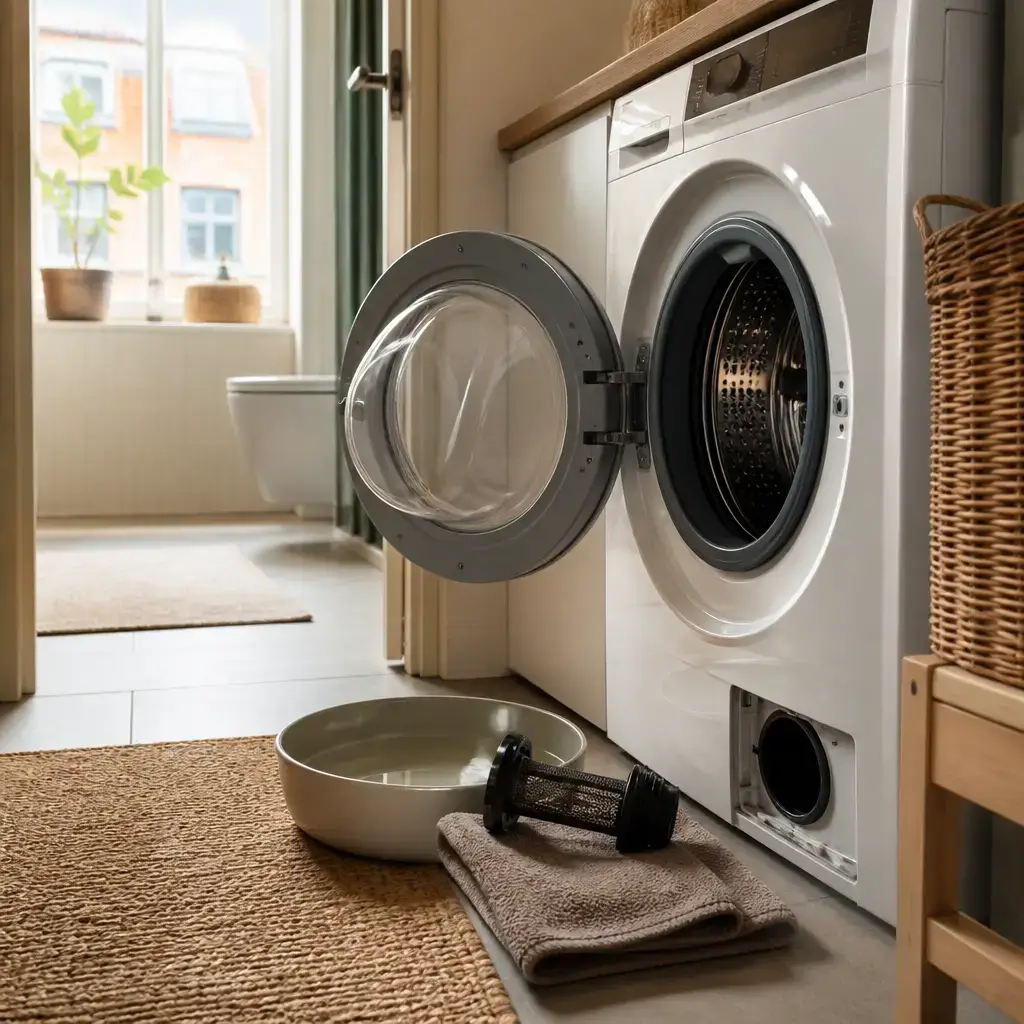
Die Waschmaschine ist mitten im Waschgang stehen geblieben.
dee VAHSH-muh-SHEE-nuh ist MIT-en im VAHSH-gahng STEH-en guh-BLEE-bun. The washing machine stopped halfway through the cycle.Gibt es eine Warnung auf dem Display?
GIPT ess EYE-nuh VAHR-noong owf daym dis-PLAY? Is there a warning on the screen?Dort steht, dass der Filter verstopft sein könnte.
dort SHTAYT dahss dare FIL-ter fair-SHTOPFT zine KERN-tuh. It says the filter may be blocked.Schau in die Anleitung, bevor du irgendwelche Tasten drückst.
show in dee AHN-lai-toong, beh-FOR doo EER-gent-VEL-khuh TAH-sten DRURKST. Check the manual before trying random buttons.In der Anleitung steht, dass ich den Filter vorsichtig reinigen soll.
in dare AHN-lai-toong SHTAYT, dahss ikh dayn FIL-ter FOR-zikh-tikh RYE-nig-en zoll. The manual says I should clean the filter carefully.Zieh dann den Stecker der Maschine, bevor du irgendetwas berührst.
tsee dan dayn SHTEK-er dare muh-SHEE-nuh, beh-FOR doo EER-gent-vas buh-RUE-rst. Then unplug the machine before you touch anything.Soll ich danach den Waschgang neu starten?
zoll ikh dah-NAKH dayn VAHSH-gahng noy SHTAR-ten? After that, should I restart the cycle?Starte ihn einmal neu, aber wende dich an den Wartungsdienst, wenn die Warnung wieder erscheint.
SHTAR-tuh een EYE-nahl noy, AH-ber VEN-duh dikh ahn dayn VAHR-toongs-deenst, venn dee VAHR-noong VEE-der er-SHINE-t. Restart it once, but contact maintenance if the warning returns.Ich werde zuerst die sicheren Schritte befolgen.
ikh VAIR-duh tsoo-AIRST dee ZIKH-er-en SHREET-uh beh-FOL-gen. I will follow the safe steps first.Eine einfache Fehlersuche ist nützlich, aber riskiere nicht, die Maschine zu beschädigen.
EYE-nuh EYEHN-fah-khuh FAY-ler-ZOO-khuh ist NOOTZ-likh, AH-ber riss-KEER-uh nikht, dee muh-SHEE-nuh tsoo buh-SHAY-dig-en. Simple troubleshooting is useful, but do not risk damaging the machine.Sentence explanations
Die Waschmaschine ist mitten im Waschgang stehen geblieben.
The washing machine stopped halfway through the cycle.
- Waschmaschine
- washing machine
- mitten im
- in the middle of
- Waschgang
- cycle
- stehen geblieben
- stopped
More detail
Waschmaschine means “washing machine.” It is a feminine noun: die Waschmaschine; its plural is die Waschmaschinen. The compound combines Wasch- (“washing”) with Maschine (“machine”). Example: Die Waschmaschine läuft. — “The washing machine is running.” mitten im expresses being in the middle of something. im is the contraction of in dem; here, in takes the dative because the phrase describes a location or stage rather than movement toward it. The pattern mitten im + masculine or neuter noun is useful: mitten im Film means “in the middle of the film.” Waschgang means “washing cycle.” It is a masculine compound noun: der Waschgang; the plural is die Waschgänge. In im Waschgang, im represents in dem Waschgang, with the dative form of the noun. Example: Der Waschgang dauert eine Stunde. — “The washing cycle lasts an hour.” stehen geblieben comes from the separable verb stehen bleiben, literally “remain standing,” which commonly means “stop” when something that was operating or moving ceases to operate. In the perfect tense, this verb uses sein: ist stehen geblieben. geblieben is the past participle of bleiben, while stehen remains part of the verb combination. Example: Der Aufzug ist stehen geblieben. — “The elevator stopped.” The whole sentence is assembled in source order as Die Waschmaschine (“the washing machine”) + mitten im Waschgang (“in the middle of the washing cycle”) + ist stehen geblieben (“stopped”). Thus it means: “The washing machine stopped halfway through the cycle.”
Gibt es eine Warnung auf dem Display?
Is there a warning on the screen?
- Gibt es
- is there
- Warnung
- warning
- Display
- screen
More detail
Gibt es is the standard German existence question, meaning “is there?” or “are there?” It is formed from geben (“to give”) in the fixed expression es gibt (“there is/are”); in a question, the finite verb comes first: Gibt es ...? The form gibt is third-person singular present, while es is the fixed grammatical subject of this construction. Example: Gibt es hier einen Aufzug? — “Is there an elevator here?” Warnung means “warning” here. Its base form is the feminine noun die Warnung; the form in the utterance is eine Warnung, with the indefinite article marking the noun phrase as feminine singular in this case. The related verb is warnen (“to warn”), but Warnung is the noun for the warning itself. Example: Die Warnung ist wichtig. — “The warning is important.” Display means “screen” or “display.” It is a neuter loanword in standard German: das Display. In auf dem Display, the article is dem because auf takes the dative for a fixed location. This describes something shown on the screen, not movement onto it. Example: Die Meldung steht auf dem Display. — “The message is on the display.” The whole pattern is Gibt es + [thing] + auf dem Display?: “Is there a [thing] on the screen?” Here, eine Warnung is the thing whose presence is being asked about, and auf dem Display specifies its location. Thus the utterance means, “Is there a warning on the screen?”
Dort steht, dass der Filter verstopft sein könnte.
It says the filter may be blocked.
- Dort
- there
- steht
- it says
- dass
- that
- der Filter
- the filter
- verstopft
- blocked
- sein könnte
- might be
More detail
Dort means “there,” pointing to a place identified by the situation. It is a location word, not a pronoun naming a particular object. Example: Dort ist die Anleitung. — “The manual is there.” steht is the third-person singular present form of stehen (“to stand”). Here, however, Dort steht, dass ... is a common impersonal pattern meaning that information is written or stated there: “It says there that ...”. The subject of the English “it” is not a separately identified participant. dass introduces a subordinate clause and corresponds to “that.” In German, this clause places its finite verb at the end. The material after dass therefore ends with könnte, not with the verb earlier in the clause. der Filter means “the filter.” Filter is a masculine noun in the singular; its plural is die Filter, with the same noun form but a different article. The article der marks the masculine singular definite form here; it does not by itself state a quantity beyond the sentence’s reference to a singular filter. verstopft means “blocked” or “clogged” here. It is the past participle of verstopfen (“to block/clog”), used as a predicate adjective with sein: Der Filter ist verstopft. — “The filter is blocked.” The form verstopft can also occur in perfect constructions, but here it describes the filter’s condition. sein könnte expresses possibility: “might be” or “may be.” sein is the infinitive “to be”; könnte is the third-person singular form of können in the subjunctive II form used here for a possible situation. In the subordinate clause, the infinitive and finite modal form appear together at the end: ... verstopft sein könnte — “... might be blocked.” Together, Dort steht identifies a place where information is stated, dass introduces that information, and der Filter verstopft sein könnte says that the filter may be blocked. The complete utterance means: “It says the filter may be blocked.”
Schau in die Anleitung, bevor du irgendwelche Tasten drückst.
Check the manual before trying random buttons.
- Schau
- check; look
- in die
- into the
- Anleitung
- manual; instructions
- bevor
- before
- irgendwelche
- any; random
- Tasten
- buttons; keys
- drückst
- press
More detail
Schau is the informal singular imperative of schauen (“to look”). The imperative addresses one person with du: Schau! means “Look!” In this sentence, Schau in ... is used for checking or consulting a source. in die expresses movement or direction into/onto something, so it takes the accusative here. die is the accusative singular form of the feminine article; the article itself does not state a numeric quantity. Compare location: in der Anleitung (“in the manual”), but direction: in die Anleitung (“into/to the manual”). Anleitung is a feminine noun meaning “manual” or “instructions”: die Anleitung, plural die Anleitungen. In this utterance it refers to the manual that should be consulted. Example: Lies die Anleitung. — “Read the instructions.” bevor means “before” and introduces a subordinate clause. In German, the finite verb normally goes to the end of this clause. The reusable pattern is bevor + subject + ... + verb. irgendwelche modifies a plural accusative noun here and means “any” or, in this context, “random.” It presents the buttons as unspecified rather than identifying particular ones. Its form agrees with the plural noun Tasten in this phrase. Tasten is the plural of die Taste, meaning “button” or “key.” The plural form is the same in the nominative and accusative. Example: Drücke keine Tasten. — “Do not press any buttons.” drückst is the second-person singular present form of drücken (“to press”): du drückst. Because it appears in the subordinate clause introduced by bevor, it comes at the end of that clause. The form identifies an action performed by the person addressed; it does not itself mean “try.” Together, Schau in die Anleitung gives the instruction to consult the manual. bevor du irgendwelche Tasten drückst sets the time condition: this should happen before you press any or random buttons. The complete meaning is: “Check the manual before trying random buttons.”
In der Anleitung steht, dass ich den Filter vorsichtig reinigen soll.
The manual says I should clean the filter carefully.
- Anleitung
- manual
- steht, dass
- says that
- ich … soll
- I should
- Filter
- filter
- vorsichtig
- carefully
- reinigen
- clean
More detail
Anleitung means “manual” here. Its base form is die Anleitung; the plural is die Anleitungen. As a feminine noun, it appears as der Anleitung after in when the phrase expresses location, as in In der Anleitung (“in the manual”). In the preceding example, in die Anleitung uses the accusative form; here it means looking into or consulting the manual, not necessarily physical movement onto it. steht, dass is a common pattern meaning that information is written or stated somewhere. steht is the third-person singular present form of stehen, and dass introduces the subordinate clause. Here, steht does not agree with die Anleitung: In der Anleitung is a locative phrase, while the following dass clause is the stated content. The whole pattern is In X steht, dass ... — “It says in X that ...”. ich soll expresses what the manual says the speaker is supposed or instructed to do. soll is the first-person singular present form of sollen; its infinitive is sollen. With a modal verb, the other verb normally appears at the end of the clause in the infinitive: Ich soll warten. — “I am supposed to wait.” Ich muss warten expresses stronger necessity. Filter means “filter.” The base noun is der Filter, and its plural is die Filter. In den Filter, the masculine article is in the accusative because the filter is the object of reinigen: it is the thing being cleaned. The article changes from masculine nominative der to accusative den. vorsichtig means “carefully” here. The same form can also be an adjective meaning “careful,” as in eine vorsichtige Person — “a careful person.” In this sentence it describes how the cleaning is done, so it is used adverbially and has no adjective ending. reinigen means “to clean.” It is the infinitive at the end of the dass clause, as required with the modal soll. A reusable pattern is etwas vorsichtig reinigen — “clean something carefully.” Example: Ich soll das Gerät vorsichtig reinigen. — “I am supposed to clean the device carefully.” Together, In der Anleitung steht, dass frames written information: “The manual says that ...”. The subordinate clause gives the instruction: ich soll den Filter vorsichtig reinigen, “I should clean the filter carefully.” The complete meaning is: “The manual says I should clean the filter carefully.”
Zieh dann den Stecker der Maschine, bevor du irgendetwas berührst.
Then unplug the machine before you touch anything.
- Zieh
- unplug
- dann
- then
- den Stecker
- the plug
- der Maschine
- of the machine
- bevor
- before
- du
- you
- irgendetwas
- anything
- berührst
- touch
More detail
Zieh is the informal singular imperative of ziehen (“to pull”). In this sentence, ziehen is used in the established sense “to unplug” when the object is a plug: Zieh den Stecker! means “Unplug the plug!” The imperative addresses one person; the polite form is Ziehen Sie .... dann means “then” and places this action after the earlier instruction or step. It does not itself express the order or reason; it simply marks the sequence. den Stecker means “the plug.” The noun’s base form is der Stecker; den shows masculine accusative case because the plug is the direct object of Zieh. The plural is die Stecker. The article changes with case: for example, mit dem Stecker means “with the plug.” der Maschine means “of the machine.” die Maschine is feminine, and here der Maschine is feminine genitive, marking what the plug belongs to: “the machine’s plug.” This is different from the dative form, which also has der in some contexts; the relationship here is possession or association, supplied by the noun phrase der Stecker der Maschine. bevor introduces a time clause meaning “before.” A clause after bevor normally sends its finite verb to the end. Pattern: ..., bevor + subject + other elements + finite verb. The clause describes the action that must not happen until the first action has been completed. du is the informal singular subject pronoun “you.” It is the subject of the clause introduced by bevor and corresponds to the informal imperative’s addressee. For a formal addressee, German uses Sie, as in Bevor Sie etwas berühren .... irgendetwas means “anything” in this negative or limiting context. It refers generally to any possible thing being touched, without identifying a particular object. In a positive statement, it can also mean “something”: Du kannst irgendetwas auswählen. — “You can choose something.” berührst is the second-person singular present form of berühren, “to touch.” The stem remains recognizable, with the ending -st marking du: du berührst. The verb appears at the end because it is the finite verb of the bevor subordinate clause. Berühren Sie nichts. means “Touch nothing,” but that is a different construction and uses the formal imperative. Together, Zieh dann den Stecker der Maschine gives the instruction “Then unplug the machine,” literally referring to pulling the machine’s plug. bevor du irgendetwas berührst sets the time condition “before you touch anything.” The complete utterance therefore means: “Then unplug the machine before you touch anything.”
Soll ich danach den Waschgang neu starten?
After that, should I restart the cycle?
- Soll ich
- Should I
- danach
- after that
- Waschgang
- cycle
- neu starten
- restart
More detail
Soll ich combines the first-person form soll of sollen with ich. In this question, it asks whether the speaker ought to do something: “Should I ...?” The same verb has forms such as du sollst and sie sollen; after Soll ich, the other verb stays in the infinitive at the end of the question. danach is a temporal adverb meaning “after that” or “afterwards.” Here it refers to the action mentioned immediately before in the supplied context. Unlike a noun, it does not change for case, number, or gender. Waschgang is the masculine noun for a washing cycle or wash cycle. Its plural is Waschgänge. In den Waschgang, den marks this singular masculine noun as the accusative object of the action. The noun is capitalized because German nouns are capitalized. neu starten means “to start again” or “to restart.” starten is the verb; neu modifies the restarting action here and is not an adjective agreeing with Waschgang. After the modal verb sollen, starten remains in the infinitive. For example: Ich starte den Computer neu. — “I restart the computer.” Together, Soll ich asks for guidance, danach places the action after the preceding step, den Waschgang names what is restarted, and neu starten expresses starting it again. The complete question is therefore: “After that, should I restart the cycle?” This is a neutral, practical way to ask whether that is the next recommended action.
Starte ihn einmal neu, aber wende dich an den Wartungsdienst, wenn die Warnung wieder erscheint.
Restart it once, but contact maintenance if the warning returns.
- Starte
- start
- ihn
- it
- einmal
- once
- neu
- anew
- wende dich an
- contact
- Wartungsdienst
- maintenance service
- Warnung
- warning
- wieder
- again
- erscheint
- appears
More detail
Starte is the informal singular imperative of starten (“to start”). The command is addressed to one person: Starte! means “Start!” The verb is separable in some finite forms, but the imperative here is simply the single form Starte. ihn is the masculine singular accusative form of er (“he/it”). Here the fixed translation supports the object meaning “it”; the specific thing referred to is not identified in the supplied text. Compare the forms er (subject), ihn (direct object), and ihm (indirect object or object after certain prepositions). einmal means “once” here. Together with the command, it specifies one restart rather than an open-ended number of restarts. Example: Lies den Text einmal. — “Read the text once.” neu means “anew” or “again from the beginning.” With starten, neu starten is a useful pattern meaning “restart.” It is different from wiederholen, which means “repeat” an activity or content. wende dich an is an informal singular imperative construction meaning “contact” or “turn to” someone or a service. Its base verb is sich an jemanden wenden; dich is the reflexive accusative form matching the informal singular addressee. The preposition an takes the accusative in this contact pattern: sich an den Support wenden — “contact support.” Wartungsdienst is a masculine noun meaning “maintenance service.” In the sentence, it follows an in the accusative, shown by the surrounding form den Wartungsdienst. The noun itself remains Wartungsdienst; its plural is Wartungsdienste. Warnung is a feminine noun meaning “warning.” In wenn die Warnung ... erscheint, it is the subject of erscheint, and the feminine article is die. Example: Die Warnung erscheint. — “The warning appears.” wieder means “again” here: the warning appears again after having appeared before. It does not itself specify how many times this happens. erscheint is the third-person singular present form of erscheinen (“to appear”). The form agrees with the singular subject die Warnung: Die Warnung erscheint. In the wenn clause, the finite verb comes at the end: wenn die Warnung wieder erscheint — “if the warning appears again.” The present form can describe a future condition in such a clause; it does not by itself mean that the return is happening now. The first part combines the imperative Starte with the object ihn, the one-time instruction einmal, and neu: “Restart it once.” The second imperative, wende dich an den Wartungsdienst, gives the alternative action “contact maintenance.” The condition wenn die Warnung wieder erscheint says when that second action applies: “if the warning returns.” Together: “Restart it once, but contact maintenance if the warning returns.”
Ich werde zuerst die sicheren Schritte befolgen.
I will follow the safe steps first.
- Ich werde
- I will
- zuerst
- first
- sicheren
- safe
- Schritte
- steps
- befolgen
- follow
More detail
Ich werde combines the first-person singular pronoun Ich (“I”) with werde, the present-tense form of werden (“will/become”) used here as a future auxiliary. With a full infinitive later in the clause, werden marks a future action: Ich werde warten. — “I will wait.” zuerst is an adverb meaning “first” or “at first” in the relevant sequence. It places the following action before other actions: Ich lese zuerst die Anleitung. — “I read the instructions first.” sicheren is the adjective sicher (“safe”) in an inflected form. It describes Schritte here. Because die is a definite article and Schritte is plural in the accusative object phrase, the adjective has the ending -en: die sicheren Schritte. The base form is sicher; the opposite is commonly unsicher (“unsafe” or “uncertain”), depending on context. Schritte is the plural of the noun Schritt (“step”). Here it means steps or actions to follow, not necessarily physical footsteps. The plural accusative form is also Schritte: Ich plane die Schritte. — “I plan the steps.” befolgen is the infinitive meaning “to follow” in the sense of obeying or carrying out instructions, rules, or steps. It is a regular verb whose present first-person singular form is ich befolge. In a future construction with werden, the infinitive remains at the end: Ich werde die Anweisungen befolgen. — “I will follow the instructions.” Together, Ich werde marks the future, zuerst specifies the order, and die sicheren Schritte befolgen means “follow the safe steps.” The complete utterance therefore means: “I will follow the safe steps first.”
Eine einfache Fehlersuche ist nützlich, aber riskiere nicht, die Maschine zu beschädigen.
Simple troubleshooting is useful, but do not risk damaging the machine.
- einfache
- simple
- Fehlersuche
- troubleshooting
- nützlich
- useful
- riskiere
- risk
- Maschine
- machine
- beschädigen
- damage
More detail
einfache describes Fehlersuche here as “simple.” Its base form is einfach; the ending -e is the adjective ending used with feminine nominative eine + noun: eine einfache .... For example: Das ist eine einfache Lösung. — “That is a simple solution.” Fehlersuche means “troubleshooting” or “fault-finding.” It is a feminine compound noun: der Fehler (“fault/error”) + die Suche (“search”), with the compound’s gender being feminine: die Fehlersuche. In the sentence, eine Fehlersuche is the subject. Example: Die Fehlersuche dauert lange. — “The troubleshooting takes a long time.” nützlich means “useful.” It is a predicate adjective after ist, so it has no ending here: Die Fehlersuche ist nützlich. Adjectives used predicatively after forms of sein normally remain in their basic form. Example: Diese Anleitung ist nützlich. — “This guide is useful.” riskiere means “risk” in the informal singular imperative. Its base form is riskieren; the imperative addresses one person with du. The negative command is formed with nicht: Riskiere nicht ... — “Don’t risk ...”. Example: Warte hier! — “Wait here!” Maschine means “machine.” In die Maschine, it is the feminine noun with the definite article; here the noun phrase is the object of beschädigen. For feminine nouns, nominative and accusative have the same article form: die Maschine. Example: Ich repariere die Maschine. — “I repair the machine.” beschädigen means “damage.” It is an infinitive after riskieren in the construction riskieren, etwas zu tun: “risk doing something.” The infinitive remains beschädigen, while zu marks the infinitival construction: die Maschine zu beschädigen — “damaging the machine.” Example: Er riskiert, den Computer zu beschädigen. — “He risks damaging the computer.” Together, Eine einfache Fehlersuche ist nützlich says “Simple troubleshooting is useful.” aber introduces a contrast, and riskiere nicht, die Maschine zu beschädigen is an informal singular command meaning “but do not risk damaging the machine.”
Grammar Points
sein + stehen geblieben
Der Waschgang ist stehen geblieben.
dare VAHSH-gahng ist STEH-en guh-BLEE-bun.The wash cycle has stopped.
For a change of state, German uses sein plus the past participle: ist stehen geblieben.
die sicheren Schritte
Befolgen Sie die sicheren Schritte.
beh-FOL-gen zee dee ZIKH-er-en SHREET-uh.Follow the safe steps.
After die in the plural accusative, the adjective takes -en: die sicheren Schritte.
German Vocabulary
Quiz
Spelling
Tap the letters to spell the word.
warning
Show Answer
Warnungblocked
Show Answer
verstopftwash cycle
Show Answer
Waschgangfilter