10 minutes free every day
Continue audio lessons in the app
Word explanations appear automatically in sync with the audio.
No login required · synced translations · playback with the screen locked
Choose your learning language and open this lesson in the app.

About This Lesson
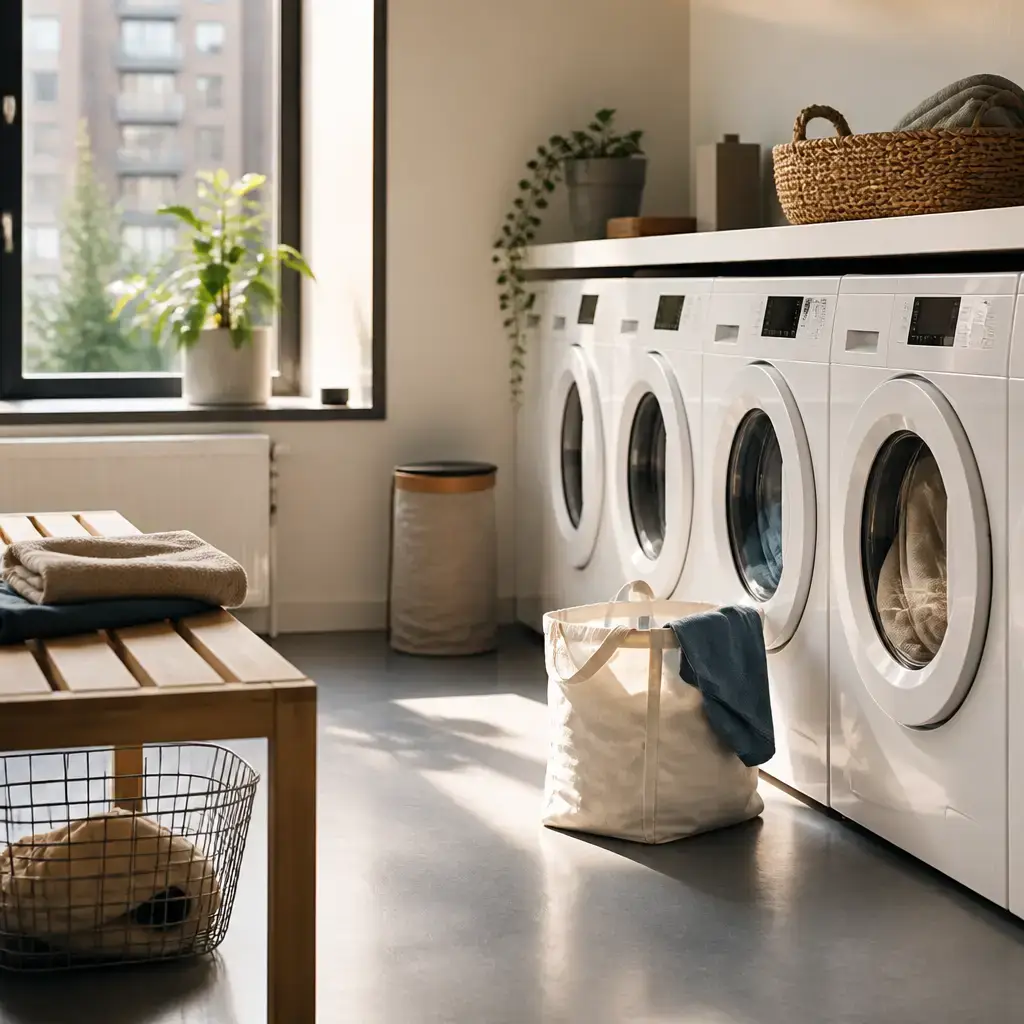
Use Using the shared laundry room fairly to practice German conversation, pronunciation, vocabulary, grammar, and quizzes.
Dialogue
Alle Waschmaschinen sind wieder voll.
AH-luh VASH-mah-SHEE-nun zint VEE-dur foll. All the washing machines are full again.Schau in den Zeitplan und sieh nach, wann die nächste Ladung fertig wird.
sh-OW in dayn TSYTE-plahn oont zee nahkh, vahn dee NEKH-stuh LAH-doong FAIR-tikh veert. Check the schedule and see when the next load finishes.Eine sollte bald fertig sein, aber die Person, die sie gestartet hat, ist nicht da.
EYE-nuh ZOL-tuh bahlt FAIR-tikh zine, AH-bur dee pair-ZOHN, dee zee geh-SHTAR-tet haht, ist nikht dah. One should be done soon, but the person who started it isn't around.Gib der Person ein paar Minuten, bevor du ihre Wäsche umräumst.
Gip dair pair-ZOHN ine pahr mee-NOO-ten, beh-FOHR doo EE-ruh VESH-uh oom-ROYMST. Give them a few minutes before moving their laundry.Wie lange sollte ich fairerweise warten, bevor ich sie umräume?
Vee LAHNG-uh ZOL-tuh ikh FAIR-uh-VY-zuh VART-en, beh-FOHR ikh zee oom-ROY-muh? How long is fair before I move it?Eine kurze Kulanzzeit reicht aus, wenn andere Leute warten.
EYE-nuh KOOR-tsuh koo-LAHNTS-tsite RYKHT ows, venn AHN-duh-ruh LOY-tuh VART-en. A short grace period is enough if other people are waiting.Ich stelle eine Erinnerung ein, damit ich zurückkomme, sobald meine Wäsche fertig ist.
Ikh SHTEL-luh EYE-nuh air-IN-uh-roong ine, dah-MIT ikh tsoo-ROOK-kom-uh, zoh-BAHLT MY-nuh VESH-uh FAIR-tikh ist. I'll set a reminder so I come back as soon as my load is done.So ist es leichter, dasselbe von allen anderen zu erwarten.
Zoh ist ess LYKHT-uh, dahs-ZEL-buh fon AH-lun AHN-duh-run tsoo air-VAR-ten. That makes it easier to ask the same of everyone else.Ich kann mich nicht über liegen gelassene Wäsche beschweren, wenn ich meine auch dort liegen lasse.
Ikh kahn mikh nikht OO-bur LEE-gun geh-LAS-uh-nuh VESH-uh beh-SHVAIR-en, venn ikh MY-nuh OWKH dort LEE-gun LAS-suh. I can't complain about abandoned laundry if I leave mine there too.Das gemeinsame Waschen läuft reibungsloser, wenn die Leute auf die Laufzeiten achten.
Dahs geh-MYNE-zah-muh VASH-un loyft RY-boongs-LOH-zur, venn dee LOY-tuh owf dee LOWF-tsye-tun AHKH-tun. Shared laundry goes more smoothly when people watch the cycle times.Sentence explanations
Alle Waschmaschinen sind wieder voll.
All the washing machines are full again.
- Alle
- all
- Waschmaschinen
- washing machines
- sind
- are
- wieder
- again
- voll
- full
More detail
Alle means “all” here and refers to the complete set of washing machines being discussed. It is the plural form used with a plural noun; compare alle Waschmaschinen (“all washing machines”) with singular jede Waschmaschine (“each washing machine”). Example: Alle Fenster sind offen. — “All the windows are open.” Waschmaschinen is the plural of Waschmaschine, “washing machine.” The ending -n marks the plural here: eine Waschmaschine → zwei Waschmaschinen. The compound combines Wasch- (“washing”) with Maschine (“machine”), but it is learned and used as one noun. sind is the present-tense form of sein (“to be”) for a plural subject, including sie sind and wir sind. With the plural subject alle Waschmaschinen, it means “are.” Example: Die Maschinen sind neu. — “The machines are new.” wieder means “again,” indicating that the state described by voll has returned or is true another time. It does not itself mean “full.” Example: Der Bus ist wieder leer. — “The bus is empty again.” voll means “full.” As a predicate after sein, it stays in this basic form rather than taking an adjective ending: Die Waschmaschine ist voll — “The washing machine is full.” Its opposite is leer (“empty”). Together, Alle Waschmaschinen is the plural subject “all the washing machines,” sind voll says that they are full, and wieder adds that this is the case again. The complete utterance therefore means: “All the washing machines are full again.”
Schau in den Zeitplan und sieh nach, wann die nächste Ladung fertig wird.
Check the schedule and see when the next load finishes.
- Schau
- check; look
- Zeitplan
- schedule
- sieh … nach
- check; look up
- nächste
- next
- Ladung
- load
- fertig
- finished; ready
- wird
- becomes; gets
More detail
Schau is the informal singular imperative of schauen (“to look”). It addresses one person directly. The same verb can be used in a simple instruction such as Schau hier! — “Look here!” Zeitplan means “schedule” or “timetable.” It is a masculine noun: der Zeitplan; its plural is die Zeitpläne. In this sentence, in den Zeitplan means “in(to) the schedule”: the masculine article is den because in expresses a direction toward something here. sieh ... nach is the separable verb nachsehen, meaning “to check” or “to look something up.” Its informal singular imperative is sieh nach; the two parts are separated in the sentence because the imperative places nach at the end of the clause. For example, Sieh im Kalender nach. means “Check the calendar.” This is a different construction from the first imperative, even though both can be translated with “check” or “look.” nächste means “next.” Its base form is the adjective nächst-; here it is the feminine form agreeing with die Ladung: die nächste Ladung. The adjective is not the noun’s base form. Other forms include der nächste Termin (“the next appointment”) and die nächsten Termine (“the next appointments”). Ladung is a feminine noun, die Ladung. In this context, supported by the surrounding washing-machine context, it means a load of laundry. The word can also mean other kinds of load in other contexts, but this sentence does not require those meanings. fertig means “finished” or “ready.” With werden, it describes something reaching a finished state: fertig werden = “become finished” or “get done.” For example, Die Arbeit wird fertig. means “The work is getting finished.” wird is the third-person singular present form of werden, whose basic meaning here is “become” or “get.” The subject is die nächste Ladung, so the singular form wird is used. In the subordinate clause introduced by wann, it appears at the end: wann ... fertig wird. Together, wann die nächste Ladung fertig wird is an indirect question: “when the next load gets finished.” Wann asks about the time, and the subordinate clause places the conjugated verb at the end. The full utterance is an informal instruction to check the schedule and find out when the next load will be finished: “Check the schedule and see when the next load finishes.”
Eine sollte bald fertig sein, aber die Person, die sie gestartet hat, ist nicht da.
One should be done soon, but the person who started it isn't around.
- Eine
- one
- sollte
- should
- bald
- soon
- fertig
- done
- sein
- be
- Person
- person
- sie
- it
- gestartet
- started
- ist nicht da
- isn't around
More detail
Eine is an independent feminine form meaning “one” or “one feminine item”; because no noun follows it here, it is not an article before a noun. Its form agrees with the understood feminine noun, but the supplied sentence does not identify that noun more specifically. Here it is the item expected to be finished. sollte is the third-person singular form of sollen, used here for “should” or “is expected to”. With a following infinitive, the modal expresses an expectation: sollte ... sein means “should be ...”. bald means “soon”, referring to a time near the speaking point. fertig is an adjective meaning “finished” or “done”. sein is the infinitive “to be”; after a modal such as sollte, the infinitive appears at the end of this clause. Reusable example: Der Bericht sollte bald fertig sein. — “The report should be finished soon.” Person means “person”. The preceding die is the feminine singular definite article for this noun. The sequence die Person, die ... begins a relative clause: the second die is a feminine singular relative pronoun referring grammatically to Person and introducing information about that person. Grammatical feminine agreement does not by itself state the person’s real-world gender. sie means “it” here, as established by the fixed translation. In the relative clause it is the object of gestartet: it is the thing that was started. The form sie can have other grammatical roles in German, so its role here comes from its use in this clause and the supplied meaning. gestartet is the participle of starten, “to start”. Together with hat, it forms the perfect construction gestartet hat, meaning “started”. In the relative clause, the relative pronoun die is the person who performed the action, while sie is the thing affected by it. The pattern die ... gestartet hat means “who started ...”. ist nicht da means “isn’t around” or “is not present” in this context. ist is the third-person singular present form of sein; nicht negates the statement; and da describes presence or availability in the relevant situation. The whole sentence first states that one feminine item is expected to be finished soon: Eine sollte bald fertig sein. aber contrasts this with information about the person who started it. die Person, die sie gestartet hat means “the person who started it”, and ist nicht da says that this person is not around. Together: “One should be done soon, but the person who started it isn’t around.”
Gib der Person ein paar Minuten, bevor du ihre Wäsche umräumst.
Give them a few minutes before moving their laundry.
- Gib
- give
- Person
- person
- ein paar
- a few
- Minuten
- minutes
- bevor
- before
- Wäsche
- laundry
- umräumst
- move or rearrange
More detail
Gib is the imperative of geben (“to give”) for du: du gibst → Gib!. It addresses one person directly. The imperative is used for the request here, not as a statement about what someone is currently doing. Person means “person.” In der Person, Person is feminine, singular, and the dative form is marked by the article der. The dative identifies the recipient: jemandem etwas geben = “give someone something.” Example: Gib dem Kind das Buch. — “Give the child the book.” ein paar means “a few,” a small, nonspecific number. It does not identify an exact count. It is followed here by the plural noun Minuten. Minuten is the plural of Minute, “minute.” ein paar Minuten therefore means “a few minutes.” Example: Warte ein paar Minuten. — “Wait a few minutes.” bevor introduces a clause meaning “before.” In a German clause introduced by bevor, the conjugated verb normally comes at the end. The pattern is bevor + subject + ... + verb. Wäsche means “laundry.” It is commonly an uncountable collective noun, so this form does not itself specify individual items or a number. In ihre Wäsche, ihre means “their” in the intended reading and agrees with the feminine noun Wäsche; the phrase refers to that person’s laundry. umräumst comes from the separable verb umräumen, “to move or rearrange.” With du, the present-tense form is du räumst ... um; inside the bevor clause, the parts are joined at the end as du ... umräumst. Example: Du räumst die Sachen um. — “You move the things around.” Together, Gib der Person ein paar Minuten means “Give the person a few minutes,” and bevor du ihre Wäsche umräumst means “before you move their laundry.” The complete utterance is therefore: “Give them a few minutes before moving their laundry.”
Wie lange sollte ich fairerweise warten, bevor ich sie umräume?
How long is fair before I move it?
- Wie lange
- how long
- sollte ich
- should I
- fairerweise
- fairly; in fairness
- warten
- wait
- bevor
- before
- sie
- it
- umräume
- move; rearrange
More detail
Wie lange asks about duration: “how long?” It is a reusable question pattern for a length of time. For example, Wie lange wartest du? means “How long are you waiting?” Ich sollte uses sollte, the first-person singular form of sollen, with ich as the subject. Here it expresses a recommendation or what would be appropriate: “I should.” In this use, sollte does not itself make the situation past; the intended meaning is present or future-oriented advice. Compare Ich soll warten (“I am supposed to wait”) with Ich sollte warten (“I should wait”). fairerweise is an adverb meaning “in fairness” or “fairly” in the sense of acting considerately. It describes the standard being applied to the waiting time, rather than describing how someone physically waits. warten is the base form “to wait.” After the modal verb sollte, the other verb remains in the infinitive: Ich sollte warten (“I should wait”). In the question, warten is part of the action whose appropriate duration is being asked about. bevor introduces a clause meaning “before.” It places the action in that clause after the waiting period in the relevant sequence: first waiting, then moving the item. In a bevor clause, the conjugated verb goes to the end, as in bevor ich gehe (“before I leave”). Sie here is the third-person singular object meaning “it,” as fixed by the translation. The context supports an understood feminine singular item such as the laundry mentioned previously. In this sentence, sie is the object of umräume; its form is also compatible with other grammatical readings in isolation, so the intended referent comes from the sentence and context rather than from the form alone. umräume is the first-person singular present form of the separable verb umräumen, “to move or rearrange something.” Its subject is ich. The prefix um- is separated in a main clause, as in Ich räume die Sachen um (“I rearrange the things”), but it remains attached in the bevor clause: bevor ich sie umräume (“before I move it”). Together, Wie lange sollte ich fairerweise warten asks what waiting duration would be appropriate, and bevor ich sie umräume identifies the later action as moving the item. The complete meaning is: “How long is fair before I move it?” The question is a polite way to ask for an appropriate grace period before rearranging or moving something.
Eine kurze Kulanzzeit reicht aus, wenn andere Leute warten.
A short grace period is enough if other people are waiting.
- kurze
- short
- Kulanzzeit
- grace period
- reicht … aus
- is enough
- andere
- other
- Leute
- people
- warten
- are waiting
More detail
kurze describes the duration or extent of the Kulanzzeit here: a short grace period. Its base form is kurz; useful comparison forms are kürzer (“shorter”) and am kürzesten (“shortest”). In this nominative phrase, kurze is the feminine singular adjective form used with the indefinite article eine and the noun Kulanzzeit. Kulanzzeit is a compound noun meaning a period allowed as a courtesy or concession. Zeit means “time,” while Kulanz refers to leniency or a goodwill accommodation. German nouns are capitalized, and this noun is feminine: die Kulanzzeit. reicht ... aus is the separable verb ausreichen, meaning “to be sufficient” or “to be enough.” In the present tense, the finite part is reicht and the separable prefix aus appears at the end of the main clause. Its base form is ausreichen; for example, Das reicht aus. means “That is enough.” The singular form reicht matches the singular subject Eine kurze Kulanzzeit. andere means “other” in the sense of people different from the person or group being considered. In andere Leute, it is the plural nominative form modifying Leute. Useful singular nominative forms are anderer for masculine, andere for feminine, and anderes for neuter; case and the type of determiner can change the ending. The word does not itself specify who these other people are. Leute means “people” and is normally used as a plural noun. Because it is plural here, the verb in its clause is also plural. For one person, German normally uses Person rather than a singular form of Leute. warten means “to wait.” Here it is the third-person plural present-tense form after andere Leute; it has the same written form as the infinitive. German simple present can describe an action in progress, so the fixed translation uses “are waiting.” Example: Die Gäste warten. — “The guests are waiting.” The word wenn introduces the condition “if” here. The conditional clause is wenn andere Leute warten; German places the finite verb warten at the end of this subordinate clause. The main clause is Eine kurze Kulanzzeit reicht aus, with the separable prefix aus at the end of that main clause. Together, Eine kurze Kulanzzeit is the singular subject, reicht ... aus says that it is sufficient, and wenn andere Leute warten gives the condition. The whole utterance therefore means: “A short grace period is enough if other people are waiting.”
Ich stelle eine Erinnerung ein, damit ich zurückkomme, sobald meine Wäsche fertig ist.
I'll set a reminder so I come back as soon as my load is done.
- stelle … ein
- set (something)
- Erinnerung
- reminder
- damit
- so that
- zurückkomme
- come back
- sobald
- as soon as
- Wäsche
- laundry
- fertig
- done
More detail
stelle ... ein is the separated present-tense form of einstellen, used here for “set” a reminder. The prefix ein- moves to the end of a main clause: Ich stelle eine Erinnerung ein. In the first-person singular, the verb form is stelle; the same verb can have other context-dependent meanings, so the reminder context supplies the intended one. Erinnerung means “reminder” here. Its base form is the feminine noun die Erinnerung; eine is its indefinite article and does not itself state a numerical count. The noun is related to remembering, but the useful reusable form here is the noun itself: eine Erinnerung einstellen means “set a reminder.” damit introduces a purpose clause, meaning “so that.” In this clause, the finite verb goes to the end. For example: Ich schreibe es auf, damit ich es nicht vergesse. — “I write it down so that I do not forget it.” zurückkomme is the first-person singular present form of zurückkommen, “come back” or “return.” In the damit clause, the verb appears as one written form at the end rather than separating zurück- from komme: damit ich zurückkomme. The form identifies ich as the subject; it does not by itself specify where the speaker returns. sobald introduces a time clause meaning “as soon as.” Like damit, it places the finite verb at the end of its clause. Example: Ich rufe dich an, sobald ich Zeit habe. — “I’ll call you as soon as I have time.” Wäsche means “laundry” here, with the fixed translation specifying the intended load of laundry. It is the feminine noun die Wäsche. The word is commonly used as a mass or collective noun, so meine Wäsche means “my laundry” without requiring a stated number of items. fertig means “done” or “finished.” In meine Wäsche fertig ist, it is a predicate adjective after ist; it describes the laundry’s state. The adjective itself does not take an ending here. The finite form is ist, the third-person singular present form of sein, agreeing with the singular noun Wäsche. Together, Ich stelle eine Erinnerung ein means “I’ll set a reminder” in this context. damit ich zurückkomme gives the purpose: “so that I come back,” and sobald meine Wäsche fertig ist gives the condition in time: “as soon as my laundry is done.” The complete utterance therefore means: “I’ll set a reminder so I come back as soon as my load is done.”
So ist es leichter, dasselbe von allen anderen zu erwarten.
That makes it easier to ask the same of everyone else.
- So
- that way
- ist es
- it is
- leichter
- easier
- dasselbe
- the same thing
- von allen anderen
- from everyone else
- erwarten
- expect
More detail
So means “that way” or “in this way” here. It links the situation to a result: So ist es besser. — “That way, it is better.” German so can also mean “so” in the sense of “to such a degree,” as in so leicht — “so easy”; the construction here expresses manner or result instead. ist es combines sein (“to be”) with es (“it”). ist is the third-person singular present form of sein: ich bin, du bist, er/sie/es ist. In es ist leichter, ... zu ..., es functions as a formal subject, while the following infinitive phrase says what is easier. Thus, it does not by itself identify a particular noun as the referent of “it.” leichter means “easier.” It is the comparative form of leicht (“easy” or “light”): leicht → leichter → am leichtesten. German uses leichter sein to describe an action or situation as easier: Das ist leichter. — “That is easier.” dasselbe means “the same thing,” with an emphasis on exact identity. It is written as one word. A useful contrast is dasselbe (“the very same thing”) versus das Gleiche (“the same kind or type”); speakers do not always maintain this distinction strictly, but it is useful when exact identity matters. von allen anderen means “from everyone else.” von takes the dative case. allen is the dative plural form of alle (“all”), and anderen is the dative plural form of andere (“other”), used substantivally here for “the others.” erwarten means “to expect.” It is the infinitive/base form of the inseparable verb erwarten; its prefix er- does not split off. For example, Ich erwarte das. means “I expect that.” German can use von plus the dative for the person from whom something is expected: Ich erwarte das von ihm. — “I expect that from him.” In the sentence, erwarten occurs in the infinitive construction zu erwarten. Together, So ist es leichter means “That makes it easier,” more literally “That way, it is easier.” The infinitive phrase dasselbe von allen anderen zu erwarten specifies what is easier: expecting the same thing from everyone else. The complete meaning is “That makes it easier to ask/expect the same of everyone else.”
Ich kann mich nicht über liegen gelassene Wäsche beschweren, wenn ich meine auch dort liegen lasse.
I can't complain about abandoned laundry if I leave mine there too.
- Ich kann
- I can
- mich … über … beschweren
- complain about something
- nicht
- not
- liegen gelassene
- left lying; abandoned
- Wäsche
- laundry
- wenn
- if; when
- ich
- I
- meine
- mine
- auch
- too; also
- dort
- there
- liegen lasse
- leave lying
More detail
Ich kann gives the speaker’s ability or possibility: können is the base form, and kann is its present-tense form for ich (also for er/sie/es). In the fixed sentence, the negation comes separately in nicht, so this is “I can,” not yet “I can’t.” Example: Ich kann heute kommen. — “I can come today.” mich über beschweren is the reusable reflexive pattern sich über etwas beschweren — “to complain about something.” Here mich is the first-person reflexive form matching ich, and beschweren is the infinitive after kann. The preposition über takes the thing being complained about here in the accusative. Example: Sie beschwert sich über den Lärm. — “She complains about the noise.” nicht negates the ability or possibility expressed with kann and the complaint construction: Ich kann mich nicht beschweren means “I can’t complain.” Its position before über does not make it mean that the laundry itself is not being complained about; the whole clause is negated. liegen gelassene describes something that has been left lying around. It comes from the verb combination liegen lassen (“to leave lying”); the participial form used attributively is liegen gelassen, with gelassen receiving the adjective ending here: liegen gelassene. Because it describes feminine singular accusative Wäsche after über, the visible ending is -e. Example: Das ist liegen gelassene Kleidung. — “That is clothing left lying around.” Wäsche means laundry. It is a feminine noun: die Wäsche; its form is the same in the singular nominative and accusative. In this sentence, it is the thing referred to by über liegen gelassene Wäsche. wenn introduces the condition “if” here. It starts a subordinate clause, and German places that clause’s finite verb at the end. The following clause explains the condition under which the speaker says they cannot complain. ich is the first-person singular pronoun “I.” It is the subject of the wenn clause and refers to the same speaker as Ich at the start. meine is a possessive pronoun meaning “mine” here, standing for the speaker’s own laundry or laundry items. In this context, the intended referent is understood from the laundry topic, but the form itself can represent a feminine singular noun or plural nouns; meine does not by itself identify the omitted noun’s number. It is not the verb meinen (“to mean” or “to think”). Example: Welche Wäsche ist deine? — Meine. — “Which laundry is yours? — Mine.” auch adds “too” or “also”: the speaker leaves their own laundry there as well. It does not by itself mean “again.” dort means “there,” pointing to a place understood from the situation. It is an invariable place adverb. liegen lasse expresses “leave lying.” The base construction is liegen lassen; in the wenn clause, lasse is the first-person singular present form of lassen, while liegen remains the infinitive. Because this is a subordinate clause introduced by wenn, the finite form lasse comes at the end: wenn ich meine auch dort liegen lasse. Example: Ich lasse die Tasche dort liegen. — “I leave the bag there.” Together, Ich kann mich nicht über liegen gelassene Wäsche beschweren means “I can’t complain about laundry left lying around.” The conditional wenn ich meine auch dort liegen lasse adds “if I leave mine there too.” The complete utterance is therefore: “I can’t complain about abandoned laundry if I leave mine there too.”
Das gemeinsame Waschen läuft reibungsloser, wenn die Leute auf die Laufzeiten achten.
Shared laundry goes more smoothly when people watch the cycle times.
- gemeinsame
- shared, joint
- Waschen
- washing; laundry
- läuft
- runs; goes
- reibungsloser
- more smoothly
- wenn
- when
- Leute
- people
- auf die Laufzeiten achten
- watch the cycle times
More detail
gemeinsame comes from gemeinsam (“shared” or “joint”). Here it is an adjective modifying the neuter noun Waschen; after the definite article das, it has the ending -e: das gemeinsame Waschen. The ending reflects the noun phrase’s grammatical form, not a change in the adjective’s basic meaning. Waschen is the capitalized nominalized infinitive of waschen (“to wash”). As a noun, it is neuter and can name the activity itself: Das Waschen dauert lange. — “The washing takes a long time.” In this sentence, the translation presents that activity in the context of shared laundry. läuft is the third-person singular present form of laufen (“to run; to go”). Its singular form agrees with the singular subject das gemeinsame Waschen. German commonly uses laufen for how an activity or process proceeds, not only for physical movement: Der Plan läuft gut. — “The plan is going well.” reibungsloser is the comparative form of the adjective reibungslos (“smooth; frictionless”). In läuft reibungsloser, it functions adverbially and means that the activity proceeds more smoothly than under some comparison understood from context. The comparison chain is reibungslos — reibungsloser — am reibungslosesten (“smooth” — “smoother/more smoothly” — “smoothest/most smoothly”). wenn introduces a subordinate condition or time-related clause, here meaning “when.” In a German wenn-clause, the conjugated verb normally goes to the end. For example, Ich helfe, wenn ich Zeit habe. — “I help when I have time.” Leute means “people” and is plural here, as shown by the plural article die and the plural verb form achten. The singular is die Person or, in a different lexical choice, der Mensch; these are not simply interchangeable in every context. auf die Laufzeiten achten is the reusable pattern auf etwas achten, meaning “to pay attention to” or “to watch something.” achten is the lexical verb; auf belongs to this construction and takes the accusative here. die has the same form in the nominative and accusative plural, so the case is governed by the construction rather than visibly marked on this article. Laufzeiten is the plural of Laufzeit, literally a duration or running time; in this laundry context, it means the cycle times. A reusable example is Achte auf die Zeit. — “Pay attention to the time.” Together, Das gemeinsame Waschen names the shared washing activity, and läuft reibungsloser says that it proceeds more smoothly. The wenn-clause specifies the condition: die Leute pay attention to die Laufzeiten. Thus the whole utterance means, “Shared laundry goes more smoothly when people watch the cycle times.”
Grammar Points
sobald + Nebensatz: Verb am Ende
Sobald ich zurückkomme, stelle ich eine Erinnerung ein.
zoh-BAHLT ikh tsoo-ROOK-kom-uh, SHTEL-luh ikh EYE-nuh air-IN-uh-roong ine.As soon as I come back, I set a reminder.
Nach „sobald“ steht das konjugierte Verb am Ende des Nebensatzes.
Trennbare Verben im Hauptsatz
Ich stelle eine Erinnerung ein.
Ikh SHTEL-luh EYE-nuh air-IN-uh-roong ine.I set a reminder.
Bei trennbaren Verben steht der Präfix im Hauptsatz am Satzende.
German Vocabulary
Eine sollte bald fertig sein, aber die Person, die sie gestartet hat, ist nicht da.
Eine sollte bald fertig sein, aber die Person, die sie gestartet hat, ist nicht da.
Eine sollte bald fertig sein, aber die Person, die sie gestartet hat, ist nicht da.
Schau in den Zeitplan und sieh nach, wann die nächste Ladung fertig wird.
Gib der Person ein paar Minuten, bevor du ihre Wäsche umräumst.
Schau in den Zeitplan und sieh nach, wann die nächste Ladung fertig wird.
Schau in den Zeitplan und sieh nach, wann die nächste Ladung fertig wird.
Eine sollte bald fertig sein, aber die Person, die sie gestartet hat, ist nicht da.
Alle Waschmaschinen sind wieder voll.
Alle Waschmaschinen sind wieder voll.
Alle Waschmaschinen sind wieder voll.
Schau in den Zeitplan und sieh nach, wann die nächste Ladung fertig wird.
Quiz
Word Order
Arrange the words in the correct order.
All the washing machines are full again.
Show Answer
Alle Waschmaschinen sind wieder voll.Spelling
Tap the letters to spell the word.
soon
Show Answer
baldagain
Show Answer
wiederschedule
Show Answer
Zeitplanfull