10 minutes free every day
Continue audio lessons in the app
Word explanations appear automatically in sync with the audio.
No login required · synced translations · playback with the screen locked
Choose your learning language and open this lesson in the app.

About This Lesson
Use Cleaning up a shared common room to practice German conversation, pronunciation, vocabulary, grammar, and quizzes.
Dialogue
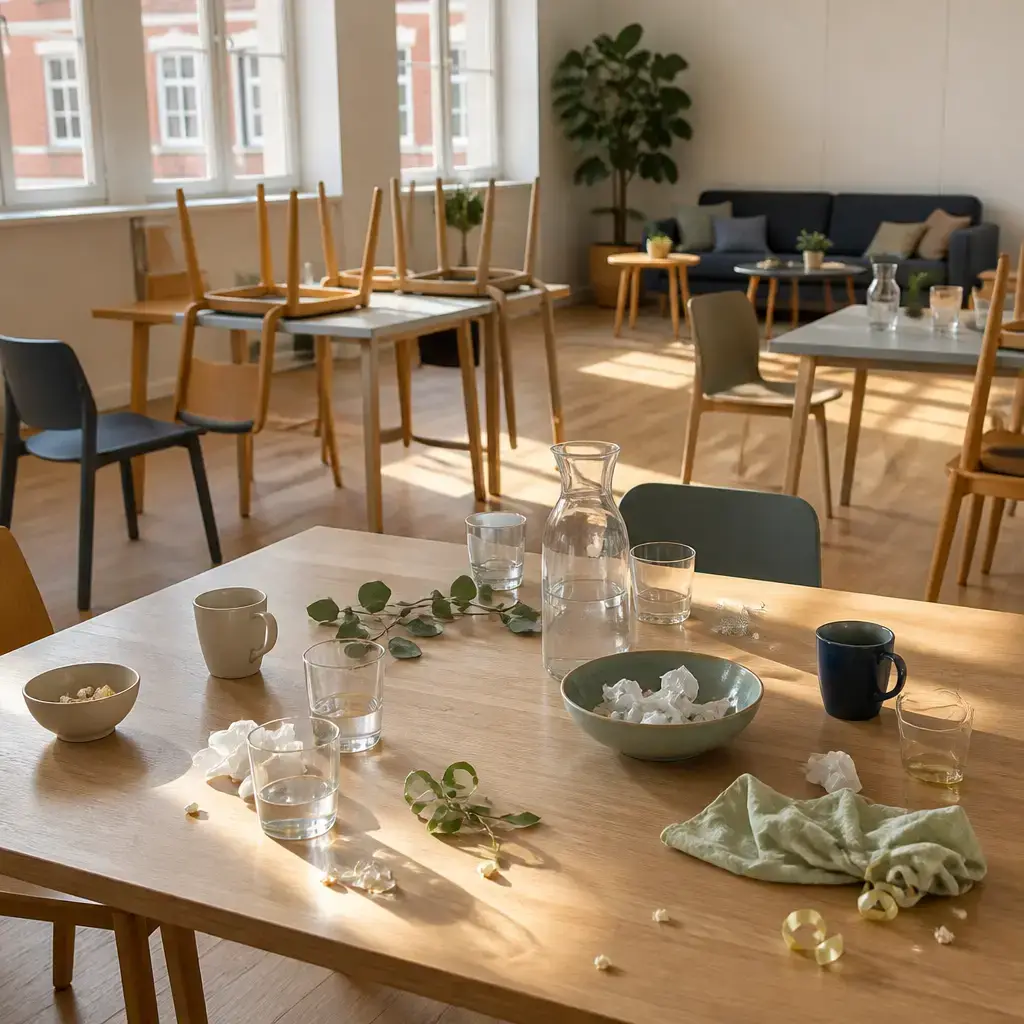
Der Gemeinschaftsraum sieht nach der Veranstaltung unordentlich aus.
dehr guh-MINE-shahfts-rowm zeet nahkh dehr fehr-AN-shtahl-toong oon-ORD-nunt-likh ows. The common room looks messy after the event.Wir müssen ihn sauber machen, weil wir ihn reserviert haben.
veer MEWSS-en een ZOW-ber MAKH-en, vile veer een reh-zehr-VEERT HAH-ben. We need to clean it because we reserved it.Lass uns eine Checkliste benutzen, damit wir nichts übersehen.
lahss oons EYE-nuh CHECK-lis-tuh beh-NOOT-sen, dah-MIT veer nikhts EW-ber-ZEH-en. Let's use a checklist so we don't miss anything.Ich kann den Müll einsammeln, und du kannst die Stühle wieder hinstellen.
ikh kahn dehn MEWL EYN-zahm-meln, oont doo kahnst dee SHTEW-luh VEE-der HIN-shtel-len. I can collect the trash, and you can put the chairs back.Sollen die Tische wieder so stehen wie vorher?
ZOL-len dee TISH-uh VEE-der zoh SHTEH-en vee for-HAIR? Should the tables go back the way they were?Die nächste Gruppe wird den üblichen Aufbau erwarten.
dee NEKH-stuh GROO-puh veert dehn EW-blih-khen OWF-bow ehr-VAR-ten. The next group will expect the usual setup.Ich schaue auch nach, ob jemand persönliche Sachen liegen gelassen hat.
ikh SHOW-uh owkh nahkh, ohp YEH-mant per-ZURN-lih-khuh ZAH-khen LEE-gen guh-LASS-en hat. I'll also check whether anyone left personal items behind.Ladegeräte und Notizbücher vergisst man leicht.
LAH-duh-guh-RAY-tuh oont noh-TEETS-bew-kher fehr-GISST mahn likeht. Chargers and notebooks are easy to forget.Der Raum ist jetzt wieder bereit.
dehr rowm ist yetst VEE-der beh-RITE. The room looks ready now.Wenn wir den Raum sauber hinterlassen, sollte es leichter sein, ihn wieder zu buchen.
ven veer dehn rowm ZOW-ber HIN-ter-lass-en, ZOL-tuh ess LIKEH-ter zine, een VEE-der tsoo BOO-khen. Leaving it clean should make it easier to book again.Sentence explanations
Der Gemeinschaftsraum sieht nach der Veranstaltung unordentlich aus.
The common room looks messy after the event.
- Gemeinschaftsraum
- common room
- sieht … aus
- looks; seems
- nach
- after
- Veranstaltung
- event
- unordentlich
- messy
More detail
Gemeinschaftsraum means “common room.” It is a compound noun: Gemeinschaft (“community”) + Raum (“room”), but the combined word names a shared room. As a German noun, it is masculine: der Gemeinschaftsraum; its plural is die Gemeinschaftsräume. sieht ... aus is the separated form of aussehen (“to look; to appear”). In the present tense, sieht agrees with the subject and aus moves to the end of the clause: Der Raum sieht ... aus (“The room looks ...”). The form sieht is the third-person singular present form of sehen; aus is part of the verb, not a separate preposition here. Example: Das Essen sieht gut aus. — “The food looks good.” nach means “after” here and introduces a time expression. In this use, nach governs the dative, so the phrase is nach der Veranstaltung. This is not dependent on the noun being definite; here, der is the dative feminine form of the definite article. The temporal use is distinct from other uses of nach, such as direction in nach Berlin (“to Berlin”). Veranstaltung means “event” or “organized event.” It is feminine: die Veranstaltung; after dative nach, the article becomes der: nach der Veranstaltung. Its plural is die Veranstaltungen. Example: Nach der Veranstaltung gehen wir nach Hause. — “After the event, we go home.” unordentlich means “messy” or “untidy.” It is a descriptive adjective. In sieht ... unordentlich aus, it appears after the linking verb aussehen as a predicate adjective, so it has no adjective ending: Der Raum ist unordentlich (“The room is messy”). Its opposite is ordentlich (“tidy; orderly”). Together, Der Gemeinschaftsraum is the subject, sieht ... aus says how it appears, unordentlich describes that appearance, and nach der Veranstaltung specifies when. The complete meaning is: “The common room looks messy after the event.”
Wir müssen ihn sauber machen, weil wir ihn reserviert haben.
We need to clean it because we reserved it.
- Wir müssen
- we need to
- ihn
- it
- sauber
- clean
- machen
- make; do
- weil
- because
- reserviert
- reserved
- haben
- have
More detail
Wir müssen expresses “we need to / must.” müssen is the modal verb müssen; with wir, its present-tense form is müssen. A modal verb is followed by the other verb in the infinitive: Wir müssen arbeiten = “We need to work.” ihn means “it” here and is the accusative form of the masculine personal pronoun: er → ihn. The surrounding context identifies the common room, der Gemeinschaftsraum, as the thing being cleaned and reserved. The accusative form marks it as the object of the action. sauber means “clean.” In sauber machen, it describes the result: to make something clean. The adjective itself remains sauber; it does not take an ending in this construction. Example: Wir machen den Tisch sauber. — “We clean the table.” machen means “make” or “do”; here it is the infinitive “make” in the reusable pattern [object] sauber machen = “to clean [object].” Because müssen is present, machen appears at the end of the main clause. weil introduces the reason for the main clause and sends the finite verb to the end of its subordinate clause. The pattern is ..., weil [subject] ... [finite verb]: ..., weil wir müde sind = “..., because we are tired.” reserviert is the past participle of the verb reservieren, “to reserve.” Here it means that the reservation happened before the present need to clean. The participle is used with the auxiliary haben to form the perfect: wir haben ... reserviert = “we reserved ...” haben is the auxiliary verb “have.” With wir, its present form is haben. In this weil clause, the perfect construction places the participle before the auxiliary at the end: weil wir ihn reserviert haben = “because we reserved it.” Together, Wir müssen ihn sauber machen means “We need to clean it.” weil wir ihn reserviert haben gives the reason: “because we reserved it.” The complete utterance is therefore “We need to clean it because we reserved it.”
Lass uns eine Checkliste benutzen, damit wir nichts übersehen.
Let's use a checklist so we don't miss anything.
- Lass uns
- let’s
- eine
- a
- Checkliste
- checklist
- benutzen
- use
- damit
- so that
- nichts
- nothing
- übersehen
- miss
More detail
Lass uns is a reusable German suggestion pattern: Lass uns + infinitive means “Let’s …”. Lass is the singular imperative of lassen, addressed to one person; the whole construction proposes a joint action with uns (“us”). With a plural addressee, German uses Lasst uns …. Example: Lass uns anfangen. — “Let’s start.” eine belongs to Checkliste: Checkliste is a feminine noun, and here it is singular accusative because it is the object of benutzen. The article reflects feminine singular accusative; it does not by itself assert a numerical count as a teaching point. The useful contrast is eine Checkliste (feminine singular) and ein Formular (neuter singular), where the indefinite article changes with the noun’s grammatical gender. Checkliste means “checklist”. It is a feminine noun: die Checkliste, plural die Checklisten. German compounds such as this one are written as one word. Example: Die Checkliste ist kurz. — “The checklist is short.” benutzen is the infinitive “to use”. In Lass uns … benutzen, it follows the Lass uns suggestion pattern and names the proposed action. Its ordinary present-tense forms include ich benutze, du benutzt, and wir benutzen; the infinitive remains benutzen after this construction. Example: Wir benutzen den Plan. — “We use the plan.” damit introduces a purpose clause, here “so that”. In a damit clause, the finite verb normally goes to the end: damit wir nichts übersehen (“so that we do not overlook anything”). Damit is different from dazu: damit introduces the clause expressing the purpose, while dazu is an adverb meaning roughly “for that” and does not introduce a finite subordinate clause in the same way. nichts is the indefinite pronoun “nothing” and, in this clause, is the object of übersehen. It expresses the negative indefinite meaning directly, so German does not need a separate nicht before it. Example: Ich sehe nichts. — “I see nothing.” übersehen is the infinitive “to overlook” or “to miss” in this context: failing to notice something. Here it is not the separate sense “to survey” or “to have a view over something”; the purpose clause concerns avoiding missed items. Example: Wir dürfen keinen Schritt übersehen. — “We must not overlook any step.” Together, Lass uns eine Checkliste benutzen proposes that the speaker and the addressed person use a checklist. damit wir nichts übersehen gives the purpose: the checklist is intended to help them avoid overlooking anything. The complete meaning is therefore “Let’s use a checklist so we don’t miss anything.”
Ich kann den Müll einsammeln, und du kannst die Stühle wieder hinstellen.
I can collect the trash, and you can put the chairs back.
- Ich kann
- I can
- Müll
- trash
- einsammeln
- collect
- du kannst
- you can
- Stühle
- chairs
- wieder hinstellen
- put back
More detail
Ich kann means “I can.” können is the modal verb used here for ability; kann is its present-tense form with ich. After a modal verb, the other verb normally remains an infinitive at the end of the clause. Example: Ich kann helfen. — “I can help.” den Müll means “the trash.” Müll is a masculine mass noun, and den is the masculine accusative form of the definite article because the trash is what is being collected. The sentence does not assert a count of separate items. einsammeln means “to collect” or “gather up.” It is a separable verb built from ein- and sammeln; after kann, its infinitive stays together: Ich kann den Müll einsammeln. In a finite clause without a modal, the prefix separates: Ich sammle den Müll ein. — “I collect the trash.” du kannst means “you can.” kannst is the present-tense form of können with du: ich kann, but du kannst. die Stühle means “the chairs.” Stühle is the plural of Stuhl (“chair”), with the vowel change u to ü. The article die is used for plural subjects and objects, so its form does not show the case distinction here. wieder hinstellen means “put back.” wieder adds the idea of doing something again or returning it to an earlier placement. hinstellen means “put or set [something] in a standing position” and is separable. In a finite clause it appears as Du stellst die Stühle wieder hin. — “You put the chairs back.” After the modal, the infinitive remains together: Du kannst die Stühle wieder hinstellen. — “You can put the chairs back.” The first clause combines Ich, kann, den Müll, and einsammeln to mean “I can collect the trash.” und links it to the second clause. There, du kannst expresses that you can put die Stühle back, and wieder hinstellen describes returning them to their earlier placement. Together, the utterance means: “I can collect the trash, and you can put the chairs back.”
Sollen die Tische wieder so stehen wie vorher?
Should the tables go back the way they were?
- Sollen die
- Should the …?
- Tische
- tables
- wieder
- again; back
- so
- like this; that way
- stehen
- stand; be standing
- wie vorher
- as before
More detail
Sollen die combines the present-tense form sollen with the subject phrase die Tische and starts a yes/no question. Here sollen asks whether something is intended or should happen; it is not a statement that the tables actually will do it. The modal verb uses the infinitive stehen at the end of the clause. For example: Soll ich anfangen? — “Should I start?” Tische means “tables” here. Its singular base form is der Tisch; Tische is the plural form. The article also shows the plural here: die Tische. Example: Die Tische stehen draußen. — “The tables are standing outside.” wieder means “back” in this sentence because the question concerns returning the tables to an earlier arrangement. It can also mean “again” when an action is repeated. Example: Wir treffen uns wieder morgen. — “We are meeting again tomorrow.” The exact sense comes from the surrounding idea of restoring a previous position. so means “that way” or “like this” and points to a manner or arrangement. It does not identify the arrangement by itself; wie vorher supplies the comparison. Example: Stell die Stühle so. — “Put the chairs that way.” stehen means “stand” or “be standing.” In this utterance it describes the tables' resulting position or arrangement, rather than the action of putting them there. Its base form is stehen; the present forms include ich stehe and sie stehen. Compare stellen, “to put or place [something] upright,” which focuses on an action: Die Tische stehen dort. — “The tables are standing there.” wie vorher means “as before.” wie introduces the comparison, and vorher means “before” or “previously.” Together they refer to the earlier arrangement without specifying its details. Example: Alles ist wieder wie vorher. — “Everything is the way it was before.” Taken together, the modal question Sollen ... stehen asks whether the tables are supposed to be in a particular position. wieder so ... wie vorher adds that the intended position is the same as the earlier one, so the whole utterance means: “Should the tables go back the way they were?”
Die nächste Gruppe wird den üblichen Aufbau erwarten.
The next group will expect the usual setup.
- nächste
- next
- Gruppe
- group
- wird
- will
- den
- the
- üblichen
- usual
- Aufbau
- setup
- erwarten
- expect
More detail
nächste describes the group as the next one in the relevant sequence. Its base form is nächst-; here it has the ending -e because it is an adjective before the feminine nominative noun Gruppe after the definite article die. Example: die nächste Woche — “next week.” Gruppe means “group.” It is a feminine noun, so its nominative singular article is die: die Gruppe. Its plural is Gruppen; for example, Die Gruppen warten. — “The groups are waiting.” wird is the third-person singular present form of werden, used here as the future auxiliary “will.” The infinitive that it supports, erwarten, appears at the end of the sentence. Example: Sie wird kommen. — “She will come.” Werden can also mean “become” in other constructions, but that is not its meaning here. den is the definite article “the” in the masculine accusative singular. It marks Aufbau as the direct object of erwarten; it does not state a quantity. The corresponding nominative masculine form is der, as in der Aufbau. üblichen means “usual” here. Its base form is üblich; the ending -en appears because the adjective modifies the masculine accusative noun Aufbau after den: den üblichen Aufbau. Example: Wir folgen dem üblichen Ablauf. — “We follow the usual procedure.” Aufbau is a masculine noun meaning “setup” here, and can also refer to structure or organization in other contexts. Its definite nominative form is der Aufbau, while the masculine accusative form is den Aufbau. erwarten is the infinitive “to expect.” It takes the expected person or thing as a direct object, so the expected setup is expressed by den üblichen Aufbau. Example: Die Gäste erwarten eine Antwort. — “The guests expect an answer.” Together, Die nächste Gruppe is the subject, wird ... erwarten forms the future meaning “will expect,” and den üblichen Aufbau is the expected object. The whole utterance means: “The next group will expect the usual setup.”
Ich schaue auch nach, ob jemand persönliche Sachen liegen gelassen hat.
I'll also check whether anyone left personal items behind.
- Ich
- I
- schaue … nach
- check; look into
- auch
- also
- ob
- whether
- jemand
- anyone; someone
- persönliche
- personal
- Sachen
- things; items
- liegen gelassen
- left behind
- hat
- has
More detail
Ich means “I” here. It is the first-person singular personal pronoun. Its form does not change for grammatical gender; gender distinctions apply to some third-person forms, not to Ich. schaue ... nach comes from the separable verb nachschauen, “to check” or “to look into.” schaue is its present-tense first-person singular form, while the particle nach appears separately at the end of the main clause. Example: Ich schaue später nach. — “I’ll check later.” auch means “also” or “too.” It adds this checking action to something already relevant, without changing who performs it or when it occurs. ob introduces an indirect yes/no question: “whether.” In the clause introduced by ob, the finite verb appears at the end. This differs from wenn, which commonly means “if” or “when” and does not simply mark an indirect question. jemand means “someone” or, in this question, “anyone.” It refers to an unspecified person; the sentence does not identify who that person is. Example: Jemand hat angerufen. — “Someone called.” persönliche means “personal” here. It is the adjective persönlich, with the ending -e because it modifies the plural noun Sachen in this articleless accusative noun phrase. The adjective describes the items as personal, rather than naming a particular owner. Sachen means “things” or “items.” It is the plural of Sache (“thing” or “item”). Here it is the object of the leaving-behind action: the items are what may have been left behind. liegen gelassen expresses “left lying” or, naturally here, “left behind.” It is the participial form of liegen lassen, literally “to leave [something] lying.” In this sentence it refers to items that someone failed to take with them. Example: Sie hat den Schlüssel liegen gelassen. — “She left the key behind.” hat is the present-tense third-person singular form of haben (“to have”). Here it is the auxiliary in the perfect construction liegen gelassen hat; the completed event is presented as occurring before the checking being described. The subordinate clause ends with this auxiliary, following the German verb-final pattern after ob. Together, Ich schaue auch nach means “I’ll also check.” It is followed by ob, which makes an indirect yes/no question: jemand persönliche Sachen liegen gelassen hat — “anyone left personal items behind.” The complete utterance therefore means: “I’ll also check whether anyone left personal items behind.”
Ladegeräte und Notizbücher vergisst man leicht.
Chargers and notebooks are easy to forget.
- Ladegeräte
- chargers
- Notizbücher
- notebooks
- vergisst
- forgets
- man
- one; people
- leicht
- easy
More detail
Ladegeräte means “chargers” here. Its singular base form is das Ladegerät; Ladegeräte is the plural. In this sentence it is one of the things being forgotten, so it is a fronted accusative object, not the grammatical subject. Notizbücher means “notebooks.” The singular base form is das Notizbuch, and Notizbücher is its plural. Like Ladegeräte, it is part of the coordinated object placed at the beginning of the sentence. vergisst comes from vergessen, “to forget.” It is the present-tense third-person singular form: man vergisst. The vowel changes from e in vergessen to i in vergisst. Example: Man vergisst leicht den Schlüssel. — “People easily forget the key.” man is the generic pronoun for “one” or “people” in general. It is grammatically singular, so the verb is singular: man vergisst, not a plural verb. It does not identify a particular person. leicht means “easily” in this sentence. Here it functions as an adverb describing how readily the forgetting happens. The adjective leicht can also mean “easy” when it describes a noun, as in eine leichte Aufgabe — “an easy task.” Together, Ladegeräte und Notizbücher is the fronted object, vergisst man says “one forgets,” and leicht says that this happens easily. The whole utterance therefore means: “Chargers and notebooks are easy to forget.”
Der Raum ist jetzt wieder bereit.
The room looks ready now.
- Raum
- room
- ist
- is
- jetzt
- now
- wieder
- again
- bereit
- ready
More detail
Raum means “room” here. Its base form is der Raum; the plural is die Räume, with an umlaut and a changed ending. Raum is masculine, and der is used here because this is a definite, masculine, singular subject in the nominative. Example: Der Raum ist groß. — “The room is large.” ist is the third-person singular present form of sein (“to be”): sein → ist. It agrees with the singular subject Der Raum. Here it links the room to the adjective bereit, expressing the room’s state. Example: Der Raum ist frei. — “The room is available.” jetzt is the time adverb “now.” It places the room’s readiness in the present. Example: Jetzt ist der Raum frei. — “Now the room is available.” wieder means “again” or “once more.” Here it indicates a return to a ready state. Example: Der Raum ist wieder frei. — “The room is available again.” bereit is an adjective meaning “ready.” After sein, it is predicative and has no adjective ending: Der Raum ist bereit. For the opposite meaning, ordinary German commonly uses nicht bereit (“not ready”). Example: Wir sind bereit. — “We are ready.” Together, Der Raum is the singular subject, ist states its condition, jetzt places that condition in the present, and wieder bereit means “ready again.” The German utterance directly says “The room is ready again now.” The fixed English translation, “The room looks ready now,” conveys the intended meaning while leaving the repeated-state nuance of wieder less explicit.
Wenn wir den Raum sauber hinterlassen, sollte es leichter sein, ihn wieder zu buchen.
Leaving it clean should make it easier to book again.
- Wenn wir
- if we
- Raum
- room
- sauber
- clean
- hinterlassen
- leave behind
- sollte
- should
- leichter
- easier
- sein
- be
- wieder
- again
- buchen
- book
More detail
Wenn wir introduces a subordinate conditional clause: wenn means “if/when,” and wir is the first-person plural pronoun “we.” A reusable pattern is Wenn wir ..., ... = “If we ..., ...”. The verb in this clause is placed at the end: Wenn wir den Raum sauber hinterlassen. den Raum means “the room.” Raum is a masculine noun; its definite article is der in the basic form, but den here marks the masculine accusative object of hinterlassen. The preceding context supports this as the room that is ready again. sauber means “clean.” Here it describes the condition in which the room is left: “leave the room clean.” German can use an adjective after an object in this way to describe the resulting state. Example: Sie lässt die Tür offen. — “She leaves the door open.” hinterlassen is the infinitive/base form meaning “to leave behind” or “to leave something in a particular condition.” With wir in the present tense, the form is also hinterlassen: wir hinterlassen. It is different from simply “to go away,” which is commonly expressed by weggehen. sollte is the third-person singular form of sollen in the form used here. With es, it conveys “should,” presenting the result as expected or appropriate. The form sollte can also be used in other contexts as the past or subjunctive form of sollen; its meaning depends on the construction. leichter is the comparative form of leicht (“easy” or “light”): leicht → leichter → am leichtesten. It means “easier” here. The comparison is with an understood alternative or standard; the sentence does not specify exactly what that standard is. The adjective is leichter; it is not derived from or inflected by Raum. sein is the infinitive “to be.” After sollte, the infinitive remains at the end of its clause: sollte ... sein = “should be ...”. The predicate is leichter sein, “be easier.” ihn is the masculine accusative form of er (“he/it” for a masculine noun). Here it refers to den Raum, so ihn means “it” in “book it again.” The form reflects the pronoun’s masculine grammatical class and its object role: er (subject), ihn (accusative object). wieder means “again,” indicating a repeated booking. zu buchen is the infinitive construction “to book.” buchen is the base verb; with zu, it forms zu buchen. Together, ihn wieder zu buchen means “to book it again.” In es sollte leichter sein, ihn wieder zu buchen, es is an expletive or formal subject in the construction es ist/sollte ..., rather than a pronoun referring to the room. The following infinitive phrase states what is easier: ihn wieder zu buchen. The complete structure is Wenn wir den Raum sauber hinterlassen, sollte es leichter sein, ihn wieder zu buchen. The conditional clause says “If we leave the room clean”; the main clause says that booking the room again should then be easier. Thus the intended meaning is: “Leaving it clean should make it easier to book again.”
Grammar Points
nachschauen: schaue ... nach
Ich schaue vorher nach.
ikh SHOW-uh for-HAIR nahkh.I check beforehand.
With separable verbs, the prefix moves to the end of the main clause: schaue ... nach.
zu + Infinitiv
Es ist leichter, den Gemeinschaftsraum zu buchen.
ess ist LIKEH-ter, dehn guh-MINE-shahfts-rowm tsoo BOO-khen.It is easier to book the common room.
zu + infinitive expresses an action connected to an adjective such as leichter.
German Vocabulary
Quiz
Word Order
Arrange the words in the correct order.
Chargers and notebooks are easy to forget.
Show Answer
Ladegeräte und Notizbücher vergisst man leicht.The room looks ready now.
Show Answer
Der Raum ist jetzt wieder bereit.Spelling
Tap the letters to spell the word.
trash; rubbish
Show Answer
Müllto use
Show Answer
benutzento reserve
Show Answer
reserviertto overlook; to miss