10 minutes free every day
Continue audio lessons in the app
Word explanations appear automatically in sync with the audio.
No login required · synced translations · playback with the screen locked
Choose your learning language and open this lesson in the app.

About This Lesson
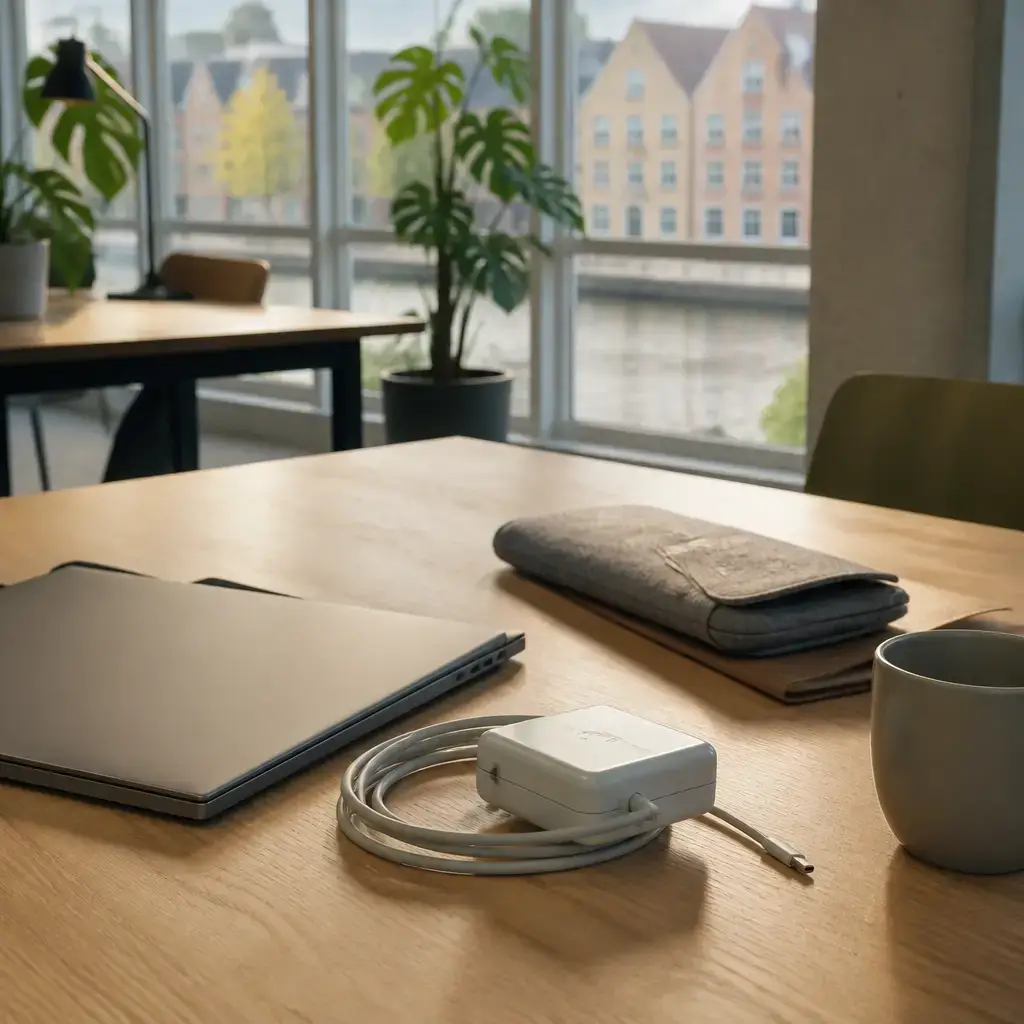
Use Borrowing a charger while confirming its return to practice German conversation, pronunciation, vocabulary, grammar, and quizzes.
Dialogue
Ich habe mein Ladegerät woanders liegen lassen, und der Akku meines Laptops ist fast leer.
ikh HAH-buh mine LAH-duh-guh-RAIT voh-AHN-ders LEE-gun LAH-sun, oont dair AH-koo MY-nus LAP-tops ist fahst lair. I left my charger elsewhere and my laptop battery is nearly empty.Meins sollte passen, vorausgesetzt, dein Anschluss hat den neueren Stecker.
mines ZHOL-tuh PAH-sun, fohr-OWS-guh-ZETST dine port oozes dair NOY-uh-run SHTEK-er. Mine should fit, provided your port uses the newer connector.Das ist der Fall, obwohl ich das Ladegerät nur für diesen Upload brauche.
dahs ist dair fahl, ohb-VOHL ikh dahs LAH-duh-guh-RAIT noor fewr DEE-zun OOP-lowt BROW-khuh. It does, although I only need it during this upload.Das lässt sich einrichten, da mein Computer bereits vollständig geladen ist.
dahs LESST zikh EYE-nrikh-tun, dah mine kom-PYOO-ter buh-RAITS FOLL-shtend-ikh guh-LAH-dun ist. That is manageable, since my computer is already fully charged.Ich kann es zurückgeben, sobald die Dateien vollständig synchronisiert sind.
ikh kahn ess tsoo-ROOK-gay-bun, zoh-BAHLD dee dah-TYE-un FOLL-shtend-ikh zyn-khroh-nee-ZEERT zint. I can give it back as soon as the files finish synchronizing.Bitte lass es in der Nähe, weil ich es später vielleicht brauche.
BIT-tuh lahss ess in dair NAY-uh, vile ikh ess SHPAY-ter fee-LYKH BROW-khuh. Please keep it nearby, because I may need it later.Ich kann in der Nähe bleiben, damit du es leicht zurückbekommst.
ikh kahn in dair NAY-uh BLY-bun, dah-MIT doo ess light tsoo-ROOK-buh-KOMST. I can stay close by so you can get it back easily.So funktioniert es, ohne dass einer von uns unterbrochen wird.
zoh foonk-tsee-oh-NEERT ess, OH-nuh dahss EYE-ner fon oons oon-ter-BROKH-un veert. That arrangement works without interrupting either of us.Sentence explanations
Ich habe mein Ladegerät woanders liegen lassen, und der Akku meines Laptops ist fast leer.
I left my charger elsewhere and my laptop battery is nearly empty.
- Ich habe
- I have
- Ladegerät
- charger
- woanders
- elsewhere
- liegen lassen
- leave behind
- Akku
- battery
- Laptops
- laptop
- fast
- nearly
- leer
- empty
More detail
Ich habe is the first-person singular present form of haben used here as the auxiliary for a completed past construction. The subject is ich (“I”); habe agrees with that subject. In German perfect constructions, the auxiliary is conjugated while the main verb forms remain at the end. Example: Ich habe ihn gesehen. — “I saw him.” Ladegerät means “charger,” specifically a device used to charge something. In mein Ladegerät, mein means “my” and has the neuter singular form required by das Ladegerät; the full noun phrase is the object of the verb construction. Example: Mein Ladegerät ist zu Hause. — “My charger is at home.” woanders means “elsewhere” or “somewhere else.” It gives an unspecified location and does not identify where that location is. Example: Der Schlüssel liegt woanders. — “The key is somewhere else.” liegen lassen is a reusable verb construction meaning “to leave something lying” or, in this context, “to leave something behind.” Its two parts occur together here as the infinitive phrase after the auxiliary: Ich habe ... liegen lassen. The construction uses liegen (“lie/be lying”) plus lassen (“let/leave”); it is not the same as simply liegen (“be lying”). In the perfect with this construction, German keeps the two infinitives at the end rather than using a participle for lassen. Example: Ich habe das Buch im Zug liegen lassen. — “I left the book on the train.” Akku means “battery,” especially a rechargeable battery. Here der Akku is the subject of the second clause. Example: Der Akku ist leer. — “The battery is empty.” Laptops is the genitive singular form of Laptop, meaning “of the laptop.” The ending -s marks the genitive here; meines Laptops means “of my laptop.” The possessive form meines agrees with the masculine noun Laptop in the genitive singular. Example: Die Tasche meines Laptops ist schwarz. — “My laptop’s bag is black.” fast means “nearly” or “almost.” It modifies leer and shows that the battery is close to being empty, not necessarily completely empty. Example: Der Akku ist fast voll. — “The battery is almost full.” leer means “empty.” Here it is a predicative adjective after ist, describing the condition of der Akku; fast leer means “nearly empty.” Example: Die Flasche ist leer. — “The bottle is empty.” The first clause, Ich habe mein Ladegerät woanders liegen lassen, combines “I,” the perfect auxiliary habe, the object mein Ladegerät, the location adverb woanders, and liegen lassen: “I left my charger somewhere else.” The conjunction und joins it to the second clause, der Akku meines Laptops ist fast leer: “my laptop battery is nearly empty.” Together, the utterance says: “I left my charger elsewhere and my laptop battery is nearly empty.”
Meins sollte passen, vorausgesetzt, dein Anschluss hat den neueren Stecker.
Mine should fit, provided your port uses the newer connector.
- Meins
- mine
- sollte
- should
- passen
- fit
- vorausgesetzt
- provided that
- Anschluss
- port
- hat
- has
- neueren
- newer
- Stecker
- connector
More detail
Meins is a standalone possessive pronoun meaning “mine.” In this sentence it refers to the charger mentioned in the context; Ladegerät is neuter, and the neuter standalone form is meins. Compare the attributive form mein Ladegerät (“my charger”) with Das Ladegerät ist meins (“The charger is mine”). Sollte is the form of sollen used here for a cautious expectation: “should.” It is followed by the infinitive passen. Sollte is not the simple present soll (“is supposed to/should” in a more direct formulation). The pattern etwas sollte passen is useful for saying that something is expected to fit or work. Passen means “to fit” here. It is a regular verb, with forms such as ich passe, du passt, and the infinitive passen. Example: Der Stecker passt. — “The connector fits.” Vorausgesetzt introduces a condition and means “provided that” or “assuming that.” In this sentence it begins the condition on which the expected fit depends. A reusable pattern is vorausgesetzt, dass ...; German can also use vorausgesetzt directly before a clause, as here. Anschluss means “port” here, in the sense of a connection socket or interface. Its plural is Anschlüsse. In the conditional clause, dein Anschluss is the subject, so the clause is about what the port has or accepts, not about who owns the connector. Hat is the third-person singular present form of haben (“to have”): ich habe, du hast, er/sie/es hat. Here it describes the port as having the newer connector. Because this is a subordinate conditional clause, the finite verb appears at the end: dein Anschluss hat den neueren Stecker. Neueren is the comparative form of neu (“new”): neu → neuer (“newer”) → am neuesten (“newest”). The ending -en belongs to neueren, not to Stecker. It appears here because the adjective modifies masculine accusative Stecker after den: den neueren Stecker. Example: Ich nehme den neueren Adapter. — “I’ll take the newer adapter.” Stecker means “connector” or “plug.” Its plural is Stecker; the form is identical in the singular and plural, while the article distinguishes them in many contexts. Here den Stecker is the masculine accusative object of hat. Together, Meins sollte passen means “Mine should fit.” The condition vorausgesetzt, dein Anschluss hat den neueren Stecker specifies that this expectation holds provided that the listener’s port has the newer connector. The full utterance therefore means: “Mine should fit, provided your port uses the newer connector.”
Das ist der Fall, obwohl ich das Ladegerät nur für diesen Upload brauche.
It does, although I only need it during this upload.
- Das ist der Fall
- That is the case
- obwohl ich
- although I
- das Ladegerät
- the charger
- nur
- only
- für
- for
- diesen
- this
- Upload
- upload
- brauche
- need
More detail
Das ist der Fall is a reusable German expression meaning “That is the case.” Das is a neuter singular demonstrative pronoun here, referring to the situation asserted in the surrounding context; ist is the present-tense third-person singular form of sein (“to be”). The fixed translation confirms the intended meaning as an affirmative reference to that situation, not a literal physical “case.” obwohl ich introduces a subordinate clause meaning “although I.” Obwohl marks a contrast: the following information is true despite what was just stated. In a German subordinate clause introduced by obwohl, the finite verb normally goes to the end. Ich is the first-person singular subject, “I.” das Ladegerät means “the charger.” Ladegerät is a neuter compound noun, so its nominative and accusative singular article is das; here it is the accusative object of brauche. The compound is built from laden (“to charge”) and Gerät (“device”), but Ladegerät is learned as the noun for a charger. Example: Ich suche das Ladegerät. — “I am looking for the charger.” nur means “only” and limits the following purpose or use: the speaker needs the charger for this upload, rather than asserting a broader need. Its exact scope is understood from the clause as a whole. für means “for.” This preposition takes the accusative case in this use. It can mark the intended purpose or occasion of something: Das ist für den Computer. — “That is for the computer.” diesen means “this” in the masculine accusative singular form. It agrees with Upload, which is masculine in German: der Upload; after für, the accusative form is diesen. The form chain is dieser (masculine nominative), diesen (masculine accusative), and diesem (masculine or neuter dative). This demonstrative identifies the upload intended here; it does not itself state a numerical count. Upload is a masculine noun meaning “upload,” a transfer of data to an online service or system. In this sentence it is the object of für, so the phrase is für diesen Upload (“for this upload”). brauche is the first-person singular present-tense form of brauchen, “to need.” In the obwohl subordinate clause it appears at the end: obwohl ich ... brauche. The subject ich determines the form; compare ich brauche (“I need”) with du brauchst (“you need”). Example: Ich brauche Zeit. — “I need time.” Together, Das ist der Fall states that the relevant situation is indeed the case. Obwohl ich das Ladegerät nur für diesen Upload brauche then adds the contrasting fact that the speaker needs the charger only for this upload. The complete meaning is: “It does, although I only need it during this upload.”
Das lässt sich einrichten, da mein Computer bereits vollständig geladen ist.
That is manageable, since my computer is already fully charged.
- Das
- that
- lässt sich einrichten
- is manageable
- Computer
- computer
- bereits
- already
- vollständig
- fully; completely
- geladen
- charged
More detail
Das is a neuter singular demonstrative pronoun meaning “that” here. It points to the matter being discussed, without naming that matter in this sentence. As a pronoun, its form reflects grammatical gender and number, not a claim about the real-world gender of the referent. Compare das “that” with dieses “this” when greater proximity is intended. lässt sich einrichten is a reusable German construction meaning that something can be arranged or managed. lässt is the third-person singular present form of lassen; einrichten is the infinitive, and sich marks the reflexive construction. The pattern Das lässt sich + infinitive is useful for saying that a proposed arrangement is feasible, for example: Das lässt sich erklären. — “That can be explained.” This is a construction-level meaning, not the literal meaning “lets itself arrange.” Computer is the noun “computer.” Its base form is Computer; in the sentence it appears with the masculine singular possessive phrase mein Computer. The noun is the subject of the later clause: the computer is the thing described as charged. German commonly uses the same loanword in everyday contexts. bereits means “already” and places the state before the relevant reference point. It is an adverb, so it does not change form for the noun. Compare schon, another common word for “already”; bereits can sound somewhat more formal or neutral. vollständig means “fully” or “completely” here and modifies the state expressed by geladen. It is the adjective/adverbial form of vollständig, “complete.” In vollständig geladen, it specifies the degree of charging: the computer is charged completely, not merely partly. geladen is the past participle of laden in the relevant sense, “to charge.” With ist, it describes the computer’s resulting state: ist geladen means “is charged.” In this sentence, geladen is not the finite verb; ist carries present tense and agrees with singular mein Computer. The same participle can occur in other contexts with a different sense of laden, so the fixed translation establishes the charging sense here. The clause after da gives the reason and has German subordinate-clause word order: da mein Computer bereits vollständig geladen ist — “since my computer is already fully charged.” Within it, mein Computer is the subject, bereits marks the prior state, vollständig geladen describes that state, and ist comes at the end because of da. Together, Das lässt sich einrichten says that the matter can be managed, while da mein Computer bereits vollständig geladen ist gives the reason: the speaker’s computer already has a full charge. The complete utterance therefore means: “That is manageable, since my computer is already fully charged.”
Ich kann es zurückgeben, sobald die Dateien vollständig synchronisiert sind.
I can give it back as soon as the files finish synchronizing.
- Ich kann
- I can
- es
- it
- zurückgeben
- give back
- sobald
- as soon as
- Dateien
- files
- vollständig
- fully
- synchronisiert
- synchronized
More detail
Ich kann: This is “I can”; kann is the present-tense first-person singular form of können. A modal verb such as können is followed here by an infinitive, so the infinitive appears at the end of the main clause. Example: Ich kann helfen. — “I can help.” es: This is an accusative singular neuter pronoun meaning “it” here. Its grammatical form is neuter singular, but the supplied sentence does not identify what the pronoun refers to. The accusative form marks it as the thing affected by zurückgeben. zurückgeben: This infinitive means “to give back” or “to return.” It is a separable verb built from zurück and geben, but after the modal kann it remains as one infinitive at the end of the main clause. Example: Ich möchte das Buch zurückgeben. — “I would like to return the book.” sobald: This subordinating conjunction means “as soon as.” It introduces a time clause and places that clause’s finite verb at the end. Pattern: sobald + subject + other information + finite verb. Dateien: This noun means “files” here. Its singular form is Datei, and Dateien is its plural form. The article die before it belongs to the noun phrase, while the selected word itself is the plural noun. Example: Die Dateien sind neu. — “The files are new.” vollständig: Here this word means “fully” or “completely” and describes the extent to which the files are synchronized. The same form can also be used as the adjective “complete,” depending on what it describes; in this sentence it functions adverbially with synchronisiert. synchronisiert: This form comes from the verb synchronisieren, “to synchronize.” Here it is a past participle used with sind in synchronisiert sind, describing the files as having reached the synchronized state. The finite form sind is at the end because this is a subordinate clause. Example: Die Daten sind synchronisiert. — “The data is synchronized.” Together, Ich kann es zurückgeben means “I can give it back.” The time clause sobald die Dateien vollständig synchronisiert sind means “as soon as the files are fully synchronized.” In the full utterance, the subordinate clause sets the condition in time for the main action: “I can give it back as soon as the files finish synchronizing.”
Bitte lass es in der Nähe, weil ich es später vielleicht brauche.
Please keep it nearby, because I may need it later.
- Bitte
- please
- lass
- keep; leave
- es
- it
- in der Nähe
- nearby; in the vicinity
- weil
- because
- ich
- I
- später
- later
- vielleicht
- perhaps; maybe
- brauche
- need
More detail
Bitte is a polite request word meaning “please.” It can appear at the beginning or elsewhere in a request. For example: Bitte warten Sie. — “Please wait.” lass is the informal singular imperative of lassen. Here lassen means “to leave” or “to keep” something in a place, so lass es means “keep/leave it.” The form lass addresses one person informally; it is not the form used for a formal or plural addressee. For example: Lass die Tür offen. — “Leave the door open.” es is a third-person singular pronoun, here corresponding to “it.” The fixed translation identifies the intended object as “it,” but does not specify what that object is. Its grammatical role is the object of lass and brauche. in der Nähe is a location phrase meaning “nearby” or “in the vicinity.” in combines with der Nähe here to describe a place where the object should remain. For example: Das Handy liegt in der Nähe. — “The phone is nearby.” weil introduces a reason clause and means “because.” In standard German, a finite verb usually goes to the end of a clause introduced by weil. This places brauche after the other elements of its clause. ich is the first-person singular pronoun “I.” It is the subject of brauche, so the speaker presents themself as the person who may need the object. später means “later,” referring to a time after the relevant present or current situation. For example: Ich mache das später. — “I’ll do that later.” vielleicht means “perhaps” or “maybe.” It marks the need as uncertain: the speaker may need the object, but does not assert that the need will definitely arise. For example: Vielleicht komme ich später. — “Maybe I’ll come later.” brauche is the first-person singular present form of brauchen, “to need.” The useful present-tense pattern is ich brauche; for example, Ich brauche Zeit. means “I need time.” In this sentence, vielleicht makes the meaning “I may need it,” rather than a definite statement of need. Together, Bitte lass es in der Nähe is a polite request to one person addressed informally: “Please keep it nearby.” The clause weil ich es später vielleicht brauche gives the reason, with weil sending the finite verb brauche to the end: “because I may need it later.” The complete utterance is therefore: “Please keep it nearby, because I may need it later.”
Ich kann in der Nähe bleiben, damit du es leicht zurückbekommst.
I can stay close by so you can get it back easily.
- Ich kann
- I can
- in der Nähe
- nearby
- bleiben
- stay
- damit
- so that
- du
- you
- es
- it
- leicht
- easily
- zurückbekommst
- get back
More detail
Ich kann means “I can” here: kann is the first-person singular present form of können, used for ability or possibility. With a modal verb, the other verb normally goes to the end of the main clause in the infinitive: Ich kann bleiben = “I can stay.” in der Nähe means “nearby” or “close by.” Nähe is a feminine noun; after in for a stationary location, German uses the dative, hence der in in der Nähe. Compare the reusable location contrast: in der Nähe = “nearby,” but in die Nähe = “to a nearby place,” with movement toward a location. bleiben means “to stay” or “to remain.” It is the infinitive required by kann. Example: Wir bleiben hier. — “We are staying here.” damit introduces a purpose clause, meaning “so that.” It is useful when the purpose clause has its own subject, as here: the main clause has Ich, while the purpose clause has du. In a damit clause, the finite verb goes to the end. du is the informal second-person singular subject form, “you.” The verb in its clause agrees with this subject: du ... zurückbekommst. es is the third-person singular neuter pronoun, “it,” and is the object of zurückbekommst here. Its specific real-world referent is not named in the fixed sentence; the translation confirms that it is the thing being got back. es can also serve other grammatical roles in German, so its form alone does not identify the referent. leicht means “easily” in this sentence. The same form can be the adjective “easy” when it describes a noun, as in the example eine leichte Aufgabe — “an easy task.” Here it describes how the action is performed, so it functions adverbially. zurückbekommst is the second-person singular present form of zurückbekommen, “to get back” or “to receive back.” The form is built from bekommen (“get/receive”) with zurück (“back”); in the subordinate clause, the finite verb appears together at the end: du bekommst es zurück becomes damit du es zurückbekommst. The -st ending marks du in the present tense. Example: Du bekommst dein Buch zurück. — “You get your book back.” Together, Ich kann in der Nähe bleiben says “I can stay nearby.” damit du es leicht zurückbekommst gives the purpose: “so that you can get it back easily.” The complete utterance is therefore: “I can stay close by so you can get it back easily.”
So funktioniert es, ohne dass einer von uns unterbrochen wird.
That arrangement works without interrupting either of us.
- So
- that way
- funktioniert
- works
- es
- it
- ohne dass
- without … happening
- einer von uns
- either of us
- unterbrochen wird
- is interrupted
More detail
So means “that way” here: it points back to the arrangement or method being discussed. It is a useful way to connect a previously described way of doing something with its result. funktioniert is the present-tense third-person singular form of funktionieren (“to work”, “to function”). The subject is es, so the singular form is used. For example: Das funktioniert. — “That works.” es is the pronoun “it” here, referring to the arrangement or method described in the fixed translation. In So funktioniert es, it is the subject: “That way, it works.” The form es itself does not show grammatical gender or plural number. ohne dass introduces a subordinate clause meaning “without … happening” or “without the fact that …”. It is followed by a clause rather than an infinitive construction. In this clause, the finite verb goes to the end: ohne dass … unterbrochen wird. einer von uns means “one of us”; in the fixed translation, the intended meaning is “either of us.” einer is singular, while uns is the dative form of wir after von: von uns means “of us” or “from us.” Because einer is singular, the passive auxiliary later appears as singular wird, despite uns referring to more than one person. unterbrochen wird is a present passive form. unterbrochen is the past participle of unterbrechen (“to interrupt”), and wird is the third-person singular present form of werden, used here as the passive auxiliary. Thus, the clause literally describes one of us being interrupted, while the whole ohne dass clause expresses that this does not happen. Compare: Er wird unterbrochen. — “He is interrupted.” Together, So funktioniert es says “That way, it works.” The following ohne dass clause adds the condition that one of the two people involved is not interrupted: “without either of us being interrupted.” The complete utterance is therefore: “That arrangement works without interrupting either of us.”
Grammar Points
obwohl + Nebensatz: Verb am Ende
Obwohl der Akku fast leer ist, passt der Stecker.
ohb-VOHL dair AH-koo fahst lair ist, pahst dair SHTEK-er.Although the battery is nearly empty, the plug fits.
Nach „obwohl“ steht das konjugierte Verb im Nebensatz am Ende.
sobald + Nebensatz: Verb am Ende
Sobald du die Dateien zurückbekommst, sind sie vollständig synchronisiert.
zoh-BAHLD doo dee dah-TYE-un tsoo-ROOK-buh-KOMST, zint zee FOLL-shtend-ikh zyn-khroh-nee-ZEERT.As soon as you get the files back, they are fully synchronized.
„Sobald“ leitet einen Nebensatz ein; das konjugierte Verb steht am Ende.
German Vocabulary
der Akku meines Laptops
dein Anschluss
mein Ladegerät
den neueren Stecker
den neueren Stecker
für diesen Upload
Quiz
Spelling
Tap the letters to spell the word.
charger
Show Answer
Ladegerätto fit
Show Answer
passenport; connection
Show Answer
Anschlusselsewhere