10 minutes free every day
Continue audio lessons in the app
Word explanations appear automatically in sync with the audio.
No login required · synced translations · playback with the screen locked
Choose your learning language and open this lesson in the app.

About This Lesson
Use Handling a Seating Issue Politely to practice German conversation, pronunciation, vocabulary, grammar, and quizzes.
Dialogue
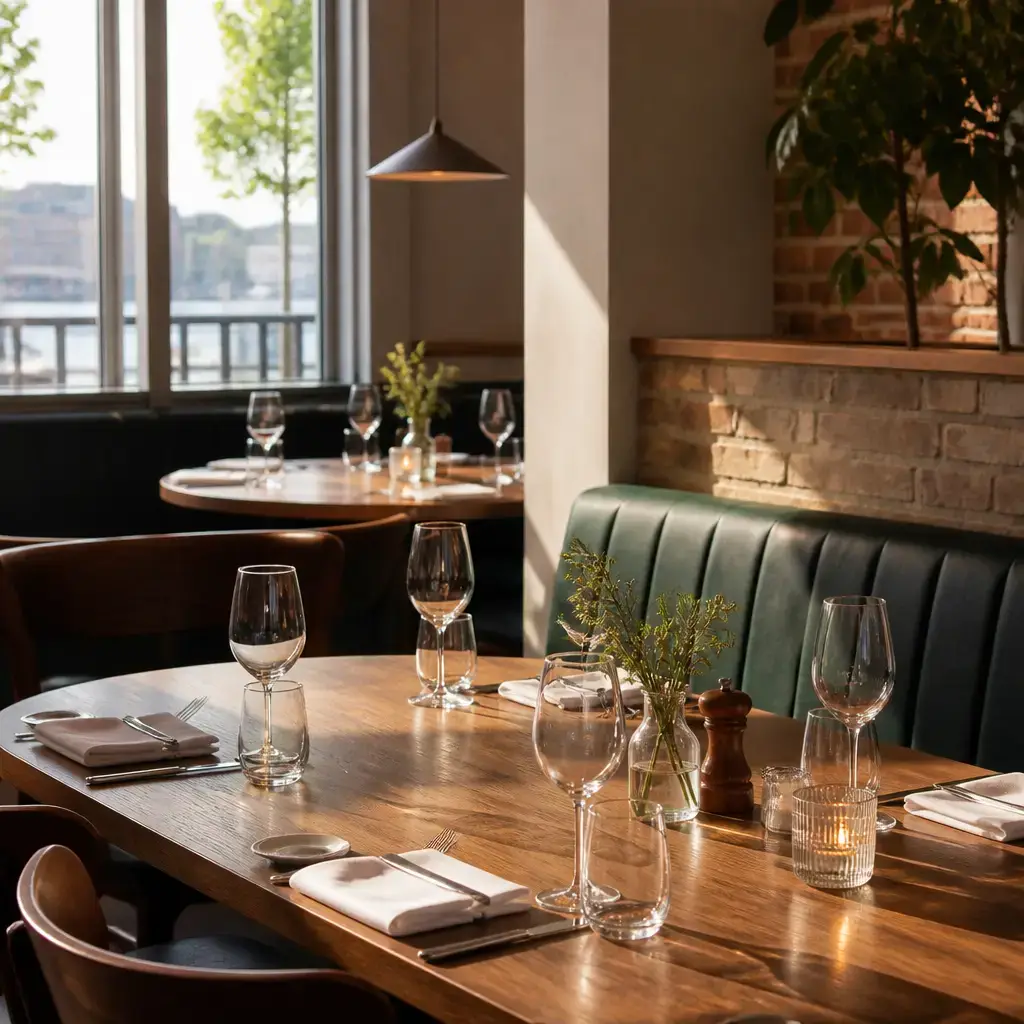
Wir haben einen ruhigen Tisch reserviert, aber dieser Bereich ist viel lauter als erwartet.
veer HAH-ben EYE-nen ROO-ih-gen tish zeh-zehr-VEERT, AH-ber DEE-zer beh-RYKH ist feel LOW-ter als ehr-VAR-tet. We reserved a quiet table, but this area is much louder than expected.Es tut mir leid; dieser Bereich war früher voll belegt, als wir erwartet hatten.
ess toot meer like; DEE-zer beh-RYKH vahr FROO-er fohl beh-LEHKT, als veer ehr-VAR-tet HAH-ten. I'm sorry; that section filled up earlier than we expected.An diesem Tisch wird es für unsere Gruppe schwierig sein, einander zu hören.
ahn DEE-zem tish veert ess fyoor OON-zeh-ruh GROO-peh SHVEE-rikh zine, eye-NAN-der HUR-en. This table will make it hard for our group to hear each other.Ich kann Sie an einen Ecktisch umsetzen, um den herum mehr Platz ist.
ikh kahn zee ahn EYE-nen EHK-tish OOM-zet-sen, oom den heh-ROOM mair plahts ist. I can move you to a corner table that has more space around it.Das würde helfen, solange unser Kellner mit uns Schritt halten kann.
dahs VUR-duh HEL-fen, zoh-LAHNG-uh OON-zer KEL-ner mit oons shrit HAHL-ten kahn. That would help, as long as our server can still keep up with us.Derselbe Kellner bedient diesen Ecktisch, daher sollte der Service weiterhin reibungslos laufen.
DAIR-zel-buh KEL-ner beh-DEENT DEE-zen EHK-tish, DAH-hair ZOL-tuh dair zehr-VEES VY-ter-HEEN RYE-boongs-LOHSS LOW-fen. The same server covers that corner, so service should stay on track.Dann wechseln wir den Tisch, bevor sich alle hinsetzen.
dahn VEHK-seln veer den tish, beh-FOHR zikh AH-luh HIN-zet-sen. Then let's move before everyone sits down.Ich lasse den Tisch jetzt neu eindecken.
ikh LAH-suh den tish yetst noy EYE-dehk-en. I'll have the table reset now.Sentence explanations
Wir haben einen ruhigen Tisch reserviert, aber dieser Bereich ist viel lauter als erwartet.
We reserved a quiet table, but this area is much louder than expected.
- Wir
- we
- haben
- have
- ruhigen
- quiet
- Tisch
- table
- reserviert
- reserved
- aber
- but
- dieser
- this
- Bereich
- area; section
- ist
- is
- viel
- much
- lauter
- louder
- als erwartet
- than expected
More detail
Wir means “we” here: the speaker includes themself and at least one other person. It is the first-person plural pronoun. Compare ich (“I”) for one speaker and wir (“we”) for a group. Example: Wir kommen morgen. — “We are coming tomorrow.” haben is the present-tense form of haben (“to have”) for wir. Here it is an auxiliary, not the main meaning “possess”: with reserviert, it forms the German perfect: wir haben reserviert — “we reserved / have reserved.” The auxiliary agrees with the subject, while reserviert remains the participle. ruhigen means “quiet” in this sentence. Its base form is ruhig; the ending -en appears because the adjective is before the masculine accusative noun Tisch after the indefinite article einen: einen ruhigen Tisch. For comparison, ruhiger means “quieter” and am ruhigsten means “quietest.” Example: Wir suchen einen ruhigen Raum. — “We are looking for a quiet room.” Tisch is the noun “table.” Its plural is Tische. In einen ... Tisch, it is the direct object of the reservation: the table is what was reserved. Example: Der Tisch ist frei. — “The table is free.” reserviert is the participle of reservieren (“to reserve”). Together with haben, it gives the perfect construction haben + reserviert. The form itself does not show whether the subject is singular or plural; the auxiliary does that. Example: Sie hat einen Tisch reserviert. — “She reserved a table.” aber connects two contrasting statements and means “but.” It does not itself indicate a new time or participant. Example: Wir wollten bleiben, aber es war spät. — “We wanted to stay, but it was late.” dieser means “this” and belongs with the masculine noun Bereich in the phrase dieser Bereich. Here it has the masculine nominative form because the phrase is the subject of ist. The demonstrative form changes with grammatical case and gender: compare diesen Bereich when it is a masculine direct object. Its exact real-world referent is the area identified by the fixed translation as “this area.” Bereich means “area” or “section.” Its plural is Bereiche. In this sentence it is the subject of the second clause, and dieser marks it as a particular nearby or contextually identified area. Example: Dieser Bereich ist geschlossen. — “This area is closed.” ist is the present-tense form of sein (“to be”) for a third-person singular subject such as dieser Bereich. It links the subject to the description viel lauter. Example: Der Raum ist ruhig. — “The room is quiet.” viel means “much” here and intensifies the comparative lauter: viel lauter means “much louder.” It is not the noun’s quantity; it strengthens the degree of comparison. Example: Heute ist es viel kälter. — “Today it is much colder.” lauter is the comparative of the adjective laut (“loud”). Thus laut – lauter – am lautesten means “loud – louder – loudest.” The comparison is between the area’s noise level and the level implied by what was expected; viel makes the difference substantial. Example: Dieser Raum ist lauter als der andere. — “This room is louder than the other one.” als erwartet completes the comparative: lauter als ... means “louder than ...,” and erwartet means “expected.” The fuller comparison can be understood as “louder than expected,” with the person or people who expected it left unexpressed. German can use this compact participial phrase when the comparison is clear. Example: Die Prüfung war schwieriger als erwartet. — “The exam was more difficult than expected.” As a whole, Wir haben einen ruhigen Tisch reserviert says that the speakers reserved a quiet table. aber contrasts that with dieser Bereich ist viel lauter als erwartet, which says that this area is much louder than expected. The complete meaning is therefore: “We reserved a quiet table, but this area is much louder than expected.”
Es tut mir leid; dieser Bereich war früher voll belegt, als wir erwartet hatten.
I'm sorry; that section filled up earlier than we expected.
- Es tut mir leid
- I'm sorry
- dieser
- this
- Bereich
- section; area
- früher
- earlier
- voll
- full
- belegt
- occupied; booked
- als wir erwartet hatten
- than we expected
More detail
Es tut mir leid is a fixed German way to apologize: literally, something like “it causes me sorrow,” but it is used as “I’m sorry.” The form tut is the third-person singular present of tun; mir is the dative form of ich (“to me”). Learn the whole expression rather than replacing mir with a nominative form. Example: Das tut mir leid. — “I’m sorry about that.” dieser means “this” here and agrees with the noun it accompanies. In dieser Bereich, it is masculine singular nominative because Bereich is the subject of the clause. The demonstrative changes with grammatical case, gender, and number; for example, diese Fläche is “this area/surface,” while diesen Bereich would be the masculine accusative form. Bereich is a masculine noun meaning an area, section, or department. Its plural is Bereiche. In this utterance, the intended meaning is a physical section or area, supported by the surrounding references to a table and a place in the venue. Example: Dieser Bereich ist ruhiger. — “This section is quieter.” früher means “earlier” in this sentence. It is also the comparative form of früh (“early”): früh = “early,” früher = “earlier,” am frühesten = “the earliest.” Here it compares the time when the area became unavailable with the time the speakers expected. voll means “full.” It is an adjective and can describe something with no available space. In voll belegt, it strengthens the idea that all places were occupied or reserved. Example: Der Saal ist voll. — “The hall is full.” belegt means “occupied” or “booked” here. It is the past participle of belegen, “to occupy, reserve, or book,” and it functions here as an adjective after voll. The observed form describes the area’s state; it does not by itself say who occupied or booked it. Example: Alle Plätze sind belegt. — “All seats are occupied.” als wir erwartet hatten is the comparison clause “than we expected.” als introduces a comparison involving a difference, while wir is the first-person plural subject (“we”). erwartet hatten uses the past perfect: hatten is the past form of haben, and erwartet is the participle of erwarten (“expect”). This places the expectation before the earlier point being compared. Example: Es war schwieriger, als wir erwartet hatten. — “It was more difficult than we expected.” Together, dieser Bereich war früher voll belegt says that this section had already been fully occupied earlier, and als wir erwartet hatten compares that time with the speakers’ expectation. With the apology at the beginning, the complete utterance means: “I’m sorry; that section filled up earlier than we expected.”
An diesem Tisch wird es für unsere Gruppe schwierig sein, einander zu hören.
This table will make it hard for our group to hear each other.
- diesem
- this
- Tisch
- table
- wird es
- it will
- Gruppe
- group
- schwierig
- difficult
- sein
- be
- einander
- each other
- zu hören
- to hear
More detail
diesem refers to the demonstrative form in diesem Tisch. The base form is dieser (“this/that one” in the demonstrative system); here it is dative singular masculine because an describes a location and Tisch is masculine. The ending is carried by diesem, not by Tisch. Compare dieser Tisch for a nominative subject and an diesem Tisch for “at this table.” Tisch means “table.” Its plural is Tische: ein Tisch (“a table”), zwei Tische (“two tables”). In this sentence, an diesem Tisch means “at this table.” wird es introduces the future-time impersonal pattern. werden is the base form; wird is its third-person singular present form, used here as the future auxiliary. es is an expletive subject: it does not identify a separate participant. In the complete pattern, wird ... sein means “will be.” Gruppe means “group.” The sentence uses unsere Gruppe, “our group”; unsere is the possessive form agreeing with the feminine singular noun Gruppe. The noun itself is feminine, and its plural is Gruppen. schwierig means “difficult” or “hard.” It is a descriptive adjective. Here it is the predicate adjective after sein, so it does not take an ending: Es ist schwierig means “It is difficult.” A useful contrast is leicht (“easy”): Es ist leicht, das zu verstehen. — “It is easy to understand that.” sein is the infinitive “to be.” Its common present-tense forms include ich bin (“I am”), du bist (“you are”), and er/sie/es ist (“he/she/it is”). With the future auxiliary, the infinitive stays at the end: Es wird schwierig sein. — “It will be difficult.” einander is a reciprocal pronoun meaning “each other.” It indicates that the members of unsere Gruppe are hearing one another, rather than one person hearing an unspecified person. It is commonly used without a separate article: Sie helfen einander. — “They help each other.” zu hören is the infinitive construction “to hear.” hören is the base verb “to hear/listen,” and zu marks this infinitive in the construction schwierig sein, ... zu hören. The verb remains at the end of this infinitive phrase: Es ist schwer, ihn zu hören. — “It is hard to hear him.” Together, An diesem Tisch sets the location, wird es schwierig sein says that the situation will be difficult, and für unsere Gruppe identifies the group affected. The final infinitive phrase einander zu hören specifies what will be difficult: hearing one another. Thus the whole utterance means, “At this table, it will be difficult for our group to hear each other.”
Ich kann Sie an einen Ecktisch umsetzen, um den herum mehr Platz ist.
I can move you to a corner table that has more space around it.
- Ich kann
- I can
- Sie
- you
- umsetzen
- move; reseat
- Ecktisch
- corner table
- um den herum
- around which
- mehr
- more
- Platz
- space
More detail
Ich kann expresses the speaker’s ability or offer: “I can.” können is the base form; kann is its present-tense form for ich. With a modal verb such as kann, the other verb stays in the infinitive and goes to the end of the clause. Sie means formal “you” here, as the person being moved. Capitalized Sie is the formal second-person pronoun; its accusative form is also Sie. The form therefore does not reveal the person’s gender or number. umsetzen means “to move or reseat someone,” especially to another seat. It is a separable verb in many finite uses: for example, Ich setze Sie um. — “I’ll move you.” After kann, its infinitive form remains together at the end: Ich kann Sie umsetzen. Ecktisch means “corner table.” It is a compound noun formed from Ecke (“corner”) and Tisch (“table”); the compound is masculine: der Ecktisch. After an with movement toward a destination, it appears here in the accusative form an einen Ecktisch. um den herum means “around which” in this relative clause. den refers to the table and is the masculine accusative form of the relative pronoun, required by um; herum completes the meaning “around.” The construction can be reused with another masculine noun, for example: ein Haus, um das herum Bäume wachsen — “a house around which trees grow.” mehr means “more.” It compares an amount with another amount but does not itself change for gender or case. Here it modifies the amount of Platz. Platz means “space” in this context. The phrase mehr Platz means “more space”; Platz is masculine (der Platz), although no article appears here because the sentence refers to an amount of space generally. Together, an einen Ecktisch gives the destination, and um den herum mehr Platz ist describes that table: there is more space around it. The complete structure is Ich kann Sie [destination] umsetzen, um den herum mehr Platz ist: “I can move you to a corner table that has more space around it.” The infinitive clause um ... umzusetzen is not used here; instead, umsetzen is the infinitive selected by the modal kann.
Das würde helfen, solange unser Kellner mit uns Schritt halten kann.
That would help, as long as our server can still keep up with us.
- Das
- that
- würde
- would
- helfen
- help
- solange
- as long as
- Kellner
- server
- mit uns
- with us
- Schritt halten
- keep up
- kann
- can
More detail
Das means “that” here and points to the situation or proposal understood from the conversation, rather than naming a specific noun. As a demonstrative pronoun, its form is neuter singular; the form would differ with a different grammatical gender or number. würde is the third-person singular form of werden in the subjunctive II. With an infinitive, würde commonly expresses a hypothetical or conditional result: Das würde helfen = “That would help.” The infinitive remains in its base form after würde. Compare present Das hilft (“That helps”) with the more conditional Das würde helfen. helfen means “to help.” Its useful forms include helfen (base form), hilft (third-person singular present), and half (simple past). Example: Das hilft mir. — “That helps me.” solange introduces a condition meaning “as long as.” It begins a subordinate clause, so the finite verb goes to the end of that clause. Pattern: solange + subject + ... + finite verb. Kellner means “server” here. It is a masculine noun: der Kellner; its plural is die Kellner, so the noun itself has the same form in singular and plural. In this sentence, unser marks the intended server as “our” server; the noun is not what carries that possessive marking. mit uns means “with us.” uns is the first-person plural pronoun in the dative form after mit; the same form also appears as an accusative pronoun in other contexts. Example: Komm mit uns. — “Come with us.” Schritt halten is a reusable expression meaning “to keep up,” especially to remain at the same pace as someone. Its literal components are Schritt (“step”) and halten (“hold/keep”), but the combination is understood idiomatically. Example: Ich kann mit euch Schritt halten. — “I can keep up with you.” kann is the third-person singular present form of the modal verb können (“can, be able to”). The subject here is unser Kellner, so the form is kann; with ich, it is kann as well, while with wir it is können. In the subordinate clause introduced by solange, kann appears at the end, after the infinitive expression Schritt halten. Together, Das würde helfen presents something as a helpful hypothetical result. solange unser Kellner mit uns Schritt halten kann adds the condition: this would be helpful as long as the server is able to keep up with the group. The complete meaning is: “That would help, as long as our server can still keep up with us.”
Derselbe Kellner bedient diesen Ecktisch, daher sollte der Service weiterhin reibungslos laufen.
The same server covers that corner, so service should stay on track.
- Derselbe
- the same
- Kellner
- server
- bedient
- serves; covers
- diesen
- this/that
- Ecktisch
- corner table
- daher
- therefore
- sollte
- should
- Service
- service
- weiterhin
- still; continuing
- reibungslos
- smoothly
- laufen
- run; go
More detail
Derselbe means “the same” here and refers back to an already mentioned individual. Its form agrees with Kellner: masculine, singular, nominative, because the waiter is the subject. The useful pattern is derselbe/dieselbe/dasselbe for “the same” with different grammatical genders; the ending changes with case and number as well. Example: Derselbe Bus kommt wieder. — “The same bus is coming again.” Kellner is the noun for a waiter or server. Its plural is Kellner; the form is unchanged between singular and plural, so the article or another agreeing word helps show the number. In this sentence, der Kellner is masculine singular. bedient comes from bedienen, “to serve” or “to attend to.” bedient is the third-person singular present form: er/sie bedient. Here the waiter serves the table, so bedienen takes an accusative object. Example: Die Kellnerin bedient den Tisch. — “The waitress is serving the table.” diesen is the masculine singular accusative form of the demonstrative dieser, used here with Ecktisch. English may use “this” or “that”; the fixed translation selects “that” in this context. The accusative form marks the table as the object of bedient: Dieser Tisch is nominative, but Ich bediene diesen Tisch is accusative. Ecktisch is a compound noun meaning “corner table”: Eck- means “corner,” and Tisch means “table.” As a masculine noun, it has the forms der Ecktisch in the nominative and den/diesen Ecktisch in the masculine singular accusative. The compound is written as one word in German. daher means “therefore” or “so” and connects the service situation with its consequence. In the sentence it introduces the second clause. Because the finite verb occupies the second position after this sentence adverb, the order is Daher sollte ..., with sollte before the subject der Service. sollte is the form of sollen used here for “should.” With a following infinitive, the modal construction expresses an expectation or recommendation: sollte ... laufen. Sollte can also be a past-tense form of sollen in another context, so its exact meaning comes from the construction and context. Example: Der Plan sollte funktionieren. — “The plan should work.” Service is the noun “service.” Here it is the subject of the second clause, and German uses the masculine article: der Service. It is not the waiter himself; it names the service operation or quality being discussed. weiterhin means “still” or “continuing to.” It says that the smooth operation is expected to continue, rather than introducing a new one-time action. Example: Sie arbeitet weiterhin hier. — “She still works here.” reibungslos means “smoothly” in this sentence. It describes how the service is expected to operate. The related adjective can also be used predicatively: Der Ablauf ist reibungslos. — “The process is smooth.” laufen is the infinitive of laufen, literally “to run” or “to go,” but with Service it means “to operate” or “to proceed.” It remains at the end of this modal clause: Der Service sollte reibungslos laufen — “The service should run smoothly.” Together, Derselbe Kellner bedient diesen Ecktisch means “The same server covers that corner table.” Daher links this fact to the expectation that follows: sollte der Service weiterhin reibungslos laufen means “so service should stay on track.” The complete utterance therefore says that, because the same server is covering the corner table, service is expected to continue smoothly.
Dann wechseln wir den Tisch, bevor sich alle hinsetzen.
Then let's move before everyone sits down.
- Dann
- then
- wechseln
- move; change
- wir
- we
- Tisch
- table
- bevor
- before
- alle
- everyone; everybody
- sich … hinsetzen
- sit down
More detail
Dann means “then” here: it places the proposed change after the current situation or decision. Example: Dann gehen wir. — “Then we’ll go.” wechseln is the verb “change” or “switch.” In den Tisch wechseln, it means changing from the current table to another table; the object is den Tisch. Its base form is wechseln, and with wir the present-tense form is also wechseln: wir wechseln. This is different from sich bewegen (“move oneself”) when the focus is physical movement. wir means “we” and is the subject of wechseln. The sentence therefore presents the speaker together with at least one other person as the people making the change. Example: Wir wechseln den Platz. — “We change seats.” Tisch means “table.” In this sentence it appears as den Tisch, because Tisch is masculine and is the direct object of wechseln; the masculine definite article changes from nominative der Tisch to accusative den Tisch. The noun itself does not change form here. bevor introduces a subordinate clause meaning “before.” The event in that clause is the time condition for the change. In a German bevor clause, the finite verb normally goes to the end: bevor sich alle hinsetzen. Example: Wir gehen, bevor es dunkel wird. — “We’ll leave before it gets dark.” alle means “everyone” or “all [of them].” Here it is the subject of hinsetzen; it refers to the people who are expected to sit down, without the sentence specifying a number. As a pronoun, alle takes a plural verb: Alle kommen. — “Everyone is coming.” sich hinsetzen is the reflexive verb “sit down.” Its base form is sich hinsetzen; in the clause, hinsetzen is the finite present form for the plural subject alle, while sich marks the reflexive relation. In a main clause, the separable verb appears as Alle setzen sich hin. — “Everyone sits down.” In this subordinate clause, the complete verb appears at the end as sich hinsetzen. Together, Dann wechseln wir den Tisch means “Then we’ll change tables” or “Then let’s move to another table.” bevor sich alle hinsetzen adds the time condition “before everyone sits down.” The full utterance is therefore: “Then let’s move before everyone sits down.”
Ich lasse den Tisch jetzt neu eindecken.
I'll have the table reset now.
- Ich lasse
- I have ... done
- Tisch
- table
- jetzt
- now
- neu
- anew
- eindecken
- set up / lay
More detail
Ich lasse uses lassen with another infinitive to express arranging for something to be done: Ich lasse ... eindecken = “I’ll have ... laid.” The subject Ich is the person arranging the action; it does not mean that the speaker personally performs the setting. Compare Ich decke den Tisch ein (“I set the table”) with Ich lasse den Tisch eindecken (“I have the table set”). Tisch means “table.” Its base form is der Tisch; here it appears in the phrase den Tisch. The masculine accusative article den marks the table as the object of the setting action expressed by eindecken; it is not best described as an object directly governed by lasse in this causative construction. In this sentence, the fixed translation identifies the table as the thing being reset. jetzt means “now” and places the arranged action at the current time. Example: Wir beginnen jetzt. — “We are starting now.” neu means “anew” or “again in a new arrangement.” Here it describes the setting action, not the table itself: the table is to be set anew. Its comparative form is neuer, but no comparison is expressed here. eindecken means “to set” or “lay” a table. It is a separable verb: in an ordinary main clause, Ich decke den Tisch ein splits the verb, while after lassen the infinitive stays together at the end: Ich lasse den Tisch eindecken. The form eindecken is an infinitive, so it does not show the person performing the setting. Together, Ich lasse den Tisch jetzt neu eindecken means “I’ll have the table reset now.” The structure is Ich lasse + object den Tisch of the setting action + time jetzt + manner/change neu + infinitive eindecken: the speaker arranges for the table to be set anew at this time.
Grammar Points
bevor + Nebensatz mit Verb am Ende
Wir wechseln, bevor wir uns hinsetzen.
veer VEH-k-seln, beh-FOHR veer oons HIN-zet-sen.We switch before we sit down.
After bevor, the conjugated verb moves to the end of the subordinate clause.
Komparativ + als erwartet
Der Bereich ist lauter als erwartet.
dair beh-RYKH ist LOW-ter als ehr-VAR-tet.The area is louder than expected.
Use the comparative form with als to compare something with what was expected.
German Vocabulary
viel lauter als erwartet
einen ruhigen Tisch
Quiz
Spelling
Tap the letters to spell the word.
louder
Show Answer
lauterearlier
Show Answer
früherto reserve
Show Answer
reservierttable