10 minutes free every day
Continue audio lessons in the app
Word explanations appear automatically in sync with the audio.
No login required · synced translations · playback with the screen locked
Choose your learning language and open this lesson in the app.

About This Lesson
Use Reporting a Lost Item with Useful Details to practice German conversation, pronunciation, vocabulary, grammar, and quizzes.
Dialogue
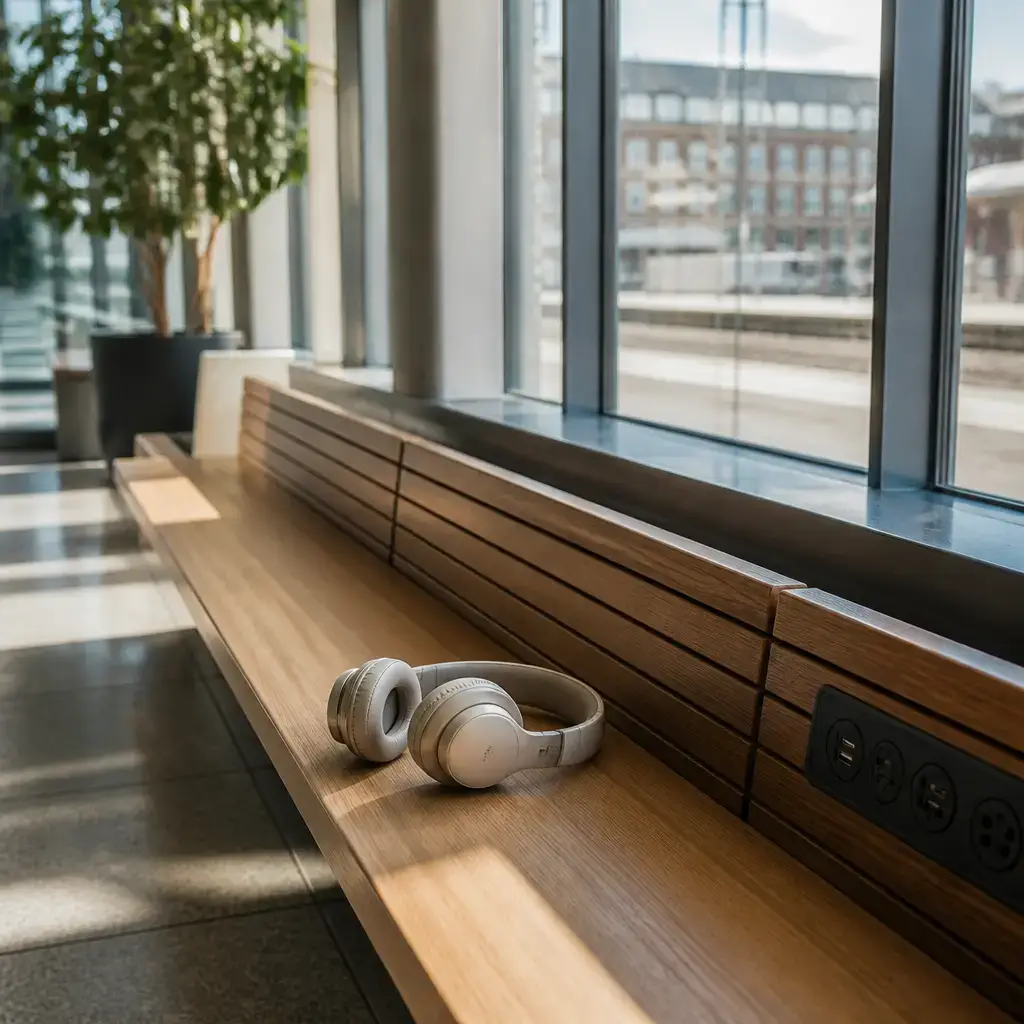
Ich glaube, ich habe meine Kopfhörer im Wartebereich liegen lassen.
ikh GLOW-buh, ikh HAH-buh MY-nuh KOPF-hur-uh im WAR-tuh-buh-RAIKH LEE-gun LAHS-un. I think I left my headphones in the waiting area.Erinnerst du dich, wo du gesessen hast?
air-IN-uh-rst doo dikh, voh doo guh-ZESS-un hahst? Do you remember where you were sitting?In der Nähe des Fensters, bei den Ladestationen.
in dair NAY-uh dess FEN-sters, by den LAH-duh-tsyo-NOH-nun. Near the window, by the charging points.Damit kann das Personal den Ort besser eingrenzen.
dah-MIT kahn dahs pair-soh-NAHL den ORT BESS-uh EYN-grents-un. That narrows it down for the staff.Ich mache mir mehr Sorgen über den Verlust der gespeicherten Einstellungen als über die Kosten.
ikh MAKH-uh meer mair ZOR-gun OO-buh dair fer-LOOST dair guh-SHPIE-khert-un EYN-shtel-loong-un ahls OO-buh dee KOSS-tun. I am more worried about losing the saved settings than the cost.Dann lass es uns melden, bevor der Bereich geräumt wird.
dahn lahss ess oons MEL-dun, buh-FOR dair buh-RAIKH guh-ROYMT veert. Then let us report it before the area gets cleared.Was sollte ich in die Verlustmeldung aufnehmen?
vahs SHOLL-tuh ikh in dee fer-LOOST-mel-doong OWP-nay-mun? What should I include in the lost item report?Beschreibe die Farbe, die Art und alles Ungewöhnliche an dem Etui.
buh-SHREE-buh dee FAR-buh, dee Ahrt oont AH-luss OON-guh-VURN-likh-uh ahn dame eh-TOO-ee. Describe the color, the type, and anything unusual about the case.Sentence explanations
Ich glaube, ich habe meine Kopfhörer im Wartebereich liegen lassen.
I think I left my headphones in the waiting area.
- Ich glaube
- I think
- habe
- have
- Kopfhörer
- headphones
- Wartebereich
- waiting area
- liegen lassen
- leave lying; leave behind
More detail
Ich glaube means “I think” here. glaube is the first-person singular present form of glauben (“to think, believe”); Ich glaube, ... is a common way to present a statement as the speaker’s belief rather than absolute certainty. Example: Ich glaube, er ist zu Hause. — “I think he is at home.” habe is the first-person singular present form of haben (“to have”). In this sentence it is an auxiliary: ich habe ... liegen lassen is a perfect-tense construction. The auxiliary carries the person and tense, while the lexical action remains at the end in the infinitive forms liegen lassen. Kopfhörer means “headphones.” The form is the same in the singular and plural, so the surrounding form supplies the number here: meine Kopfhörer is plural. meine also marks the headphones as the speaker’s; in this sentence the phrase is the accusative object of lassen. Example: Ich suche meine Kopfhörer. — “I’m looking for my headphones.” Wartebereich means “waiting area.” It is a masculine noun, and im is the contraction of in dem. With a stationary location, in takes the dative: im Wartebereich means “in the waiting area.” The phrase describes where the headphones were left, not movement into the area. liegen lassen is the construction “to leave something lying” or, in this context, “to leave something behind.” liegen describes the object’s resulting position, while lassen expresses causing or allowing it to remain there. In the perfect, German uses habe plus the unchanged infinitive group liegen lassen: Ich habe mein Buch im Zug liegen lassen. — “I left my book on the train.” Together, Ich glaube introduces the speaker’s uncertainty, ich habe ... liegen lassen says that the speaker left something behind, meine Kopfhörer identifies what was left, and im Wartebereich gives its location. The complete meaning is: “I think I left my headphones in the waiting area.”
Erinnerst du dich, wo du gesessen hast?
Do you remember where you were sitting?
- Erinnerst du dich
- do you remember
- wo
- where
- gesessen
- sat / been sitting
More detail
Erinnerst du dich is the reusable German pattern for “do you remember?” It comes from sich erinnern (“to remember”), a reflexive verb: with du, the reflexive form is dich. The finite verb is present-tense erinnerst, while du is the subject. For example: Erinnerst du dich an den Namen? — “Do you remember the name?” wo asks about a place: “where.” In this sentence it introduces an embedded question, so it connects the question about remembering with the remembered location. Compare wann (“when”) and warum (“why”), which ask about time and reason instead. gesessen is the past participle of sitzen (“to sit; to be sitting”). Its base form is sitzen; gesessen does not mean “set” or “placed,” which would use the different verb setzen. The form gesessen combines with the auxiliary hast from haben: du hast gesessen means “you sat” or “you were sitting.” In the embedded question, hast comes at the end: wo du gesessen hast. Together, Erinnerst du dich asks whether the listener remembers, and wo du gesessen hast specifies what should be remembered: the place where the listener was sitting. Thus the complete utterance means “Do you remember where you were sitting?”
In der Nähe des Fensters, bei den Ladestationen.
Near the window, by the charging points.
- In der Nähe
- nearby; in the vicinity
- Fensters
- window
- bei
- by; at
- Ladestationen
- charging points
More detail
In der Nähe means “near” or “in the vicinity.” German commonly uses the pattern in der Nähe + genitive: in der Nähe des Fensters means “near the window.” Here Nähe is a feminine noun, so the fixed phrase uses der; this der is not the article directly marking Fensters. Fensters is the genitive singular form of das Fenster (“the window”). The genitive marks the thing whose vicinity is meant: die Nähe des Fensters = “the vicinity of the window.” The noun itself remains neuter; des and the ending -s show the genitive form. Example: neben dem Fenster = “next to the window.” bei expresses being by, at, or near a place or situation and takes the dative. In this utterance it introduces the second location, “by the charging points.” It is different from in der Nähe, which is the first location phrase here. Example: Sie arbeitet bei einer Firma. — “She works for a company.” Ladestationen means “charging points” or “charging stations.” It is the plural of die Ladestation; Lade- relates to charging and Station means station, but the whole compound is the useful vocabulary item. After bei, the plural dative form is bei den Ladestationen; the plural noun itself has the same form as the nominative and accusative plural here. Together, In der Nähe des Fensters gives the first location, “near the window,” and bei den Ladestationen adds a second, closely specified location, “by the charging points.” The complete utterance is therefore: “Near the window, by the charging points.”
Damit kann das Personal den Ort besser eingrenzen.
That narrows it down for the staff.
- Damit
- with that; thereby
- kann
- can
- Personal
- staff
- Ort
- place; location
- besser
- better
- eingrenzen
- narrow down
More detail
Damit means “with that” or “by doing that.” Here it refers back to the location information in the preceding sentence: using that information, the staff can narrow down the location. In German, damit can function as a pronominal adverb referring to an already mentioned thing or situation. Example: Damit kann ich arbeiten. — “I can work with that.” kann is the third-person singular present form of können (“can; be able to”). It agrees with das Personal, which is grammatically singular even though it refers to a group of staff members. With a modal verb such as können, the other verb normally remains in the infinitive at the end: Das Personal kann den Ort eingrenzen. — “The staff can narrow down the location.” Personal means “staff” or “personnel.” Here it appears as das Personal, with the neuter article, and functions as the subject. This collective noun is grammatically singular here, so the verb is kann, not a plural form. The noun itself has the same visible form in the nominative and accusative, and the neuter article is also das in both cases; the form therefore does not by itself distinguish those two cases. Here, the subject role identifies das Personal as nominative: Das Personal arbeitet. — “The staff is working.” Ort means “place” or “location.” Here it is den Ort, the accusative form of the masculine noun der Ort, because it is the thing being narrowed down. A useful contrast is der Ort as a subject and den Ort as a direct object: Der Ort ist bekannt. — “The location is known”; Sie suchen den Ort. — “They are looking for the location.” besser is the comparative form of gut (“good; well”). In this sentence it is an adverb modifying eingrenzen, so it means “more effectively” or “better,” not “a better place.” The useful comparison chain is gut – besser – am besten: “well – better – best.” Example: So kann ich die Auswahl besser verstehen. — “This way I can understand the selection better.” eingrenzen means “to narrow down” or “to limit.” It is an infinitive here because it follows the modal kann. The verb is separable in a finite main clause: Das Personal grenzt den Ort ein. — “The staff narrows down the location.” After a modal, the complete infinitive stays at the end: Das Personal kann den Ort eingrenzen. Together, Damit gives the means, kann expresses the staff’s ability or possibility, das Personal is the singular collective subject, den Ort is the location being narrowed down, besser describes a more effective result, and eingrenzen supplies the main action. The complete meaning is: “With that information, the staff can narrow down the location.”
Ich mache mir mehr Sorgen über den Verlust der gespeicherten Einstellungen als über die Kosten.
I am more worried about losing the saved settings than the cost.
- mache mir … Sorgen
- worry
- mehr … als
- more ... than
- über
- about
- Verlust
- loss
- gespeicherten
- saved
- Einstellungen
- settings
- Kosten
- costs
More detail
mache mir + Sorgen is the German construction sich Sorgen machen, “to worry.” Here mir is the first-person dative reflexive form, referring back to ich; mache is the first-person singular present form of machen. The construction is used with a concern: Ich mache mir Sorgen. — “I am worried.” The word Sorgen is plural, although the construction expresses one person’s state of worry. mehr + als forms a comparative: mehr ... als means “more ... than.” mehr is the comparative counterpart of viel in this quantity/intensity use; als introduces what the comparison is made against. This is different from so ... wie, “as ... as,” which expresses equality. über means “about” here and introduces the topic of the worry. With this meaning, it takes the accusative: über den Verlust and, in the second comparison, über die Kosten. Its meaning here is not the spatial sense “over.” Verlust means “loss.” Its base form is der Verlust, a masculine noun. In den Verlust, the masculine singular article shows the accusative form required after über in this use. The noun phrase der gespeicherten Einstellungen specifies what is lost: literally, “of the saved settings.” gespeicherten means “saved” here. It is the adjective form related to the verb speichern, “to save.” In der gespeicherten Einstellungen, it modifies the plural noun Einstellungen and has the -en ending required by this noun phrase; the form does not itself indicate that the settings are masculine or singular. Einstellungen means “settings.” It is the plural of die Einstellung; in this context it refers to saved configuration choices. The genitive phrase der gespeicherten Einstellungen expresses the relation “of the saved settings.” Kosten means “cost” or “costs” here. German commonly uses die Kosten as a plural noun for an amount of expense; the surrounding comparison identifies the cost as the second concern. This word is distinct from Verlust: the sentence compares worry about the loss of the settings with worry about the expense. Together, Ich mache mir mehr Sorgen über den Verlust der gespeicherten Einstellungen als über die Kosten. means “I am more worried about losing the saved settings than the cost.” The structure is Ich mache mir mehr Sorgen über A als über B: “I am more worried about A than about B.” The German uses the noun Verlust (“loss”) where the English translation naturally uses the gerund-like phrase “losing.”
Dann lass es uns melden, bevor der Bereich geräumt wird.
Then let us report it before the area gets cleared.
- Dann
- then
- lass es uns
- let us
- melden
- report
- bevor
- before
- Bereich
- area
- geräumt wird
- gets cleared
More detail
Dann means “then” and links this utterance to a next step in time or sequence. It is a temporal adverb and can also begin a sentence: Dann gehen wir. — “Then we’ll go.” lass es uns is a reusable way to say “let us do it” in an informal imperative construction. lass is the imperative of lassen for du; es is the object “it,” and uns means “us.” The following infinitive names the proposed action: Lass uns anfangen. — “Let’s start.” Here, es refers to the thing to be reported, as reflected by the fixed translation and the surrounding context. melden means “to report” here. It is the infinitive after the construction with lass: Lass es uns melden — “Let us report it.” The same verb can be used for reporting something to an authority or system, for example Ich melde den Verlust. — “I report the loss.” Its present-tense forms include ich melde, du meldest, and sie meldet; the infinitive melden does not show the person. bevor introduces an event that occurs earlier than another event: “before.” It starts a subordinate clause, so the finite verb goes to the end: bevor der Bereich geräumt wird — “before the area gets cleared.” The word expresses the time relationship; it does not by itself say that the earlier event is required to happen. Bereich is the noun “area.” Its plural is Bereiche; the definite article in the sentence is der because Bereich is masculine singular and is the nominative subject of the passive clause here. The noun can describe a physical area or a more abstract domain, depending on context. geräumt wird expresses “gets cleared.” geräumt is the past participle of räumen (“to clear”), and wird is the third-person singular present form of werden. Together they form the present passive: the area is presented as receiving the action, while the person or organization clearing it is not stated. Compare active Jemand räumt den Bereich. — “Someone clears the area.” In the subordinate clause, wird comes last because bevor has introduced it. The utterance combines the proposal lass es uns melden (“let us report it”) with the time condition bevor der Bereich geräumt wird (“before the area gets cleared”). Dann places this proposal as the next step: “Then let us report it before the area gets cleared.”
Was sollte ich in die Verlustmeldung aufnehmen?
What should I include in the lost item report?
- Was
- what
- sollte ich
- should I
- Verlustmeldung
- lost-item report
- aufnehmen
- include
More detail
Was asks for the thing or information being requested: “what.” It is an interrogative pronoun and does not identify the thing in advance. Example: Was soll ich schreiben? — “What should I write?” Sollte ich expresses “should I” here: it asks for advice or the expected content of an action. Sollte is the form of sollen used with ich in this sentence; the same form also occurs with singular er/sie/es, so the subject identifies the person. A reusable question pattern is Was sollte ich …? — “What should I …?” Verlustmeldung is a compound noun meaning a report about a lost item. Its useful base words are Verlust (“loss”) and Meldung (“report” or “notification”), but the compound functions as one noun. It is feminine: die Verlustmeldung; after in with movement into something, it appears here as in die Verlustmeldung. Aufnehmen means “to include” or “to add” information to a document or record in this context. It is an infinitive and remains at the end because sollen is the finite modal verb: Ich sollte die Beschreibung aufnehmen. — “I should include the description.” Aufnehmen is also separable when used as a finite verb: Ich nehme die Beschreibung auf. — “I include the description.” Together, Was sollte ich asks what action or content is appropriate, in die Verlustmeldung specifies the report receiving that content, and aufnehmen supplies the action “include.” The complete meaning is: “What should I include in the lost item report?”
Beschreibe die Farbe, die Art und alles Ungewöhnliche an dem Etui.
Describe the color, the type, and anything unusual about the case.
- Beschreibe
- describe
- Farbe
- color
- Art
- type
- alles Ungewöhnliche
- anything unusual
- an dem
- about the
- Etui
- case
More detail
Beschreibe is the imperative of beschreiben (“to describe”) for one person addressed as du. The imperative tells that person what to do. The same verb appears in other forms such as ich beschreibe (“I describe”) and du beschreibst (“you describe”). Example: Beschreibe den Gegenstand. — “Describe the object.” Farbe means “color.” Here die Farbe is feminine singular and is the direct object of beschreibe, so it is in the accusative; the feminine article looks the same in the nominative and accusative: die. Example: Die Farbe ist blau. — “The color is blue.” Art means “type” or “kind.” Here die Art is another accusative singular object coordinated with die Farbe. In other contexts, Art can also mean “manner” or “way,” so the surrounding words determine which sense is intended. Example: Welche Art ist das? — “What type is that?” alles Ungewöhnliche means “anything unusual.” alles is a neuter singular form meaning “everything” or, in this context, “anything”; Ungewöhnliche is an adjective used as a noun, meaning an unusual thing in a general, unspecified sense. The capital letter marks this nominalized adjective. It is a third coordinated object of beschreibe. Example: Notiere alles Ungewöhnliche. — “Write down anything unusual.” an dem means “about the” in this expression. dem is the dative masculine or neuter form of the definite article. Here an is used with dative because the phrase expresses a static relation to the case rather than movement toward it. The contraction am is also common in many uses of an dem, but the fixed sentence explicitly uses an dem. Etui means “case.” It is a neuter noun: das Etui; after an here, the article is dative dem, giving an dem Etui. The phrase an dem Etui specifies what the color, type, and unusual features are about. Together, Beschreibe gives the instruction, while die Farbe, die Art, and alles Ungewöhnliche list three things to include. an dem Etui links that list to the case. The complete meaning is: “Describe the color, the type, and anything unusual about the case.”
Grammar Points
sich erinnern: Erinnerst du dich?
Erinnerst du dich?
air-IN-uh-rst doo dikh?Do you remember?
sich erinnern is a reflexive verb; the pronoun changes with the subject, as in du → dich.
sich Sorgen machen: Ich mache mir Sorgen.
Ich mache mir mehr Sorgen.
ikh MAKH-uh meer mair ZOR-gun.I worry more.
This fixed expression uses a reflexive pronoun: ich → mir. The verb machen stays conjugated, while Sorgen remains plural.
German Vocabulary
Damit kann das Personal den Ort besser eingrenzen.
In der Nähe des Fensters, bei den Ladestationen.
Ich glaube, ich habe meine Kopfhörer im Wartebereich liegen lassen.
In der Nähe des Fensters, bei den Ladestationen.
Ich glaube, ich habe meine Kopfhörer im Wartebereich liegen lassen.
In der Nähe des Fensters, bei den Ladestationen.
Ich glaube, ich habe meine Kopfhörer im Wartebereich liegen lassen.
Damit kann das Personal den Ort besser eingrenzen.
Erinnerst du dich, wo du gesessen hast?
Ich mache mir mehr Sorgen über den Verlust der gespeicherten Einstellungen als über die Kosten.
Erinnerst du dich, wo du gesessen hast?
Ich glaube, ich habe meine Kopfhörer im Wartebereich liegen lassen.
Quiz
Spelling
Tap the letters to spell the word.
waiting area
Show Answer
Wartebereichto think; to believe
Show Answer
glaubewindow
Show Answer
Fenstersto sit