10 minutes free every day
Continue audio lessons in the app
Word explanations appear automatically in sync with the audio.
No login required · synced translations · playback with the screen locked
Choose your learning language and open this lesson in the app.

About This Lesson
Use Calmly addressing late-night noise to practice German conversation, pronunciation, vocabulary, grammar, and quizzes.
Dialogue
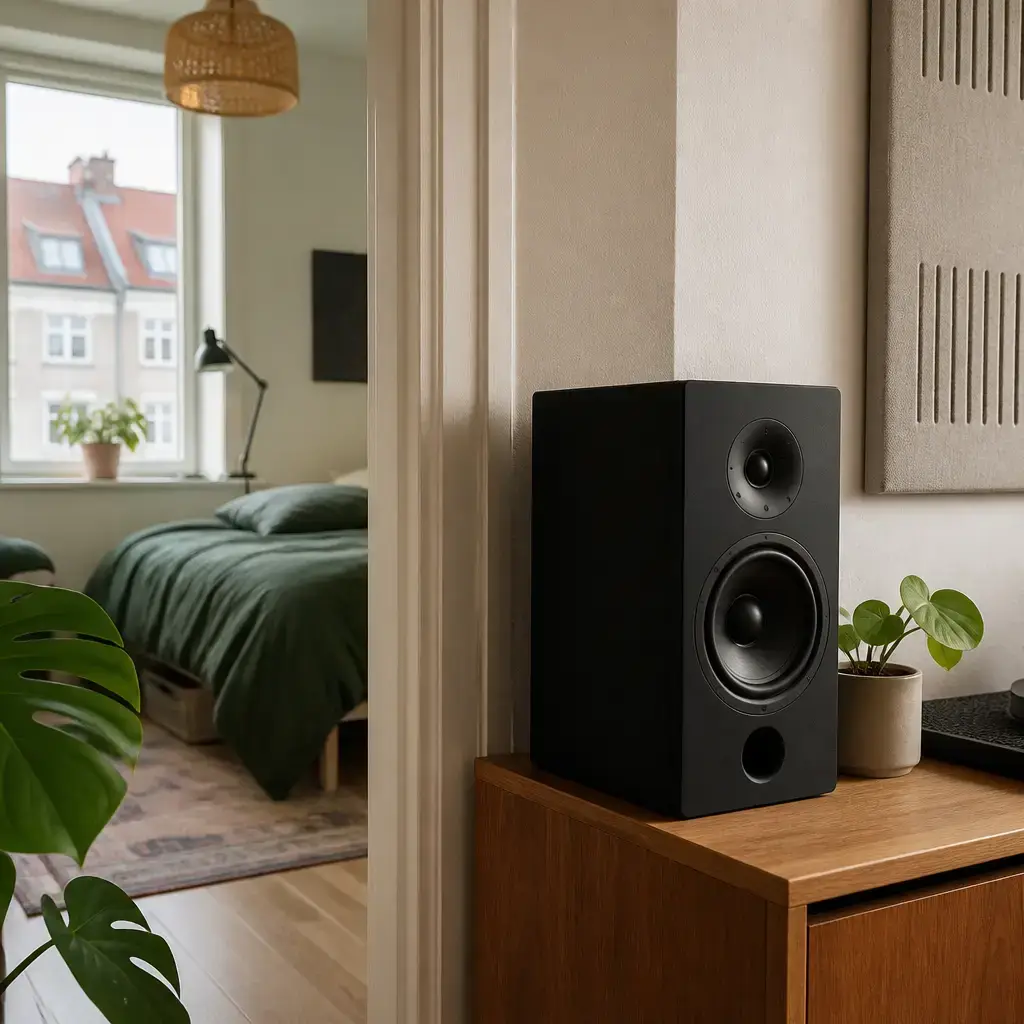
Ich wollte erwähnen, dass deine Musik deutlich durch die Wand zu hören ist.
ikh VOL-tuh air-VAIR-nun, dahss DYE-nuh moo-ZEEK DOYT-likh doorKH dee vahnt tsoo HUR-en ist. I wanted to mention that your music carries clearly through the wall.Ich hatte nicht gemerkt, dass sie bis zu dir durchdringt.
ikh HAH-tuh nikht guh-MERKT, dahss zee bis tsoo DEER doorKH-DRINGT. I did not realize it was reaching your side.Man hört sie vor allem spät in der Nacht, wenn es im Gebäude ruhig ist.
mahn HURT zee fohr AH-lem shpayt in dair NAKHT, venn ess im guh-BOY-duh ROO-ikh ist. It is mostly noticeable late at night, when the building is quiet.Ich kann den Bass leiser stellen und die Lautsprecher von der Wand abrücken.
ikh kahn den behss LYE-zer SHTEL-len unt dee LOWT-shpreh-kher fon dair vahnt ahb-RUE-ken. I can lower the bass and move the speakers away from the wall.Das würde helfen, besonders an Abenden vor Arbeitstagen.
dahss VUR-duh HEL-fen, buh-ZON-ders ahn AH-bent-en fohr AR-bites-tah-gen. That would help, especially on work nights.Sag mir bitte, wenn die Änderung nicht ausreicht.
zahk meer BIT-tuh, venn dee AIRN-duh-roong nikht OWSS-rikht. Please tell me if the change is not enough.Ich weiß es zu schätzen, dass du bereit bist, darüber zu sprechen.
ikh vice ess tsoo SHET-sen, dahss doo buh-RITE bist, dah-ROO-ber tsoo SHPREKH-en. I appreciate you being willing to talk about it.Es ist besser, das zu klären, bevor sich daraus Spannungen entwickeln.
ess ist BES-ser, dahss tsoo tsoo KLAY-ren, buh-FOHR zikh dah-ROWSS SHPAN-noong-en ent-VIK-keln. It is better to sort this out before it turns into tension.Sentence explanations
Ich wollte erwähnen, dass deine Musik deutlich durch die Wand zu hören ist.
I wanted to mention that your music carries clearly through the wall.
- Ich wollte
- I wanted
- erwähnen
- mention
- Musik
- music
- deutlich
- clearly
- durch
- through
- Wand
- wall
- zu hören ist
- can be heard
More detail
Ich wollte uses wollte, the first-person singular past form of wollen (“to want”). Here it introduces the action that the speaker intended to perform: Ich wollte erwähnen ... = “I wanted to mention ...”. With a modal verb such as wollen, the other verb stays in the infinitive and comes later: Ich will gehen = “I want to go”; Ich wollte gehen = “I wanted to go.” erwähnen means “to mention” or “to bring up.” It is the infinitive selected by wollte in this sentence. Example: Ich möchte etwas erwähnen. — “I would like to mention something.” Musik is the noun “music.” Its useful base form is die Musik; the article shows that this noun is feminine in German. In the sentence, deine Musik means “your music”: deine agrees with the feminine singular noun Musik in this form. Example: Die Musik ist leise. — “The music is quiet.” deutlich means “clearly” here and describes how the music can be heard. The same word can also mean “clear” when it describes a noun, but in this sentence it functions adverbially. Example: Man hört die Stimme deutlich. — “One can hear the voice clearly.” durch means “through” and marks passage from one side of something to the other. With the definite article and noun here, durch die Wand means “through the wall.” In this use, durch takes the accusative case; die has the same visible form for feminine singular accusative as for feminine singular nominative. Example: Das Licht kommt durch das Fenster. — “The light comes through the window.” Wand means “wall.” Its base form is die Wand, and its plural is die Wände (“walls”), with an umlaut in the plural. The phrase durch die Wand identifies the wall as the surface through which the sound travels; it does not by itself state which particular wall beyond the intended context. zu hören ist is the German construction zu hören sein, literally “to be to hear,” used idiomatically for being audible or being able to be heard. In the fixed sentence, ist is the third-person singular present form of sein, and zu hören is the infinitive phrase. Because this is a subordinate clause introduced by dass, the finite verb ist appears at the end: ..., dass ... zu hören ist. Compare Die Musik ist zu hören. — “The music can be heard.” Together, dass deine Musik deutlich durch die Wand zu hören ist means “that your music carries clearly through the wall” or, more directly, “that your music can be heard clearly through the wall.” The complete utterance combines the past intention Ich wollte with erwähnen and then gives the content of the mention after dass: “I wanted to mention that your music can be heard clearly through the wall.”
Ich hatte nicht gemerkt, dass sie bis zu dir durchdringt.
I did not realize it was reaching your side.
- Ich hatte
- I had
- nicht
- not
- gemerkt
- noticed; realized
- dass
- that
- sie
- it
- bis zu dir
- to your side
- durchdringt
- reaches
More detail
Ich hatte introduces a past-before-past perspective: hatte is the first-person singular imperfect of haben, used here as the auxiliary for the pluperfect. With gemerkt, it means “I had realized/noticed.” Example: Ich hatte das schon gehört. — “I had already heard that.” nicht negates the realization: the speaker had not noticed it. German commonly places nicht before the part being negated; here it combines with hatte ... gemerkt to give “had not realized.” gemerkt is the past participle of merken (“to notice, realize”). The useful chain is merken — merkte — hat gemerkt; with hatte, the participle forms the pluperfect: hatte gemerkt. dass introduces the content of what was or was not realized. In a dass clause, the finite verb normally goes to the end, so durchdringt appears after the other clause elements rather than directly after sie. sie is the third-person singular feminine pronoun in this context, translated by the fixed text as “it.” In the supplied context, it continues the previously discussed sound or music. The pronoun itself marks feminine singular agreement; the English translation does not show that grammatical distinction. bis zu dir expresses an endpoint: “as far as you” or “to your location.” zu takes the dative, so du appears as dir. This phrase describes how far the reaching extends; it does not by itself specify a physical side or surface. durchdringt is the third-person singular present form of durchdringen, “to penetrate, permeate, or reach through.” Its form matches the singular subject sie. In this sentence, the present form presents the reaching as the relevant situation inside the content clause, even though the noticing happened earlier. Example: Der Schall durchdringt die Wand. — “The sound penetrates the wall.” Together, Ich hatte nicht gemerkt means “I had not realized,” and dass sie bis zu dir durchdringt gives the content of that realization: “that it reaches as far as you.” The complete utterance therefore means, “I did not realize it was reaching your side,” with the supplied context identifying “it” as the previously discussed music or sound.
Man hört sie vor allem spät in der Nacht, wenn es im Gebäude ruhig ist.
It is mostly noticeable late at night, when the building is quiet.
- hört
- hears
- sie
- it
- vor allem
- especially; mostly
- spät
- late
- Nacht
- night
- Gebäude
- building
- ruhig
- quiet
More detail
hört is the present-tense form of hören (“to hear”). With the subject man, it has the third-person singular form: man hört. In this context, hearing the sound can naturally be expressed in English as noticing it. Example: Man hört den Bass. — “You can hear the bass.” sie is the accusative form used here for “it.” The fixed translation and context identify it as the sound being discussed. In German, this written form can also represent feminine singular accusative “her/it” or plural accusative “them”; the intended singular “it” here comes from the supplied meaning and context, not from the form alone. It is the object of hört, not the subject. Compare Sie hört den Bass. — “She hears the bass,” where capitalized Sie is the subject and hört agrees with that third-person singular subject. The surface form sie alone does not show the object-versus-subject role in these examples; the role is established by the sentence structure and meaning. vor allem is a fixed adverbial construction meaning “especially” or “mostly.” It highlights the circumstance that is particularly relevant. Example: Ich höre es vor allem nachts. — “I hear it mostly at night.” spät means “late.” It can describe a late time: spät in der Nacht means “late at night.” Its opposite is früh (“early”). Nacht is the noun “night.” In in der Nacht, the preposition in is used with the dative for this time expression, giving the feminine article form der. Example: In der Nacht ist es still. — “At night it is quiet.” Gebäude means “building.” In im Gebäude, im is the contraction of in dem, meaning “in the building.” The noun is neuter: das Gebäude; after in for a location rather than movement, the article is dative dem. ruhig means “quiet” or “calm.” In ruhig ist, it is a predicate adjective describing a state, so it does not take an adjective ending. Example: Das Zimmer ist ruhig. — “The room is quiet.” The whole sentence begins with the general subject man and the verb-object combination hört sie: “one hears it,” naturally “it is noticeable.” vor allem spät in der Nacht specifies when this is most noticeable. The subordinate clause introduced by wenn gives the condition: wenn es im Gebäude ruhig ist, “when it is quiet in the building.” Here es is the grammatical subject of ist, while ruhig describes the state; im Gebäude indicates the location. Together, the utterance means: “It is mostly noticeable late at night, when the building is quiet.”
Ich kann den Bass leiser stellen und die Lautsprecher von der Wand abrücken.
I can lower the bass and move the speakers away from the wall.
- Ich kann
- I can
- Bass
- bass
- leiser
- quieter; lower
- stellen
- set; adjust
- Lautsprecher
- speakers
- von der Wand
- from the wall
- abrücken
- move away
More detail
Ich kann combines ich (“I”) with können (“can; be able to”). The form kann is present tense, first-person singular. With a following infinitive, können expresses ability or a feasible option: Ich kann helfen. = “I can help.” Bass means “bass,” here the low-frequency sound component being adjusted. Its base form is der Bass; in den Bass, the masculine singular article shows the accusative object of stellen. leiser is the comparative form of leise (“quiet; soft”). In den Bass leiser stellen, it means making the bass quieter or lower, not necessarily comparing it with a specifically named thing. The useful pattern is etwas leiser stellen = “turn something down / make something quieter.” stellen means “to set or adjust” here. In this combination, it describes changing a control or level: Ich stelle die Musik leiser. = “I turn the music down.” After the modal kann, it remains in the infinitive. Lautsprecher means “speaker” or “loudspeaker.” Here die Lautsprecher is plural, referring to the speakers being moved. The singular is der Lautsprecher; the plural form is also Lautsprecher, while the article marks the plural in this sentence. von der Wand means “away from the wall” in this sentence. von takes the dative, so feminine singular die Wand becomes der Wand. The phrase identifies the wall as the point from which the speakers are moved: Der Tisch steht von der Wand ab. would not use the same verb, whereas Die Box rückt von der Wand ab. means “The box moves away from the wall.” abrücken means “move away” or “move back.” It is a separable verb: in a finite main clause, rückt ... ab, but after a modal it stays as the infinitive abrücken at the end. Its prefix gives the movement-away meaning; it is not the same as simply placing something somewhere. Together, den Bass leiser stellen describes lowering the bass level, while die Lautsprecher von der Wand abrücken describes physically moving the speakers away from the wall. kann applies to both coordinated actions: “I can lower the bass and move the speakers away from the wall.”
Das würde helfen, besonders an Abenden vor Arbeitstagen.
That would help, especially on work nights.
- Das würde
- That would
- helfen
- help
- besonders
- especially
- Abenden
- evenings
- Arbeitstagen
- workdays
More detail
Das würde combines das (“that”) with würde, the third-person singular form of werden used with an infinitive to express a hypothetical or conditional result. Here das refers to an already understood action or situation; the sentence itself does not specify exactly which one. The pattern Das würde + infinitive is reusable: Das würde funktionieren. — “That would work.” helfen is the infinitive “to help.” With würde, the infinitive stays at the end of this clause: Das würde helfen — “That would help.” The verb helfen commonly takes a dative object when a person is named, as in Das hilft mir. — “That helps me.” No such person is stated here. besonders means “especially” and highlights one circumstance within the broader statement. It can also appear before another emphasized element: Besonders abends ist es ruhig. — “It is especially quiet in the evenings.” Abenden is the plural dative form of der Abend (“evening”): der Abend, die Abende, an Abenden. The temporal preposition an takes the dative here, so an Abenden means “on evenings.” Arbeitstagen is the plural dative form of der Arbeitstag (“workday”): der Arbeitstag, die Arbeitstage, vor Arbeitstagen. The preposition vor takes the dative when it means “before” in this time expression. vor Arbeitstagen therefore means “before workdays,” naturally rendered in the fixed translation as “work nights.” Together, besonders an Abenden vor Arbeitstagen identifies the particularly relevant time: evenings that come before workdays. The complete utterance says that the understood action or situation would help, especially during those evenings.
Sag mir bitte, wenn die Änderung nicht ausreicht.
Please tell me if the change is not enough.
- Sag mir
- tell me
- wenn
- if
- Änderung
- change
- ausreicht
- is enough / suffices
More detail
Sag mir is an informal singular imperative of sagen (“to tell/say”) with mir (“to me”) in the dative. The subject du is understood from the imperative, so the request is addressed to one person informally. Sag is the imperative form; compare the present-tense form du sagst (“you say”). Bitte softens the request and means “please.” wenn introduces the condition “if” here. It can also have a temporal meaning (“when”), but the fixed translation gives the conditional reading. In a wenn subordinate clause, the finite verb normally goes to the end. Änderung means “change” here and is a feminine noun: die Änderung. Its plural is die Änderungen. It is related to the verb ändern (“to change”), but the noun itself names the change, not the action as a verb. Example: Die Änderung hilft. — “The change helps.” ausreicht means “is enough” or “suffices” in this sentence. It is the third-person singular present form of ausreichen. This verb is separable: in a main clause, Die Änderung reicht aus means “The change is enough”; inside the wenn clause, the parts remain together at the end: wenn die Änderung ausreicht. The word nicht negates it, producing “is not enough.” Together, wenn die Änderung nicht ausreicht means “if the change is not enough.” The complete utterance Sag mir bitte, wenn die Änderung nicht ausreicht. means “Please tell me if the change is not enough.”
Ich weiß es zu schätzen, dass du bereit bist, darüber zu sprechen.
I appreciate you being willing to talk about it.
- Ich weiß es zu schätzen
- I appreciate it
- bereit
- willing; ready
- darüber
- about it
- zu sprechen
- to talk
More detail
Ich weiß es zu schätzen is an established German way to say “I appreciate it” or “I appreciate …”. Here, weiß is the first-person singular present form of wissen (“to know”), but the whole expression is idiomatic: es is the thing appreciated. The following dass-clause explains what es refers to; it is not a following zu-infinitive clause. In ordinary use, wissen means “to know,” as in Ich weiß die Antwort. — “I know the answer.” dass du bereit bist introduces the content of the appreciation: “that you are willing.” In a German dass-clause, the finite verb normally comes at the end: bist is the second-person singular present form of sein (“to be”), agreeing with du. bereit means “willing” or “ready”; its intended sense here is willingness to do something. A reusable pattern is jemand ist bereit, etwas zu tun — “someone is willing to do something.” darüber means “about it” here. It is a da-compound referring to a matter or topic, with über meaning “about.” The fixed translation supports the intended reference to the matter being discussed, without identifying that matter more specifically. For a person, German normally uses über ihn or über sie rather than darüber. zu sprechen means “to talk” or “to speak.” sprechen is the base form; adding zu gives the infinitive zu sprechen. In the pattern bereit sein, zu ..., this infinitive names the action someone is willing to perform. Example: Sie ist bereit, zuzuhören. — “She is willing to listen.” Together, Ich weiß es zu schätzen expresses appreciation, while dass du bereit bist, darüber zu sprechen identifies what is appreciated: the addressee’s willingness to talk about the matter. The complete meaning is “I appreciate you being willing to talk about it.”
Es ist besser, das zu klären, bevor sich daraus Spannungen entwickeln.
It is better to sort this out before it turns into tension.
- besser
- better
- das
- this
- zu klären
- to clarify; to sort out
- bevor
- before
- daraus
- from this; as a result
- Spannungen
- tensions
- sich … entwickeln
- develop; turn into
More detail
besser means “better” here and is the comparative form of gut (“good”): gut → besser → am besten (“best”). In Es ist besser ..., the comparison is left implicit: one option is presented as preferable to another. Es ist besser, ... is a useful impersonal pattern meaning “It is better to ...”. das means “this” in the fixed translation. It is a demonstrative pronoun, not an article here, and it functions as the object of zu klären. Its exact referent is supplied by the situation rather than named in this sentence. The form das is neuter singular in this use; the pronoun’s grammatical form does not by itself identify what “this” refers to. zu klären means “to clarify” or “to sort out”. The base verb is klären; zu klären is its infinitive with zu. After expressions such as Es ist besser, German commonly uses this infinitive to state the preferable action: Es ist besser, das jetzt zu klären. — “It is better to sort this out now.” bevor introduces a subordinate clause meaning “before”. In that clause, the finite verb goes to the end: bevor sich daraus Spannungen entwickeln (“before tensions develop from it”). This is a time relation; it places the sorting-out action before the development described in the subordinate clause. daraus means “from this/that” or “out of it”. It is a fused form of da + aus and links the result to something already established in the context. Here it presents the matter as the source from which the tensions may develop. A useful related contrast is darin (“in this/that”), which expresses location or involvement inside something rather than origin from it. Spannungen means “tensions”. Its base form is the feminine singular noun die Spannung; Spannungen is its plural. The target sentence therefore uses a plural noun, although the fixed English translation expresses the idea with the mass noun “tension”. sich entwickeln means “to develop” or, with a result, “to turn into”. entwickeln is the base verb, and sich entwickeln is the reflexive construction used when something develops on its own or comes to take shape. Here Spannungen is the subject, so the finite verb is plural: Spannungen entwickeln sich. In the subordinate clause, the parts are ordered sich ... entwickeln, with the finite verb at the end. Example: Aus kleinen Problemen entwickeln sich Konflikte. — “Conflicts develop from small problems.” Taken together, Es ist besser presents a preferable course of action, das zu klären names the action, and bevor sich daraus Spannungen entwickeln sets the time limit: it is better to sort this out before tensions develop from it. The sentence is a general, neutral way to recommend resolving an issue early.
Grammar Points
sein + zu + Infinitiv
Die Musik ist deutlich zu hören.
dee moo-ZEEK ist DOYT-likh tsoo HUR-en.The music is clearly audible.
„sein + zu + Infinitiv“ expresses that something can be done or is possible.
etwas zu schätzen wissen
Ich weiß es zu schätzen.
ikh vice ess tsoo SHET-sen.I appreciate it.
This fixed expression uses „wissen“ with „zu“ plus the infinitive and means to appreciate something.
German Vocabulary
Ich wollte erwähnen, dass deine Musik deutlich durch die Wand zu hören ist.
Quiz
Spelling
Tap the letters to spell the word.
clearly
Show Answer
deutlichto penetrate / to carry through
Show Answer
durchdringtto notice / to realize
Show Answer
gemerktto mention