10 minutes free every day
Continue audio lessons in the app
Word explanations appear automatically in sync with the audio.
No login required · synced translations · playback with the screen locked
Choose your learning language and open this lesson in the app.

About This Lesson
Use Handling a Misdelivered Package Politely to practice German conversation, pronunciation, vocabulary, grammar, and quizzes.
Dialogue
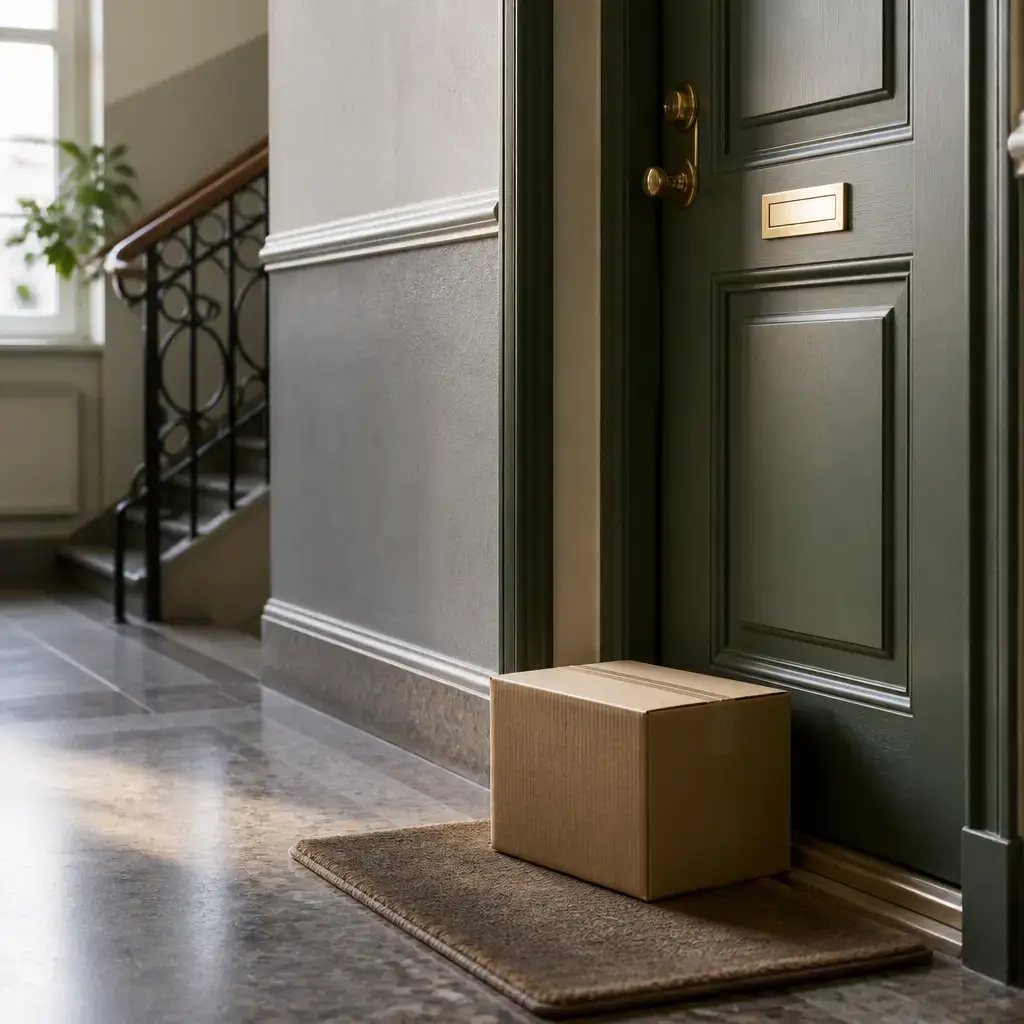
Ein Paket für meine Wohnung wurde vor deiner Tür abgestellt.
ine pah-KAYT fyoor MY-nuh VOHN-oong VOOR-duh fohr DYE-nuh TEWR AP-guh-SHTELLT. A package for my apartment was left outside your door.Ich habe es bemerkt und für dich neben der Tür gelassen.
ikh HAH-buh ess buh-MERKT oont fyoor dikh NAY-bun dair TEWR guh-LASS-un. I noticed it and kept it by the door for you.Ich hatte gehofft, dass es nicht verschwunden war.
ikh HAT-tuh guh-HOHFT dass ess nikht fair-SHVOON-dun vahr. I was hoping it had not gone missing.Das war wahrscheinlich nur eine Verwechslung der Etiketten.
dass vahr vah-SHINE-likh noor EYE-nuh fair-VEX-loong dair ay-tee-KET-un. It was probably just a label mix-up.Ich kann in ein paar Minuten vorbeikommen, um es abzuholen.
ikh kahn in ine pahr mee-NOO-tun for-BYE-kom-un, oom ess AHP-tsoo-HOH-lun. I can come by in a few minutes to pick it up.Ich kann es dir bringen, wenn das für dich einfacher ist.
ikh kahn ess deer BRING-un, venn dass fyoor dikh EYE-n-fah-kher ist. I can bring it over if that is easier for you.Ich weiß das zu schätzen, aber ich bin schon in der Nähe.
ikh vice dass tsoo SHET-sun, AH-buh ikh bin shohn in dair NAY-uh. I appreciate that, but I am nearby already.Ich lasse es neben meiner Tür liegen, bis du hier bist.
ikh LASS-uh ess NAY-bun MY-nuh TEWR LEE-gun, biss doo heer bist. I'll leave it by my door until you get here.Sentence explanations
Ein Paket für meine Wohnung wurde vor deiner Tür abgestellt.
A package for my apartment was left outside your door.
- Paket
- package
- Wohnung
- apartment
- wurde
- was
- abgestellt
- left; placed
- Tür
- door
More detail
Paket means “package” here. It is a neuter noun: das Paket; its plural is die Pakete. In Ein Paket, the noun phrase is the grammatical subject of the passive sentence. The singular indefinite article corresponds to “a package” here, but it does not by itself add any extra measurement or quantity beyond the singular noun. für meine Wohnung means “for my apartment.” für is a preposition that takes the accusative case. meine agrees with the feminine singular noun Wohnung; for this feminine form, the possessive determiner has the same shape in the nominative and accusative: meine Wohnung. Compare the dative form meiner Wohnung in a context that requires dative. Wohnung means “apartment” here. The noun is feminine: die Wohnung; its plural is die Wohnungen. The related word wohnen means “to live,” but Wohnung is the noun for a dwelling, not the verb. wurde is the third-person singular past form of werden, used here as the passive auxiliary. The passive pattern is wurde + past participle for something that “was” done: Das Paket wurde geliefert. — “The package was delivered.” Wurde agrees with the singular subject Ein Paket; it is not the form of abgestellt. abgestellt is the past participle of abstellen, meaning “to set down” or “to leave/place” something. In this sentence, wurde abgestellt forms the simple past passive: “was left” or “was placed.” The agent is not stated, so the sentence says what happened to the package without saying who left it. In an active sentence, Jemand stellte das Paket ab. means “Someone left the package.” vor deiner Tür means “outside/in front of your door.” vor is a two-way preposition: with dative it describes a location, while with accusative it can describe movement to a location. Here the package is located in front of the door, so Tür is dative: deiner Tür. Tür is feminine (die Tür), and its plural is die Türen. deiner is the feminine singular dative form of the possessive determiner dein. Together, Ein Paket für meine Wohnung is the subject, wurde ... abgestellt says that it was left or placed, and vor deiner Tür gives the location. The complete meaning is: “A package for my apartment was left outside your door.”
Ich habe es bemerkt und für dich neben der Tür gelassen.
I noticed it and kept it by the door for you.
- Ich habe
- I have
- es
- it
- bemerkt
- noticed
- für dich
- for you
- neben
- next to
- Tür
- door
- gelassen
- left
More detail
Ich habe is the first-person singular present form of haben, used here as the auxiliary for the German perfect tense. The speaker uses habe with the subject Ich; the lexical actions are expressed by the participles later in the sentence. In coordinated clauses, the same auxiliary can support more than one participle: Ich habe ... bemerkt und ... gelassen. es is an unstressed pronoun meaning “it” here. Its grammatical form is third-person singular neuter, while its concrete referent is the item identified as “it” in the translation and compatible with the package in the preceding context. German pronoun form and actual referent are separate facts: es has neuter form, but that form alone does not identify what the item is. bemerkt is the past participle of bemerken (“to notice”). The form bemerken is the useful base form; in the perfect, haben combines with bemerkt: Ich habe es bemerkt = “I noticed it.” The participle is not an adjective here; it completes the past-tense verb construction. für dich means “for you.” dich is the accusative form of the second-person singular pronoun du; compare du (“you,” subject) and dich (“you,” direct object or after an accusative-taking preposition). The preposition für requires the accusative: für mich = “for me,” für dich = “for you.” neben means “next to” or “beside.” With a location rather than movement toward a destination, neben takes the dative. In neben der Tür, der is the dative singular form of the feminine noun phrase; the location is beside the door. With movement to a position, the same preposition can take the accusative, as in the example Ich stelle es neben die Tür — “I place it next to the door.” Tür is the noun “door.” Its base form is Tür; it is a feminine noun, and the phrase here is der Tür, dative singular after the locative use of neben. The noun itself is the element that names the location, while der marks the form required in this phrase. gelassen is the past participle of lassen, meaning “to leave” in this context. Here it says that the speaker left the item in the stated place; it does not by itself mean that the speaker retained ownership of it. The perfect pattern is hat ... gelassen or, with this first-person subject, habe ... gelassen. Together, Ich habe es bemerkt means “I noticed it.” The conjunction und joins that action to für dich neben der Tür gelassen, meaning “left it next to the door for you.” The full utterance therefore means: “I noticed it and kept it by the door for you,” with the German verb gelassen specifically expressing leaving it there. In ordinary reusable form, Ich habe X bemerkt und Y für dich neben Z gelassen combines two completed actions, with für dich marking the intended recipient and neben der Tür marking the location.
Ich hatte gehofft, dass es nicht verschwunden war.
I was hoping it had not gone missing.
- Ich
- I
- hatte gehofft
- was hoping
- dass
- that
- es
- it
- nicht
- not
- verschwunden
- gone missing
- war
- was
More detail
Ich means “I” here and is the first-person singular subject. It is the form used for the speaker; compare du (“you,” singular informal) when addressing one person. hatte gehofft is the two-word form of hoffen (“to hope”). hatte is the first-person singular past form of haben, and gehofft is the past participle of hoffen. Together they form the German pluperfect: ich hatte gehofft = “I had hoped.” In this sentence, the fixed translation naturally presents that earlier hope as “I was hoping.” Example: Ich hatte gehofft, dass du kommst. — “I had hoped that you would come.” dass introduces a subordinate clause meaning “that.” In a German dass clause, the finite verb normally moves to the end. Reusable pattern: Ich hoffe, dass ... — “I hope that ...”; Ich hatte gehofft, dass ... places the same kind of content inside an earlier hope. es is a third-person singular neuter pronoun, meaning “it” here. Its grammatical form is neuter singular; the supplied translation identifies its intended referent only as “it,” without naming a more specific noun. Example: Ich sehe es. — “I see it.” nicht means “not” and negates the following proposition here. The sentence therefore expresses hope that the item had not gone missing, rather than hope that it had gone missing. Example: Es ist nicht hier. — “It is not here.” verschwunden is the past participle of verschwinden, “to disappear” or “to go missing.” It describes the item as no longer present. With the auxiliary sein, it forms a perfect or pluperfect construction: ist verschwunden = “has disappeared / is gone,” while war verschwunden = “had disappeared / was gone.” war is the third-person singular past form of sein (“to be”). Here it is the finite auxiliary at the end of the dass clause, combining with verschwunden to form verschwunden war, “had gone missing” or “was gone.” The form agrees with the neuter-singular subject es; the same form is also used with third-person singular masculine and feminine subjects in the simple past, so this form alone does not identify gender. The sentence assembles as Ich hatte gehofft (“I had hoped / I was hoping”) + dass (“that”) + es nicht verschwunden war (“it had not gone missing”). Thus the complete meaning is: “I was hoping it had not gone missing.”
Das war wahrscheinlich nur eine Verwechslung der Etiketten.
It was probably just a label mix-up.
- Das
- it
- war
- was
- wahrscheinlich
- probably
- nur
- just
- Verwechslung
- mix-up
- Etiketten
- labels
More detail
Das means “it” here as a neuter singular nominative form. Its specific referent is not identified by the sentence itself; the form marks the grammatical role and neuter singular agreement, not a particular noun. In other contexts, das can also be a demonstrative meaning “that” or introduce a clause, so its use depends on the surrounding structure. war is the simple-past form of sein (“to be”) for the first- or third-person singular: sein → war. Here it agrees with the third-person singular subject Das and places the situation in the past. Example: Das war ein Fehler. — “That was a mistake.” wahrscheinlich means “probably” and marks the statement as likely rather than certain. It can be used with a finite verb in the same way: Sie kommt wahrscheinlich später. — “She will probably come later.” nur means “just” in the sense of limiting the characterization: the situation was merely a mix-up, not something presented as more serious. Its exact effect comes from the word or phrase it limits; here it applies to eine Verwechslung. Verwechslung is a feminine noun meaning “mix-up” or “confusion between things.” It is related to the verb verwechseln (“to mix up” or “to confuse”), but the noun names the resulting mistake or situation. The phrase eine Verwechslung uses the feminine indefinite article eine; this article does not by itself state a numerical count. Example: Das war eine Verwechslung. — “That was a mix-up.” Etiketten is the plural form of Etikett, meaning “labels.” In der Etiketten, the genitive plural expresses the labels involved in the mix-up: literally, “a mix-up of the labels.” The form Etiketten is also used for the accusative and dative plural; the surrounding article or preposition can show the case. Example: Die Etiketten sind neu. — “The labels are new.” The full structure is Das war wahrscheinlich nur eine Verwechslung der Etiketten. Das war says that the situation was something in the past; wahrscheinlich adds uncertainty, and nur eine Verwechslung der Etiketten characterizes it specifically as merely a mix-up involving the labels. Together: “It was probably just a label mix-up.”
Ich kann in ein paar Minuten vorbeikommen, um es abzuholen.
I can come by in a few minutes to pick it up.
- Ich kann
- I can
- in ein paar Minuten
- in a few minutes
- vorbeikommen
- come by
- es
- it
- abzuholen
- pick up
More detail
Ich kann means “I can” here. kann is the present-tense form of können for ich; the same verb is used for ability or possibility, with the intended sense determined by context. With a modal verb, the other verb normally stays in the infinitive at the end of the clause: Ich kann kommen = “I can come.” in ein paar Minuten gives the time: “in a few minutes.” German in can express the time until a future event with a time span. ein paar is an approximate small number, not a precise count. vorbeikommen means “to come by” or “to stop by.” It is a separable verb formed with vorbei- and kommen. In the fixed sentence it remains an infinitive after kann; in a main clause without the modal, the prefix separates: Ich komme morgen vorbei. — “I’m coming by tomorrow.” es means “it” here. It is the accusative form of the third-person singular neuter pronoun: nominative es, accusative es. The fixed translation supports an unspecified singular object, but does not identify exactly what that object is. abzuholen means “to pick up.” It is the zu-infinitive of the separable verb abholen; for this verb, zu is placed between the prefix and the verb stem: abzuholen. The pattern um ... zu + infinitive expresses purpose: Ich komme, um es abzuholen. — “I’m coming in order to pick it up.” Together, Ich kann in ein paar Minuten vorbeikommen says “I can come by in a few minutes.” The purpose phrase um es abzuholen adds what the visit is for, producing the complete meaning: “I can come by in a few minutes to pick it up.”
Ich kann es dir bringen, wenn das für dich einfacher ist.
I can bring it over if that is easier for you.
- Ich kann
- I can
- es
- it
- dir
- to you
- bringen
- bring
- wenn
- if
- das
- that
- für dich
- for you
- einfacher
- easier
- ist
- is
More detail
Ich kann combines the first-person singular subject Ich (“I”) with the present-tense modal form kann from können (“can, be able to”). The modal is followed by an infinitive later in the clause: Ich kann es bringen means “I can bring it.” German modal clauses commonly place that infinitive at the end. es is an accusative personal pronoun meaning “it.” Its neuter form is es; the form does not identify the specific object by itself. Here the fixed translation supports the meaning “it” as the thing to be brought. dir is the dative form of the informal singular pronoun du (“you”). The verb bringen can take a recipient in the dative: Ich bringe dir das Buch means “I bring you the book.” The dative marks the person receiving or benefiting from the action; it is not the object being brought. bringen is the infinitive “to bring.” Its present first-person form is ich bringe, while after the modal kann the infinitive remains bringen: Ich kann es bringen — “I can bring it.” In this utterance, es is the item and dir identifies the person it can be brought to. wenn introduces a conditional subordinate clause meaning “if.” In a German clause introduced by wenn, the finite verb normally goes to the end. The pattern wenn ... einfacher ist is therefore “if ... is easier,” with ist at the end. das means “that” here and functions as a demonstrative pronoun. It refers to the relevant option or arrangement as a whole, rather than naming a particular noun in the sentence. As the subject of this clause, it controls the singular form ist. für dich means “for you.” The preposition für takes the accusative case, so the informal singular pronoun is dich, not the dative form dir. Compare Ich mache das für dich — “I’ll do that for you.” einfacher is the comparative form of the adjective einfach (“easy” in this use). The chain is einfach — “easy,” einfacher — “easier,” am einfachsten — “easiest.” Here it is a predicative adjective after sein, so it describes das and is not inflected for a noun: Das ist einfacher — “That is easier.” ist is the third-person singular present form of sein (“to be”). Its subject here is the singular demonstrative pronoun das: das ist — “that is.” The finite verb appears at the end because this is the subordinate clause introduced by wenn. Together, Ich kann es dir bringen means “I can bring it to you.” The conditional clause wenn das für dich einfacher ist adds “if that is easier for you.” The complete utterance is therefore: “I can bring it over if that is easier for you.” It presents bringing the item as an available option, conditional on that option being easier for the other person.
Ich weiß das zu schätzen, aber ich bin schon in der Nähe.
I appreciate that, but I am nearby already.
- weiß … das zu schätzen
- appreciate that
- aber
- but
- bin
- am
- schon
- already
- in der Nähe
- nearby
More detail
weiß … das zu schätzen is the reusable German expression for appreciating something. The finite form weiß comes from wissen and is the present-tense first-person singular form: ich weiß. The construction etwas zu schätzen wissen literally uses wissen with zu schätzen, but together it means “to appreciate something.” Here, das means “that,” referring to the helpful action being discussed. Example: Ich weiß deine Hilfe zu schätzen. — “I appreciate your help.” aber introduces a contrast, meaning “but.” It connects the appreciation with the speaker’s different practical situation. bin is the first-person singular present form of sein (“to be”): ich bin. It describes the speaker’s current location or state. Example: Ich bin zu Hause. — “I am at home.” schon means “already” here. It says that the situation is true by now; it does not itself indicate how long the speaker has been there. Example: Ich bin schon fertig. — “I am already finished.” in der Nähe is a common location phrase meaning “nearby” or “in the vicinity.” Nähe is a feminine noun, so the location phrase has der after in in this dative use. The phrase identifies a nearby location without specifying exactly nearby what. Example: Der Laden ist in der Nähe. — “The shop is nearby.” Together, Ich weiß das zu schätzen says “I appreciate that.” aber then contrasts this appreciation with ich bin schon in der Nähe, “I am already nearby.” The complete meaning is: “I appreciate that, but I am nearby already.”
Ich lasse es neben meiner Tür liegen, bis du hier bist.
I'll leave it by my door until you get here.
- Ich
- I
- lasse
- leave
- es
- it
- neben
- beside; by
- meiner
- my
- Tür
- door
- liegen
- lie; be left
- bis
- until
- du
- you
- hier
- here
- bist
- are; be
More detail
Ich is the first-person singular pronoun, “I.” It identifies the speaker as the subject. In German, the subject form is ich; the object form is different, for example mich (“me”). lasse is the first-person singular present form of lassen. Here lassen means “leave or let something remain in a place,” not “allow” in isolation. The pattern etwas irgendwo liegen lassen means “leave something lying somewhere.” Other present forms include du lässt (“you leave/let”) and er/sie lässt (“he/she leaves/lets”). es is an accusative singular pronoun meaning “it.” In this personal-pronoun use, es is the neuter form; the supplied sentence does not identify the specific thing it refers to. It is the thing being left. German uses es here for the object of lasse. neben means “next to” or “beside.” For a stationary location, it takes the dative: neben + dative. With movement toward a position, German can instead use the accusative, as in the example Ich stelle es neben die Tür. — “I put it next to the door.” meiner means “my” here in the dative feminine singular form. Its base possessive form is mein; the form meiner is selected because it modifies the feminine noun Tür after the stationary-location use of neben. This is the possessive form that carries the relevant inflection, not the noun. Tür means “door.” It is a feminine noun: die Tür. In this sentence, meiner Tür is dative feminine singular, meaning “my door” within the location phrase. A useful contrast is die Tür for the nominative or accusative singular and der Tür for the dative singular when no possessive replaces the article. liegen means “lie” or “be lying.” Here it is an infinitive completing lasse: the speaker leaves es in a lying or remaining position. The construction etwas liegen lassen is reusable for “leave something lying.” For example, Ich lasse das Buch auf dem Tisch liegen. — “I leave the book on the table.” bis means “until” and introduces the time boundary for the main action. It connects the main clause with du hier bist, so the leaving remains relevant up to the point described by that clause. du is the second-person singular informal pronoun, “you.” It is the subject of the clause introduced by bis. The corresponding formal “you” is Sie, which has different agreement. hier means “here,” referring to the location relevant to the speaker and listener in this utterance. It is an adverb and does not inflect. bist is the second-person singular present form of sein, “to be.” The form chain is ich bin, du bist, er/sie/es ist. Because bist is in the subordinate clause introduced by bis, it appears at the end of that clause. Together, Ich lasse es neben meiner Tür liegen means “I’ll leave it lying by my door”: lasse combines with the infinitive liegen, es is the object, and neben meiner Tür gives the stationary location. The clause bis du hier bist adds the endpoint “until you get here.” Thus the whole utterance means: “I’ll leave it by my door until you get here.”
Grammar Points
Trennbare Verben: ab- steht im Hauptsatz am Satzende.
Ich stelle das Paket ab.
ikh SHTELL-uh dass pah-KAYT AHP.I put the package down.
Bei trennbaren Verben steht der Präfix im Hauptsatz getrennt am Ende: abstellen → stelle ... ab.
zu + Infinitiv bei trennbaren Verben: zu steht zwischen Präfix und Verb.
Es ist einfacher, das Paket abzuholen.
ess ist EYE-n-fah-kher, dass pah-KAYT AHP-tsoo-HOH-lun.It is easier to pick up the package.
Bei abholen wird zu eingeschoben: abholen → abzuholen.
German Vocabulary
Quiz
Spelling
Tap the letters to spell the word.
apartment
Show Answer
Wohnungto disappear
Show Answer
verschwundento leave or put down
Show Answer
abgestelltto leave