10 minutes free every day
Continue audio lessons in the app
Word explanations appear automatically in sync with the audio.
No login required · synced translations · playback with the screen locked
Choose your learning language and open this lesson in the app.

About This Lesson
Use Gym Equipment Etiquette to practice German conversation, pronunciation, vocabulary, grammar, and quizzes.
Dialogue
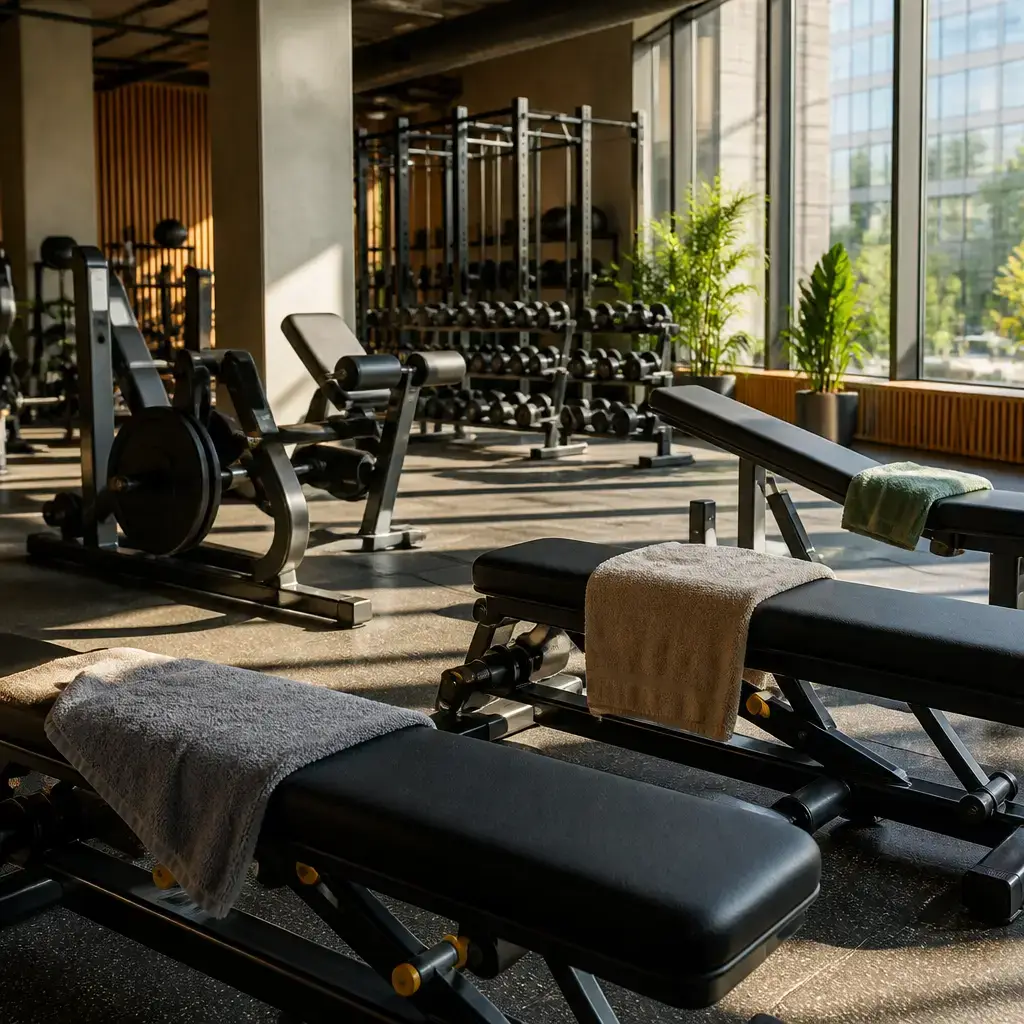
Mir ist aufgefallen, dass mehrere Geräte lange Zeit mit Handtüchern blockiert wurden.
meer ist OWF-guh-fall-en, dass MAYR-uh-reh guh-RAY-tuh LAHNG-uh tsight mit HAHNT-tewrn bloh-KEERT VOOR-den. I noticed several machines were being reserved with towels for a long time.Das kann frustrierend sein, besonders wenn das Fitnessstudio voll ist.
dass kann froo-STREE-rent zine, beh-ZON-ders venn dass FIT-ness-SHTOO-dee-oh foll ist. That can be frustrating, especially when the gym is busy.Ich wollte niemanden direkt zur Rede stellen.
ikh VOL-tuh NEE-mahn-den dee-REKT tsoor RAY-duh SHTELL-en. I did not want to confront anyone directly.Das Personal kann allgemein daran erinnern, ohne jemanden gezielt herauszugreifen.
dass pehr-soh-NAHL kann ahl-guh-MINE dah-RAHN eh-RIN-ern, OH-nuh YAY-mahn-den guh-TSEELT heh-ROWSS-tsoo-GRY-fen. Staff can give a general reminder without singling anyone out.Das würde weniger konfrontativ wirken.
dass VUR-duh VAY-nee-ger kon-fron-tah-TEEF VEER-ken. That would feel less aggressive.Ich kann eine Durchsage machen und den Trainingsbereich häufiger kontrollieren.
ikh kann EYE-nuh DOORKH-zah-guh MAKH-en oont dehn TRAY-ningz-beh-RYKH HOY-fikh-er kon-troh-LEER-en. I can make an announcement and monitor the gym floor more often.Das sollte den Zugang zu den Geräten verbessern, ohne Spannungen zu erzeugen.
dass ZOLL-tuh dehn TSOO-gahng tsoo dehn guh-RAY-ten beh-FESS-ern, OH-nuh SHPAN-noong-en tsoo ehr-TSOY-gen. That should improve access without creating tension.Bitte melde es wieder, wenn dasselbe weiterhin passiert.
BIT-tuh MEL-duh ess VEE-der, venn DAHSS-el-buh VY-ter-HINE pah-SEERT. Please report it again if the same thing keeps happening.Sentence explanations
Mir ist aufgefallen, dass mehrere Geräte lange Zeit mit Handtüchern blockiert wurden.
I noticed several machines were being reserved with towels for a long time.
- Mir ist aufgefallen
- I noticed
- mehrere
- several
- Geräte
- machines
- lange Zeit
- for a long time
- mit Handtüchern
- with towels
- blockiert wurden
- were reserved
More detail
Mir ist aufgefallen uses the German construction jemandem fällt etwas auf for noticing something. mir is the dative form of ich and marks the person who notices; it does not function as the grammatical subject. The base verb is auffallen: in the present, Mir fällt etwas auf; its perfect form here is ist aufgefallen. The separable prefix appears joined in the participle aufgefallen. mehrere means “several” and refers to a plural number greater than one without stating an exact count. It is the plural form used with Geräte; it is not the singular indefinite article. Geräte is the plural of Gerät, “machine/device.” The umlaut and ending distinguish this plural form from the singular. Example: Drei Geräte sind neu. — “Three machines/devices are new.” lange Zeit expresses duration: “for a long time.” lange modifies Zeit here, while the complete phrase functions as a time expression. Example: Sie wartete lange Zeit. — “She waited for a long time.” mit Handtüchern means “with towels.” The preposition mit requires the dative. Handtüchern is the dative plural of Handtuch; the plural noun receives the additional -n in this case. Example: Er trocknet den Tisch mit Handtüchern. — “He dries the table with towels.” blockiert wurden forms a past passive construction. blockieren means “to block,” and blockiert is its past participle. wurden is the simple-past plural form of werden, which serves here as the passive auxiliary. In this context, the towels are used to keep machines unavailable, so the fixed translation naturally gives “were being reserved.” In a subordinate clause, the finite auxiliary comes at the end, producing ..., dass ... blockiert wurden; in a main clause, the order would be Die Geräte wurden blockiert. The connector dass introduces the content of what was noticed. Thus Mir ist aufgefallen, dass means “I noticed that,” followed by the clause mehrere Geräte lange Zeit mit Handtüchern blockiert wurden: several machines were kept reserved/unavailable with towels for a long time. Together, the utterance means: “I noticed several machines were being reserved with towels for a long time.”
Das kann frustrierend sein, besonders wenn das Fitnessstudio voll ist.
That can be frustrating, especially when the gym is busy.
- kann
- can; may
- frustrierend
- frustrating
- sein
- to be
- besonders wenn
- especially when
- Fitnessstudio
- gym; fitness center
- voll
- full; busy
More detail
kann is the present-tense form of können for er/sie/es and das. Here it expresses possibility: “can be,” rather than physical ability. With a modal verb, the other verb stays in the infinitive and goes to the end of the clause. frustrierend describes something that causes frustration. It is a predicate adjective here, so it has no adjective ending after sein. Example: Die Wartezeit ist frustrierend. — “The waiting time is frustrating.” sein is the infinitive “to be.” In kann frustrierend sein, kann carries the tense and sein remains infinitive. The same verb appears as ist later in das Fitnessstudio voll ist; there it is the finite present form because that subordinate clause has no modal verb. besonders wenn introduces a condition that is especially relevant: “especially when.” A clause beginning with wenn normally sends its finite verb to the end. Example: Ich trainiere gern, besonders wenn es ruhig ist. — “I like training, especially when it is quiet.” Fitnessstudio is a neuter noun meaning “gym” or “fitness center.” Its definite article is das: das Fitnessstudio. German compound nouns are written as one word; the final element, Studio, determines the grammatical gender here. voll literally means “full.” With a place such as a gym, it naturally means that there are many people or little available space, so “busy” is the intended translation here. Example: Der Bus ist voll. — “The bus is crowded.” The sentence begins with Das, meaning “that,” referring to the situation under discussion. kann frustrierend sein says that this situation may be frustrating. besonders wenn das Fitnessstudio voll ist adds the condition “especially when the gym is busy.” Together: “That can be frustrating, especially when the gym is busy.”
Ich wollte niemanden direkt zur Rede stellen.
I did not want to confront anyone directly.
- wollte
- wanted
- niemanden
- no one
- direkt
- directly
- zur Rede stellen
- confront someone
More detail
wollte is the first-person singular preterite of wollen (“to want”): ich will = “I want,” ich wollte = “I wanted.” With a second verb, wollen places that verb in the infinitive at the end: Ich wollte gehen. = “I wanted to leave.” Here, Ich is the subject, and wollte expresses the speaker’s past desire or intention. niemanden means “no one” here as the direct object. It is the accusative form of niemand; the nominative form is niemand, while niemanden is used when this pronoun is the direct object. For example, Ich sehe niemanden. means “I see no one.” Here, it identifies the person whom the speaker did not want to confront. direkt means “directly” here. The same word can also be used before a noun, as in eine direkte Antwort (“a direct answer”); in this sentence it functions adverbially and describes how the confronting would take place. zur Rede stellen is the fixed construction “to confront someone” or “to call someone to account.” It is used with a person as its object: jemanden zur Rede stellen. zur is the contracted form of zu der; Rede is a feminine noun, and stellen is the infinitive used after wollte. Example: Sie stellte ihn zur Rede. = “She confronted him.” Together, Ich wollte (“I wanted”), niemanden (“no one”), direkt (“directly”), and zur Rede stellen (“to confront”) produce: “I did not want to confront anyone directly.” The negative meaning is expressed by niemanden; the sentence says that the speaker did not want to confront any person directly.
Das Personal kann allgemein daran erinnern, ohne jemanden gezielt herauszugreifen.
Staff can give a general reminder without singling anyone out.
- Das Personal
- staff
- kann
- can
- allgemein
- generally
- daran erinnern
- remind about it
- ohne
- without
- jemanden
- someone
- gezielt
- deliberately
- herauszugreifen
- single out
More detail
Das Personal means “the staff” here. Personal is a collective or mass noun that is grammatically singular in German, so the sentence uses the third-person singular form kann, not the plural form können. The article das identifies the noun as neuter; this grammatical gender does not describe the people themselves as neuter. kann is the third-person singular present form of können (“can, be able to”). Here it presents the staff as able to give a general reminder. With a plural subject, the corresponding form is können, as in Die Mitarbeitenden können helfen. — “The employees can help.” allgemein means “generally” or “in general.” Here it presents the reminder as general rather than directed at one identified person. Example: Sie gab eine allgemeine Information. — “She gave general information.” daran erinnern is a reusable pattern meaning “remind about it” or “remind someone of it,” with daran representing something introduced or understood from context. erinnern is the verb, and daran is a pronominal adverb formed from da- plus an. With an explicitly named thing, German can use an plus a noun phrase: Sie erinnert mich an den Termin. — “She reminds me about the appointment.” In the supplied sentence, the specific matter is not stated. ohne means “without” and introduces what is absent. Before a verb phrase, German uses ohne with a zu-infinitive: ohne jemanden zu stören means “without disturbing anyone.” Here, the zu belongs inside the following infinitive herauszugreifen. jemanden is the accusative form of the indefinite pronoun jemand (“someone”). It is the object of herauszugreifen: someone is being singled out. The form jemand is used for a subject, while jemanden marks an accusative object; for example, Jemand hilft. — “Someone is helping,” but Ich sehe jemanden. — “I see someone.” gezielt means “specifically” or “deliberately.” It modifies the act of singling out, contrasting a general reminder with deliberately selecting one person. Example: Sie sprach gezielt eine Person an. — “She addressed one person specifically.” herauszugreifen is the zu-infinitive of the separable verb herausgreifen, meaning “to pick out” and here “to single out.” The prefix heraus- is separated in finite forms: Sie greift niemanden heraus. — “She singles no one out.” With zu, it appears inside the infinitive: jemanden herauszugreifen. This form completes the pattern ohne jemanden gezielt herauszugreifen — “without deliberately singling anyone out.” Taken together, Das Personal kann presents the staff as able to act, allgemein daran erinnern describes giving a general reminder about a matter understood from context, and ohne jemanden gezielt herauszugreifen adds the condition that no individual is deliberately singled out. The whole utterance therefore means: “Staff can give a general reminder without singling anyone out.”
Das würde weniger konfrontativ wirken.
That would feel less aggressive.
- Das
- that
- würde
- would
- weniger
- less
- konfrontativ
- aggressive; confrontational
- wirken
- seem; feel
More detail
Das means “that” here and points to an already understood proposal or situation. As a pronoun, it is neuter singular in this form; the utterance itself does not identify a specific noun as its referent. Example: Das ist hilfreich. — “That is helpful.” würde is the Konjunktiv II form of werden used with an infinitive to express a hypothetical or conditional result: würde + wirken = “would seem/come across.” It does not mean that the effect is certainly occurring now. Example: Das würde helfen. — “That would help.” weniger means “less” and modifies the following description, creating a comparison with a stronger degree of the same quality. The contrast is mehr — “more”: weniger direkt means “less direct,” while mehr direkt is generally replaced by the more natural direkter for the adjective direkt. konfrontativ describes an approach that feels confrontational or aggressive. Here it is used predicatively with wirken, so it has no visible adjective ending. Example: Die Antwort wirkt konfrontativ. — “The answer comes across as confrontational.” wirken is the infinitive “to seem,” “to come across,” or “to have an effect.” With würde, it remains in the infinitive at the end: würde ... wirken. This verb focuses on the impression something gives, rather than asserting that it objectively is aggressive. Example: Die Formulierung wirkt freundlich. — “The wording comes across as friendly.” Together, Das würde introduces a hypothetical assessment, weniger konfrontativ means “less confrontational,” and wirken expresses the resulting impression. The complete utterance therefore means: “That would feel less aggressive.”
Ich kann eine Durchsage machen und den Trainingsbereich häufiger kontrollieren.
I can make an announcement and monitor the gym floor more often.
- Ich kann
- I can
- Durchsage
- announcement
- machen
- make
- Trainingsbereich
- gym floor
- häufiger
- more often
- kontrollieren
- monitor
More detail
Ich kann combines the first-person singular pronoun ich (“I”) with kann, the first-person singular present form of the modal verb können (“can; be able to”). With a modal verb, the other verb stays in the infinitive: Ich kann ... machen = “I can ... make.” The same kann also applies to the coordinated infinitive kontrollieren later in the sentence. Durchsage means an announcement, especially one delivered for people in a shared place. Its base form is the feminine noun die Durchsage; here it appears as eine Durchsage, the accusative form after machen. The useful pattern is eine Durchsage machen (“to make an announcement”). Example: Sie macht eine Durchsage. — “She makes an announcement.” machen is the infinitive “to make” and is used here with kann. German commonly uses machen in fixed combinations such as eine Durchsage machen; the noun determines the concrete action. The infinitive remains unchanged after a modal verb. Trainingsbereich means the training area or gym floor in this context. It is a masculine compound noun: der Trainingsbereich. Here den Trainingsbereich is accusative, marking the area that is being monitored. Example: Der Trainingsbereich ist geöffnet. — “The training area is open.” häufiger means “more often.” It is the comparative form of häufig (“often; frequent”): häufig → häufiger → am häufigsten (“most often”). Here it modifies the action kontrollieren, so the monitoring is to happen more often than before or than at a comparison point; the sentence does not specify that comparison point. kontrollieren means “to monitor” here. It is a regular infinitive, and after kann it stays in that form. In this context it takes den Trainingsbereich as its object: den Trainingsbereich kontrollieren means “monitor the training area.” Example: Wir kontrollieren den Eingang regelmäßig. — “We monitor the entrance regularly.” The conjunction und links two actions under the same modal verb: eine Durchsage machen and den Trainingsbereich häufiger kontrollieren. Together, Ich kann eine Durchsage machen und den Trainingsbereich häufiger kontrollieren. means “I can make an announcement and monitor the gym floor more often.”
Das sollte den Zugang zu den Geräten verbessern, ohne Spannungen zu erzeugen.
That should improve access without creating tension.
- Das sollte
- That should
- Zugang
- access
- Geräten
- devices
- verbessern
- improve
- Spannungen
- tensions
- erzeugen
- create
More detail
Das sollte: sollte is the form of sollen used here with das as the subject. In this sentence, it expresses an expected result: “should,” rather than a command to someone. The pronoun Das refers to the measure or situation understood from the sentence; the supplied texts do not identify a more specific noun. Example: Das sollte helfen. — “That should help.” Zugang: This means “access” and is masculine: der Zugang. Here it appears as den Zugang, the accusative singular, because it is what the improvement affects. A useful pattern is Zugang zu + dative: Zugang zu Informationen — “access to information.” Geräten: The base noun is das Gerät (“device”); its plural is die Geräte. After the preposition zu, the plural is dative: zu den Geräten — “to the devices.” The ending in Geräten marks this dative plural. Example: Der Zugang zu den Geräten ist beschränkt. — “Access to the devices is restricted.” verbessern: This infinitive means “to improve.” With sollte, the modal verb is conjugated and the lexical verb remains in the infinitive: Das sollte ... verbessern — “That should improve ...” Example: Die Änderung soll den Service verbessern. — “The change is intended to improve the service.” Spannungen: This is the plural of die Spannung; in this context it means “tensions,” especially strained relations. It is accusative here, the object of erzeugen. The singular can refer to one tension, while the plural refers to tensions generally or multiple tensions. Example: Das Gespräch erzeugte Spannungen. — “The conversation created tensions.” erzeugen: This verb means “to create” or “to produce.” In ohne ... zu erzeugen, the zu-infinitive construction describes an action that does not occur: ohne Spannungen zu erzeugen — “without creating tensions.” Together, den Zugang zu den Geräten verbessern means “improve access to the devices.” The structure ohne + zu adds the condition that this happens without creating tensions. Thus the complete utterance means: “That should improve access to the devices without creating tensions.”
Bitte melde es wieder, wenn dasselbe weiterhin passiert.
Please report it again if the same thing keeps happening.
- Bitte
- please
- melde
- report
- es
- it
- wieder
- again
- wenn
- if
- dasselbe
- the same thing
- weiterhin
- still
- passiert
- happens
More detail
Bitte makes the request polite: “please.” It is a flexible politeness word and does not itself specify who should act. melde is the imperative addressed to one person informally, from melden (“to report” or “notify”). The verb form tells the listener to report something; it does not mean “reporting” as a noun. For example: Melde den Fehler. — “Report the error.” es is the accusative form of the pronoun meaning “it.” Here it is the thing to be reported, while the fixed translation leaves that thing unspecified. German es has the same form for nominative and accusative in this use. wieder means “again,” so melde es wieder asks for another report. It is separate from the verb and adds repetition rather than changing the tense of melde. wenn introduces the condition “if/when.” In the following subordinate clause, German places the finite verb at the end: wenn ... passiert. In this sentence, the intended reading is conditional: report it again if the event recurs. dasselbe means “the same thing.” It is the neuter form of derselbe used independently, rather than a separate noun meaning “thing.” Compare dieselbe for a feminine referent and derselbe for a masculine referent when the relevant noun requires those forms. The form here identifies sameness, not merely similarity. weiterhin means “still” or “continually” and indicates that the situation continues. It modifies the event in the subordinate clause; it is not part of the meaning of dasselbe. passiert is the third-person singular present form of passieren, “to happen” or “occur.” The base form is passieren; passiert agrees with the singular subject dasselbe. For example: Das passiert weiterhin. — “That is still happening.” Together, wenn dasselbe weiterhin passiert means “if the same thing keeps happening.” The conditional clause comes after the request: Bitte melde es wieder (“Please report it again”) + wenn ... (“if ...”). The complete utterance therefore means: “Please report it again if the same thing keeps happening.”
Grammar Points
werden + Partizip II
Geräte wurden blockiert.
guh-RAY-tuh VOOR-den bloh-KEERT.Equipment was blocked.
The passive uses werden plus the past participle; wurden is the past-tense form of werden.
häufiger
Spannungen passieren häufiger im Fitnessstudio.
SHPAN-noong-en pah-SEER-en HOY-fikh-er im FIT-ness-SHTOO-dee-oh.Tensions happen more often in the gym.
häufiger is the comparative adverb meaning “more often.”
German Vocabulary
Mir ist aufgefallen
daran erinnern
jemanden gezielt herauszugreifen
Ich wollte niemanden direkt zur Rede stellen
Quiz
Word Order
Arrange the words in the correct order.
That would feel less aggressive.
Show Answer
Das würde weniger konfrontativ wirken.Spelling
Tap the letters to spell the word.
towel
Show Answer
Handtüchernpiece of equipment
Show Answer
Gerätestaff
Show Answer
Personalfrustrating