10 minutes free every day
Continue audio lessons in the app
Word explanations appear automatically in sync with the audio.
No login required · synced translations · playback with the screen locked
Choose your learning language and open this lesson in the app.

About This Lesson
Use Basic home actions and choices to practice Danish conversation, pronunciation, vocabulary, grammar, and quizzes.
Dialogue
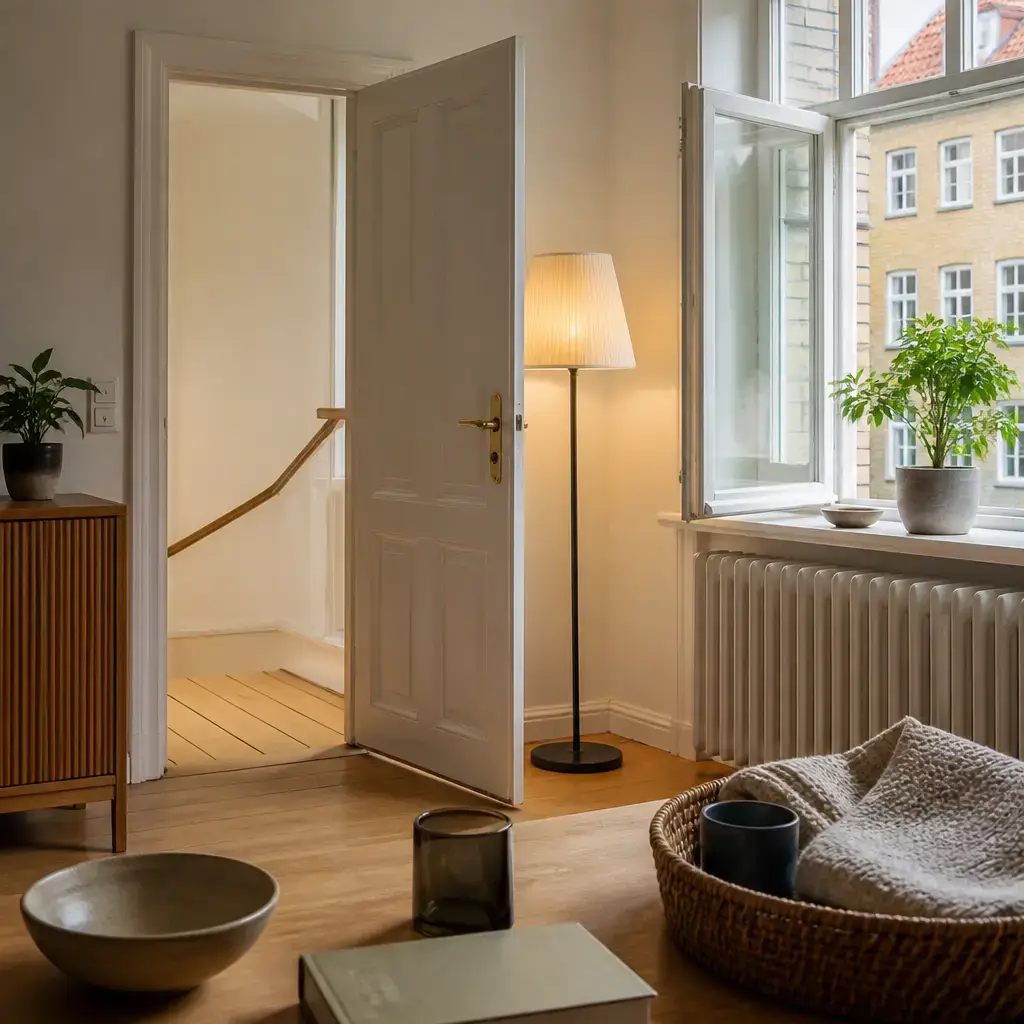
Åbn venligst døren.
OHM VEN-list DUHR-en. Please open the door.Luk venligst vinduet.
LOOK VEN-list VIN-oo-eth. Please close the window.Tænd den venligst.
TEN den VEN-list. Please turn it on.Sluk den venligst.
SLOOG den VEN-list. Please turn it off.Giv mig dette, tak.
GEEV my DEH-də, TEG. Please give me this.Jeg tager dette.
YAI TAIR-uh DEH-də. I will take this.Sentence explanations
Åbn venligst døren.
Please open the door.
- Åbn
- open
- venligst
- please
- døren
- the door
More detail
Åbn is the imperative of åbne (“to open”). It directly gives the instruction to open something. A reusable pattern is Åbn + [thing], for example: Åbn vinduet. — “Open the window.” venligst is a polite adverb meaning “please”. It softens a request or instruction and can be placed with an imperative, as in Luk venligst vinduet. — “Please close the window.” døren means “the door”. The base noun is dør (“door”); døren is its singular definite form, meaning one specific door understood in the situation. The ending -en marks this form for this noun. For comparison, vindue (“window”) has the singular definite form vinduet (“the window”), as in the supplied neighboring sentence. Together, Åbn venligst døren. means “Please open the door.” The imperative Åbn supplies the instruction, venligst makes it polite, and døren identifies what should be opened.
Luk venligst vinduet.
Please close the window.
- Luk
- close
- venligst
- please
- vinduet
- the window
More detail
Luk is the imperative of lukke, “to close.” The imperative gives a direct instruction and normally has no separately stated subject. For example: Luk døren. — “Close the door.” venligst is a polite word meaning “please.” It can soften a request without changing the action being requested. For example: Vent venligst. — “Please wait.” vinduet means “the window.” It is the definite singular form of vindue (“window”); the ending -et marks this form as definite and singular. For comparison, et vindue means “a window,” while vinduet means “the window.” Together, Luk venligst vinduet. forms a polite imperative: “Please close the window.”
Tænd den venligst.
Please turn it on.
- Tænd
- turn on
- den
- it
- venligst
- please
More detail
Tænd is the imperative of tænde, meaning “turn on” here. The imperative gives a direct instruction and normally has no written subject: Tænd! means “Turn it on!” or “Light it!” depending on context. In this sentence, den supplies the object. The contrasting verb in the supplied next sentence is slukke → sluk, “turn off.” den means “it” here. It is a Danish object pronoun for a singular noun of common gender; the form does not identify the specific thing by itself, and the supplied translation does not name that thing. Danish also uses det for a singular neuter-gender noun, while plural “them” is dem. The pronoun comes directly after the imperative verb in this sentence. venligst means “please.” It is an adverb often used to make an instruction more polite, and it can appear after the verb and object as here. The previous sentence uses the same word in Luk venligst vinduet, where Luk is the imperative of lukke, “close.” Together, Tænd + den gives “turn it on,” and final venligst adds “please”: “Please turn it on.”
Sluk den venligst.
Please turn it off.
- Sluk
- turn off
- den
- it
- venligst
- please
More detail
Sluk is the imperative of slukke, “to turn off” or “to switch off.” The imperative addresses someone directly and gives a command or request. Compare the related opposite action in the preceding sentence: Tænd means “turn on.” Example: Sluk lyset. — “Turn off the light.” den means “it” here. It is a Danish third-person singular pronoun used for a common-gender singular referent; the sentence and translation do not identify exactly what the referent is. The pronoun is the object of Sluk, so the requested action is directed at that referent. Example: Jeg ser den. — “I see it.” venligst is a polite word meaning “please.” It softens a request or command. It does not itself express the action; that comes from Sluk. Example: Vent venligst. — “Please wait.” Together, Sluk + den gives “turn it off,” and venligst marks the request as polite. The whole utterance therefore means “Please turn it off.”
Giv mig dette, tak.
Please give me this.
- Giv
- give
- mig
- me
- dette
- this
- tak
- please
More detail
Giv is the imperative of give (at give). It directly tells the listener to perform the action. Danish imperatives commonly omit the subject: Giv mig ... means “Give me ...”. Example: Giv ham bogen. — “Give him the book.” mig means “me” as the object of the action. Compare jeg for “I” when the person performs the action and mig when the person receives or is otherwise affected: Jeg giver dig bogen. — “I give you the book.” dette means “this” here and is used independently as a demonstrative pronoun. It is the neuter singular form; the corresponding common-gender form is denne. The sentence does not identify what dette refers to. Example: Jeg vælger dette. — “I choose this.” tak literally means “thanks,” but after a request it is a polite marker conventionally translated as “please.” Its meaning here is not a separate object or action; it softens the request. Tak can also be used after receiving something to express thanks. Together, Giv mig dette forms the request “Give me this”: the imperative Giv expresses the requested action, mig identifies the recipient, and dette identifies the thing requested. tak adds politeness, yielding “Please give me this.”
Jeg tager dette.
I will take this.
- Jeg
- I
- tager
- take
- dette
- this
More detail
Jeg means “I” and is the first-person singular subject pronoun. It identifies the speaker as the actor. Danish also has du for “you” when addressing one person. tager is the present-tense form of tage, “to take.” The present form can describe an action happening now or, as in the fixed translation, an intended or scheduled action understood as future: “will take.” The same form is used with different singular subjects; for example, Hun tager bogen. means “She takes the book” or, depending on context, “She will take the book.” dette means “this” and is used here as a standalone demonstrative pronoun referring to a specific thing understood from the situation. It is the neuter singular form; Danish also uses denne with common-gender singular nouns, while dette can stand alone without naming the thing. The fixed sentence does not identify what the thing is. Together, Jeg tager dette. has the structure “I + take/will take + this.” With the fixed translation and context, it means “I will take this.” The present-tense verb tager receives a future-intended reading here, and dette is the object being taken.
Grammar Points
Imperativ: verbets stamme
Åbn døren, venligst.
OHM DUHR-en, VEN-list.Open the door, please.
Den danske imperativ bruger ofte verbets stamme uden et subjekt: åbne → Åbn.
Bestemt form: substantiv + -en eller -et
Luk døren. Åbn vinduet.
LOOK DUHR-en. OHM VIN-oo-eth.Close the door. Open the window.
På dansk sættes bestemt kendeord ofte bag på navneordet: dør → døren og vindue → vinduet.
Danish Vocabulary
- Gender
- common
Tænd den venligst.
- Gender
- neuter
Giv mig dette, tak.
- Gender
- common
Åbn venligst døren.
Giv mig dette, tak.
Luk venligst vinduet.
Giv mig dette, tak.
Sluk den venligst.
Giv mig dette, tak.
Tænd den venligst.
Åbn venligst døren.
- Gender
- neuter
Luk venligst vinduet.
Åbn venligst døren.
Quiz
Word Order
Arrange the words in the correct order.
Please open the door.
Show Answer
Åbn venligst døren.Please close the window.
Show Answer
Luk venligst vinduet.Please turn it on.
Show Answer
Tænd den venligst.Spelling
Tap the letters to spell the word.
please
Show Answer
venligstturn off
Show Answer
Slukdoor
Show Answer
dørenwindow