10 minutes free every day
Continue audio lessons in the app
Word explanations appear automatically in sync with the audio.
No login required · synced translations · playback with the screen locked
Choose your learning language and open this lesson in the app.

About This Lesson
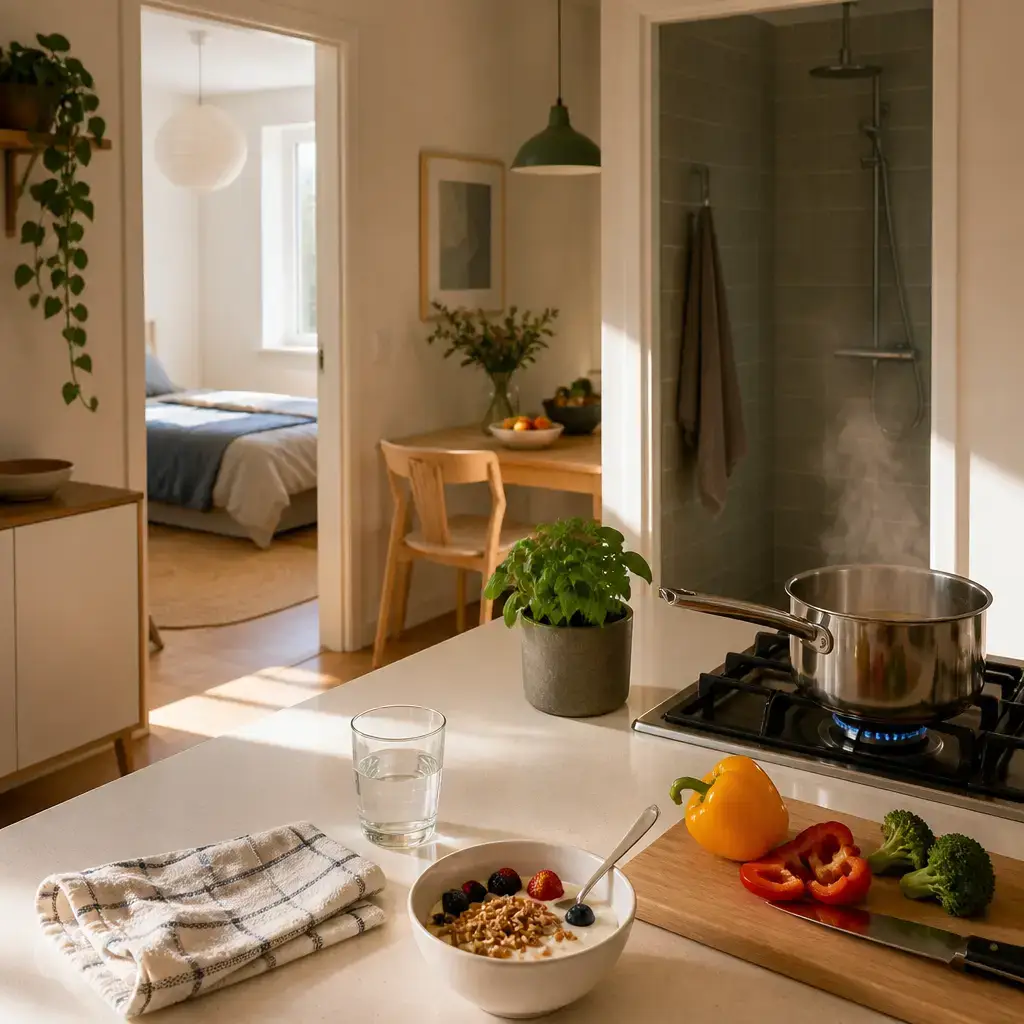
Use Basic actions happening now to practice Danish conversation, pronunciation, vocabulary, grammar, and quizzes.
Dialogue
Hvad laver du?
vay LAIR-er doo? What are you doing?Jeg spiser nu.
yai SPEE-er noo. I am eating now.Jeg drikker vand.
yai DREG-er vahn(d). I am drinking water.Jeg laver aftensmad.
yai LAIR-er AF-dn-smayth. I am making dinner.Jeg gør mit værelse rent.
yai GUHR meet VAIR-luhs REN(d). I am cleaning my room.Jeg tager et brusebad.
yai TAIR-er ay BROO-suh-bayth. I am taking a shower.Sentence explanations
Hvad laver du?
What are you doing?
- Hvad
- what
- laver
- do; make
- du
- you
More detail
Hvad means “what” and asks for information about an action or thing. It is a question word; compare hvem (“who”) when asking about a person. Example: Hvad læser du? — “What are you reading?” laver is the present-tense form of lave, “to do” or “to make.” In this question, it means “are doing”; the surrounding context determines the intended sense. Danish present tense can describe an action happening now, so it can correspond to English “are doing.” Example: Jeg laver mad. — “I am cooking.” du means “you” and is the second-person singular pronoun. It does not mark the addressee’s gender. The plural “you” is I, so Hvad laver I? means “What are you doing?” when addressing several people. Together, Hvad asks which activity, laver places that activity in the present, and du identifies one person as the actor. Thus Hvad laver du? means “What are you doing?” The word order is question word + verb + subject, a common pattern for a direct information question in Danish.
Jeg spiser nu.
I am eating now.
- Jeg
- I
- spiser
- eat; am eating
- nu
- now
More detail
Jeg means “I” here: it is the first-person singular subject pronoun. Danish uses jeg for a speaker referring to themself; it does not change for grammatical gender. spiser is the present-tense form of spise, “to eat.” The present tense can describe an action happening now, so spiser can correspond to English “eat” or “am eating” when the context indicates an ongoing action. Example: Jeg spiser brød. — “I am eating bread.” nu means “now.” It is an adverb that places the eating at the current time. Example: Jeg arbejder nu. — “I am working now.” Together, Jeg spiser nu. means “I am eating now.” Danish expresses the ongoing present meaning with the ordinary present-tense verb spiser plus the time word nu; it does not need a separate progressive verb form here.
Jeg drikker vand.
I am drinking water.
- Jeg
- I
- drikker
- drink; am drinking
- vand
- water
More detail
Jeg means “I” here, the first-person singular subject pronoun. It identifies the speaker as the person doing the action. Danish uses jeg for both masculine and feminine speakers; it does not change for the speaker’s gender. drikker is the present-tense form of drikke, “to drink.” In Danish, the present tense can describe an action happening now, so drikker can mean “drink” or “am drinking”; Danish does not require a separate progressive verb form here. Example: Jeg drikker kaffe. — “I drink coffee” or “I am drinking coffee,” depending on the situation. vand means “water.” It is normally used as a mass noun when referring to water in general or an unspecified amount. Example: Hun drikker vand. — “She is drinking water.” Together, Jeg drikker vand. means “I am drinking water.” The subject Jeg comes first, followed by the present-tense verb drikker and then its object, vand. The same present-tense pattern can be reused with another object, such as Jeg laver aftensmad. — “I am making dinner.”
Jeg laver aftensmad.
I am making dinner.
- Jeg
- I
- laver
- make; am making
- aftensmad
- dinner
More detail
Jeg is the first-person singular pronoun “I.” It identifies the speaker as the person doing the action. The same form is used as the subject in examples such as Jeg læser. — “I am reading.” laver is the present-tense form of lave, “to make” or “to do.” Here it means “am making” because its object is a meal. Danish present tense does not itself require a separate progressive form, so context can give it the ongoing English translation “am making.” Example: Jeg laver kaffe. — “I am making coffee.” aftensmad means “dinner” or “the evening meal.” It is a noun referring to the meal itself; in this sentence it appears without a separate article. Example: Vi spiser aftensmad. — “We are eating dinner.” Together, Jeg + laver + aftensmad means “I am making dinner.”
Jeg gør mit værelse rent.
I am cleaning my room.
- Jeg
- I
- gør … rent
- clean
- mit
- my
- værelse
- room
More detail
Jeg means “I” here: the speaker is the actor. Danish uses this pronoun for a first-person singular subject. For example, Jeg læser. means “I am reading” or “I read,” depending on context. gør ... rent is the useful Danish construction for “clean” or “clean up.” Its verb is gør, the present form of gøre (“to do”); gøre → gør is the form used in the present with all subjects. The separated rent completes the construction, so this is not simply the ordinary meaning of gøre plus an unrelated adjective. In this expression, rent is the form used in gøre rent; do not treat it as a form of the noun værelse. Example: Hun gør køkkenet rent. — “She is cleaning the kitchen.” mit means “my” before the neuter singular noun værelse. It is a possessive form of min, and the form is chosen by the possessed noun, not by the person who owns it. A common contrast is min bog (“my book,” common gender) but mit værelse (“my room,” neuter); plural uses mine, as in mine bøger (“my books”). værelse means “room.” It is a neuter noun: et værelse means “a room,” værelset means “the room,” and værelser means “rooms.” In the sentence, mit marks the room as belonging to or being associated with the speaker; the form does not by itself state how many rooms the speaker has. Together, Jeg identifies the speaker as the cleaner, gør ... rent expresses the cleaning activity, and mit værelse identifies the object being cleaned. The whole utterance is therefore “I am cleaning my room.” Danish present tense can describe an activity in progress, so the English progressive translation fits here; the Danish sentence does not require a separate progressive construction.
Jeg tager et brusebad.
I am taking a shower.
- Jeg
- I
- tager
- take
- brusebad
- shower
More detail
Jeg means “I” here: the speaker is the subject of the sentence. Danish subject pronouns include jeg (“I”), du (“you,” singular), and han/hun (“he”/“she”). Example: Jeg læser. — “I am reading.” tager is the present-tense form of tage, “to take.” In this sentence, tage is used in the Danish expression tage et brusebad, meaning “take a shower”; it does not mean physically carrying the shower. The present form tager is used with jeg here. Example: Jeg tager en pause. — “I am taking a break.” brusebad means “shower,” specifically a shower or showering as an activity. It is a neuter Danish noun, which is why the indefinite article is et: et brusebad. The article marks an indefinite noun phrase; it does not by itself assert a numerical count. Example: Et brusebad hjælper. — “A shower helps.” The useful reusable pattern is Jeg tager et [activity noun], literally “I take a [activity noun],” for activities conventionally expressed with tage. In the fixed utterance, et belongs with the neuter noun brusebad, while tager supplies the present-tense verb. Together, Jeg + tager + et brusebad means “I am taking a shower.” Danish present tense can express an activity happening now, so the present form tager matches the fixed English translation “am taking.”
Grammar Points
Hvad + verb + du
Hvad laver du?
vath LAIR-er doo?What are you doing?
In Danish questions, the question word comes first, followed by the verb and then the subject.
mit + neuter noun
mit værelse
meet VAIR-luhsmy room
mit is the possessive form used with neuter nouns such as værelse.
Danish Vocabulary
Quiz
Word Order
Arrange the words in the correct order.
What are you doing?
Show Answer
Hvad laver du?I am eating now.
Show Answer
Jeg spiser nu.I am drinking water.
Show Answer
Jeg drikker vand.Spelling
Tap the letters to spell the word.
water
Show Answer
vandeating
Show Answer
spiserdrinking
Show Answer
drikkerdoing; making