10 minutes free every day
Continue audio lessons in the app
Word explanations appear automatically in sync with the audio.
No login required · synced translations · playback with the screen locked
Choose your learning language and open this lesson in the app.

About This Lesson
Use Trying on shoes to practice Danish conversation, pronunciation, vocabulary, grammar, and quizzes.
Dialogue
Disse sko ser behagelige ud.
TES-uh sgoh sair beh-HAIR-lee-uh ooth. These shoes look comfortable.De er lavet til lange gåture.
Dee air LAIR-vuhth tehl LAHNG-uh KOR-too-er. They are made for long walks.Må jeg prøve dem her?
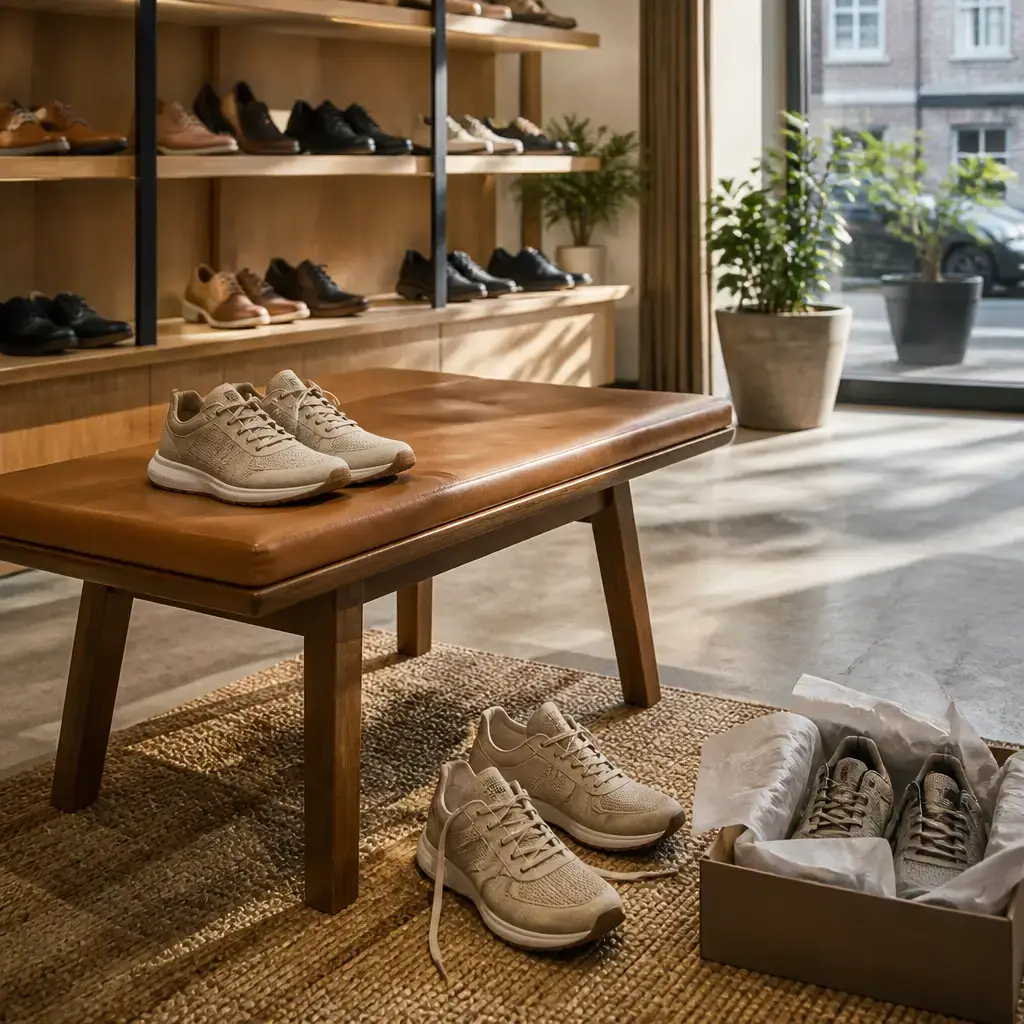
Moh yai PRUH-vuh dem hair? Can I try them on here?Brug denne bænk, mens du tager dem på.
Broo TEN-uh benk, mens doo TAIR dem paw. Use this bench while you put them on.De føles lidt små.
Dee FURL-us let smoh. They feel a little small.Prøv dette større par.
PRUH dette STUR-uh pahr. Try this larger pair.Dette par føles bedre.
DEH-tuh pahr FURL-us BEH-thruh. This pair feels better.Den størrelse passer dig.
Den STUR-uhl-suh PASS-uh dai. That size looks right on you.Sentence explanations
Disse sko ser behagelige ud.
These shoes look comfortable.
- Disse
- these
- sko
- shoes
- ser … ud
- look
- behagelige
- comfortable
More detail
Disse means “these” here. It is the Danish demonstrative used with plural nouns; the corresponding singular forms are denne for common-gender nouns and dette for neuter nouns. Example: Disse bøger er nye. — “These books are new.” Sko means “shoes” here. It is the plural form of sko; Danish uses the same written form for the indefinite singular and plural in this noun: en sko — “a shoe”, sko — “shoes”. The plural meaning in the sentence is clear from disse and the fixed translation. Ser ... ud is a reusable Danish construction meaning “looks/seems ...”. Ser is the present form of se, “to see”, while ud is a separate particle. Together, they describe appearance rather than literal seeing. Example: Bilen ser ny ud. — “The car looks new.” Behagelige means “comfortable” in this sentence. It is the plural form of the adjective behagelig, agreeing with plural sko. The useful forms are behagelig with a common-gender singular noun, behageligt with a neuter singular noun, and behagelige with plural or definite forms. Example: Stolene ser behagelige ud. — “The chairs look comfortable.” Putting the parts together, Disse sko identifies the shoes, and ser behagelige ud says how they appear: “These shoes look comfortable.”
De er lavet til lange gåture.
They are made for long walks.
- De
- they
- er lavet
- are made
- til
- for
- lange
- long
- gåture
- walks
More detail
De means “they” here and refers to the shoes mentioned in the preceding sentence. It is a third-person plural pronoun; Danish uses de for plural people or things, while den and det are singular forms in relevant contexts. er lavet is the present passive form of lave (“make”). The verb phrase literally presents the shoes as having been made, without naming the maker. A useful active/passive contrast is: Nogen laver skoene — “Someone makes the shoes”; Skoene er lavet — “The shoes are made.” til introduces the intended use or purpose here: “for.” The reusable pattern lavet til + noun means “made for + noun,” as in Denne taske er lavet til rejser — “This bag is made for travel.” lange means “long” and modifies gåture. It is the plural form of the adjective lang; compare singular en lang gåtur — “a long walk” — with plural lange gåture — “long walks.” The ending reflects the plural noun in this phrase. gåture means “walks.” It is the plural of gåtur, “walk.” For example, Vi tager lange gåture means “We take long walks.” Together, De er lavet til lange gåture means “They are made for long walks.” The pronoun identifies the shoes, er lavet describes their intended design in the passive, and til lange gåture states the purpose. The whole utterance is a neutral way to describe what an item is designed or suitable for.
Må jeg prøve dem her?
Can I try them on here?
- Må jeg
- Can I …?
- prøve
- try
- dem
- them
- her
- here
More detail
Må jeg combines the modal verb må with the subject pronoun jeg. Here må asks for permission, so the chunk means “May/Can I …?” rather than stating that the speaker is able to do something. In a direct question, the modal comes before the subject: Må jeg ...? Compare the statement Jeg må ... (“I may/must ...”), where the subject comes first. The exact sense of må depends on context; in this utterance, the fixed translation establishes permission. prøve is the infinitive “try.” After the modal må, the following verb remains in the infinitive: Må jeg prøve ...? (“May I try ...?”). The form prøve is also used in other contexts, for example Jeg vil prøve igen — “I will try again.” dem is the third-person plural object pronoun “them.” It refers here to the plural items already established in the surrounding exchange, the same items described as made for long walks and later put on. Danish distinguishes object dem from subject de: De er ... means “They are ...,” while Jeg prøver dem means “I try them.” her is the place adverb “here.” It specifies the place of trying, without changing who tries the items or what is being tried. For example, Vent her means “Wait here.” Together, Må jeg prøve dem her? has the pattern Må jeg + infinitive + object + place adverb, producing “Can I try them on here?” The surrounding meaning makes prøve concern trying the items on; the Danish sentence itself does not need a separate word corresponding to “on.”
Brug denne bænk, mens du tager dem på.
Use this bench while you put them on.
- Brug
- use
- denne
- this
- bænk
- bench
- mens
- while
- du
- you
- tager … på
- puts on
- dem
- them
More detail
Brug is the imperative of bruge, “to use.” It gives a direct instruction and normally has the same form for singular and plural addressees. Example: Brug denne stol. — “Use this chair.” denne means “this” and is used here with one common-gender noun. It agrees with bænk: denne bænk means “this bench.” With a neuter-gender noun, Danish uses dette, as in dette bord — “this table.” bænk means “bench.” Its plural is bænke: to bænke — “two benches.” Here, the singular noun occurs with the singular demonstrative denne. mens introduces an action happening at the same time as another action: “while.” Example: Læs, mens du venter. — “Read while you wait.” du is the second-person singular subject pronoun “you.” It is the subject of the clause after mens. Danish uses I for “you” when addressing more than one person. tager ... på is the separated form of tage på, used here for putting clothing or another wearable item on. tager is the present-tense form of tage; in this expression, på completes the putting-on meaning. The object can come between them: tager jakken på — “puts the jacket on.” This differs from the ordinary sense of tage, as in tage bogen — “take the book.” dem is the plural object pronoun “them.” Here it refers to the plural items being tried on. Danish uses dem for a plural object, while de is the corresponding plural subject form: de passer — “They fit”; Jeg tager dem på — “I put them on.” Together, mens du tager dem på means “while you put them on”: du performs the action, dem is what is put on, and tager ... på expresses the putting-on action. The complete utterance is an instruction to use this bench during that action: “Use this bench while you put them on.”
De føles lidt små.
They feel a little small.
- De
- they
- føles
- feel
- lidt
- a little
- små
- small
More detail
De is a third-person plural pronoun, meaning “they” here. It marks the subject as plural; the sentence does not need to identify the items again. Danish also has den for “it” with common-gender singular reference and det for neuter singular reference, but de is the plural form. føles comes from føle, “to feel,” and is the present-tense form used with a third-person subject such as de. In this sentence, it describes how the items seem when they are being worn or experienced: “feel.” Example: Skoene føles behagelige. — “The shoes feel comfortable.” lidt means “a little” or “slightly.” It softens the following description, so lidt små means “a little small,” not simply “small.” It is an adverb and does not change to agree with the items. små means “small” here. It is the plural form of the adjective lille; the adjective is the word carrying this plural form, not de. Compare en lille sko (“a small shoe”) with små sko (“small shoes”). In the following context, større means “larger,” a comparative form of stor (“large”), giving a useful size contrast. Together, De føles lidt små. means “They feel a little small.” The plural subject de is followed by the present-tense verb føles; lidt modifies the adjective små, producing a mild assessment of size.
Prøv dette større par.
Try this larger pair.
- Prøv
- try
- dette
- this
- større
- larger
- par
- pair
More detail
Prøv is the imperative of prøve, “to try.” It addresses one or more people without stating the subject, as English “Try …” does. The present-tense form is prøver; the imperative removes the final -r: prøver → prøv. dette means “this” here and points to one nearby item. It is the neuter singular form of the Danish demonstrative; denne is used with common-gender singular nouns, while disse is plural. In this sentence, dette agrees with par, which is a neuter noun (et par). større means “larger” here. It is the comparative form of stor (“large”): stor → større → størst (“largest”). The comparative compares the pair with another pair or relevant size standard; it does not itself specify how much larger it is. For example, Dette par er større. means “This pair is larger.” par means “pair,” two items considered together. Danish uses et par for an indefinite singular pair, while the form par can also occur as the plural; the definite singular is parret. Here, the noun is singular because dette refers to one pair. Together, dette større par forms the noun phrase “this larger pair”: dette identifies the pair, and større compares its size. Prøv makes the utterance an instruction to try it. The complete meaning is “Try this larger pair.”
Dette par føles bedre.
This pair feels better.
- Dette
- this
- par
- pair
- føles
- feels
- bedre
- better
More detail
Dette is the neuter singular demonstrative meaning “this” when it modifies an et-word noun. In Dette par, it agrees with par, which is used with et: et par. Compare denne with a common-gender singular noun and disse with plural nouns. par means “pair” here. Its singular and plural form is par: et par = “a pair”, to par = “two pairs”. In this sentence, the fixed translation identifies the intended meaning as “pair”. føles is the present-tense s-form of føle, “to feel”. The ordinary present form is føler, as in jeg føler (“I feel”) and de føler (“they feel”); Danish present-tense verbs do not change for the subject’s person or number. In Dette par føles ..., the s-form is used with the pair as the subject and means that the pair has a certain felt quality: “the pair feels ...”. bedre means “better”. It is the comparative form related to god (“good”): god → bedre → bedst (“best”). Here it presents the pair’s feel as better than some comparison point, while the sentence does not specify exactly what that point is. Together, Dette par identifies the pair, føles describes how it feels, and bedre makes the comparison: “This pair feels better.”
Den størrelse passer dig.
That size looks right on you.
- Den
- that
- størrelse
- size
- passer
- suits; fits
- dig
- you
More detail
Den points to a particular size here and agrees with the singular common-gender noun størrelse. Danish uses den with common-gender singular nouns and det with neuter singular nouns; the plural demonstrative form is de. In this sentence, den størrelse means “that size.” størrelse means “size.” Its indefinite singular form is en størrelse, its definite singular form is størrelsen, and its plural is størrelser. Example: Hvilken størrelse bruger du? — “What size do you wear/use?” passer is the present-tense form of passe. Here, with a person as its object, it means “fits” or “suits,” expressing that the size is right for that person. The same verb can also describe physical fit: Skoene passer. — “The shoes fit.” dig is the object form of singular du, “you.” Danish uses du for the subject and dig when the person is affected by or receives the action. Example: Tøjet passer dig. — “The clothes fit you.” Together, the subject Den størrelse (“that size”) and passer dig (“fits/suits you”) produce the meaning “That size looks right on you.”
Grammar Points
Adjektiv i flertal: lange gåture
lange gåture
LAHNG-uh KOR-too-erlong walks
Adjectives take a plural form before plural nouns: lang becomes lange with gåture.
Komparativ: større
større par
STUR-uh pahrlarger pair
Use the comparative form to compare size: stor becomes større.
Danish Vocabulary
Disse sko ser behagelige ud.
Brug denne bænk, mens du tager dem på.
Brug denne bænk, mens du tager dem på.
De er lavet til lange gåture.
Må jeg prøve dem her?
De er lavet til lange gåture.
De er lavet til lange gåture.
Brug denne bænk, mens du tager dem på.
Må jeg prøve dem her?
Disse sko ser behagelige ud.
Disse sko ser behagelige ud.
Brug denne bænk, mens du tager dem på.
Quiz
Word Order
Arrange the words in the correct order.
These shoes look comfortable.
Show Answer
Disse sko ser behagelige ud.They are made for long walks.
Show Answer
De er lavet til lange gåture.Can I try them on here?
Show Answer
Må jeg prøve dem her?Spelling
Tap the letters to spell the word.
use
Show Answer
Brugwalk
Show Answer
gåturetry
Show Answer
prøvelong