10 minutes free every day
Continue audio lessons in the app
Word explanations appear automatically in sync with the audio.
No login required · synced translations · playback with the screen locked
Choose your learning language and open this lesson in the app.

About This Lesson
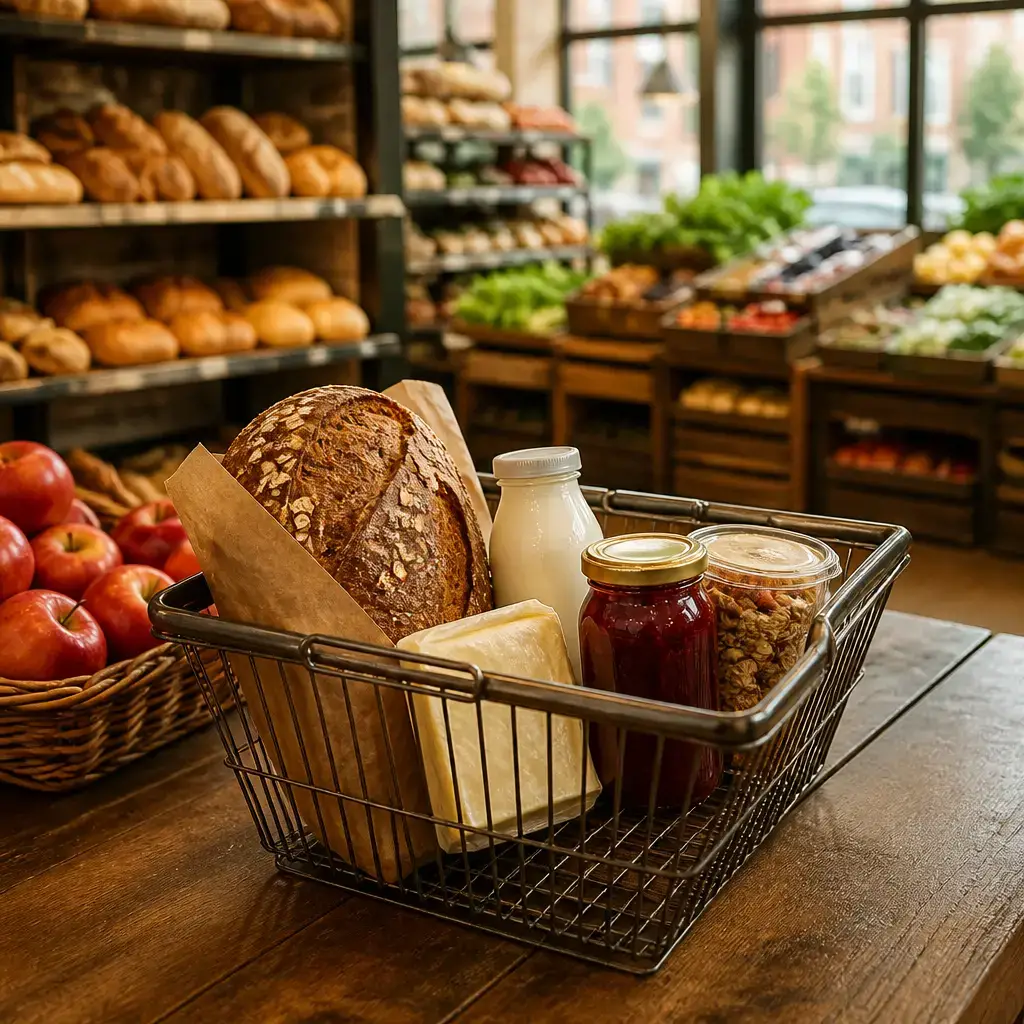
Use Breakfast shopping to practice Danish conversation, pronunciation, vocabulary, grammar, and quizzes.
Dialogue
Hvad skal vi købe i dag?
vath sgal vee KUR-buh ee DAY? What should we buy today?Vi skal bruge ting til morgenmaden i morgen.
vee skal BROO-uh teng tel MOR-en-mah-den ee MOR-en. We need things for tomorrow's breakfast.Så skal vi have brød og smør.
soh skal vee HAY-vuh bruhth uh SMUR. Then we need bread and butter.Skal vi også have yoghurt?
skal vee OW-soh HAY-vuh YOH-goort? Do we need yogurt too?Jeg vil spise den med jordbærsyltetøj.
yai vel SPEE-suh dehn mehth YOR-bair-SOOL-tuh-toy. I want to eat it with strawberry jam.Så lad os købe yoghurt og syltetøj.
soh lad ohs KUR-buh YOH-goort uh SOOL-tuh-toy. Then let's get yogurt and jam.Sentence explanations
Hvad skal vi købe i dag?
What should we buy today?
- Hvad
- what
- skal vi
- should we
- købe
- buy
- i dag
- today
More detail
Hvad means “what” here: it asks for the thing or things involved in the action. It is a question word, not a form that changes to show the number or gender of the answer. Compare the same function in a simple example: Hvad køber du? — “What are you buying?” skal vi combines skal with vi. Skal is the present-tense form of skulle, a modal verb that can express what someone should or is going to do; in this sentence, the fixed translation gives the intended “should.” Vi means “we” and is the subject. In a question, Danish places the question word first, then the finite verb and subject: Hvad skal vi ...? — “What should we ...?” The modal is followed by an infinitive without at. købe is the infinitive of købe, “to buy.” It stays in the infinitive after the modal skal: Vi skal købe ... — “We should buy ...” The form does not itself show who buys; vi supplies the subject. i dag is the time expression “today.” i is part of this expression, so the whole phrase identifies the day on which the buying is relevant. Compare the reusable expression i morgen — “tomorrow.” Together, Hvad asks what is to be bought, skal vi expresses “should we,” købe names the action, and i dag gives the time. The complete utterance therefore means: “What should we buy today?”
Vi skal bruge ting til morgenmaden i morgen.
We need things for tomorrow's breakfast.
- Vi skal
- we are to; we must
- bruge
- use; need
- ting
- things
- til
- for
- morgenmaden
- the breakfast
- i morgen
- tomorrow
More detail
Vi skal combines vi (“we”) with skal, the present form of skulle. By itself, skal expresses that someone is to do something or must do it; the meaning “need” in this sentence comes from the combination skal bruge, not from Vi skal alone. Vi is the first-person plural pronoun and does not change for grammatical gender. bruge is the infinitive of bruge, meaning “to use.” After the modal skal, the next verb remains in the infinitive: skal bruge. In this sentence, that combination means “need,” while bruge can mean “use” in other contexts. Example: Jeg skal bruge en pen. — “I need a pen.” ting means “things” and is the plural of ting (“thing”). It is indefinite here. The definite plural is tingene, “the things.” Example: Jeg har mange ting. — “I have many things.” til is a preposition meaning “for” here. It can mark purpose or intended use before a noun phrase: en gave til min ven — “a gift for my friend.” morgenmaden means “the breakfast.” It is the definite singular form of morgenmad (“breakfast”); the ending -en marks definite singular for this common-gender noun. Morgenmad without the definite ending can refer to breakfast more generally. i morgen is the two-word time expression “tomorrow.” Example: Vi rejser i morgen. — “We are travelling tomorrow.” It differs from i morges, which means “this morning.” Together, Vi skal bruge means “we need,” ting names the needed items, til morgenmaden says what they are for, and i morgen places the breakfast tomorrow. The complete meaning is: “We need things for tomorrow’s breakfast.”
Så skal vi have brød og smør.
Then we need bread and butter.
- Så
- then
- skal vi
- we need to
- have
- have
- brød
- bread
- og
- and
- smør
- butter
More detail
Så means “then” here and links this decision to the preceding plan. It can also introduce a result in other contexts, so its exact English translation depends on how the clauses relate. skal vi combines skal with the subject pronoun vi (“we”). In this sentence, skal expresses what is needed or planned, so the construction means “we need to” rather than simply a future prediction. Vi is the first-person plural form, referring to the speaker together with at least one other person. Danish places the subject after skal here because the sentence begins with Så; this is the usual verb-second pattern. Compare the reusable pattern Skal vi ...? in the next sentence, where the same words form a question: “Shall we ...?” have is the infinitive after skal. Its basic meaning is “have,” and in this context it means having or obtaining the food that is needed. After a modal such as skal, the following verb stays in the infinitive: Vi skal have brød = “We need to have/get bread.” brød means “bread.” It is a noun and is commonly used as a mass or uncounted food term in this kind of shopping or meal-planning statement. A countable loaf or piece can be specified with additional wording when needed; the fixed sentence does not state a number. og means “and” and joins the two food items in the same need: bread together with butter. smør means “butter.” Like brød in this context, it is presented as a food substance rather than as a stated number of separate units. Together, Så skal vi have brød og smør means “Then we need bread and butter.” The sequence is Så (“then”) + skal vi (“we need to”) + have (“have/get”) + the coordinated items brød og smør (“bread and butter”). It is a concise statement about what is needed for the planned breakfast.
Skal vi også have yoghurt?
Do we need yogurt too?
- Skal vi
- shall we…?
- have
- have
- også
- too
- yoghurt
- yogurt
More detail
Skal vi combines skal, the present form of skulle, with vi, “we.” In a Danish yes/no question, the finite verb comes before the subject: Skal vi ...? means “Shall we ...?” or, depending on the following verb and context, “Are we to ...?” Here, the specific meaning “Do we need ...?” comes from the combination skal have, not from Skal vi alone. have is the infinitive of have. After the modal skal, Danish uses the infinitive: skal have. In this sentence, that combination means “need to have,” naturally shortened in English to “need.” On its own, have commonly means “have” or “possess.” Example: Vi skal have brød. — “We need bread.” også means “too” or “also.” Here it adds yoghurt as an additional item to the things already being considered. Its position after have and before yoghurt supports the meaning “need yoghurt too.” yoghurt is the noun “yogurt.” Here it names the thing that may be needed. The form shown is unchanged by its object role; Danish noun forms can nevertheless have other forms in other number or definiteness contexts. Together, Skal vi have yoghurt? follows the reusable pattern Skal vi have + noun? for asking whether the speakers need a particular thing. også marks that thing as an addition, giving the whole utterance the meaning “Do we need yogurt too?”
Jeg vil spise den med jordbærsyltetøj.
I want to eat it with strawberry jam.
- Jeg vil
- I want
- spise
- eat
- den
- it
- med
- with
- jordbærsyltetøj
- strawberry jam
More detail
Jeg vil means “I want” here. Jeg is the first-person singular subject, “I”. vil is the present form of ville; in this sentence it expresses wanting and is followed by an infinitive. In other contexts, vil can also express future intention, so the intended meaning comes from the sentence and context. spise is the infinitive “to eat”. After vil, Danish uses the infinitive directly, without an equivalent of English “to”: Jeg vil spise = “I want to eat.” den is a standalone pronoun meaning “it” here. It is the singular common-gender form; Danish uses det for a singular neuter referent and de for plural referents. The supplied sentence identifies the referent only as “it”, not as a uniquely named object. med means “with”. It introduces what accompanies the eating: spise noget med ... can mean “eat something with ...”. jordbærsyltetøj is the noun “strawberry jam”. It is a Danish compound: jordbær means “strawberry” and syltetøj means “jam/preserve”. The compound as a whole names the jam, rather than describing a separate strawberry and a separate jam in this sentence. Together, Jeg vil spise den gives “I want to eat it”, and med jordbærsyltetøj adds “with strawberry jam”. The complete utterance is therefore: “I want to eat it with strawberry jam.”
Så lad os købe yoghurt og syltetøj.
Then let's get yogurt and jam.
- Så
- then
- lad os
- let's
- købe
- get; buy
- yoghurt
- yogurt
- syltetøj
- jam
More detail
Så means “then” here and links this suggestion to what has just been said. It can also introduce a consequence in other sentences, so the surrounding context determines whether it means “then” in time or “so” as a result. lad os is the Danish construction for “let’s”: lad is the imperative of lade (“let” or “allow”), and os is the object form meaning “us.” With an infinitive, the pattern is lad os + infinitive: Lad os spise. — “Let’s eat.” The construction presents the action as a joint suggestion; the subject of the suggested action is understood as “we.” købe is the infinitive of købe, “to buy.” In this sentence, “get” is a natural translation because the context is obtaining the items, but the basic meaning is “buy.” After lad os, Danish uses the infinitive: Lad os købe brød. — “Let’s buy bread.” yoghurt is the noun “yogurt.” Its form is unchanged here; the sentence does not add a separate marker for a quantity. Danish nouns can be used without an article when referring generally to food or provisions, as in Vi køber yoghurt. — “We are buying yogurt.” syltetøj is the noun “jam.” It is coordinated with yoghurt by og (“and”), so both are items included in what is to be bought. The related expression jordbærsyltetøj in the previous sentence means “strawberry jam,” with jordbær (“strawberry”) specifying the type; here the shorter noun refers to jam without specifying a flavor. Together, Så lad os købe means “Then let’s buy/get,” and yoghurt og syltetøj names the two things included in the suggestion. The whole utterance therefore means: “Then let’s get yogurt and jam.”
Grammar Points
lad os + infinitiv
Lad os købe brød og smør.
lad ohs KUR-buh bruhth uh SMUR.Let's buy bread and butter.
Lad os + infinitiv bruges til at foreslå noget, vi gør sammen.
Bestemt form: -en
til morgenmaden
tel MOR-en-mah-den.for breakfast
Et navneord får bestemt endelse: morgenmad bliver morgenmaden, når det er kendt.
Danish Vocabulary
Vi skal bruge ting til morgenmaden i morgen.
Så skal vi have brød og smør.
Så skal vi have brød og smør.
Hvad skal vi købe i dag?
Hvad skal vi købe i dag?
Vi skal bruge ting til morgenmaden i morgen.
Hvad skal vi købe i dag?
- Gender
- common
Vi skal bruge ting til morgenmaden i morgen.
Så skal vi have brød og smør.
Så skal vi have brød og smør.
Vi skal bruge ting til morgenmaden i morgen.
Vi skal bruge ting til morgenmaden i morgen.
Quiz
Word Order
Arrange the words in the correct order.
What should we buy today?
Show Answer
Hvad skal vi købe i dag?Do we need yogurt too?
Show Answer
Skal vi også have yoghurt?I want to eat it with strawberry jam.
Show Answer
Jeg vil spise den med jordbærsyltetøj.Spelling
Tap the letters to spell the word.
buy
Show Answer
købeneed; use
Show Answer
brugethings
Show Answer
tingwhat