10 minutes free every day
Continue audio lessons in the app
Word explanations appear automatically in sync with the audio.
No login required · synced translations · playback with the screen locked
Choose your learning language and open this lesson in the app.

About This Lesson
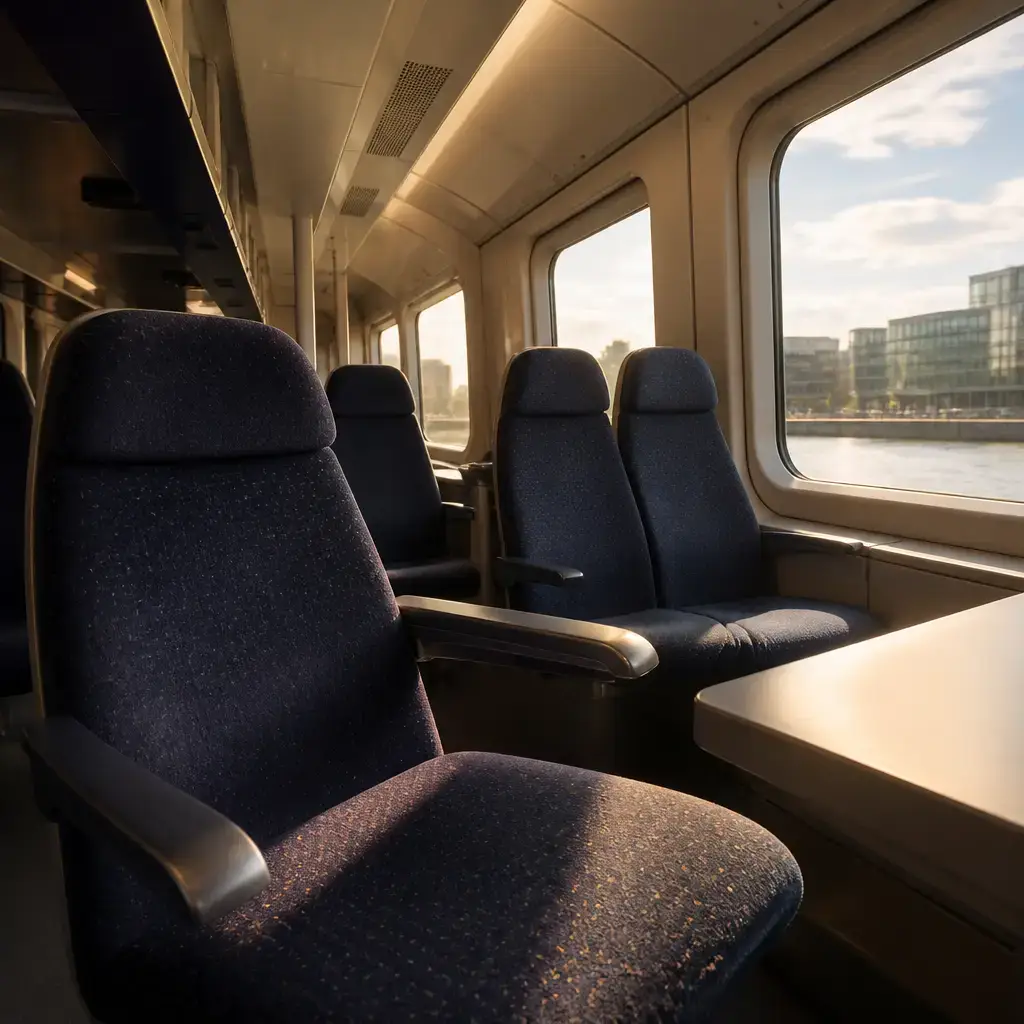
Use Finding seats on a train to practice Danish conversation, pronunciation, vocabulary, grammar, and quizzes.
Dialogue
Det føles køligt inde i toget.
deh FUH-lus KUH-lee EN-uh ee TOH-wuth. It feels cool inside the train.Der er ledige pladser længere inde.
dah ah LAY-thee-uh PLASS-uh LENG-uh EN-uh. There are open seats farther in.Jeg vil gerne sidde efter at have gået så meget.
yai vel GAIR-nuh SEH-thuh EF-tuh ehd HEH-wuh GOH-uth soh MY-uhth. I want to sit after all that walking.De her sæder er behagelige.
dee HAIR SAY-thuh ah beh-HAH-yuh-lee. These seats are comfortable.Togturen føles også rolig.
TOH-too-uhn FUH-lus OH-soh ROH-lee. The ride feels quiet too.Kan du se stationsskærmen derfra?
kan doo SAY stah-SHOHNS-skair-mun dah-FRAH? Can you see the station display from there?Vi har tre stop mere.
vee hah TRAY STOHB MAY-uh. We have three more stops.Så kan vi hvile os lidt, før vi står af.
SOH kan vee VEE-luh oss LEHT, fuh vee STOHR ahf. Then we can rest a little before we get off.Sentence explanations
Det føles køligt inde i toget.
It feels cool inside the train.
- føles
- feels
- køligt
- cool
- inde i
- inside
- toget
- the train
More detail
føles means “feels” here, describing how the temperature is experienced. It is the present -s form of føle in the impersonal construction Det føles ... (“It feels ...”). Do not treat it as the ordinary active present form: that form is føler, as in Jeg føler mig træt. — “I feel tired.” Danish -s forms can have several functions; in this fixed construction, føles expresses the impersonal sensation. køligt means “cool” here. The base adjective is kølig; køligt is its neuter singular form. In Det føles køligt, the adjective describes the felt condition, and the form agrees with the neuter det. A useful comparison is køligere (“cooler”) and køligst (“coolest”): Det føles køligere udenfor. — “It feels cooler outside.” inde i is a reusable location pattern meaning “inside” or “within.” inde identifies an interior location, while i introduces the thing or place containing it: Hun sidder inde i huset. — “She is sitting inside the house.” toget means “the train” here. Its base noun is tog (“train”), and the ending -et marks the definite singular form: tog → toget. The indefinite singular is et tog (“a train”), while the definite form refers to the particular train intended in this utterance. The utterance begins with Det, a neuter singular pronoun used here as the grammatical subject of an impersonal sensation statement; it does not identify a separate participant. Det føles køligt means “It feels cool,” and inde i toget specifies the location: “inside the train.” Together, the sentence means: “It feels cool inside the train.”
Der er ledige pladser længere inde.
There are open seats farther in.
- Der er
- there are
- ledige
- open; available
- pladser
- seats
- længere inde
- farther in
More detail
Der er is the Danish existential pattern for saying that something exists or is present: “there is/are.” er is the present form of være (“to be”). Danish uses the same Der er pattern with singular and plural nouns; the noun after it shows whether the English translation uses “is” or “are.” Example: Der er en stol. — “There is a chair.” ledige means “available” or, here, “unoccupied.” Its base form is ledig; ledige is the form used with a plural noun such as pladser. The same form is also used with a definite noun phrase, so the surrounding noun phrase determines the precise grammatical pattern. Example: Der er ledige stole. — “There are available chairs.” pladser means “seats” in this sentence. Its singular form is plads, and pladser is its plural form. The word can also mean “places” in other contexts, so the fixed translation identifies the intended sense here. Example: Vi fandt to pladser. — “We found two seats.” længere inde means “farther in” or “further inside.” længere is the comparative form associated with lang (“long”) and is also used for greater distance or a position farther along; inde means “inside/in.” Together they describe a location farther toward the inside, rather than merely stating that something is inside. Example: Toiletterne ligger længere inde. — “The toilets are farther inside.” The sentence assembles as Der er + ledige pladser + længere inde: “There are available seats farther in.” It presents the seats as existing or being available and locates them farther inside. The wording is a neutral, practical way to point out where seats can be found.
Jeg vil gerne sidde efter at have gået så meget.
I want to sit after all that walking.
- Jeg
- I
- vil gerne
- would like to
- sidde
- sit
- efter at
- after
- gået
- walked
- så meget
- so much
More detail
Jeg means “I.” It is the first-person singular pronoun. It does not itself show whether the speaker is male or female. vil gerne is a useful Danish pattern for expressing a wish or polite preference: “would like to” or “want to.” vil is the present form of ville; gerne makes the intended wish clear. Example: Jeg vil gerne læse. — “I would like to read.” sidde means “sit” and is the infinitive form. After vil gerne, Danish uses the infinitive without an English-style infinitive marker: vil gerne sidde means “would like to sit.” Do not confuse sidde (“sit,” a state or position) with sætte sig (“sit down,” a movement into that position). efter at introduces an action that happened earlier than the main action: “after.” In this sentence it is followed by the perfect infinitive construction have gået, giving the pattern efter at have + past participle — “after having …”. gået is the past participle of gå (“go” or “walk”). Here, in have gået, it is understood as “walked.” The form gået combines with have to refer to a completed earlier activity; it is not the ordinary present form of the verb. så meget means “so much” and describes the large amount of the walking. så means “so” here, while meget means “much.” Example: Jeg har arbejdet så meget. — “I have worked so much.” Together, Jeg vil gerne sidde expresses the speaker’s wish to sit, and efter at have gået så meget gives the reason in time-and-activity terms: the speaker wants to sit after having walked so much. The complete utterance therefore means “I want to sit after all that walking.”
De her sæder er behagelige.
These seats are comfortable.
- De her
- these
- sæder
- seats
- er
- are
- behagelige
- comfortable
More detail
De her means “these” and refers to multiple items. It is a common Danish demonstrative pattern used with a plural noun; her contributes a sense of “here” or contextual proximity. Example: De her bøger er nye. — “These books are new.” sæder means “seats” here. Its base form is sæde, and sæder is its plural form. Example: Der er mange sæder. — “There are many seats.” er is the present-tense form of være (“to be”). Danish uses er with subjects of different persons and numbers, so this form is not marked specifically for the plural subject. Here it links the subject to a description: X er Y means “X is/are Y.” behagelige means “comfortable” here. It is the plural form of the adjective behagelig. In this sentence, the adjective describes the plural subject sæder, so the plural adjective form is used. Example: Stolene er behagelige. — “The chairs are comfortable.” Together, De her sæder identifies multiple seats, er links them to a description, and behagelige describes them as comfortable. The complete meaning is: “These seats are comfortable.”
Togturen føles også rolig.
The ride feels quiet too.
- Togturen
- the ride
- føles
- feels
- også
- too
- rolig
- quiet
More detail
Togturen means “the ride” here. It is the definite singular form of the noun togtur, “train ride” or “train journey”; the ending -en marks this noun as definite. The word functions as the subject of the sentence. føles means “feels” in this sentence. It is the present-tense form of føle, “to feel.” Danish uses føles when something has a particular perceived quality, as in Rummet føles stort. — “The room feels large.” også means “too” or “as well.” It adds this statement to another relevant statement, rather than changing the time or certainty of the sentence. Its position before rolig lets it modify the description that follows in this utterance. rolig means “quiet” here, describing the ride as calm or free from disturbing noise. It is an adjective used after føles to describe the subject. Its basic form is rolig; a useful comparison is roligere, “quieter” or “calmer,” and the superlative is roligst, “quietest” or “calmest.” For example, Denne vej føles roligere. — “This road feels quieter.” Together, Togturen føles presents the ride as having a perceived quality, også adds the sense “too,” and rolig supplies that quality. The complete meaning is: “The ride feels quiet too.”
Kan du se stationsskærmen derfra?
Can you see the station display from there?
- Kan du
- can you
- se
- see
- stationsskærmen
- the station display
- derfra
- from there
More detail
Kan du begins a yes/no question. kan is the present form of kunne, “can/be able to,” and du is the second-person singular pronoun, “you.” In a main-clause question, the finite verb comes before the subject: Kan du ...? A useful pattern is Kan du + infinitive?, for example: Kan du vente? — “Can you wait?” se means “see.” After the modal verb kan, it appears in the infinitive without an extra infinitive marker. The same verb can be used in statements such as Jeg kan se det — “I can see it.” stationsskærmen means “the station display.” It is a compound noun: station contributes the first part, and skærm means “screen/display.” The final -en marks the definite singular form of skærm in this compound, so stationsskærm is an indefinite singular form and stationsskærmen is “the station display.” This definite ending belongs to the noun, not to station as a separate word. derfra means “from there.” It is a place adverb expressing the starting point or viewpoint of seeing. In this sentence, der refers to the relevant place understood from the situation; the supplied sentence does not identify that place more specifically. A related contrast is dertil, “to there,” which expresses a destination rather than a point of origin. Together, Kan du se asks about the addressee’s ability to see, stationsskærmen names what is seen, and derfra specifies the viewpoint: “Can you see the station display from there?”
Vi har tre stop mere.
We have three more stops.
- Vi
- we
- har
- have
- tre
- three
- stop
- stops
- mere
- more
More detail
Vi means “we”: a first-person plural pronoun for the speaker together with at least one other person. Vi is the subject form. Its object form is os; for example, De ser os means “They see us.” In the supplied context, vi is also the subject in før vi står af (“before we get off”). Har is the present-tense form of have (“to have”). It is used with vi here: vi har = “we have.” The same present form is used with other subjects, for example Hun har tid = “She has time.” Tre means “three.” It is a cardinal number and states the count directly. Danish numbers can stand before a noun without an article: tre billetter = “three tickets.” Stop means “stops” here, in the transport sense. The noun is et stop; its plural is also stop, so the form does not change after tre: ét stop = “one stop,” tre stop = “three stops.” The accent in ét can emphasize the number one; the supplied sentence has the unaccented number tre. Mere means “more” and follows the counted noun here. The pattern tre stop mere means “three more stops”: mere marks the stops as additional to an already understood number or amount. For example, Vi går to kilometer mere means “We walk two more kilometres.” Together, Vi har tre stop mere means “We have three more stops.” The subject is vi (“we”), har supplies the present-tense “have,” tre stop gives the number and transport units, and mere marks those stops as additional. In the bounded context, this describes the remaining journey before getting off.
Så kan vi hvile os lidt, før vi står af.
Then we can rest a little before we get off.
- Så
- then
- kan vi
- we can
- hvile
- rest
- os
- ourselves
- lidt
- a little
- før
- before
- står af
- get off
More detail
Så means “then” here: it links the proposed action to the situation already established. In other contexts, så can have other functions, but this sentence uses it as a time/sequencing word. kan vi is the reusable pattern kan + subject: “we can.” kan is the present form of kunne, expressing ability or possibility; vi is the first-person plural subject “we.” Example: Vi kan vente. — “We can wait.” hvile means “rest.” It is the infinitive after kan, so the modal verb is followed by the base form rather than a present-tense ending. Example: Jeg kan hvile. — “I can rest.” os is the reflexive pronoun referring back to the subject vi: “ourselves.” Together, hvile os means “rest ourselves,” or naturally in English, “rest.” Danish uses this reflexive form with this expression; it is not a separate participant. lidt means “a little” and limits the amount or duration of the resting. It is an amount word, not a description of the people who rest. Example: Vi venter lidt. — “We wait a little.” før introduces a clause meaning “before.” The clause after it gives the event that has not happened yet at the relevant point: før vi står af — “before we get off.” står af is the present-tense form of the phrasal verb stå af, meaning “get off,” as from a vehicle. står is the form of stå used with vi in the present; af is a separate particle that completes the verb’s meaning. Example: Vi står af ved næste stop. — “We get off at the next stop.” Putting the parts together, Så kan vi hvile os lidt means “Then we can rest a little.” The following før-clause specifies when: the resting can happen before the travelers get off. Thus the whole utterance means, “Then we can rest a little before we get off.”
Grammar Points
føles + adjektiv
Toget føles køligt.
TOH-wuth FUH-lus KUH-lee.The train feels cool.
After føles, the adjective describes how something feels and agrees with the noun: toget is neuter, so køligt is used.
gerne + infinitiv
gerne sidde
GAIR-nuh SEH-thuhwould like to sit
gerne expresses willingness or a polite wish and is followed by the infinitive, such as sidde.
Danish Vocabulary
sæder er behagelige
Det føles køligt
vil gerne sidde
efter at have gået
inde i toget
- Gender
- neuter
Det føles køligt
ledige pladser
længere inde
ledige pladser
gerne sidde
De her sæder
i toget
Quiz
Word Order
Arrange the words in the correct order.
It feels cool inside the train.
Show Answer
Det føles køligt inde i toget.There are open seats farther in.
Show Answer
Der er ledige pladser længere inde.These seats are comfortable.
Show Answer
De her sæder er behagelige.Spelling
Tap the letters to spell the word.
gladly; would like to
Show Answer
gerneinside
Show Answer
indesit
Show Answer
siddecool