10 minutes free every day
Continue audio lessons in the app
Word explanations appear automatically in sync with the audio.
No login required · synced translations · playback with the screen locked
Choose your learning language and open this lesson in the app.

About This Lesson
Use Finding the right counter at city hall to practice Danish conversation, pronunciation, vocabulary, grammar, and quizzes.
Dialogue
Jeg har aldrig været inde på dette rådhus før.
yai ha AHL-dree VEH-uht EN-uh poh DEH-duh ROH-hooss fuhr I have never been inside this city hall before.Bygningen er pænere, end jeg havde forventet.
BOO-nehng-en air PEH-nuh-ruh ehn yai HAH-vuh foh-VAIR-duht The building is nicer than I expected.Indgangen ligger ved siden af cykelparkeringen.
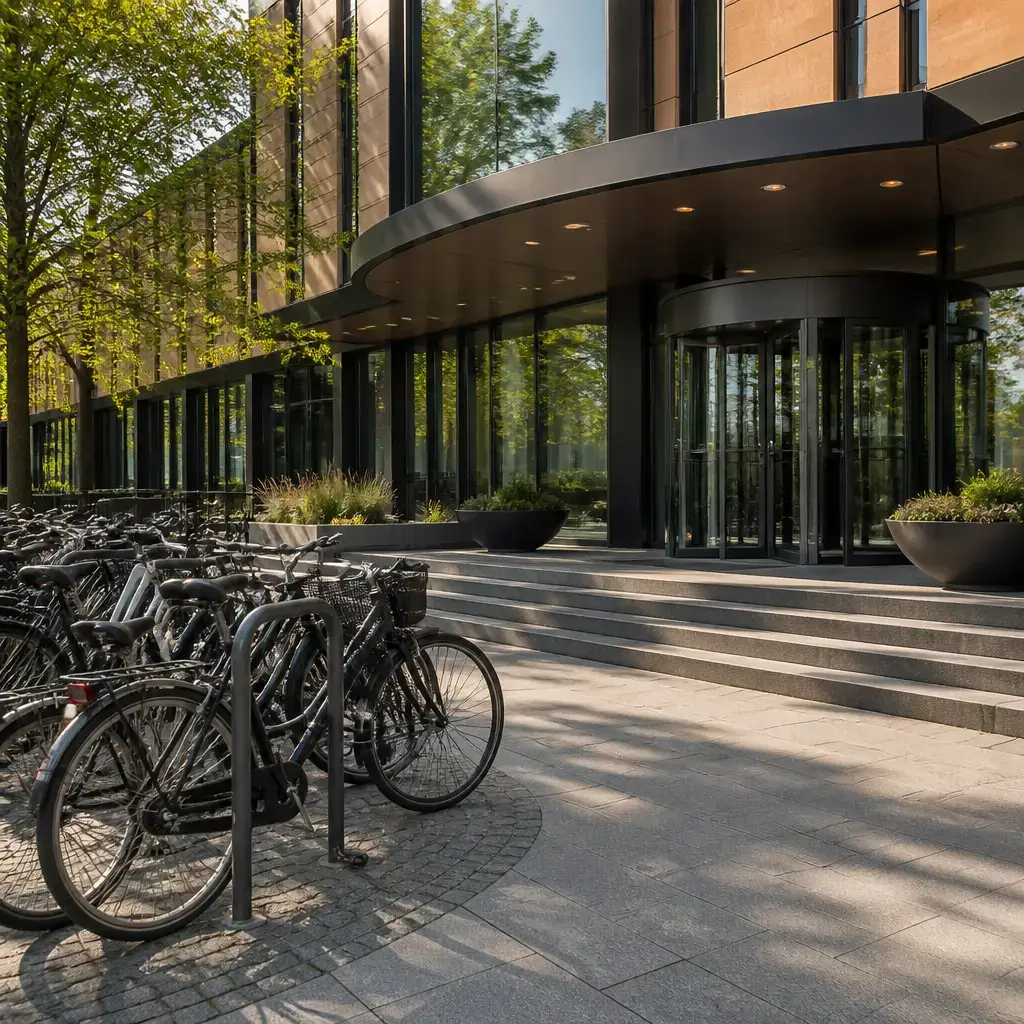
EN-gahng-en LEH-uh veh SEE-den ehv SOO-guhl-par-KEH-rehng-en The entrance is beside the bicycle parking area.Mange mennesker kom på cykel.
MAHNG-uh MEH-nuh-sguh kohm poh SOO-guhl A lot of people came by bike.Det giver mening.
deh GHEE-vuh MEH-neeng That makes sense.Det er nemmere end at vente på bussen.
deh air NEH-muh-ruh ehn uh VEH-nuh poh BOO-sen It is easier than waiting for the bus.Næste gang kunne vi også cykle hertil.
NEH-stuh gahng KOO-nuh vee OH-soh SOO-gluh heh-TEEL Next time, we could ride here too.Så kan vi stille cyklerne tæt på indgangen.
soh kan vee SDEH-luh SOO-gluh-nuh teht poh EN-gahng-en Then we can leave the bikes close to the entrance.Lige nu går vi ind og finder den rigtige skranke.
LEE-uh noo goh vee en oh FEHN-uh dehn REH-dee SGRAHNG-uh For now, let's go inside and find the right counter.Sentence explanations
Jeg har aldrig været inde på dette rådhus før.
I have never been inside this city hall before.
- Jeg har
- I have
- aldrig
- never
- været
- been
- inde på
- inside/at
- dette
- this
- rådhus
- city hall
- før
- before
More detail
Jeg har is the first-person singular present form of have: “I have.” Here it is an auxiliary, not a statement of possession. Danish commonly uses have + a past participle to form the perfect, describing a past experience with relevance to the present. For example, Jeg har læst bogen means “I have read the book.” aldrig means “never.” In this sentence it makes the experience negative: the speaker has not been inside the city hall at any time before now. It normally occurs before the past participle in this kind of perfect construction. været is the past participle of være, “to be.” The form is used with har in har været, “have been.” For example, Jeg har været i Aarhus means “I have been in Aarhus.” inde på expresses being inside or at a place. In this utterance it introduces the location of the speaker’s past experience. The exact preposition used with a place is part of Danish usage; do not replace it automatically with a direct word-for-word equivalent of English “in.” dette means “this.” It is the neuter singular form of the demonstrative, used here with the neuter noun rådhus (et rådhus). Danish demonstratives agree with the noun’s grammatical gender and number: compare dette hus (“this house,” neuter singular) with denne bygning (“this building,” common gender singular) and disse huse (“these houses,” plural). rådhus means “city hall” or “town hall.” Its base form is rådhus; the indefinite form is et rådhus, and the definite form is rådhuset, “the city hall.” In the fixed sentence, dette rådhus identifies the place as “this city hall.” før means “before.” Here it refers to an earlier time relative to the present, so aldrig ... før contributes the meaning “never before.” It can also introduce an earlier event in other sentences, for example Jeg har set filmen før — “I have seen the film before.” Together, Jeg har aldrig været gives “I have never been,” inde på dette rådhus specifies the location as “inside this city hall,” and før adds “before.” The complete utterance therefore means: “I have never been inside this city hall before.”
Bygningen er pænere, end jeg havde forventet.
The building is nicer than I expected.
- Bygningen
- the building
- pænere
- nicer
- end
- than
- jeg havde forventet
- I had expected
More detail
Bygningen means “the building” here. It is the definite singular form of bygning (“building”): the ending -en marks a common-gender singular noun as definite. The form identifies the building as a particular one, consistent with the fixed meaning. pænere means “nicer” here. It is the comparative form of the adjective pæn (“nice” or “pretty”): pæn → pænere. Danish commonly forms this comparison with -ere; the form compares the building with an understood standard, namely what the speaker had expected. The superlative is pænest (“nicest”). end introduces the second side of a comparison and means “than” in this use. A reusable pattern is A er X-ere, end ... (“A is more X, than ...”). jeg havde forventet means “I had expected.” jeg is the first-person singular pronoun “I”. havde is the past form of have (“have”), and forventet is the past participle of forvente (“expect”). Together, havde forventet forms the past perfect: the expectation occurred before the comparison being made. The subject is explicitly jeg, so the expected action belongs to the speaker. Putting the parts together, the sentence says that the particular building is nicer than the speaker had expected. The comparative describes the building, end links it to the speaker’s earlier expectation, and havde forventet places that expectation earlier in time.
Indgangen ligger ved siden af cykelparkeringen.
The entrance is beside the bicycle parking area.
- Indgangen
- the entrance
- ligger
- is located
- ved siden af
- beside
- cykelparkeringen
- the bicycle parking area
More detail
Indgangen means “the entrance” here. It is the definite singular form of indgang (“entrance”): en indgang = “an entrance,” indgangen = “the entrance.” The ending -en marks definiteness for this noun; it does not itself state a number beyond the singular form. ligger is the present-tense form of ligge, “to lie” or, for a place or object, “to be located.” Danish commonly uses ligge for a fixed location. For example, Hotellet ligger i centrum. means “The hotel is located in the city centre.” ved siden af is a reusable prepositional construction meaning “beside” or “next to.” The three words work together; siden by itself does not mean “beside” in this construction. For example, Cyklen står ved siden af døren. means “The bicycle is next to the door.” cykelparkeringen means “the bicycle parking area” here. It is the definite singular form of the compound noun cykelparkering (“bicycle parking” or “bicycle parking area”): cykelparkering is indefinite, while cykelparkeringen is definite. The first part, cykel, specifies the type of parking, and the ending -en belongs to the full noun cykelparkering, not to cykel separately. Together, Indgangen ligger identifies the entrance and states its location. ved siden af cykelparkeringen adds the place it is next to. Thus the whole utterance means: “The entrance is beside the bicycle parking area.”
Mange mennesker kom på cykel.
A lot of people came by bike.
- Mange
- many; a lot of
- mennesker
- people
- kom
- came
- på cykel
- by bike
More detail
Mange means “many” or “a lot of” here and modifies the plural noun mennesker. A useful contrast is meget, which is used with mass or uncountable amounts, as in meget vand (“a lot of water”). Example: mange bøger means “many books.” mennesker means “people” in this sentence. Its singular base form is menneske (“person” or “human being”), and mennesker is its indefinite plural. Example: To mennesker venter. — “Two people are waiting.” kom is the past-tense form of komme, “to come.” The past form is kom for all persons in ordinary Danish: jeg kom means “I came,” while de kom means “they came.” The present form is kommer, as in De kommer. — “They are coming” or “They come.” på cykel is the usual Danish transport expression meaning “by bike.” In this expression, på combines with the indefinite singular noun cykel, “bike.” Other common transport expressions use different prepositions, for example med bus (“by bus”) and med tog (“by train”). Together, Mange mennesker gives the subject “a lot of people,” kom places their coming in the past, and på cykel states the means of transport. The whole utterance therefore means: “A lot of people came by bike.”
Det giver mening.
That makes sense.
- Det
- that
- giver mening
- makes sense
More detail
Det is the Danish pronoun used here for “that.” In this sentence it points to an understood fact, idea, or situation; the fixed translation does not identify a more specific referent. Danish det is the neuter singular form, but this form can also serve as a pronoun for an entire situation or proposition. giver mening is a reusable Danish expression meaning “makes sense.” The verb giver is the present form of at give (“to give”). Danish present-tense verbs generally do not change according to the subject’s person or number, so giver is used with different subjects as well. In the expression, mening means “sense” or “meaning”; the combined expression is idiomatic rather than a literal claim about giving an object. Example: Det giver ikke mening. — “That does not make sense.” Here ikke negates the expression, while giver mening remains the same pattern. Together, Det + giver mening produces Det giver mening. — “That makes sense.”
Det er nemmere end at vente på bussen.
It is easier than waiting for the bus.
- Det er
- It is
- nemmere
- easier
- end
- than
- at vente på
- to wait for
- bussen
- the bus
More detail
Det er is a Danish pattern meaning “it is.” Here det functions as an impersonal or formal subject rather than naming a specifically identified thing, and er is the present-tense form of at være (“to be”). Example: Det er godt. — “It is good.” nemmere means “easier” here. It is the comparative form of nem (“easy”): nem → nemmere → nemmest (“easy” → “easier” → “easiest”). The comparison is completed by the phrase after end. end introduces the standard of comparison and corresponds here to “than.” A reusable pattern is X er nemmere end Y — “X is easier than Y.” at vente på means “to wait for.” at vente is the infinitive “to wait,” and på belongs to the verb pattern used for the person or thing being awaited. Example: Jeg venter på toget. — “I am waiting for the train.” bussen means “the bus.” The noun is en bus in the indefinite singular, while bussen is its singular definite form. Learn this definite form as bussen; the spelling is not formed by simply writing bus followed by -en. The definite form presents the bus as identifiable in the situation, but it does not itself state how many buses there are. Together, Det er nemmere (“It is easier”) is compared with at vente på bussen (“waiting for the bus”) through end. The complete meaning is: “It is easier than waiting for the bus.”
Næste gang kunne vi også cykle hertil.
Next time, we could ride here too.
- Næste gang
- next time
- kunne vi
- we could
- også
- also; too
- cykle
- cycle; ride a bike
- hertil
- here; to here
More detail
Næste gang means “next time”: næste is the form of næste used before the singular noun gang (“time/occasion”). The phrase sets the time for the possibility that follows. Example: Næste gang tager vi toget. — “Next time, we will take the train.” kunne vi expresses “we could.” kunne is the past form of the modal verb kunne (“can, be able to”), but here it presents a possible or suggested action rather than simply locating it in the past. vi is the first-person plural subject, “we.” After a modal verb, Danish normally uses the following verb in the infinitive without at: Vi kunne cykle. — “We could cycle.” også means “also/too” and adds this possibility to something already under consideration. Its position can affect what it emphasizes, but here it applies to the proposed cycling option: cycling here is another possibility. Example: Jeg kommer også. — “I’m coming too.” cykle is the infinitive “to cycle” or “to ride a bike.” It is the lexical verb after kunne, so it stays in the infinitive rather than taking a personal ending. Present tense is cykler: Vi cykler. — “We cycle” or “We are cycling.” hertil means “to here.” It is a destination adverb combining her (“here”) with til (“to”), and it specifies movement toward the place understood as “here.” Compare her (“here,” location) with hertil (“to here,” destination). Example: Kom hertil! — “Come here!” Together, Næste gang sets the time, kunne vi presents a possibility involving “we,” også marks it as an additional option, and cykle hertil means “cycle to here.” The complete utterance therefore means: “Next time, we could ride here too.”
Så kan vi stille cyklerne tæt på indgangen.
Then we can leave the bikes close to the entrance.
- Så
- then
- kan vi
- we can
- stille
- leave; place
- cyklerne
- the bikes
- tæt på
- close to
- indgangen
- the entrance
More detail
Så means “then” here and connects this suggestion or possibility to the preceding situation. It can also mean “so” in other contexts, but “then” is the supported meaning in this sentence. kan vi is the reusable pattern “we can.” kan is the present form of kunne for several subjects, including vi; it expresses ability or a possible action here. vi is the first-person plural pronoun “we.” Example: Vi kan gå nu. — “We can go now.” stille is the infinitive of stille, meaning “to place” or “to leave” something in a location. After the modal kan, the following verb appears in the infinitive: kan stille. In this sentence, the object being placed is the bikes. Example: Hun stiller tasken ved døren. — “She places the bag by the door.” cyklerne means “the bikes.” The noun is cykel “bike.” Its useful number-and-definiteness chain is cykel (a bike), cykler (bikes), and cyklerne (the bikes). The ending -ne marks definite plural here; it is attached to the plural form cykler. tæt på is a prepositional expression meaning “close to” or “near.” tæt describes a small distance in this use, and på introduces the place used as the reference point. Example: Bilen står tæt på huset. — “The car is close to the house.” indgangen means “the entrance.” The noun is indgang; en indgang means “an entrance,” while indgangen is the definite singular form “the entrance.” The definite form presents the entrance as identifiable in the situation. Together, Så kan vi gives “Then we can,” stille cyklerne gives “leave the bikes,” and tæt på indgangen gives “close to the entrance.” The complete meaning is: “Then we can leave the bikes close to the entrance.”
Lige nu går vi ind og finder den rigtige skranke.
For now, let's go inside and find the right counter.
- Lige nu
- for now
- går … ind
- go inside
- finder
- find
- rigtige
- right; correct
- skranke
- counter; desk
More detail
Lige nu means “for now” or “right now.” It places the action in the present situation. nu means “now”; lige strengthens the immediacy here rather than changing the basic time reference. Example: Vi gør det lige nu. — “We are doing it right now.” går ind is a two-part construction: går is the present form of gå, “go/walk,” and ind adds movement to the inside. Danish present-tense verbs do not change for the subject, so går can occur with jeg, vi, or other subjects. Example: De går ind. — “They go inside.” finder means “find” here. Its base form is finde, and finder is the present form. Danish present forms do not mark person or number, so the same form can be used with vi and with other subjects. Example: Vi finder døren. — “We find the door.” rigtige means “right” or “correct” in the sense of the suitable or intended one. Its base form is rigtig. In den rigtige skranke, the adjective has the definite form rigtige, marked by -e; this form is used with the definite determiner den in this noun phrase. Example: den rigtige vej — “the right way.” skranke means “counter” or “desk,” such as a service counter. Its indefinite form is en skranke, and its definite form is skranken. Here it is preceded by den rigtige, so the phrase identifies a particular suitable counter: den rigtige skranke — “the right counter.” The subject vi means “we.” It is shared by the coordinated verbs: vi går ind og finder ... means “we go inside and find ...” The conjunction og means “and”; it links går ind with finder without repeating the subject. Putting the parts together, Lige nu går vi ind og finder den rigtige skranke. means “For now, let’s go inside and find the right counter.” The Danish wording uses a present-tense statement with vi (“we”), while the fixed translation presents it naturally as a suggestion with “let’s.”
Grammar Points
bygning → bygningen
bygningen
BOO-nehng-enthe building
Danish adds -en to many common-gender nouns to make them definite: “the building.”
pæn → pænere
pænere
PEH-nuh-ruhnicer
The suffix -ere forms the comparative adjective, meaning “more …” or “-er.”
Danish Vocabulary
- Gender
- common
- Gender
- common
- Gender
- common
- Gender
- neuter
- Gender
- neuter
Quiz
Word Order
Arrange the words in the correct order.
The entrance is beside the bicycle parking area.
Show Answer
Indgangen ligger ved siden af cykelparkeringen.A lot of people came by bike.
Show Answer
Mange mennesker kom på cykel.That makes sense.
Show Answer
Det giver mening.Spelling
Tap the letters to spell the word.
city hall
Show Answer
rådhusnice
Show Answer
pænerebuilding
Show Answer
bygningenexpect