10 minutes free every day
Continue audio lessons in the app
Word explanations appear automatically in sync with the audio.
No login required · synced translations · playback with the screen locked
Choose your learning language and open this lesson in the app.

About This Lesson
Use Finding the Registration Desk to practice Danish conversation, pronunciation, vocabulary, grammar, and quizzes.
Dialogue
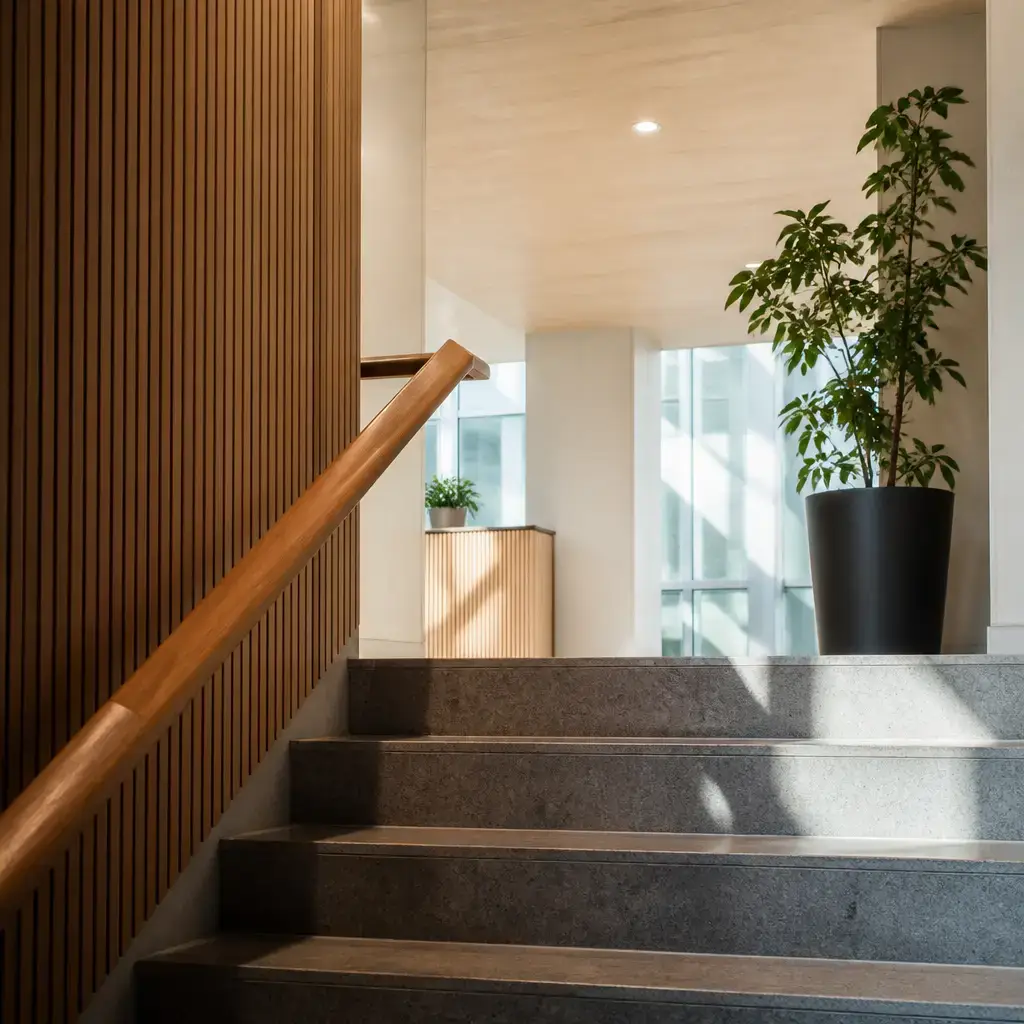
Jeg kan se skiltet til arrangementet på væggen.
YAI kan SAY SGEEL-tuh til uh-RAHN-shuh-MENT-uh poh VAI-en. I can see the event sign on the wall.Der står, at skranken er ovenpå.
Dair STOHR, eh SGRAHNG-uh air OH-vn-POH. It says the desk is upstairs.Vejen ovenpå er nem at følge.
VAI-en OH-vn-POH air NAYM eh FUR-luh. The way upstairs is easy to follow.Skiltet hjælper meget.
SGEEL-tuh YEL-puh MAY-uh. The sign helps a lot.Reposen er lige fremme.
reh-POH-sen air LEE-uh FREM-uh. The landing is just ahead.Så burde registreringsskranken være tæt på.
SOH BOO-uh reh-gis-TRAY-rings-SGRAHNG-uh VAI-uh TET POH. Then the registration desk should be close.Lad os gå, før køen bliver længere.
LAH ohs GOH, FUR KUR-en BLEE-vuh LENG-uh-uh. Let's go before the line gets longer.Jeg holder formularen klar.
YAI HOL-uh for-moo-LAIR-en KLAIR. I will keep the form ready.Sentence explanations
Jeg kan se skiltet til arrangementet på væggen.
I can see the event sign on the wall.
- Jeg kan
- I can
- se
- see
- skiltet
- the sign
- arrangementet
- the event
- væggen
- the wall
More detail
Jeg kan means “I can.” kan is the present-tense form of kunne (“can/be able to”); it does not change for person or number. After a modal such as kan, Danish uses the infinitive without at: Jeg kan se = “I can see.” se means “see.” Its base form is the infinitive se; the form does not receive an ending after kan. Example: Hun kan se bilen. — “She can see the car.” skiltet means “the sign” here. The noun is skilt (“sign”), an et-word: et skilt is “a sign,” and the definite singular is skiltet, formed with the ending -et. The phrase til arrangementet specifies what the sign is for: arrangement means “event,” and arrangementet is its definite singular form, “the event.” arrangementet means “the event” here. Its base noun is arrangement; et arrangement means “an event,” while arrangementet means “the event.” The ending marks definiteness, not a separate plural meaning. væggen means “the wall.” The noun is væg; en væg means “a wall,” and the definite singular is væggen. In på væggen, på means “on,” so this gives the location “on the wall.” Putting the parts together, Jeg kan se skiltet til arrangementet på væggen. means “I can see the event sign on the wall.” The structure is reusable as Jeg kan + infinitive + object + location: for example, Jeg kan se døren på væggen. — “I can see the door on the wall.”
Der står, at skranken er ovenpå.
It says the desk is upstairs.
- Der står
- it says
- skranken
- the desk / counter
- er
- is
- ovenpå
- upstairs
More detail
Der står is a fixed impersonal construction meaning “it says” or “it reads” when referring to written information. Here, der is an introductory “there,” not a specific person or object. står is the present form of stå (“stand”); in this construction, the combination refers to what is written rather than to physical standing. Example: Der står mit navn. — “My name is written there.” skranken means “the desk/counter” here. Its base form is skranke; skranken is the definite singular form, corresponding to “the desk/counter.” Danish marks definiteness on the noun itself in this form. Example: Jeg kan se skranken. — “I can see the desk/counter.” er is the present form of være (“be”). It links the desk/counter with its location: skranken er ... — “the desk/counter is ...” The same form is used with different subjects in the present tense; the subject’s number does not change er. ovenpå is an adverb meaning “upstairs” in this sentence. It gives the location of skranken; it is not part of the noun skranken. The related directional contrast is nedenunder (“downstairs/below”), but that would describe a different location. Together, Der står introduces written information, at introduces the content of that information, and skranken er ovenpå says where the desk/counter is. The complete meaning is: “It says that the desk is upstairs.”
Vejen ovenpå er nem at følge.
The way upstairs is easy to follow.
- Vejen
- the way
- ovenpå
- upstairs
- nem
- easy
- følge
- follow
More detail
Vejen is the definite singular form of vej, meaning “the way” here. The ending -en marks a common-gender noun in the definite singular: en vej = “a way,” vejen = “the way.” Example: Vejen er lang. — “The way is long.” ovenpå is an adverb meaning “upstairs” or “on the floor above.” In this sentence it identifies which way is being discussed: the way upstairs. The same word appears in the preceding context for the location of the desk, so that location meaning is supported here. nem means “easy” here. It is an adjective in its basic form. With a common-gender singular noun, the form is nem; compare the neuter form nemt and the plural/definite form nemme. Example: Opgaven er nem. — “The task is easy.” følge is the infinitive “to follow.” Its base form is also følge; after at, Danish uses the infinitive: at følge = “to follow.” Example: Det er nemt at følge skiltet. — “It is easy to follow the sign.” The pattern er nem at følge literally presents something as easy to follow: er means “is,” nem means “easy,” and at følge supplies the action that is easy. In the full sentence, Vejen ovenpå is the subject, so Vejen ovenpå er nem at følge means “The way upstairs is easy to follow.”
Skiltet hjælper meget.
The sign helps a lot.
- Skiltet
- the sign
- hjælper
- helps
- meget
- a lot
More detail
Skiltet means “the sign” here. It is the definite singular form of skilt (“sign”): et skilt = “a sign” and skiltet = “the sign.” The ending -et marks definiteness for this noun; it is not an independent word. Example: Skiltet er tydeligt. — “The sign is clear.” hjælper is the present-tense form of hjælpe (“to help”). In Danish, the present form is used for a current or generally valid action, and hjælper does not change according to the subject’s person or number. Example: Hun hjælper mig. — “She helps me.” meget means “a lot” in this sentence. Here it is an adverb modifying hjælper, so it describes the degree of help rather than a quantity of signs. Example: Det hjælper meget. — “That helps a lot.” Together, the subject Skiltet, the present-tense verb hjælper, and the adverb meget produce the meaning “The sign helps a lot.”
Reposen er lige fremme.
The landing is just ahead.
- Reposen
- the landing
- lige fremme
- just ahead
More detail
Reposen means “the landing” in this fixed sentence. The useful Danish noun is repos, “landing.” In standard Danish, its forms are et repos (“a landing”) and reposet (“the landing”), so the observed -en ending should not be taught as the ordinary definite ending for this noun. The fixed target is retained exactly here. er is the present-tense form of være, “to be.” It can link a subject with a description or location. lige fremme is a reusable expression meaning “just ahead” here; in other contexts, the same expression can also mean “straight ahead.” The fixed translation selects the first meaning. Example: Butikken er lige fremme. — “The shop is just ahead.” Together, Reposen er lige fremme. means “The landing is just ahead.”
Så burde registreringsskranken være tæt på.
Then the registration desk should be close.
- Så
- then
- burde
- should
- registreringsskranken
- the registration desk
- være
- be
- tæt
- close
- på
- part of “close to”
More detail
Så means “then” here and introduces the conclusion that follows from the situation. Danish så has other uses, including “so,” but the fixed translation supports “then” in this utterance. burde is the modal verb “should” here: it presents the speaker’s expectation rather than a firm statement. Its useful form chain is bør (present “should/ought to”) → burde (past-form “should/ought to”). In this modal use, the form does not change with the subject: Jeg burde gå means “I should leave,” while De burde gå means “They should leave.” registreringsskranken means “the registration desk.” It is a compound noun made from registrering (“registration”) and skranke (“desk” or “counter”). The ending -en marks the definite singular form of the common-gender noun skranke: en skranke → skranken. Example: Jeg står ved skranken. — “I am standing by the desk/counter.” være is the infinitive “be.” After the modal burde, Danish uses the infinitive: burde være means “should be.” Example: Hun burde være her. — “She should be here.” tæt means “close” in this sentence. It is the adjective in the predicate after være, describing the desk’s location relative to an understood place. In tæt på, it forms a common expression meaning “close to” or “near.” på is a preposition whose contribution here is part of the expression tæt på (“close to/near”); its meaning should not be treated as the whole location meaning by itself. When no object follows, as in this utterance, tæt på can mean “nearby.” Example: Skolen er tæt på. — “The school is nearby.” Putting the parts together, Så gives “then,” burde være gives “should be,” and tæt på gives “close.” The compound definite noun registreringsskranken identifies the subject as “the registration desk”: “Then the registration desk should be close.”
Lad os gå, før køen bliver længere.
Let's go before the line gets longer.
- Lad os
- let's
- gå
- go
- før
- before
- køen
- the line
- bliver
- gets / becomes
- længere
- longer
More detail
Lad os is a reusable way to suggest an action together: “let’s …”. Lad is the imperative of lade (“let” or “allow”), and os is the object form meaning “us”. The construction is followed by an infinitive: Lad os vente — “Let’s wait.” It expresses a suggestion, not a statement that a particular number of people is present. gå means “go” here and is the infinitive form. After Lad os, Danish uses the infinitive without at: Lad os spise — “Let’s eat.” før introduces a time clause and means “before”. It connects an action with an event that has not yet happened in the stated situation: Gå, før det bliver mørkt — “Go before it gets dark.” køen means “the line” or “the queue” here. Its base form is kø; the ending -en marks the definite singular form for this noun: en kø — “a line”, køen — “the line”. The definite form identifies a particular line understood from the situation, while the noun itself does not specify how many people are in it. bliver is the present form of blive, “become” or “get”. In this clause it describes a change: the line becomes longer. Blive is used with an adjective when something changes into a new state, for example Det bliver koldt — “It is getting cold.” længere is the comparative form of the adjective lang, “long”: lang — “long”, længere — “longer”. It compares the line’s future length with its current or understood length. The same comparative form can also mean “farther” in a distance context, but that is not its meaning here. Example: Vent ikke, til vejen bliver længere — “Don’t wait until the road gets longer.” Together, Lad os gå gives the suggestion “Let’s go”. før køen bliver længere adds the time condition “before the line gets longer”. The complete utterance therefore means: “Let’s go before the line gets longer.”
Jeg holder formularen klar.
I will keep the form ready.
- Jeg
- I
- holder
- keep
- formularen
- the form
- klar
- ready
More detail
Jeg means “I” and is the first-person singular subject pronoun. It identifies the speaker as the person who will carry out the action. A useful contrast is du (“you,” singular), as in Du holder formularen klar. — “You keep the form ready.” holder is the present-tense form of holde, “to keep” or “to hold.” In this sentence, holde ... klar means keeping something in a ready state, rather than physically holding it. Danish present tense can also refer to a future action when the context supports that reading; here, the fixed translation gives the intended future meaning “will keep.” formularen means “the form.” It is the definite singular form of formular: the ending -en marks a singular definite noun in this use. The noun itself is not the actor; it is the thing being kept ready. klar means “ready.” It describes the state of formularen. In Danish, the adjective form agrees with the noun’s relevant form: compare common-gender singular klar, neuter singular klart, and plural klare. Here, klar is the form used with this definite singular noun. Together, Jeg holder formularen klar. follows the reusable pattern subject + holde + object + adjective: “I keep the form ready.” With the future reading supplied by the fixed translation, the complete meaning is “I will keep the form ready.”
Grammar Points
Bestemt form med endelsen -en eller -et
Køen bliver lang.
KUR-en BLEE-vuh LANG.The queue becomes long.
Danish markerer ofte bestemt form med en endelse: kø → køen og skilt → skiltet.
Komparativ: længere
Vejen bliver længere.
VAI-en BLEE-vuh LENG-uh-uh.The way becomes longer.
Lang ændres til længere i komparativ, når man sammenligner eller beskriver en stigende grad.
Danish Vocabulary
- Gender
- neuter
skiltet til arrangementet
nem at følge
Skiltet hjælper meget.
hjælper meget
er nem at følge
skranken er ovenpå
- Gender
- common
Reposen er lige fremme.
- Gender
- neuter
skiltet til arrangementet
- Gender
- common
registreringsskranken
Der står, at skranken er ovenpå.
- Gender
- common
Vejen ovenpå
- Gender
- common
på væggen
Quiz
Word Order
Arrange the words in the correct order.
It says the desk is upstairs.
Show Answer
Der står, at skranken er ovenpå.The way upstairs is easy to follow.
Show Answer
Vejen ovenpå er nem at følge.The sign helps a lot.
Show Answer
Skiltet hjælper meget.Spelling
Tap the letters to spell the word.
upstairs
Show Answer
ovenpådesk; counter
Show Answer
skrankenwall
Show Answer
væggensay; stand