10 minutes free every day
Continue audio lessons in the app
Word explanations appear automatically in sync with the audio.
No login required · synced translations · playback with the screen locked
Choose your learning language and open this lesson in the app.

About This Lesson
Use Finding the event registration desk to practice Danish conversation, pronunciation, vocabulary, grammar, and quizzes.
Dialogue
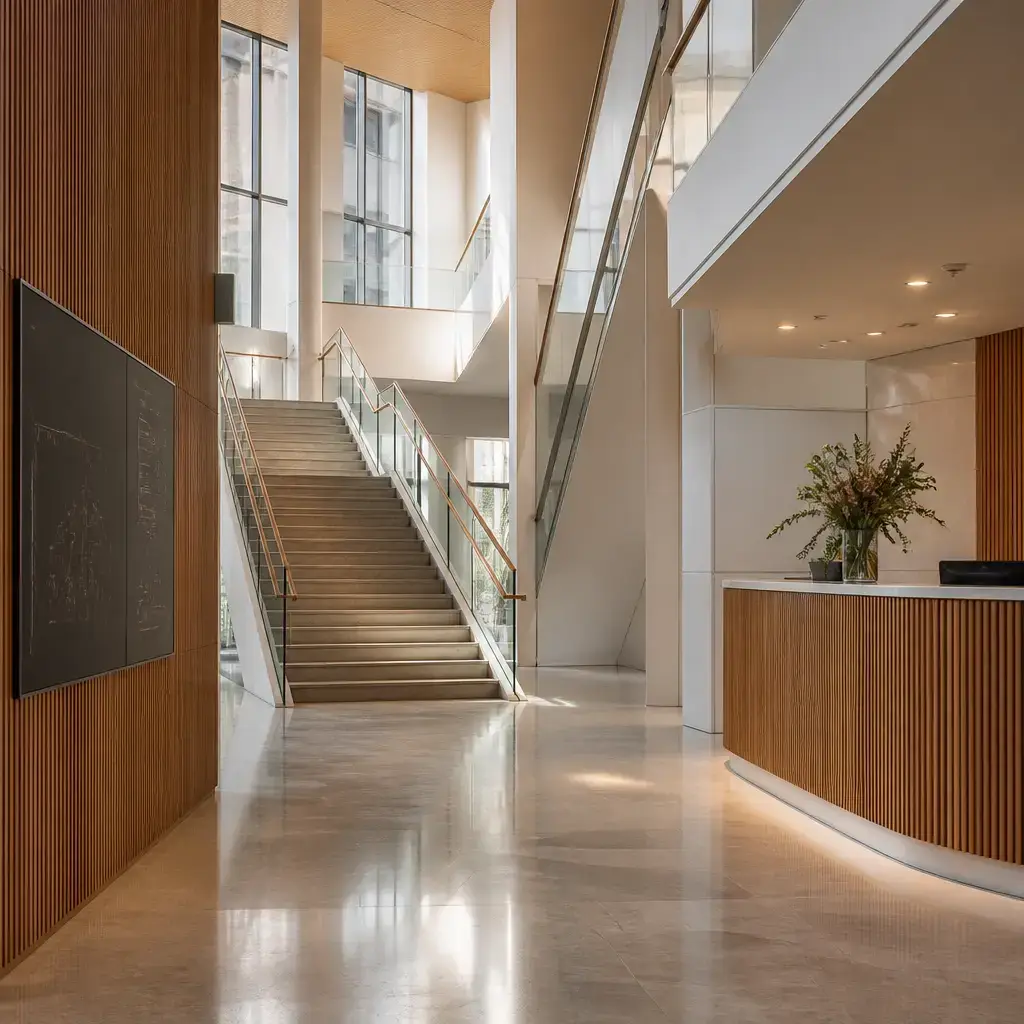
Denne bygning føles meget ren indvendigt.
DEN-uh BYOO-ning FUH-luhs MAY-uth RAYN en-VEN-dee. This building feels very clean inside.Det høje loft får lobbyen til at føles åben.
Day HUR-yuh LUHFT for LAW-bee-uhn till ath FUH-luhs OH-buhn. The high ceiling makes the lobby feel open.Lad os finde tilmeldingsskranken til arrangementet.
LATH us FEN-uh TEL-mel-ings-SGRANG-un till uh-rang-ZHAY-man. Let's find the event desk for registration.Jeg tjekker bygningens oversigt ved væggen.
YAI CHEK-uh BYOO-ning-uns OH-vuh-sekt veth VEH-gun. I'll check the building directory by the wall.Der står, at tilmeldingsskranken er ovenpå.
DAIR STOR, ath TEL-mel-ings-SGRANG-un air OH-vuhn-POH. It says the event desk is upstairs.Skal vi tage rulletrappen eller trapperne?
SGAL vee TAY ROO-luh-TRAH-bun EL-uh TRAH-buh-nuh? Should we take the escalator or the stairs?Lad os tage trapperne; de er lige her.
LATH us TAY TRAH-buh-nuh; dee air LEE-uh hair. Let's take the stairs; they are right here.De trætrapper får stedet til at virke varmt.
Dee TRAE-TRAH-buh for SDEH-th-uth till ath VAIR-guh VARM. The wooden stairs make the place feel warm.Sentence explanations
Denne bygning føles meget ren indvendigt.
This building feels very clean inside.
- Denne
- this
- bygning
- building
- føles
- feels
- meget
- very
- ren
- clean
- indvendigt
- inside
More detail
Denne means “this” and is the singular common-gender form used with bygning. Danish also has dette with singular neuter nouns and disse for plural nouns. Example: Denne stol er ny. — “This chair is new.” bygning means “building.” It is a common-gender noun: en bygning, definite bygningen, plural bygninger. føles means “feels” or “seems” here. It is the present-tense s-form of føle, used to describe how something is experienced or appears, rather than an action deliberately performed by the building. The active present form føler is used when a subject actively feels something: Jeg føler mig træt. — “I feel tired.” With the s-form, Rummet føles stort. means “The room feels large.” meget means “very” here and intensifies the adjective that follows: meget ren means “very clean.” It is different from mange, which means “many” with countable plural nouns. ren means “clean.” It is the common-gender singular form of the adjective, agreeing here with the common-gender singular subject bygning in the description after føles. The corresponding forms include rent with a singular neuter noun and rene with plural or definite nouns. Example: Et rum er rent. — “A room is clean.” indvendigt means “inside” or “on the inside.” Here it is an adverb specifying that the clean appearance concerns the building’s interior. Together, Denne bygning identifies the building, føles meget ren says that it is experienced as very clean, and indvendigt limits that description to its interior. The complete meaning is: “This building feels very clean inside.”
Det høje loft får lobbyen til at føles åben.
The high ceiling makes the lobby feel open.
- Det
- the (neuter singular definite marker)
- høje
- high
- loft
- ceiling
- får
- makes
- lobbyen
- the lobby
- til at
- to (before an infinitive)
- føles
- feels
- åben
- open
More detail
Det is the definite article used with a singular neuter noun. Here it belongs with loft, which is neuter: et loft “a ceiling” becomes loftet “the ceiling.” In this noun phrase, Det is a marker, not an independently identified pronoun. høje means “high” here. Its base form is høj; useful comparison forms are højere “higher” and højest “highest.” In det høje loft, the adjective has the -e form used in a definite noun phrase. The noun’s neuter gender is shown by det, while høje is the definite adjective form. loft is “ceiling” here. Its indefinite singular form is et loft, its definite singular form is loftet, and its plural is lofter. The phrase det høje loft therefore means “the high ceiling.” får is the present-tense form of få in the causative construction får ... til at ..., meaning “makes ...”. It is not the ordinary word order for simply saying that someone gets something. Example: Det får mig til at smile. — “It makes me smile.” lobbyen means “the lobby.” The base noun is lobby; because it is a common-gender noun, its definite singular form uses -en: lobbyen. The ending marks “the lobby,” not a separate word. til at introduces the infinitive in the causative pattern får X til at + verb: “makes X + verb.” The quoted words themselves provide this linking pattern; the following verb supplies the action or state that X is made to have. føles is the form used for “feels” in lobbyen føles åben, describing how the lobby is experienced. It is related to føle “to feel,” but Danish uses the -s form in expressions such as Det føles godt — “It feels good.” The form here is not marked for a particular person or number; the lobby is the thing that has the described impression. åben means “open.” It is the common-gender singular form of the adjective, agreeing with lobbyen in lobbyen føles åben. With a neuter singular subject, the corresponding form is åbent, as in the example Vinduet føles åbent. — “The window feels open.” Together, Det høje loft is “the high ceiling,” and får lobbyen til at føles åben uses the pattern “makes the lobby feel open.” The complete utterance is therefore: “The high ceiling makes the lobby feel open.”
Lad os finde tilmeldingsskranken til arrangementet.
Let's find the event desk for registration.
- Lad os
- let’s
- finde
- find
- tilmeldingsskranken
- registration desk
- til
- for
- arrangementet
- the event
More detail
Lad os is a reusable Danish way to make a suggestion including the speaker and the listener: “let’s …”. lad is the imperative of lade (“let”); here it is followed by os (“us”) and an infinitive. Example: Lad os gå. — “Let’s go.” This construction expresses a joint proposal, not a command to find something on the listener’s behalf alone. finde means “find” here. It is the infinitive form of finde; after Lad os, Danish uses the infinitive: Lad os finde …. Example: Lad os finde indgangen. — “Let’s find the entrance.” tilmeldingsskranken means “the registration desk.” It is a compound noun: tilmelding refers to registration, and skranke means a counter or desk. The ending -en marks the definite singular form of skranke in this compound, so the phrase refers to a particular desk. Example: Jeg står ved skranken. — “I am standing at the desk/counter.” til connects the desk with its purpose or association in tilmeldingsskranken til arrangementet: it can be understood here as “for” the event. It is a preposition, and its meaning depends on the relationship expressed; in this sentence it does not mean that the desk is physically moving toward the event. arrangementet means “the event.” Its base form is arrangement, and the ending -et marks the definite singular form of this neuter noun: “the event.” Example: Arrangementet begynder klokken otte. — “The event begins at eight.” Together, Lad os finde gives the joint suggestion “let’s find,” tilmeldingsskranken identifies the registration desk, and til arrangementet specifies that the desk is for the event. The complete meaning is: “Let’s find the event desk for registration.”
Jeg tjekker bygningens oversigt ved væggen.
I'll check the building directory by the wall.
- Jeg
- I
- tjekker
- check
- bygningens
- of the building
- oversigt
- directory
- ved
- by
- væggen
- the wall
More detail
Jeg is the first-person singular pronoun, meaning “I.” It identifies the speaker as the person doing the checking. The corresponding plural form is vi, “we”; for example, Jeg kommer means “I am coming,” while Vi kommer means “We are coming.” tjekker is the present-tense form of tjekke, “to check.” Danish present tense can describe an action that is intended to happen shortly when the context makes that clear, so here it corresponds to “I’ll check,” rather than necessarily “I am checking right now.” The present-tense ending is the same across persons: jeg tjekker and de tjekker both use tjekker. bygningens means “the building’s” or “of the building.” It is the genitive form of the noun bygning, “building,” formed with -s: bygning → bygningens. This form marks the building as the possessor or associated entity; it does not itself express a plural. For example, skolens indgang means “the school’s entrance.” oversigt means “directory” here: an organized overview or listing that can provide information about the building. Its basic form is oversigt; the definite singular form is oversigten, “the directory.” In another context, oversigt can also mean an overview or summary, but the fixed translation supports the directory sense here. ved is a preposition meaning “by” or “near” in this sentence. It places something in relation to a nearby location. For example, ved døren means “by the door.” væggen means “the wall.” It is the definite singular form of væg, “wall”: væg → væggen. Danish commonly marks definiteness on the noun itself, rather than using a separate word equivalent to “the” before it. The ending -en is the definite singular ending for this noun; it is not a general rule that every Danish noun uses -en. Together, bygningens oversigt is “the building directory,” with bygningens specifying what the directory belongs to or concerns. ved væggen means “by the wall.” Thus Jeg tjekker bygningens oversigt ved væggen. means “I’ll check the building directory by the wall.”
Der står, at tilmeldingsskranken er ovenpå.
It says the event desk is upstairs.
- Der står
- it says
- tilmeldingsskranken
- the event desk
- ovenpå
- upstairs
More detail
Der står is a fixed impersonal way to report written information: “it says” or “it is written.” Der does not identify a person or object here; it is part of the construction. står is the present-tense form of stå (“stand”). The same verb can describe physical standing in other contexts, but in this construction it refers to text appearing in writing. tilmeldingsskranken means “the event desk” here. It is the definite singular form of the compound tilmeldingsskranke, “registration/event desk.” The final -en marks this noun as definite singular. The first part, tilmeldings-, specifies the desk’s function; Danish commonly forms compounds in this way. Example: informationsskranken means “the information desk.” ovenpå is an adverb meaning “upstairs” in this sentence. It describes the desk’s location and does not change for the noun’s grammatical features. It can also mean “on top,” depending on the physical context; here the fixed translation establishes the upstairs meaning. Together, Der står introduces information found in writing, tilmeldingsskranken identifies what the information concerns, and ovenpå gives its location: “It says the event desk is upstairs.”
Skal vi tage rulletrappen eller trapperne?
Should we take the escalator or the stairs?
- Skal vi
- Should we
- tage
- take
- rulletrappen
- the escalator
- trapperne
- the stairs
More detail
Skal vi combines skal with vi. skal is the present form of skulle; here it forms a suggestion or proposal in the question “Should we …?”, rather than expressing a firm future. vi means “we” and refers to the speaker together with at least one other person. In this question pattern, the modal comes before the subject: Skal vi + infinitive? — Skal vi gå nu? means “Should we go now?” tage is the infinitive of tage, “to take.” After skal, the following verb stays in the infinitive: skal + tage, not a past-tense form. With transport or routes, tage can mean choosing or using something, as in tage bussen (“take the bus”). rulletrappen means “the escalator.” It is the definite singular form of rulletrappe (“escalator”): the ending -en marks a common-gender noun as definite singular. The word is a compound consisting of rulle (“roll”) and trappe (“stair”), but its established meaning is the moving staircase called an escalator. trapperne means “the stairs.” It is the definite plural form of trappe (“stair”): trappe → trapper (plural) → trapperne (definite plural). The ending -ne marks definite plural here. This form refers to the stairs as an identified route, not to an unspecified number of individual stairs. Together, Skal vi tage rulletrappen eller trapperne? asks the speaker and the other participant(s) to choose between using the escalator and using the stairs: “Should we take the escalator or the stairs?” The alternative is marked by eller, “or,” while the shared verb tage applies to both choices.
Lad os tage trapperne; de er lige her.
Let's take the stairs; they are right here.
- Lad os
- let’s
- tage
- take
- trapperne
- the stairs
- de
- they
- er
- are
- lige her
- right here
More detail
Lad os is the Danish pattern for “let’s” when suggesting a shared action. lad is the imperative of lade (“let” or “allow”), and os means “us”; together, this construction is followed by the action verb: Lad os vente. = “Let’s wait.” tage means “take” here, as in choosing a route or means of getting somewhere. It is the infinitive form of tage; after Lad os, Danish uses the infinitive: Lad os gå. = “Let’s go.” trapperne means “the stairs.” It is the definite plural form of trappe (“stair” or “staircase”): trappe → trapper (plural) → trapperne (the plural). The definite ending is part of the word rather than a separate word. In this utterance, the preceding question and the fixed translation identify these stairs as the selected option. de means “they” here and refers back to the plural trapperne. Danish de is the third-person plural subject pronoun; it does not show the gender of the things referred to. For example, De er åbne. means “They are open.” er means “are” here. It is the present-tense form of være (“be”), used with de: de er. The same present form is also used with other subjects, such as jeg er (“I am”) and vi er (“we are”), so the form itself does not mark plural in every subject combination. lige her means “right here.” her means “here,” while lige intensifies the location in this expression, giving the sense “exactly/right here.” For example, Bogen ligger lige her. means “The book is right here.” The utterance first proposes a shared action: Lad os tage trapperne (“Let’s take the stairs”). After the semicolon, de er lige her (“they are right here”) states the stairs’ location. Together, the utterance means: “Let’s take the stairs; they are right here.”
De trætrapper får stedet til at virke varmt.
The wooden stairs make the place feel warm.
- De
- the (plural)
- trætrapper
- wooden stairs
- får
- make
- stedet
- the place
- virke
- seem
- varmt
- warm
More detail
De introduces the plural noun phrase with the intended definite meaning “the” here, so De trætrapper refers to the wooden stairs. Danish de can also be a pronoun meaning “they” in another sentence; that is not its role here. It is capitalized because it begins the sentence. trætrapper is a compound noun: træ means “wood,” and trapper is the plural of trappe, “stair.” Together, the compound means wooden stairs. The plural is carried by trapper. får is the present-tense form of få. With til at, få ... til at is a causative pattern meaning “make or cause ... to.” Example: Det får ham til at smile. — “It makes him smile.” stedet means “the place.” It is the definite singular form of sted, “place”; the ending -et marks definiteness for this noun. The plural is steder, and its definite plural is stederne. virke is the infinitive of virke. In this construction it means “seem” or “appear”; the fixed translation naturally renders the resulting impression as “feel.” After får ... til at, the infinitive follows til at: får stedet til at virke means “makes the place seem.” varmt is the neuter singular form of the adjective varm, “warm.” It agrees with stedet, which is a neuter singular noun. Compare en varm stol — “a warm chair” — with et varmt rum — “a warm room.” Together, De trætrapper means “the wooden stairs,” får stedet til at virke means “make the place seem,” and varmt describes the resulting impression of the place. The whole utterance means: “The wooden stairs make the place feel warm.”
Grammar Points
lad os + infinitiv
Lad os finde tilmeldingsskranken.
LATH us FEN-uh TEL-mel-ings-SGRANG-un.Let's find the registration desk.
Efter lad os bruger man verbets infinitiv uden at ændre formen: lad os finde.
Det føles + adjektiv
Det føles meget varmt indvendigt.
Day FUH-luhs MAY-uth VARM en-VEN-dee.It feels very warm inside.
Dansk bruger det føles med et adjektiv for at beskrive, hvordan noget opleves.
Danish Vocabulary
- Gender
- common
Denne bygning
finde tilmeldingsskranken
bygning føles
Det høje loft
ren indvendigt
Lad os finde
- Gender
- common
lobbyen
- Gender
- neuter
det høje loft
meget ren
- Gender
- common
meget ren
- Gender
- common
tilmeldingsskranken
- Gender
- common
føles åben
Quiz
Word Order
Arrange the words in the correct order.
This building feels very clean inside.
Show Answer
Denne bygning føles meget ren indvendigt.Let's find the event desk for registration.
Show Answer
Lad os finde tilmeldingsskranken til arrangementet.I'll check the building directory by the wall.
Show Answer
Jeg tjekker bygningens oversigt ved væggen.Spelling
Tap the letters to spell the word.
high
Show Answer
højelobby
Show Answer
lobbyeninside
Show Answer
indvendigtfeel