10 minutes free every day
Continue audio lessons in the app
Word explanations appear automatically in sync with the audio.
No login required · synced translations · playback with the screen locked
Choose your learning language and open this lesson in the app.

About This Lesson
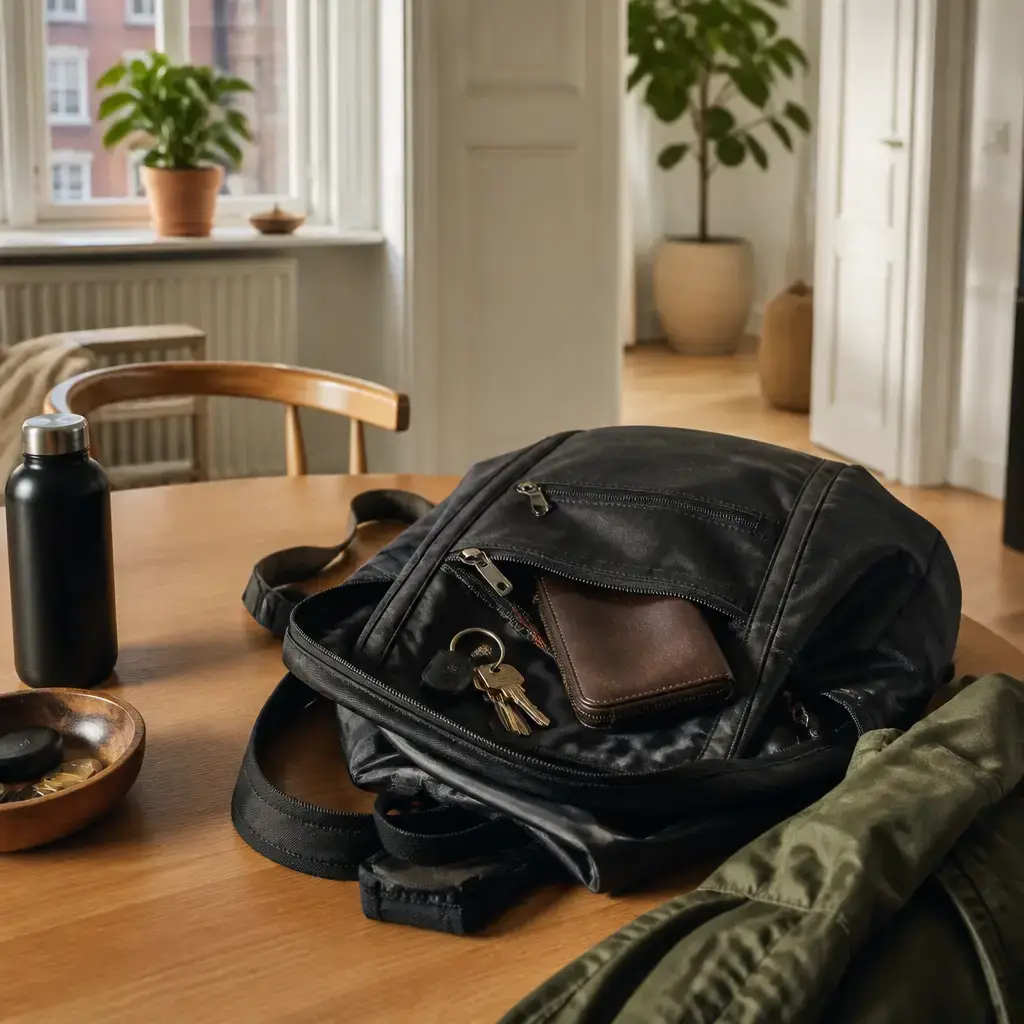
Use Finding a Wallet and Keys to practice Danish conversation, pronunciation, vocabulary, grammar, and quizzes.
Dialogue
Jeg kan ikke finde min pung.
yai kan EG-eh meen PONG I can't find my wallet.Har du tjekket inde i din rygsæk?
hah doo CHEG-et EN-eh ee deen RUE-sehk? Did you check inside your backpack?Jeg har allerede tjekket den forreste lomme.
yai hah al-RAI-deh CHEG-et den FOR-uh-steh LOM-eh I checked the front pocket already.Prøv den lille lomme ved lynlåsen.
PRUH-v den LIL-eh LOM-eh veh LUE-n-lohs-en Try the small pocket near the zipper.Jeg fandt den der.
yai FON den DAH I found it there.Luk lynlåsen, før du går.
look LUE-n-lohs-en, fuh doo GOH Close the zipper before you go.Jeg mangler stadig mine nøgler.
yai MANG-luh STAY-thee MEE-neh NUH-luh I still need my keys.De er i sidelommen.
dee ah ee SEE-theh-LOM-eh They're in the side pocket.Sentence explanations
Jeg kan ikke finde min pung.
I can't find my wallet.
- Jeg kan
- I can
- ikke
- not
- finde
- find
- min
- my
- pung
- wallet
More detail
Jeg kan means “I can” here. Jeg is the first-person singular subject, “I,” and kan is the present-tense form of kunne, “can/be able to.” In Danish, kan is followed by an infinitive without an English-style “to”: Jeg kan svømme means “I can swim.” The form kan does not change for the subject. ikke supplies the negation, “not.” With this modal construction, it comes after kan and before the infinitive: Jeg kan ikke svømme means “I cannot swim.” Here it negates the ability to find the wallet, not the identity of the speaker or the wallet. finde is the infinitive of finde, “find.” After kan, Danish uses this infinitive form: Hun kan finde nøglen means “She can find the key.” In the fixed sentence, finde is part of the negative ability construction, so kan ikke finde means “cannot find.” min means “my” here. It is the possessive form used with a singular common-gender noun. The noun pung is common gender: en pung, “a wallet,” so min pung means “my wallet.” With a singular neuter noun, the corresponding form is mit, as in the example mit hus, “my house.” pung means “wallet.” Its plural is punge: to punge means “two wallets.” In this sentence, pung is in its singular form because the possessive phrase is min pung; min is a possessive form, not a numeral, although the resulting phrase refers to a singular wallet here. Together, Jeg kan ikke finde min pung follows the reusable pattern subject + kan + ikke + infinitive + possessive + noun. The parts combine as “I can’t find my wallet.”
Har du tjekket inde i din rygsæk?
Did you check inside your backpack?
- Har du
- have you
- tjekket
- checked
- inde i
- inside
- din
- your
- rygsæk
- backpack
More detail
Har du is the Danish question pattern “have you”: har is the present form of have, and du means “you” for one person. In a question, the verb comes before the subject: Har du ...? Compare the statement Du har ... (“You have ...”). Here, har works with the following past participle to form a completed-action question. tjekket is the past participle of tjekke (“to check”). With har, it gives the meaning “have checked.” The same participle is used regardless of the subject here: Jeg har tjekket (“I have checked”) and du har tjekket (“you have checked”). inde i means “inside” and specifies an interior location. It is a useful fixed preposition pattern: inde i + place or container, as in the example inde i huset (“inside the house”). din means “your” when the possessed noun is singular and uses the common-gender form. It agrees with the possessed noun, not with the owner: din rygsæk (“your backpack”). Danish possessives also have forms such as dit with a singular neuter noun and dine with plural nouns. rygsæk means “backpack.” It is a common-gender noun, shown by en rygsæk (“a backpack”), so its singular possessive combination is din rygsæk. The plural is rygsække (“backpacks”). Together, Har du tjekket asks whether the listener has checked something, and inde i din rygsæk identifies the location checked. The complete utterance therefore means: “Did you check inside your backpack?”
Jeg har allerede tjekket den forreste lomme.
I checked the front pocket already.
- Jeg har
- I have
- allerede
- already
- tjekket
- checked
- den
- the (singular common-gender marker)
- forreste
- frontmost; front
- lomme
More detail
Jeg har is the subject Jeg (“I”) plus the auxiliary har (“have”). Together with a past participle, this forms the Danish perfect: Jeg har ... means “I have ...” and can describe a completed action. The subject form Jeg is used for “I”; it does not change for grammatical gender. allerede means “already”. It places the action before the relevant reference point. It commonly appears with a completed-action form, as here: Jeg har allerede læst den. — “I have already read it.” tjekket is the past participle of tjekke, “to check”. With har, it forms har tjekket, “have checked”. The participle does not change here for the gender or number of the object: Jeg har tjekket lommen. — “I have checked the pocket.” Here den is the definite article used before an adjective and a singular common-gender noun in den forreste lomme; it means “the”, not the object pronoun “it”. Danish also has the object pronoun den in other contexts, but that is a different use. The noun’s common-gender status is supported by lomme taking en in the indefinite form. forreste means “frontmost” or, naturally here, “front”. It describes lomme. It is the attributive form used in den forreste lomme, and is related to forrest (“at/in front; foremost”), not derived from the noun lomme. A reusable pattern is den forreste ... for “the frontmost ...”, for example den forreste stol — “the frontmost chair.” lomme means “pocket”. It is a common-gender noun: en lomme is “a pocket”, and lommen is “the pocket”. Its plural is lommer, “pockets”. Together, Jeg har allerede tjekket gives “I have already checked”, while den forreste lomme gives “the front pocket”. The complete utterance therefore means “I checked the front pocket already.”
Prøv den lille lomme ved lynlåsen.
Try the small pocket near the zipper.
- Prøv
- try
- den
- the
- lille
- small
- lomme
- ved
- near
- lynlåsen
- the zipper
More detail
Prøv is the imperative of prøve, “to try.” The imperative gives a direct instruction and normally has no written subject. Compare Prøv igen. — “Try again.” den is the singular common-gender definite article used before an adjective and noun: den lille lomme. Danish often marks definiteness with a suffix, as in lommen (“the pocket”), but an adjective before the noun brings the separate article den into this pattern. Here den belongs with the noun phrase; it is not the object pronoun meaning “it.” lille means “small” here. Its base form is lille; it is also used with a singular indefinite common-gender noun, as in en lille lomme (“a small pocket”). With a neuter noun, the corresponding form is lille as well, while the plural form is commonly små: små lommer — “small pockets.” lomme means “pocket.” It is a common-gender noun. Its indefinite singular is en lomme, its definite singular is lommen, and its plural is lommer (“pockets”). ved is a preposition meaning “near” or “by” in this sentence. It introduces the location used to identify the pocket: ved døren — “by the door.” lynlåsen means “the zipper.” The base noun is lynlås (“zipper”); its definite singular is formed as lynlåsen. The suffix -en marks definiteness for this common-gender noun. For example, Lynlåsen er åben. means “The zipper is open.” Together, den lille lomme means “the small pocket,” and ved lynlåsen specifies that it is the pocket near the zipper. The imperative Prøv takes this definite noun phrase as its object, producing the complete meaning: “Try the small pocket near the zipper.”
Jeg fandt den der.
I found it there.
- Jeg
- I
- fandt
- found
- den
- it
- der
- there
More detail
Jeg means “I” and is the Danish first-person singular subject pronoun. It stays jeg whether the speaker is male or female. Example: Jeg går. — “I am going.” fandt is the past form of finde, “to find”: finde → fandt (past) → fundet (past participle). It describes a completed finding here. Example: Jeg fandt nøglen. — “I found the key.” den means “it” here. It is the pronoun form used for a singular common-gender noun; det is used for a singular neuter noun. The choice follows the noun’s grammatical gender, not the speaker’s gender. The supplied texts do not identify exactly which item den refers to. Example: Jeg fandt den. — “I found it.” der means “there,” indicating a place. It is different from her, “here.” Example: Bogen ligger der. — “The book is there.” Together, Jeg supplies the subject, fandt says that the finding was completed in the past, den identifies the item found, and der gives its location: “I found it there.”
Luk lynlåsen, før du går.
Close the zipper before you go.
- Luk
- close
- lynlåsen
- the zipper
- før
- before
- du
- you
- går
- go
More detail
Luk is the imperative of lukke, “to close.” Danish imperatives generally do not mark the addressee’s person or number, so this form can address one person or more than one. Example: Luk døren. — “Close the door.” The subject is understood from the command and is not written here. lynlåsen means “the zipper.” Its base form is lynlås; lynlåsen is the definite singular form, with -en marking “the” for this common-gender noun. Example: Jeg reparerer lynlåsen. — “I am repairing the zipper.” før means “before.” Here it introduces a clause, so the pattern is før + subject + verb: før du går — “before you go.” It can also introduce a noun phrase in other sentences, but this sentence uses it before a complete clause. du is the subject form of the second-person pronoun, “you.” It is the form used for the person addressed in this clause. Example: Du kommer nu. — “You are coming now.” går is the present form of gå, “to go.” Danish present-tense verbs do not change according to the subject’s person or number, so går can occur with jeg, du, or other subjects. In this sentence it means “go,” not specifically “walk.” Example: Hun går hjem. — “She goes home.” Together, Luk lynlåsen gives the command “Close the zipper.” før du går adds the time condition “before you go,” producing the complete meaning: “Close the zipper before you go.”
Jeg mangler stadig mine nøgler.
I still need my keys.
- Jeg
- I
- mangler
- need; lack
- stadig
- still
- mine
- my
- nøgler
- keys
More detail
Jeg means “I” here. It is the first-person singular subject pronoun. For example, Jeg kommer means “I am coming.” mangler is the present-tense form of mangle. In this sentence, it means “need” in the sense of not having something that is needed; the more literal idea is “lack” or “be missing.” The useful form chain is mangle (base form) → mangler (present) → manglede (past). For example, Jeg mangler tid means “I need time” or “I lack time.” stadig means “still.” It marks a situation that continues at the relevant time. For example, Hun arbejder stadig means “She is still working.” mine is the first-person singular possessive form used before a plural noun, meaning “my.” Danish possessives vary with the noun phrase: min is used with one common-gender noun, mit with one neuter noun, and mine with plural nouns. Here, mine agrees with the plural noun nøgler; it does not itself state how many keys there are. nøgler means “keys.” It is the plural form of nøgle: nøgle → nøgler. For example, Jeg har to nøgler means “I have two keys.” Together, Jeg mangler expresses that the speaker needs something because it is missing, stadig says that this remains true, and mine nøgler identifies the missing item as the speaker’s keys. The whole utterance therefore means “I still need my keys.”
De er i sidelommen.
They're in the side pocket.
- De er
- they are
- i
- in
- sidelommen
- the side pocket
More detail
De er means “they are” here. De is the third-person plural subject pronoun, matching the plural item referred to in the fixed translation. er is the present-tense form of at være (“to be”); it is used with jeg, du, han/hun, and de, so it does not change for these persons in the present tense. Example: De er her. — “They are here.” i is the preposition “in” and introduces the location. Example: Nøglerne er i tasken. — “The keys are in the bag.” sidelommen means “the side pocket.” It is a compound noun: side (“side”) + lomme (“pocket”). The ending -en marks definite singular, so lomme is “a pocket,” while sidelommen is “the side pocket.” The compound noun itself is the location named after i. Together, De er + i + sidelommen produces: “They are in the side pocket.”`
Grammar Points
Prøv + infinitiv
Prøv at tjekke sidelommen.
PRUH-v ad CHEG-eh SEE-theh-LOM-ehTry checking the side pocket.
Efter imperativet Prøv står at + infinitiv: Prøv at tjekke.
før + ledsætning
Luk lynlåsen, før du går.
look LUE-n-lohs-en, fuh doo GOHClose the zipper before you go.
før indleder en ledsætning. På dansk står verbet efter subjektet: før du går.
Danish Vocabulary
Jeg har allerede tjekket den forreste lomme.
Jeg fandt den der.
Jeg fandt den der.
Jeg har allerede tjekket den forreste lomme.
Prøv den lille lomme ved lynlåsen.
- Gender
- common
Jeg har allerede tjekket den forreste lomme.
- Gender
- common
Luk lynlåsen, før du går.
Prøv den lille lomme ved lynlåsen.
- Gender
- common
Jeg kan ikke finde min pung.
- Gender
- common
Har du tjekket inde i din rygsæk?
Har du tjekket inde i din rygsæk?
Prøv den lille lomme ved lynlåsen.
Quiz
Word Order
Arrange the words in the correct order.
I can't find my wallet.
Show Answer
Jeg kan ikke finde min pung.Try the small pocket near the zipper.
Show Answer
Prøv den lille lomme ved lynlåsen.I found it there.
Show Answer
Jeg fandt den der.Spelling
Tap the letters to spell the word.
backpack
Show Answer
rygsækcheck
Show Answer
tjekketfront