10 minutes free every day
Continue audio lessons in the app
Word explanations appear automatically in sync with the audio.
No login required · synced translations · playback with the screen locked
Choose your learning language and open this lesson in the app.

About This Lesson
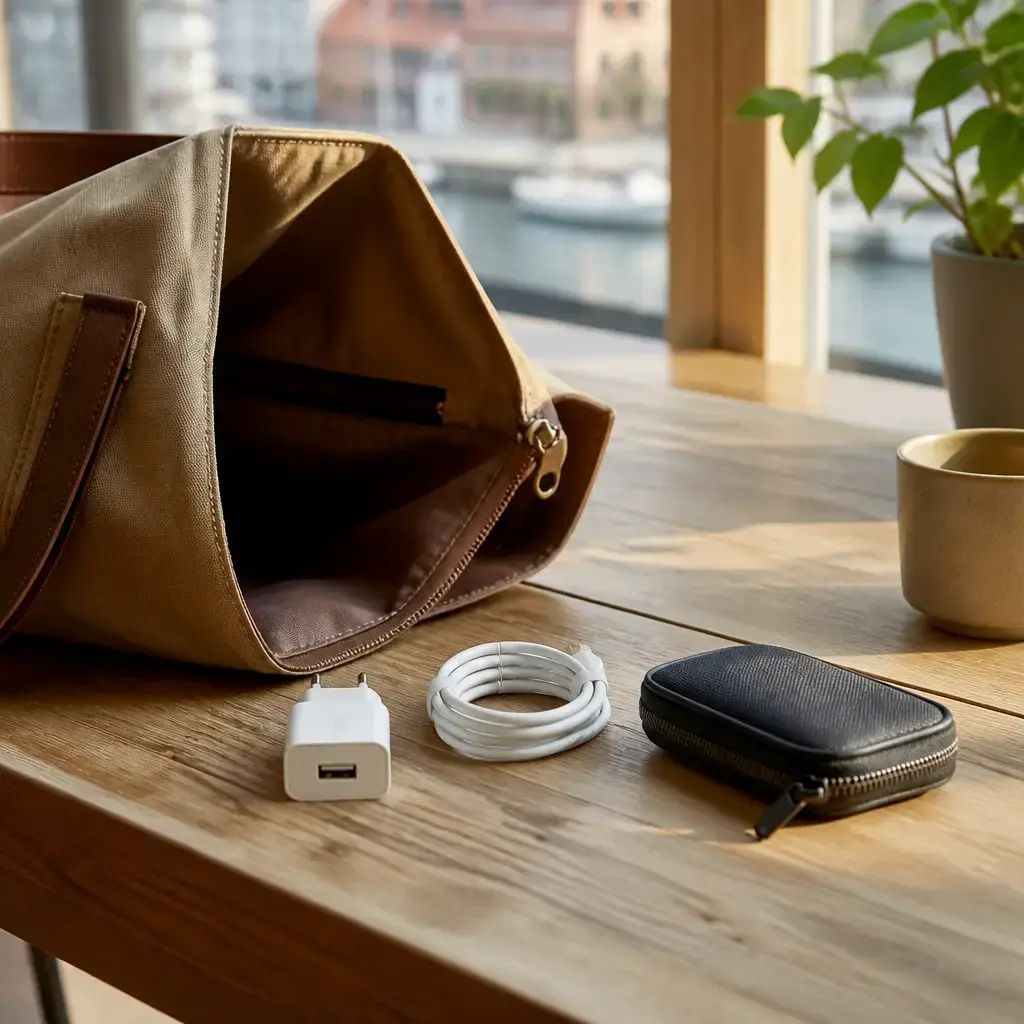
Use Borrowing a Phone Charger to practice Danish conversation, pronunciation, vocabulary, grammar, and quizzes.
Dialogue
Må jeg låne din oplader til telefonen?
maw yai LOH-nuh deen oh-PLAH-thah til teh-leh-FOH-nuhn? Can I borrow your phone charger?Den ligger i inderlommen på min taske.
dehn LEH-gah ee EN-uh-LOM-uhn paw meen TES-guh. It's in the inside pocket of my bag.Er kablet sammen med opladeren?
air KEH-bluhd SAH-mun meh oh-PLAH-thah-run? Is the cable with it?Kablet er i det lille etui.
KEH-bluhd air ee deh LEH-luh EH-too-ee. The cable is in the small case.Jeg fandt begge dele.
yai FENT BEH-guh DEH-luh. I found both.Læg kablet tilbage i etuiet, tak.
lai KEH-bluhd teh-BAI-yuh ee EH-too-ee, TEHG. Please put the cable back in the case.Jeg giver det hele tilbage, før jeg går.
yai KEE-vah deh HAY-luh teh-BAI-yuh, fuhr yai GOHR. I'll return everything before I leave.Det er fint for mig.
deh air FEENT fohr mai. That works for me.Sentence explanations
Må jeg låne din oplader til telefonen?
Can I borrow your phone charger?
- Må jeg
- May I…?
- låne
- borrow
- din
- your
- oplader
- charger
- til
- for
- telefonen
- the phone
More detail
Må jeg is a reusable permission-question pattern: “May I …?” Here må is the present-tense form of måtte, followed by the subject jeg and then an infinitive. Danish commonly places the modal before the subject in this kind of question. Example: Må jeg komme ind? — “May I come in?” låne means “borrow,” meaning to receive something temporarily with the expectation of returning it. It is an infinitive after the modal må. Do not confuse it with låne ud, “lend out,” where the person gives something temporarily to someone else. Example: Jeg vil låne din bog. — “I want to borrow your book.” din means “your” with one singular common-gender noun. Its form agrees with the possessed noun, not with the owner: din with a common-gender singular noun, dit with a neuter singular noun, and dine with a plural noun. In this sentence, it modifies oplader. oplader means “charger.” Its indefinite form is en oplader, and its definite form is opladeren, “the charger.” The word is the object being borrowed here. til can introduce what something is intended for. In til telefonen, it means “for the phone,” so oplader til telefonen is “charger for the phone” or, naturally, “phone charger.” telefonen means “the phone.” It is the definite singular form of telefon: en telefon means “a phone,” while telefonen means “the phone.” The definite ending is part of the word form rather than a separate word. Taken together, Må jeg asks for permission, låne identifies the temporary borrowing, din oplader identifies the other person’s charger, and til telefonen specifies that the charger is for the phone. The complete utterance is: “Can I borrow your phone charger?”
Den ligger i inderlommen på min taske.
It's in the inside pocket of my bag.
- Den
- it
- ligger
- is located
- i
- in
- inderlommen
- the inside pocket
- på
- of
- min
- my
- taske
- bag
More detail
Den means “it” here and refers to the item being located. Danish den is a common-gender singular pronoun; its exact referent is supplied by the situation, while its grammatical form indicates a singular common-gender referent. Compare det, used for a neuter-gender singular referent. ligger is the present-tense form of ligge, “to lie” or “to be located.” For an object’s position, Danish commonly uses ligge even when English uses “be.” Example: Bogen ligger på bordet. — “The book is on the table.” i is the preposition “in.” It introduces the place containing the item: Nøglen er i skuffen. — “The key is in the drawer.” inderlommen means “the inside pocket.” It is a definite compound noun: inderlomme means “inside pocket,” and the final -n marks the common-gender singular definite form. The word is formed from inder- (“inner/inside”) and lomme (“pocket”); the full compound is the noun used here. på expresses the relevant relation between the inside pocket and the bag. In this sentence, inderlommen på min taske means “the inside pocket of my bag.” Danish uses på in many relations that English may express with “of,” especially for an associated part or location. min means “my” and agrees with the noun it modifies. Here it is the common-gender singular possessive form used with taske. Compare mit with a neuter-gender singular noun and mine with plural nouns; the possessor is still “my.” taske is the indefinite singular form of the common-gender noun meaning “bag.” Its definite form is tasken, and its plural forms are tasker (indefinite) and taskerne (definite). Here min taske is “my bag”; the possessive makes an article unnecessary. Together, Den ligger i inderlommen says that the item is located inside the inside pocket. på min taske identifies that pocket as belonging to or being part of the speaker’s bag. The whole utterance therefore means: “It’s in the inside pocket of my bag.”
Er kablet sammen med opladeren?
Is the cable with it?
- Er
- is
- kablet
- the cable
- sammen med
- together with
- opladeren
- the charger
More detail
Er is the present-tense form of Danish være (“to be”). In Danish, er is used with all persons, so it does not change for singular versus plural: jeg er (“I am”), de er (“they are”). At the beginning here, it helps form a yes/no question: Er ...? = “Is ...?” kablet means “the cable” here. Its base form is kabel (“cable”), and kablet is the definite singular form: et kabel (“a cable”) → kablet (“the cable”). The ending -t belongs to this noun’s neuter-gender pattern; it is not an adjective ending. Example: Kablet er kort. — “The cable is short.” sammen med is a reusable expression meaning “together with” or simply “with” when describing being in the company or presence of something. sammen alone means “together,” while med means “with,” but the two-word expression gives the relation used here. Example: Telefonen ligger sammen med nøglerne. — “The phone is together with the keys.” opladeren means “the charger.” Its base form is oplader (“charger”), and opladeren is the definite singular form: en oplader (“a charger”) → opladeren (“the charger”). The ending -en is the definite ending used with this common-gender noun. Example: Jeg fandt opladeren. — “I found the charger.” Together, Er kablet asks whether the cable is in the stated condition, and sammen med opladeren specifies the accompanying item. The whole utterance therefore means “Is the cable together with the charger?”—the same intended question represented by the fixed translation “Is the cable with it?”
Kablet er i det lille etui.
The cable is in the small case.
- Kablet
- the cable
- er i
- is in
- det
- the
- lille
- small
- etui
- case
More detail
Kablet means “the cable” here. Its base form is kabel, and kablet is the definite singular form: et kabel → kablet. The noun is neuter, and -et is the definite singular ending used with this noun; the ending itself is not a separate neuter marker. er i combines the present form er of være (“to be”) with i (“in”). Together, they express that something is located inside a place or container. Example: Bogen er i tasken. — “The book is in the bag.” det is the neuter singular definite article used before the adjective in det lille etui. It agrees grammatically with the neuter noun etui; here it is not a separate numeric word meaning “one.” lille means “small” here. Its singular attributive form is lille: en lille taske (“a small bag”) and et lille etui (“a small case”). A useful contrasting plural form is små: små etuier — “small cases.” etui is a neuter noun meaning “case.” Its indefinite form is et etui, and its definite form is etuiet (“the case”). With the adjective and preceding definite article, it appears as det lille etui — “the small case.” The sentence assembles as Kablet (“the cable”) + er i (“is in”) + det lille etui (“the small case”): “The cable is in the small case.”
Jeg fandt begge dele.
I found both.
- Jeg
- I
- fandt
- found
- begge dele
- both
More detail
Jeg means “I” here: the speaker is the subject of the sentence. It is the Danish first-person singular subject pronoun. For example, Jeg ser kablet. means “I see the cable.” fandt means “found” in this sentence. It is the past-tense form of finde (“to find”): finde → fandt. The form fandt is used for past time, while present finder means “finds/am finding.” For example, Jeg fandt nøglen. means “I found the key.” begge dele means “both” when referring to two things. begge means “both,” and dele is the plural of del (“thing” or “part”); together, the expression refers to both items rather than just one. For example, Jeg vil have begge dele. means “I want both.” Together, Jeg fandt begge dele. means “I found both.” The subject Jeg (“I”) is followed by the past-tense verb fandt (“found”), and begge dele identifies the two things that were found. The supplied translation supports this reading of begge dele without specifying the two items by name.
Læg kablet tilbage i etuiet, tak.
Please put the cable back in the case.
- Læg
- put
- kablet
- the cable
- tilbage
- back
- etuiet
- the case
- tak
- please
More detail
Læg is the imperative of lægge, “to put/place.” The imperative gives a direct instruction and normally has no written subject. Compare læg (“put”) with lægger (“put/place” in present-tense clauses) and lagde (“put” in the past). Example: Læg bogen her. — “Put the book here.” kablet means “the cable” here. It is the definite singular form of kabel: et kabel means “a cable,” while kablet means “the cable.” The ending -et marks definiteness for this noun; it is not the imperative or verb ending. Example: Jeg ser kablet. — “I see the cable.” tilbage means “back,” expressing a return to an earlier place or position. It commonly combines with a movement or placement verb, as in lægge noget tilbage — “put something back.” Example: Læg nøglen tilbage. — “Put the key back.” etuiet means “the case.” It is the definite singular form of etui: et etui means “a case,” and etuiet means “the case.” The noun is neuter, which is why the indefinite article is et; the definite ending is part of the noun form. Example: Telefonen ligger i etuiet. — “The phone is in the case.” tak literally means “thanks” and can soften a request, giving the intended “please” at the end of this instruction. It is not part of the verb’s imperative form. A request can also use tak after the requested action, as here. Together, Læg kablet gives “put the cable,” tilbage adds the idea of returning it to its earlier place, and i etuiet specifies that destination as inside the case. The complete utterance is therefore: “Please put the cable back in the case.”
Jeg giver det hele tilbage, før jeg går.
I'll return everything before I leave.
- giver … tilbage
- give back; return
- det hele
- everything
- før
- before
- går
- leave
More detail
giver ... tilbage expresses returning something: giver is the present-tense form of at give (“to give”), and tilbage means “back.” Together, jeg giver ... tilbage means “I give ... back” or “I return ...”. Danish present tense can also describe a planned or future action when the context makes that clear. Example: Jeg giver bogen tilbage. — “I return the book.” det hele means “everything” here. det is the neuter singular pronoun “it” or “that,” while hele is the form used in this expression for “the whole.” Together, det hele refers to the complete set of things being returned, without stating a numerical count. Example: Jeg har læst det hele. — “I have read everything.” før means “before” and introduces a clause that sets a later event relative to the main event. In Jeg giver det hele tilbage, før jeg går, returning happens before leaving. The reusable pattern is før + clause. Example: Ring, før du kommer. — “Call before you come.” går is the present-tense form of at gå (“to go” or “to walk”). In this sentence, the fixed translation selects the context-appropriate sense “leave.” The form does not show a separate first-person ending here; jeg går means “I go” or “I leave.” Example: Jeg går nu. — “I’m leaving now.” Putting the parts together, Jeg giver det hele tilbage means “I’ll return everything,” with the present form giver referring to the intended future action. før jeg går means “before I leave”: jeg is the subject of the subordinate clause, and går is its verb. The complete utterance therefore means “I’ll return everything before I leave.”
Det er fint for mig.
That works for me.
- Det er
- it is
- fint
- fine; okay
- for mig
- for me
More detail
Det er is a common Danish pattern meaning “it is” or, as here, “that is.” Det is a pronoun whose specific referent is not named in the sentence; the fixed translation identifies it as “that.” Er is the present-tense form of være (“to be”). The pattern can be reused with an adjective: Det er godt = “That is good.” fint means “fine” or “acceptable” here. It is the neuter singular form of the adjective fin: fin (common gender), fint (neuter singular), fine (plural or definite contexts). The -t form agrees with det in this sentence. For example, Det er fint means “That is fine,” while Det er godt means “That is good.” for mig means “for me.” Mig is the first-person singular object form; compare jeg, which is used as a subject: Jeg er klar = “I am ready.” The preposition for connects the evaluation to the person for whom something is acceptable. For example, Det passer for mig can mean “That suits me.” Together, Det er fint for mig says that the matter or arrangement referred to as “that” is acceptable from the speaker’s point of view: “That works for me.”
Grammar Points
Bestemt form: substantiv + endelse
telefonen ligger i inderlommen.
teh-leh-FOH-nuhn LEH-gah ee EN-uh-LOM-uhn.The phone is in the inside pocket.
Danish often marks “the” by adding an ending to the noun: telefon → telefonen and inderlomme → inderlommen.
Imperativ: verbets stamme
Læg begge dele tilbage.
lai BEH-guh DEH-luh teh-BAI-yuh.Put both things back.
Commands use the verb stem without a subject: lægge becomes Læg.
Danish Vocabulary
Må jeg låne din oplader til telefonen?
- Gender
- neuter
Kablet er i det lille etui.
- Gender
- common
Den ligger i inderlommen på min taske.
- Gender
- neuter
Er kablet sammen med opladeren?
Den ligger i inderlommen på min taske.
Kablet er i det lille etui.
Må jeg låne din oplader til telefonen?
Den ligger i inderlommen på min taske.
- Gender
- common
Må jeg låne din oplader til telefonen?
Er kablet sammen med opladeren?
- Gender
- common
Den ligger i inderlommen på min taske.
- Gender
- common
Må jeg låne din oplader til telefonen?
Quiz
Word Order
Arrange the words in the correct order.
Is the cable with it?
Show Answer
Er kablet sammen med opladeren?The cable is in the small case.
Show Answer
Kablet er i det lille etui.I found both.
Show Answer
Jeg fandt begge dele.Spelling
Tap the letters to spell the word.
inside pocket
Show Answer
inderlommenborrow
Show Answer
lånebag
Show Answer
taskelie; be located