10 minutes free every day
Continue audio lessons in the app
Word explanations appear automatically in sync with the audio.
No login required · synced translations · playback with the screen locked
Choose your learning language and open this lesson in the app.

About This Lesson
Use Checking a Bag Before Leaving to practice Danish conversation, pronunciation, vocabulary, grammar, and quizzes.
Dialogue
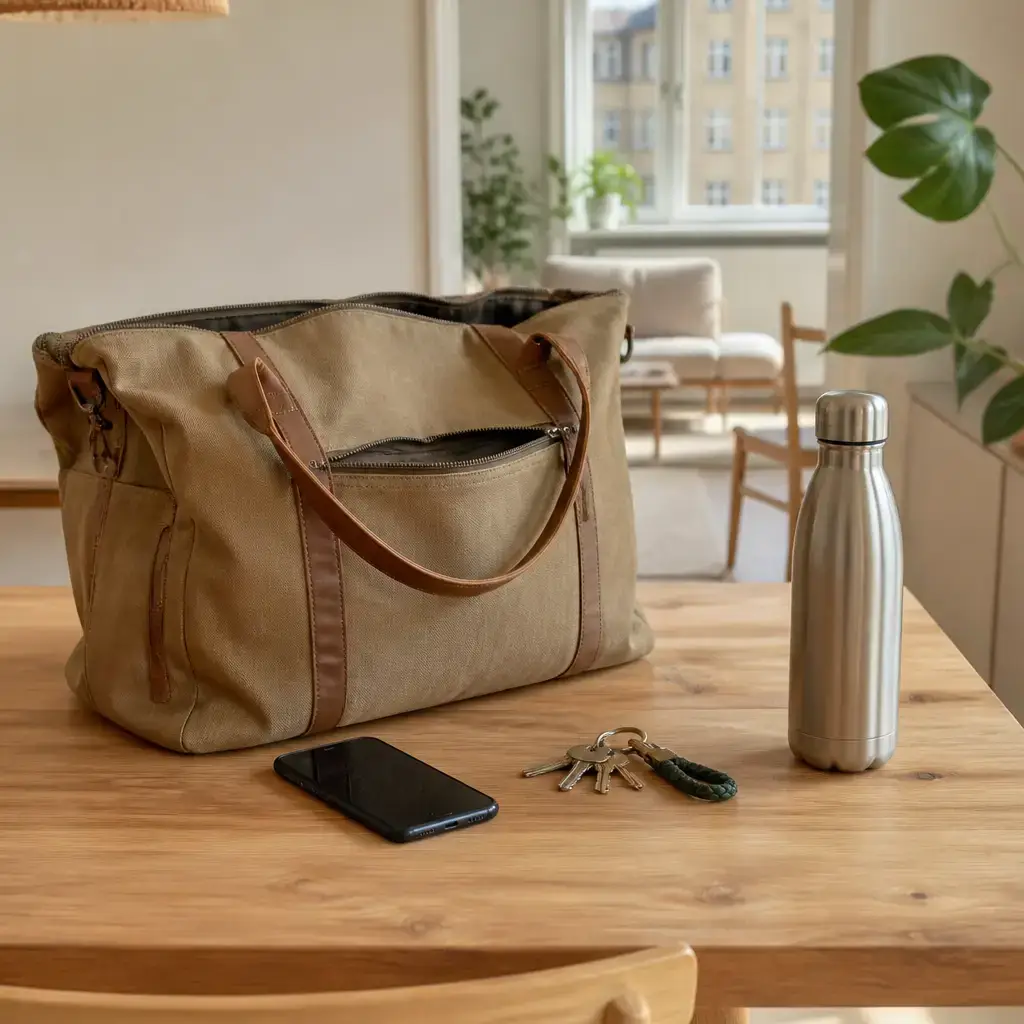
Kan vi tjekke, om min taske er klar?
kan vee CHEK-uh, ohm min TAS-guh air klah? Can we make sure my bag is ready?Læg de vigtige ting på bordet først.
lai dee VIG-duh ting poh BOH-duh ferst. Put the important things on the table first.Min telefon er i forlommen.
min teh-leh-FOHN air ee FOR-lom-un. My phone is in the front pocket.Hvor lagde du dine nøgler?
voh LAI-gthuh doo DEE-nuh NUR-gluh? Where did you put your keys?De ligger ved siden af min telefon.
dee LEG-uh veh SEE-thun eh min teh-leh-FOHN. They are next to my phone.Har du også brug for din vandflaske?
har doo OH-suh broo fohr deen VAN-flas-guh? Do you also need your water bottle?Ja, den er allerede i hovedlommen.
yai, den air al-REH-thuh ee HOO-thuh-lom-un. Yes, it is already in the main pocket.Så har du det, du skal bruge.
soh har doo deh, doo skal BROO-uh. Then you have what you need.Sentence explanations
Kan vi tjekke, om min taske er klar?
Can we make sure my bag is ready?
- Kan vi
- can we
- tjekke
- check; make sure
- om
- whether; if
- min
- my
- taske
- bag
- er
- is; are
- klar
- ready
More detail
Kan vi combines kan (“can”) with vi (“we”). kan is the present form of kunne; with a subject such as vi, it expresses ability or a request about possibility. Here, it asks whether checking is possible. After a modal verb like kan, the next verb uses its infinitive form. Example: Kan vi vente? — “Can we wait?” tjekke means “to check” here, with the practical sense “to make sure”. It is the infinitive form of tjekke, and it follows kan: kan + infinitive. Example: Vi skal tjekke døren. — “We need to check the door.” om introduces an embedded yes-or-no question. Here it means “whether” and connects the checking action with the question of the bag’s condition. Example: Jeg ved ikke, om han kommer. — “I do not know whether he is coming.” min means “my” and is the first-person singular possessive form used with a singular common-gender noun. Danish uses mit with a singular neuter noun and mine with plural nouns. The form agrees with the possessed noun, not with the owner: min taske, but mit hus (“my house”) and mine tasker (“my bags”). 'taske means “bag”. It is a singular common-gender noun; its indefinite form is en taske, and its definite form is tasken (“the bag”). With the possessive min, the phrase is min taske` (“my bag”). er is the present form of være, “to be”. Danish present er does not change for person or number, so it can correspond to “am”, “is”, or “are” depending on the subject: Jeg er klar — “I am ready”; de er klare — “they are ready.” Here the subject is min taske, so the natural translation is “is”. klar means “ready” in this sentence. It is an adjective describing the bag’s state. In attributive use, a singular common-gender noun takes klar, a singular neuter noun takes klart, and plural or definite noun phrases commonly take klare: et klart svar — “a clear answer”; klare tasker — “ready bags”. With a predicate after er, however, the adjective agrees differently: tasken er klar — “the bag is ready”. Together, om min taske er klar means “whether my bag is ready”. The full structure is Kan vi + infinitive tjekke + om-clause: “Can we check whether my bag is ready?” The fixed translation expresses this as “Can we make sure my bag is ready?”
Læg de vigtige ting på bordet først.
Put the important things on the table first.
- Læg
- put; place
- vigtige
- important
- ting
- things
- på
- on
- bordet
- the table
- først
- first
More detail
Læg is the imperative of lægge, “to put/place.” It gives a direct instruction to the person addressed. Compare the present form lægger: Jeg lægger bogen på bordet means “I put/place the book on the table.” vigtige is the form of the adjective vigtig, “important,” used here with the plural noun ting in the definite noun phrase de vigtige ting. In Danish, de plus the adjective ending -e commonly marks a definite plural phrase: de små bøger means “the small books.” ting means “things” here. Its singular is ting, while its plural is also ting; the surrounding words show the plural meaning in this sentence. For example, en ting means “one thing,” whereas flere ting means “several things.” på is the preposition “on” in this phrase. It introduces the surface where something is placed: Bogen ligger på bordet means “The book is on the table.” bordet means “the table.” The base noun is bord, “table,” and the ending -et marks the definite singular form: et bord is “a table,” while bordet is “the table.” først means “first,” indicating the order of the requested action. It comes after the placement phrase here, but it applies to the action as a whole: placing the important things on the table should happen before other actions. Together, Læg de vigtige ting gives the instruction “Put the important things,” på bordet specifies the destination or surface “on the table,” and først specifies the order “first.” The complete utterance therefore means: “Put the important things on the table first.”
Min telefon er i forlommen.
My phone is in the front pocket.
- Min
- my
- telefon
- phone
- er i
- is in
- forlommen
- front pocket
More detail
Min means “my” here and is the first-person singular possessive. It agrees with the possessed noun: min is used with a common-gender singular noun such as telefon; mit is used with a neuter-gender singular noun, and mine with plural nouns. Example: min bog means “my book,” while mit hus means “my house.” telefon is the noun “phone.” Its indefinite form is en telefon, and its definite singular form is telefonen, “the phone.” Danish nouns can show definiteness in this ending rather than with a separate word. er i combines the present form er of være, “to be,” with i, “in.” Together, this pattern states a location: “is in.” Example: Bogen er i tasken. — “The book is in the bag.” forlommen means “the front pocket.” It is the definite singular form of forlomme, “front pocket”: forlomme is an unspecified front pocket, while forlommen identifies a particular one. The word for- contributes the idea “front,” and lomme means “pocket”; the definite ending is attached to the whole noun. Together, Min telefon identifies the speaker’s phone, er i places it somewhere, and forlommen names the location. The complete meaning is: “My phone is in the front pocket.”
Hvor lagde du dine nøgler?
Where did you put your keys?
- Hvor
- where
- lagde
- put
- du
- you
- dine
- your (before a plural noun)
- nøgler
- keys
More detail
Hvor asks for a place: “where.” It is a question adverb and can be reused in questions such as Hvor bor du? — “Where do you live?” lagde is the past-tense form of lægge, “to put” or “to lay.” Here it describes a completed action of putting the keys somewhere. Compare lægger for present time and lagde for past time. Lægge normally describes placing something, while ligge describes something being located or lying somewhere: Jeg lægger bogen på bordet — “I put the book on the table”; Bogen ligger på bordet — “The book is on the table.” du means “you” and is the subject performing the action. Danish uses du for one person in this informal singular role; the plural “you” is I. dine means “your” before a plural possessed noun. Its form agrees with the possessed item, not with the owner: din nøgle means “your key,” while dine nøgler means “your keys.” The form dine therefore signals that the possessed noun is plural here. nøgler means “keys.” It is the plural of nøgle, “key”: en nøgle — “a key,” flere nøgler — “several keys.” In this sentence, the fixed translation identifies these keys as the ones being asked about; the following context refers back to them with “they.” Together, Hvor + lagde asks for the location resulting from the past action, du identifies the person who placed them, and dine nøgler identifies the object. The whole utterance means: “Where did you put your keys?”
De ligger ved siden af min telefon.
They are next to my phone.
- De
- they
- ligger
- are located
- ved siden af
- next to
- min
- my
- telefon
- phone
More detail
De is a Danish subject pronoun meaning “they” here. It is plural, but the supplied sentence and translation do not identify exactly who or what it refers to. Danish uses den as a singular common-gender pronoun for “it” when referring to a common-gender noun; personal “he” and “she” are normally han and hun. Thus De is not the singular form in this sentence. ligger comes from ligge, “to lie” or “be located.” In this sentence it describes the subjects’ location, not an action of putting something somewhere. Ligger is the present-tense form used with singular and plural subjects; the plural meaning comes from De, not from a special plural ending on ligger. Compare the past form lå: De lå ... means “They were ... / They lay ...” in the past. ved siden af is a fixed prepositional expression meaning “next to” or “beside.” The pattern X ligger ved siden af Y is reusable for saying that X is located next to Y. Example: Bogen ligger ved siden af koppen. — “The book is next to the cup.” min means “my” before a singular common-gender noun. Danish possessive forms contrast as min with common-gender singular nouns, mit with neuter singular nouns, and mine with plural nouns. Thus min telefon uses min because telefon is a common-gender noun: en telefon. telefon means “phone” or “telephone.” Its base form is telefon; a common indefinite form is en telefon, and the definite form is telefonen, “the phone.” With a possessive such as min, Danish normally does not add a separate definite article: min telefon means “my phone.” Together, De ligger gives “they are located,” ved siden af identifies the position, and min telefon identifies the object used as the reference point. The complete utterance therefore means: “They are next to my phone.”
Har du også brug for din vandflaske?
Do you also need your water bottle?
- Har du
- do you
- også
- also
- brug for
- need
- din
- your
- vandflaske
- water bottle
More detail
Har du is a yes/no question pattern. har is the present-tense form of have, and du means “you.” Danish places the verb before the subject in this kind of question: Har du ...? means “Do you have ...?” Here, Har du combines with the following brug for to express “Do you need ...?” også means “also” or “too.” It adds this item to something already relevant, without changing who needs it or whether they need it. brug for is a fixed Danish construction meaning “need.” The noun-like word brug is not being used here as the ordinary verb “use”; with for, the construction is have brug for (“need,” literally “have use for”). A reusable pattern is have brug for + noun: Jeg har brug for vand. — “I need water.” In the question, Har du brug for ...?, the present form har and the subject du are separated by question word order. din means “your” before one singular common-gender noun. It agrees with the possessed noun, not with the person who possesses it. Compare din flaske (“your bottle”) with dit ... before a singular neuter noun and dine ... before plural nouns. The fixed sentence identifies the possessed item as the water bottle, but din itself expresses possession rather than a separate quantity. vandflaske means “water bottle.” It is a compound noun formed from vand (“water”) and flaske (“bottle”); as one written Danish compound, it is treated as a single noun. The observed form is singular and indefinite here. For example, Jeg fylder min vandflaske. means “I fill my water bottle.” Together, Har du også brug for din vandflaske? forms a yes/no question: “Do you also need your water bottle?” The pattern is Har du også brug for + possessive + noun?, which can be reused with another item, such as Har du også brug for din jakke? — “Do you also need your jacket?”
Ja, den er allerede i hovedlommen.
Yes, it is already in the main pocket.
- Ja
- yes
- den er
- it is
- allerede
- already
- hovedlommen
- the main pocket
More detail
Ja means “yes” and confirms the preceding question. It is a standalone affirmative. den er means “it is.” Den is a singular common-gender pronoun in Danish; here, the translation and preceding context identify its referent as the water bottle. Er is the present-tense form of være (“to be”). Example: Den er her. — “It is here.” allerede means “already.” It indicates that the situation is true by the relevant time. Example: Hun er allerede hjemme. — “She is already at home.” hovedlommen means “the main pocket.” It is the definite singular form of hovedlomme (“main pocket”): hovedlomme → hovedlommen. In this compound, hoved- specifies the type of lomme (“pocket”), and the definite ending appears on the final element. Example: Telefonen er i hovedlommen. — “The phone is in the main pocket.” Together, Ja, den er allerede i hovedlommen. says: “Yes, it is already in the main pocket.” i introduces the location, while the sentence as a whole confirms that the water bottle is already there.
Så har du det, du skal bruge.
Then you have what you need.
- Så
- then
- har du
- you have
- det, du skal bruge
- what you need
More detail
Så means “then” here and places the utterance in sequence: after the preceding situation, the result is that you have what is needed. It can also mean “so” in other contexts, but “then” is the intended meaning here. har du uses the present-tense form har of have with the subject du (“you”). Danish main clauses commonly put the finite verb before the subject when another element such as Så comes first: Så har du ... (“Then you have ...”). This is a declarative word order, not by itself a question. Example: I dag har du tid. — “Today you have time.” det, du skal bruge is a relative construction meaning “what you need.” det means “that/the thing,” and the following clause specifies which thing. In du skal bruge, skal is the present form of the modal skulle; with the infinitive bruge (“use”), it expresses what you need to use or require in this context. The literal structure is therefore close to “that which you need to use,” while the natural English meaning is “what you need.” The complete utterance combines the sequence marker, the verb-second clause har du, and the relative construction: Så har du det, du skal bruge. — “Then you have what you need.”
Grammar Points
lægge + genstand / ligge + sted
Læg telefonen i forlommen. Nøgler ligger ved siden af bordet.
lai teh-leh-FOHN-un ee FOR-lom-un. NUR-gluh LEG-uh veh SEE-thun ehf BOH-duh.Put the phone in the front pocket. Keys are lying next to the table.
Brug lægge, når nogen placerer noget; brug ligge, når noget allerede befinder sig et sted.
Danish Vocabulary
- Gender
- neuter
- Gender
- common
- Gender
- common
- Gender
- common
- Gender
- common
Quiz
Word Order
Arrange the words in the correct order.
My phone is in the front pocket.
Show Answer
Min telefon er i forlommen.Where did you put your keys?
Show Answer
Hvor lagde du dine nøgler?Yes, it is already in the main pocket.
Show Answer
Ja, den er allerede i hovedlommen.Spelling
Tap the letters to spell the word.
phone
Show Answer
telefonfirst
Show Answer
førsttable
Show Answer
bordetthings