10 minutes free every day
Continue audio lessons in the app
Word explanations appear automatically in sync with the audio.
No login required · synced translations · playback with the screen locked
Choose your learning language and open this lesson in the app.

About This Lesson
Use Organizing a Bag to practice Danish conversation, pronunciation, vocabulary, grammar, and quizzes.
Dialogue
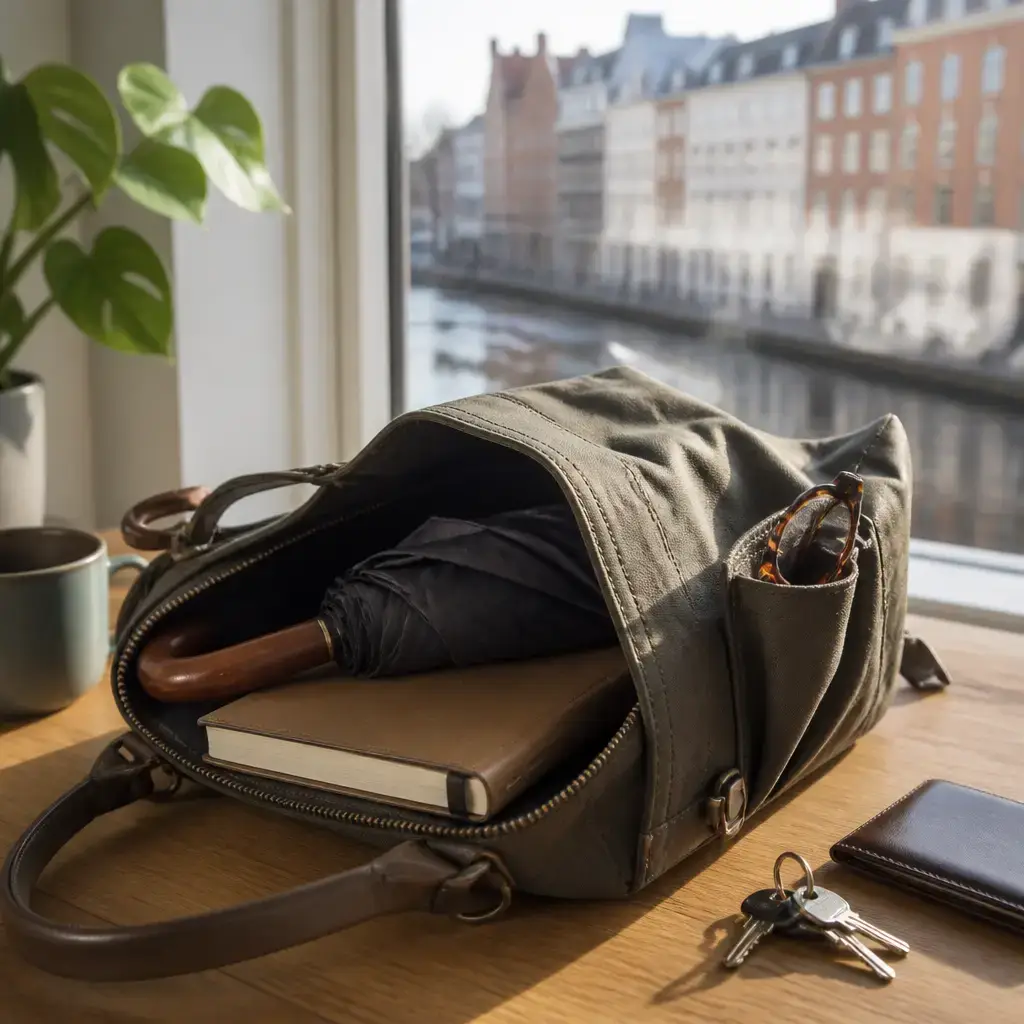
Er mine briller i denne taske?
air MEE-nuh BREL-uh ee DEN-uh TAS-guh? Are my glasses in this bag?De er i sidelommen.
dee air ee SEE-thuh-LOM-un. They're in the side pocket.Jeg skal også bruge min notesbog.
yai sGAL AW-suh BROO-uh meen NOH-tus-boh. I need my notebook too.Den er under din paraply.
den air ON-uh deen pah-rah-PLOO-un. It's under your umbrella.Må jeg flytte paraplyen?
moh yai FLUR-tuh pah-rah-PLOO-un? Can I move the umbrella?Læg den ved håndtaget, så den ikke er i vejen.
leh den veth HON-tay-uh, soh den IK-uh air ee VAI-un. Put it by the handle so it stays out of the way.Jeg organiserer tasken nu.
yai or-ga-nee-SAIR-uh TAS-gun noo. I'll organize the bag now.Så bliver det lettere at finde ting.
soh BLEE-uh deh LET-uh-ruh ad FEN-uh teng. Then it will be easier to find things.Sentence explanations
Er mine briller i denne taske?
Are my glasses in this bag?
- Er
- are / is
- mine
- my
- briller
- glasses
- denne
- this
- taske
- bag
More detail
Er is the present-tense form of være, “to be.” In this question it comes first because Danish commonly forms a yes/no question by placing the finite verb before the subject: Er ...? = “Are ...?” The form er is used with different subjects in the present, so it does not itself show the plural of briller. mine means “my” before a plural noun. It is the plural form of the possessive min/mit/mine: min is used with a common-gender singular noun, mit with a neuter singular noun, and mine with a plural noun. Here it agrees with briller, not with taske. briller means “glasses” and is the plural form of brille, “a pair of glasses / a spectacle.” Danish uses the plural form when referring to glasses as an item. Example: Mine briller er her. — “My glasses are here.” denne means “this” and is the singular common-gender form of the demonstrative. It agrees with the singular common-gender noun taske. The corresponding neuter singular form is dette, while the plural form is disse. taske means “bag.” It is a common-gender singular noun; its indefinite form is en taske, and its definite form is tasken. Example: Denne taske er ny. — “This bag is new.” Together, mine briller means “my glasses,” and i denne taske means “in this bag.” The word order Er mine briller i denne taske? places the present-tense verb before the subject to make a yes/no question: “Are my glasses in this bag?”
De er i sidelommen.
They're in the side pocket.
- De
- they
- er i
- are in
- sidelommen
- the side pocket
More detail
De means “they” here and is the third-person plural subject pronoun. In the supplied exchange, it answers the question about the glasses, so the plural referent is understood from that context. Danish uses den and det as singular pronouns for non-human common-gender and neuter nouns, respectively; human “he” and “she” are normally han and hun. Example: De er her. — “They are here.” er i combines the present form er of være (“to be”) with i (“in”). Er is used with all persons in the present: jeg er (“I am”), du er (“you are”), and de er (“they are”). The preposition i introduces the place containing the referent. Example: Bogen er i tasken. — “The book is in the bag.” sidelommen means “the side pocket.” It is the definite singular form of sidelomme (“a side pocket”): sidelomme = “a side pocket,” sidelommen = “the side pocket.” The compound contains side (“side”) plus lomme (“pocket”), and the definite ending -en is attached to the final noun. Here it identifies a particular pocket in the bag rather than introducing one generally. Example: Nøglen er i sidelommen. — “The key is in the side pocket.” Together, De is the subject, er i states its location, and sidelommen names that location: “They are in the side pocket.”
Jeg skal også bruge min notesbog.
I need my notebook too.
- Jeg skal
- I must / I shall
- også
- also; too
- bruge
- need; use
- min
- my
- notesbog
- notebook
More detail
Jeg skal: Jeg means “I”. skal is the present form of skulle. With an infinitive, it can express obligation, intention, or—depending on the verb and context—a need. Here, with bruge, the combination skal bruge means “need”. The reusable pattern is Jeg skal + infinitive, but its exact meaning comes from the context. Example: Jeg skal spise. — “I need to eat.” også: This means “also” or “too”. Here it adds this need to something else already understood. In this sentence, it modifies the statement as a whole rather than naming a separate object. bruge: This is the infinitive form of bruge, meaning “use”. In the construction skal bruge, Danish commonly expresses needing or requiring something, so Jeg skal bruge ... means “I need ...” in this utterance. Example: Jeg skal bruge en blyant. — “I need a pencil.” min: This possessive means “my”. It is used with a singular common-gender noun. Danish contrasts min with a singular common-gender noun, mit with a singular neuter noun, and mine with a plural noun. The form agrees with the possessed noun, not with the possessor Jeg. notesbog: This noun means “notebook”. It is singular here, and min notesbog means “my notebook”. Together, Jeg skal bruge means “I need”, min notesbog identifies the needed item as “my notebook”, and også adds “too”. The complete meaning is “I need my notebook too.”
Den er under din paraply.
It's under your umbrella.
- Den
- it
- er
- is
- under
- under
- din
- your
- paraply
- umbrella
More detail
Den means “it” here: a singular common-gender pronoun. Danish contrasts den with det for singular nouns, while de is plural. The exact antecedent is not identified by the supplied sentence, so learn the form as a reference to an already identifiable common-gender singular thing. Example: Den er ny. — “It is new.” er is the present-tense form of være, “to be.” The pattern X er ... can describe where something is, as in Bogen er her. — “The book is here.” under is a preposition meaning “under” and introduces the location relative to another thing. Example: Katten er under bordet. — “The cat is under the table.” din means “your” for a singular addressee when the possessed noun is common gender and singular. Its related forms are dit with a singular neuter noun and dine with a plural noun. In this sentence, din agrees with paraply, not with the person being addressed. Example: Hvor er din bog? — “Where is your book?” paraply means “umbrella.” It is a common-gender noun, so the phrase uses din paraply; its definite form is paraplyen, “the umbrella.” Example: Jeg har en paraply. — “I have an umbrella.” Together, Den er gives “It is,” under marks the location, and din paraply gives the reference point, “your umbrella.” The whole utterance therefore means “It’s under your umbrella.”
Må jeg flytte paraplyen?
Can I move the umbrella?
- Må jeg
- Can I?
- flytte
- move
- paraplyen
- the umbrella
More detail
Må jeg means “Can I?” here: må is the present-tense form of måtte, used for permission, while jeg means “I.” In this question, the speaker asks whether they are allowed to do the action, rather than stating that they will do it. Danish commonly places the subject after a modal verb in a yes/no question: Må jeg ...? = “May/Can I ...?” flytte means “to move” or “relocate” something. It is the infinitive form, used after the modal må. Compare the present-tense form flytter: Jeg flytter paraplyen. — “I am moving the umbrella.” paraplyen means “the umbrella.” Its base form is paraply (“umbrella”); the ending -en marks the common-gender definite form, “the umbrella.” The noun, not flytte, carries this definiteness marking. An indefinite noun is en paraply (“an umbrella”), while paraplyen refers to a specific umbrella in this utterance. Together, Må jeg + flytte forms a permission question, and paraplyen identifies the object being moved: “Can I move the umbrella?”
Læg den ved håndtaget, så den ikke er i vejen.
Put it by the handle so it stays out of the way.
- Læg
- put; place
- den
- it
- ved
- by; near
- håndtaget
- the handle
- så
- so that
- ikke
- not
- er i vejen
- is in the way
More detail
Læg is the imperative of lægge, “to put/place.” The imperative addresses one or more people without stating the subject: Læg den her. — “Put it here.” Do not confuse it with ligge, “to lie/be located”: Læg bogen means “Put the book,” while Bogen ligger means “The book is lying.” den is a third-person singular pronoun used here for the item being placed. In the supplied context, it naturally refers to the umbrella mentioned in the preceding sentence. Den is also the form used with common-gender singular nouns; its form does not show whether the referent is, for example, an object or a person. ved is a preposition meaning “by” or “near.” It places something close to a landmark: Hun står ved døren. — “She is standing by the door.” håndtaget means “the handle.” Its base form is håndtag; et håndtag is “a handle,” and the definite form håndtaget is “the handle.” The ending -et marks this neuter noun as definite singular. The noun, not ved, supplies the meaning of the landmark in ved håndtaget. så introduces the intended result or purpose here: “so that.” In så den ikke ..., it connects the placement with the desired situation of the item. A related use can mean “then,” but that is not the meaning in this sentence. ikke is the standard Danish negation, “not.” It negates the following situation: ikke er i vejen means “is not in the way.” er is the present form of være, “to be.” Danish uses the same present form er with different subjects: Jeg er klar — “I am ready,” and De er klar — “They are ready.” i vejen is a fixed expression meaning “in the way” or “obstructing.” It is built from i, “in,” and vejen, the definite form of vej, “way/road,” but the whole expression should be learned as the reusable pattern være i vejen: “be in the way.” Together, Læg den ved håndtaget means “Put it by the handle.” The clause så den ikke er i vejen adds the purpose or desired result: “so that it is not in the way.” The complete utterance is therefore: “Put it by the handle so it stays out of the way.”
Jeg organiserer tasken nu.
I'll organize the bag now.
- Jeg
- I
- organiserer
- organize
- tasken
- the bag
- nu
- now
More detail
Jeg means “I” here and is the first-person singular subject pronoun. It identifies the speaker as the person carrying out the action. Danish subject pronouns change with person and number; for example, jeg contrasts with du (“you,” singular) and vi (“we”). organiserer means “organize” in this sentence. Its base form is organisere; organiserer is the present-tense form. Danish present-tense verbs generally do not change form according to the subject, so the same form can occur with jeg, du, or de: Jeg organiserer = “I organize/am organizing,” while de organiserer = “they organize/are organizing.” The sentence’s nu makes the current-time reading clear. Example: Hun organiserer papirerne. — “She is organizing the papers.” tasken means “the bag.” It is the definite singular form of the noun taske (“bag”): en taske = “a bag,” tasken = “the bag.” The ending -en marks definite singular for this noun; it is part of the noun form, not a separate word. Example: Jeg finder tasken. — “I find the bag.” nu means “now.” It is a time adverb that places the organizing at the current time. Example: Vi starter nu. — “We are starting now.” Together, Jeg organiserer tasken nu. has the pattern [subject] [present-tense verb] [definite object] [time adverb]: “I’ll organize the bag now.” In the supplied translation, “I’ll” conveys an action the speaker is about to carry out; the Danish present-tense verb together with nu expresses that immediate plan or current action. The preceding and following context supports the same bag-organizing situation, but the sentence itself directly states only that the speaker will organize the bag now.
Så bliver det lettere at finde ting.
Then it will be easier to find things.
- Så
- then
- bliver
- will be
- det
- it
- lettere
- easier
- finde
- find
- ting
- things
More detail
Så means “then” here. It links this result to what has just been mentioned: organizing the bag. It can also mean “so” in other contexts, but “then” is the supported sense here. bliver is the present-tense form of blive, “become” or “be.” Danish present forms can refer to the future when the context makes that time clear, so this form gives the future meaning “will be” here. Other forms include blev for past time and blive after at or a modal verb. det is the neuter singular pronoun “it.” In this pattern, it functions as the grammatical subject of the evaluation; the sentence does not identify a separate concrete object that det refers to. Danish also uses det in constructions describing how easy, difficult, or useful an activity is. lettere is the comparative form of let, “easy.” The chain is let (easy) → lettere (easier) → lettest (easiest). The comparison is understood against the earlier situation: the finding will be easier than before. lettere is the form carrying the comparison, not ting. finde is the infinitive “to find.” With at, Danish commonly forms an infinitive phrase: at finde means “to find.” Example: Det er svært at finde nøglerne. — “It is difficult to find the keys.” ting means “things” here. It is the plural indefinite form of ting; the singular is also ting, while the definite plural is tingene. The plural indicates multiple things, without specifying exactly which things. Together, det bliver lettere gives “it will be easier,” and at finde ting specifies the activity that will become easier: “to find things.” With Så marking the result, the whole utterance means that, as a result of the organizing just mentioned, finding things will be easier. This is a neutral, reusable pattern: det bliver + comparative adjective + at + infinitive (“it will become [comparative] to [do something]”).
Grammar Points
mine + plural noun
mine briller
MEE-nuh BREL-uhmy glasses
Possessive determiners such as “mine” come before plural nouns and show who something belongs to.
blive + adjective
bliver lettere
BLEE-uh LET-uh-ruhbecomes easier
“Bliver” plus an adjective describes a change into a new state.
Danish Vocabulary
Er mine briller i denne taske?
Jeg skal også bruge min notesbog.
Er mine briller i denne taske?
Den er under din paraply.
Må jeg flytte paraplyen?
Læg den ved håndtaget, så den ikke er i vejen.
Er mine briller i denne taske?
Jeg skal også bruge min notesbog.
Må jeg flytte paraplyen?
De er i sidelommen.
Er mine briller i denne taske?
Den er under din paraply.
Quiz
Word Order
Arrange the words in the correct order.
Are my glasses in this bag?
Show Answer
Er mine briller i denne taske?They're in the side pocket.
Show Answer
De er i sidelommen.I need my notebook too.
Show Answer
Jeg skal også bruge min notesbog.Spelling
Tap the letters to spell the word.
bag
Show Answer
taskethe side pocket
Show Answer
sidelommenglasses
Show Answer
brillernotebook