10 minutes free every day
Continue audio lessons in the app
Word explanations appear automatically in sync with the audio.
No login required · synced translations · playback with the screen locked
Choose your learning language and open this lesson in the app.

About This Lesson
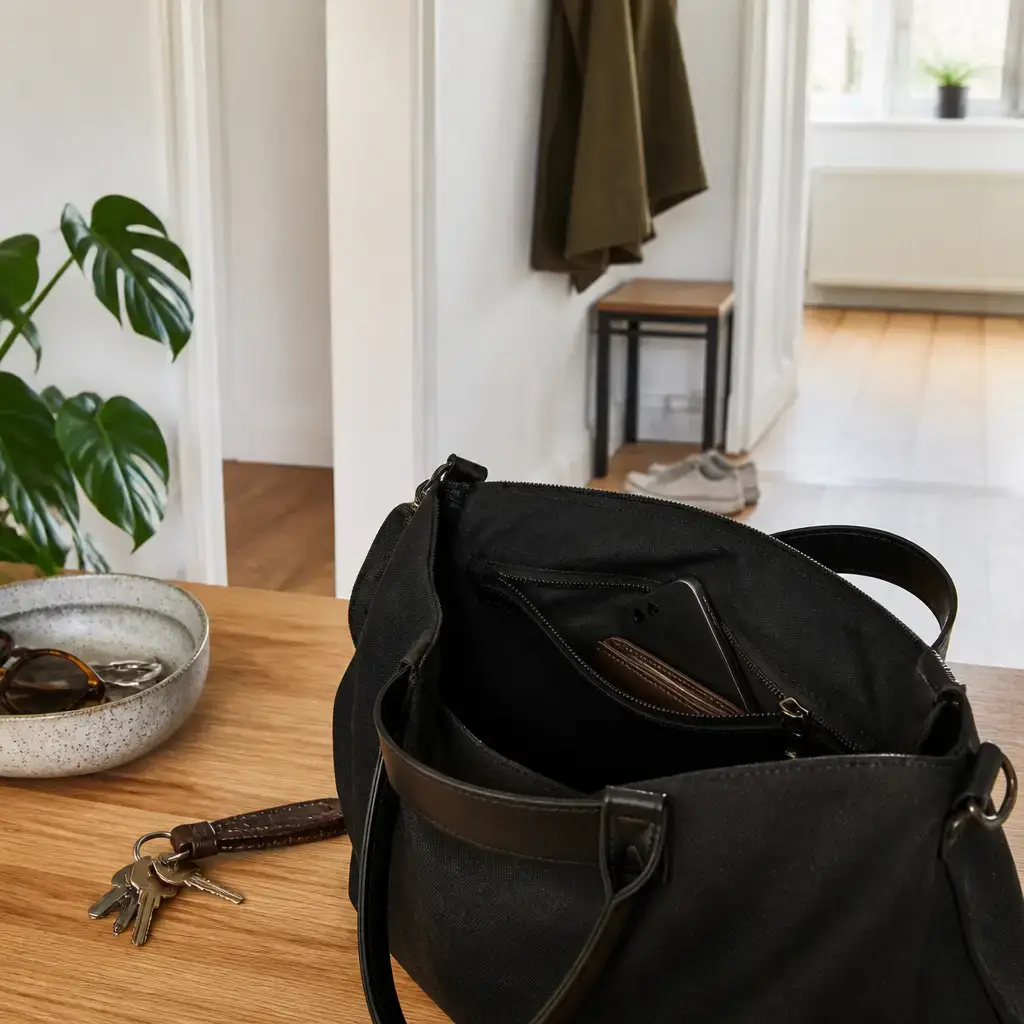
Use Keeping Valuables Safe in a Bag to practice Danish conversation, pronunciation, vocabulary, grammar, and quizzes.
Dialogue
Hvor skal jeg lægge min pung?
voh skal yai LEH-guh men POONG? Where should I put my wallet?Læg den i inderlommen.
LEH den ee EN-uh-lom-un. Keep it in the inside pocket.Er forlommen sikker?
air FOH-lom-un SEK-uh? Is the front pocket safe?Inderlommen er mere sikker.
EN-uh-lom-un air MAY-uh SEK-uh. The inside one is safer.Jeg kan lukke lynlåsen.
yai kan LOH-guh LEWN-lohs-un. I can close the zipper.Så burde den være i sikkerhed.
soh BOO-uh-duh den VAIR ee SEK-uh-hayth. That should keep it secure.Min telefon er også derinde.
men teh-leh-FOHN air AW-suh der-IN-uh. My phone is in there too.Tjek lommen, før du går.
chek LOM-un, fuh doo GOH. Check the pocket before you go.Sentence explanations
Hvor skal jeg lægge min pung?
Where should I put my wallet?
- Hvor
- where
- skal jeg
- should I
- lægge
- put
- min
- my
- pung
- wallet
More detail
Hvor means “where” and asks about a place. It normally introduces a place question: Hvor er ...? means “Where is ...?”, while here it asks for the place to which something should be put. skal jeg combines skal, the present form of skulle, with jeg, “I.” In this sentence, skal expresses what is advisable or expected, so the intended meaning is “should I.” Danish questions commonly place the verb before the subject: Skal jeg ...? means “Should I ...?” With Hvor at the front, the same order remains: Hvor skal jeg ...? lægge is the infinitive of lægge, “to put or lay something somewhere.” After the modal skal, the following verb is in the infinitive and appears without at: Jeg skal lægge ... means “I should put ...”. A useful contrast is lægge for placing something, versus ligge for something being or lying in a place. Example: Jeg lægger bogen på bordet. — “I put the book on the table.” min means “my” before a singular common-gender noun. Its form agrees with the noun it determines, not with the speaker: min pung uses min, while a neuter singular noun uses mit, as in mit .... Plural nouns use mine. pung means “wallet.” It is a common-gender noun: en pung means “a wallet,” and the definite form is pungen, “the wallet.” In this utterance, min pung is “my wallet”; min identifies possession and pung names the object. Together, Hvor skal jeg lægge min pung? asks for the appropriate place for the speaker to put their wallet: “Where should I put my wallet?” This is a natural everyday question when requesting placement instructions.
Læg den i inderlommen.
Keep it in the inside pocket.
- Læg
- put; keep
- den
- it
- i
- in
- inderlommen
- inside pocket
More detail
Læg is the imperative of lægge, “to put/place.” The imperative gives a direct instruction and normally has the same form as the verb stem here: lægge → læg. Do not confuse it with ligge (“to lie/be situated”): Læg bogen her means “Put the book here,” while Bogen ligger her means “The book is here.” den means “it” here and is the object of læg. In Danish, den is the singular pronoun used with a common-gender referent; the supplied translation identifies the intended object simply as “it,” while the preceding context makes a wallet the relevant item. Its form is not an imperative or a marker of location. i is the preposition “in.” It introduces the place where the object is to remain. For example, Læg nøglen i skuffen means “Put the key in the drawer.” inderlommen means “the inside pocket.” It is the definite form of inderlomme (“inside pocket”): inderlomme → inderlommen. The ending -en marks definiteness for this common-gender noun. The compound combines inder- (“inner/inside”) with lomme (“pocket”); the noun’s definite ending appears at the end of the whole compound. The context contrasts this pocket with forlommen, “the front pocket.” Together, Læg den means “put it,” and i inderlommen specifies the destination, “in the inside pocket.” The complete instruction is therefore: “Keep it in the inside pocket.”
Er forlommen sikker?
Is the front pocket safe?
- Er
- is
- forlommen
- the front pocket
- sikker
- safe
More detail
Er is the present-tense form of Danish at være (“to be”). In this question it comes before the subject noun, forming a yes/no question: Er ...? = “Is ...?” The form er does not show whether the subject is singular or plural; the surrounding noun or pronoun supplies that information. forlommen means “the front pocket” here. It is a compound noun: forlomme means “front pocket”, and the final -en marks the singular definite form, “the front pocket”. Danish commonly places the definite marker at the end of the noun rather than using a separate word corresponding to “the”. The related context word inderlommen means “the inside pocket”; its base form is inderlomme, with the same definite ending -en. sikker means “safe” in this sentence. It is the basic form of the adjective. In the following context, mere sikker means “safer”: mere marks comparison, while sikker itself remains in its basic form. Thus sikker and mere sikker are not two different forms of the noun; the adjective is sikker. Together, Er + forlommen + sikker forms the yes/no question “Is the front pocket safe?” The question asks about the safety of the front pocket; it does not itself state that the pocket is safe or unsafe.
Inderlommen er mere sikker.
The inside one is safer.
- Inderlommen
- the inside pocket
- mere sikker
- safer
More detail
Inderlommen means “the inside pocket” here. It is the definite singular form of inderlomme, a compound meaning “inside pocket”: lomme means “pocket,” and the ending -en marks a common-gender noun as definite singular. The definite form presents one identifiable pocket, rather than an unspecified pocket. Example: En lomme means “a pocket,” while lommen means “the pocket.” mere sikker means “safer.” Sikker is the base adjective “safe,” and mere forms this comparative expression: mere sikker = “safer.” The comparison is understood relative to another option, here the front pocket mentioned in the bounded context. Danish also has the compact comparative sikrere, but the observed form is mere sikker; do not replace the source form when quoting it. Example: Denne vej er mere sikker. — “This way is safer.” Er is the present-tense form of være, “to be.” In this statement it links the subject to its property: Inderlommen er ... means “The inside pocket is ...”. Together, Inderlommen er mere sikker. means “The inside pocket is safer.” The definite subject is identified as the inside pocket, and the comparative adjective describes it as safer than the relevant alternative.
Jeg kan lukke lynlåsen.
I can close the zipper.
- Jeg kan
- I can
- lukke
- close
- lynlåsen
- the zipper
More detail
Jeg kan combines the first-person pronoun jeg (“I”) with kan, the present-tense form of kunne (“can; be able to”). Danish modal verbs such as kan are followed directly by an infinitive, without at: Jeg kan lukke means “I can close.” The form kan is used here with jeg; it does not itself show a separate past-time meaning. For example: Jeg kan svømme. — “I can swim.” lukke is the infinitive “to close.” After kan, it names the action the speaker is able to perform. The same form can be used after other modal verbs, for example: Jeg vil lukke døren. — “I want to close the door.” Here lukke is not marked for person; the modal construction carries the finite verb function. lynlåsen means “the zipper.” It is the definite singular form of lynlås (“zipper”): en lynlås means “a zipper,” while lynlåsen means “the zipper.” The ending -en marks definiteness for this noun; it does not indicate that the noun is plural. For example: Lynlåsen er åben. — “The zipper is open.” Together, Jeg kan + lukke + lynlåsen produces the meaning “I can close the zipper.” The speaker presents closing the specifically identified zipper as an action they are able to perform.
Så burde den være i sikkerhed.
That should keep it secure.
- Så
- so
- burde den
- it should
- være
- be
- i sikkerhed
- safe; secure
More detail
Så means “so” or “then” here. It links the utterance to the preceding action: closing the zipper is presented as leading to the expected result. In other contexts, så can have other functions, but this sentence uses it as a connector. burde den contains the modal burde and the pronoun den. Burde is the past form associated with bør (“should; ought to”), but it does not necessarily place this situation in the past. Here it expresses an expectation or likely result: “should.” Danish modals such as burde are followed by an infinitive without at, as in burde være (“should be”). Den is a singular common-gender pronoun. Its grammatical form does not identify the object by itself; in this fixed meaning, the translation establishes the intended referent as “it.” være is the infinitive of “to be.” After burde, it gives the expected state: burde være = “should be.” Compare the reusable pattern burde + infinitive, for example: Det burde virke. — “It should work.” i sikkerhed is a fixed phrase meaning “safe” or “secure,” literally presenting something as being “in safety.” It describes the resulting protected state; it is not the noun sikkerhed alone functioning as an ordinary object here. Together, Så introduces the expected consequence, burde marks that consequence as likely or warranted, den supplies the singular “it,” and være i sikkerhed describes its state. The whole utterance therefore means “So/then it should be safe” and, in the fixed translation’s result-oriented wording, “That should keep it secure.”
Min telefon er også derinde.
My phone is in there too.
- Min
- my
- telefon
- phone
- er
- is
- også
- also; too
- derinde
- in there
More detail
Min means “my” here and agrees with the singular common-gender noun telefon. Danish possessive forms include min with a common-gender singular noun, mit with a neuter singular noun, and mine with a plural noun: min telefon, mit hus, mine bøger. The possessive marks the phone as belonging to the speaker; it does not by itself say who is holding or using it. telefon is the noun “phone.” Its definite form is telefonen (“the phone”), while the indefinite form seen here is telefon. Danish nouns commonly show definiteness through an ending rather than a separate word: en telefon means “a phone,” and telefonen means “the phone.” er is the present-tense form of være, “to be.” The same form is used with different subjects in the present: jeg er (“I am”), du er (“you are”), and den er (“it is”). In this sentence, er links Min telefon to its location. også means “also” or “too.” It adds the information that the phone is in that place as well, without changing the basic location expressed by the rest of the sentence. Its position can vary for emphasis, but in this utterance it comes after er and before the location word. derinde means “in there.” It is a locative adverb referring to an interior place indicated by the situation; the supplied translation supports this “in there” reading. A useful contrast is herinde, “in here,” which points toward the speaker’s current interior location rather than the more distant or otherwise indicated place in derinde. Together, Min telefon is the subject, er says that it is located somewhere, også adds “too,” and derinde supplies the location. The whole utterance therefore means “My phone is in there too.”
Tjek lommen, før du går.
Check the pocket before you go.
- Tjek
- check
- lommen
- the pocket
- før
- before
- går
- go
More detail
Tjek is the imperative of tjekke, “to check.” The imperative gives a direct instruction and normally has no written subject. Example: Tjek døren. — “Check the door.” lommen means “the pocket” here. It is the definite singular form of lomme (“pocket”): en lomme = “a pocket,” lommen = “the pocket.” The definite form identifies a particular pocket, supported here by the context about something being inside it. før introduces a time relation meaning “before.” It connects the checking action with the later action in the subordinate clause. A reusable pattern is før + clause: Vask hænderne, før du spiser. — “Wash your hands before you eat.” går is the present-tense form of gå, “to go” or “to walk.” With du, it means “you go” here. The present form can also describe an action happening now or a scheduled/expected action, but the fixed sentence uses it for the action that is to happen after the checking. Example: Du går hjem. — “You go home.” du is the second-person singular subject pronoun, “you.” In før du går, it is the subject of går; the same person is understood as the addressee of the imperative Tjek. Together, Tjek lommen means “Check the pocket.” The comma marks the following time clause: før du går means “before you go.” The whole utterance is therefore: “Check the pocket before you go.”
Grammar Points
mere + adjektiv
mere sikker
MAY-uh SEK-uhsafer
Use mere before an adjective to form a comparative, like “safer.”
Danish Vocabulary
- Gender
- common
- Gender
- common
- Gender
- common
The analytic comparative form of sikker.
- Gender
- common
- Gender
- common
Quiz
Word Order
Arrange the words in the correct order.
Where should I put my wallet?
Show Answer
Hvor skal jeg lægge min pung?Keep it in the inside pocket.
Show Answer
Læg den i inderlommen.Is the front pocket safe?
Show Answer
Er forlommen sikker?Spelling
Tap the letters to spell the word.
zipper
Show Answer
lynlåsenput; place
Show Answer
læggefront pocket
Show Answer
forlommensafe; secure