10 minutes free every day
Continue audio lessons in the app
Word explanations appear automatically in sync with the audio.
No login required · synced translations · playback with the screen locked
Choose your learning language and open this lesson in the app.

About This Lesson
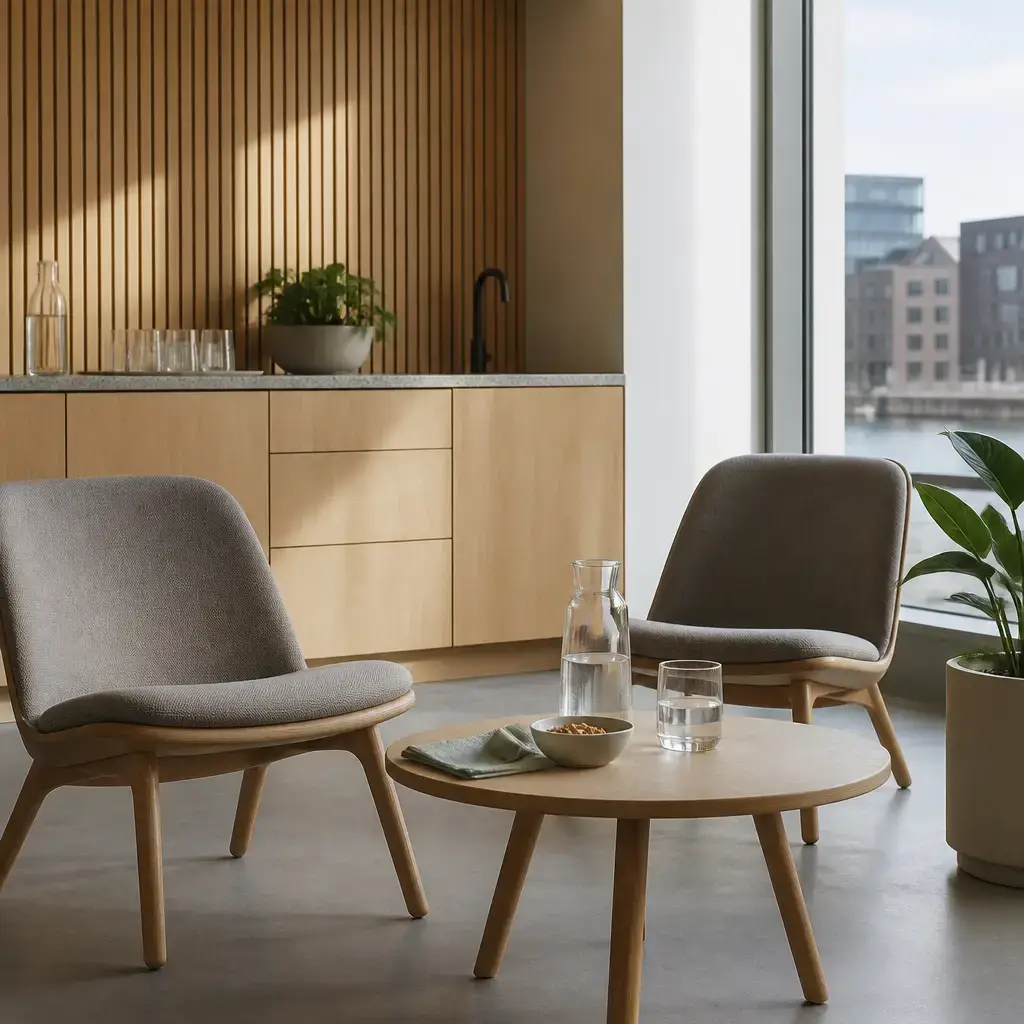
Use Taking a Short Break to practice Danish conversation, pronunciation, vocabulary, grammar, and quizzes.
Dialogue
Jeg føler mig træt.
yai FUR-uh my tryt. I feel tired.Lad os tage en kort pause.
lath ohs TAY-uh en kohd POW-suh. Let's take a short break.Er denne stol ledig?
air DEN-uh stohl LAY-thee? Is this chair free?Du kan sidde her.
doo ken SEH-thuh hair. You can sit here.Jeg har taget en lille snack med til pausen.
yai hah TAY-th en LEE-luh sneg mayth tell POW-sen. I brought a small snack for the break.Jeg henter noget vand.
yai HEN-tuh NOH-th van. I'll get some water.Der er stille her.
dair air STEL-uh hair. This place feels quiet.Så kan vi hvile os her lidt.
soh ken vee VEE-luh ohs hair leth. Then we can rest here for a bit.Sentence explanations
Jeg føler mig træt.
I feel tired.
- Jeg
- I
- føler
- feel
- mig
- myself
- træt
- tired
More detail
Jeg means “I” here: the first-person singular subject, the person who feels tired. Danish subject pronouns include jeg “I,” du “you,” and han/hun “he/she”; jeg itself does not mark the speaker’s gender. føler is the present-tense form of føle, “to feel.” In Danish, this present form is used with different subjects without a person ending: jeg føler “I feel,” du føler “you feel,” and de føler “they feel.” mig is the first-person singular reflexive/oblique pronoun. Together with jeg, it forms the reusable pattern jeg føler mig + adjective, literally “I feel myself + adjective,” used to describe the speaker’s state. The reflexive form must match the subject: for example, Hun føler sig træt means “She feels tired,” while Jeg føler mig træt uses mig because the subject is jeg. træt is the adjective “tired.” In this sentence it describes the speaker’s state after føler mig. A useful contrast is frisk, “fresh” or “well,” as in the example Jeg føler mig frisk. — “I feel well.” The adjective can take other forms in contexts that require them; for example, De føler sig trætte. means “They feel tired,” where trætte agrees with the plural subject. The chunks combine as Jeg + føler mig + træt: “I” + the reflexive feeling construction + “tired.” The complete meaning is “I feel tired.”
Lad os tage en kort pause.
Let's take a short break.
- Lad os
- let's
- tage
- take
- kort
- short
- pause
- break
More detail
Lad os is the Danish pattern for suggesting a shared action: “let’s …”. Lad is the imperative of lade (“let” or “allow”), and os means “us.” In this construction, the following verb names the proposed action. Example: Lad os gå. — “Let’s go.” tage means “take” here. It is the infinitive form of tage; after lad os, Danish uses the infinitive to state what the group is invited to do. The same verb can have other context-dependent meanings, but here it refers to taking a break. kort means “short.” It is the basic form of the adjective, modifying pause. Danish adjectives can change form according to the noun phrase, so this form should be learned together with its relevant noun context rather than treated as an unchanging English-style form. Example: en kort tur — “a short trip.” pause means “break,” in the sense of a period of rest or interruption. It is a common noun; en before it marks an indefinite singular noun phrase, corresponding here to “a break.” Example: Vi tager en pause. — “We are taking a break.” Together, Lad os introduces the suggestion, tage supplies the proposed action, and en kort pause is what is to be taken. The whole utterance therefore means: “Let’s take a short break.”
Er denne stol ledig?
Is this chair free?
- Er
- is
- denne
- this
- stol
- chair
- ledig
- free; available
More detail
Er is the present-tense form of Danish være (“to be”). It is used here as the copula linking the chair with its description. In a yes/no question, Danish commonly places the finite verb before the subject: Er ...? rather than the statement order ... er .... denne means “this” and points to one nearby or contextually identified singular item. It agrees with the noun’s gender pattern: denne stol is the common-gender singular form. For a neuter singular noun, the corresponding form is dette; for plural, use disse. stol means “chair.” Its indefinite form is en stol (“a chair”), while the definite form is stolen (“the chair”). The noun itself is the subject of the question, even though it follows Er because of question word order. ledig means “available” here: the chair is not occupied and can be used. This is the common-gender singular form of the adjective. The neuter singular form is ledigt, and the plural form is ledige; for example, to stole er ledige means “two chairs are available.” Together, Er + denne stol + ledig forms a yes/no question: “Is this chair available?” The fixed translation’s “free” has the intended sense “available,” not a statement about price or cost.
Du kan sidde her.
You can sit here.
- Du kan
- you can
- sidde
- sit
- her
- here
More detail
Du kan means “you can” here. Du is the second-person pronoun; Danish uses the same form for one person and for more than one person. kan is the present form of kunne, a modal verb meaning “can” in the sense of ability or permission. A modal is followed by an infinitive: Du kan læse means “You can read.” sidde means “sit” or “be seated.” It is the infinitive used after kan. Compare the related but different form sætte sig, “sit down,” which focuses on moving into a seated position. Example: Jeg sidder her. — “I am sitting here.” her means “here,” referring to the place relevant in the situation. It is an invariable location word, so it does not change for the person or number of the person sitting. Example: Bogen er her. — “The book is here.” Together, Du kan + sidde + her gives “You can sit here.” The modal expresses permission or possibility, sidde describes the action or seated state, and her specifies the location. The sentence is a neutral, reusable way to allow or indicate that someone may sit in the place being indicated.
Jeg har taget en lille snack med til pausen.
I brought a small snack for the break.
- Jeg
- I
- har taget
- have taken
- lille
- small
- snack
- snack
- med
- along
- til
- for
- pausen
- the break
More detail
Jeg means “I” here. It is the first-person singular subject pronoun: the speaker is the person who brought the snack. Compare du (“you,” singular) in Du kan sidde her. har taget consists of har, the present form of have, and taget, the past participle of tage (“to take”). On its own, this combination means “have taken.” With the following med, tage med means “take or bring along,” so the complete verb phrase is naturally translated here as “have brought.” A reusable pattern is Jeg har + past participle, meaning “I have …”. Example: Jeg har læst bogen. — “I have read the book.” lille describes the snack as small. It is the singular form used before the indefinite common-gender noun snack. Danish also uses lille before a singular neuter noun, as in et lille hus (“a small house”); the plural form is små, as in små huse (“small houses”). snack is the noun for a snack. Its indefinite singular form is en snack, and its definite singular form is snacken (“the snack”). Here, snack is indefinite, so the sentence presents a snack without using the definite form. med means “along” in this use. Together with tage, it forms tage med, “take or bring along.” Example: Tag en paraply med. — “Take an umbrella along.” til means “for” here and introduces the occasion for which the snack was brought. In other contexts, til can also express direction or destination. pausen means “the break.” It is the definite singular form of pause (“break”): en pause means “a break,” while pausen means “the break.” The ending -en marks the definite common-gender singular form. Together, Jeg har taget ... med means “I have brought ... along,” en lille snack means “a small snack,” and til pausen means “for the break.” The complete meaning is: “I brought a small snack for the break.”
Jeg henter noget vand.
I'll get some water.
- Jeg
- I
- henter
- get
- noget
- some
- vand
- water
More detail
Jeg means “I” here and is the first-person singular subject pronoun: the speaker is the person who will get the water. Danish uses jeg for this subject regardless of the speaker’s gender. For example, Jeg kommer. means “I’m coming.” henter is the present-tense form of hente, “to get, fetch, or pick up.” In this utterance, the present form refers to a planned or imminent action, so the fixed translation naturally uses “I’ll get.” The verb form does not show the subject’s person or number; jeg henter, du henter, and de henter all use henter. For example, Jeg henter kaffen. means “I’ll get the coffee.” noget means “some” before the mass noun vand. It indicates an unspecified amount, not a stated numeric quantity. Danish also uses noget as an indefinite pronoun in other contexts, but here it functions as a quantity word modifying the following noun. For example, Jeg vil have noget te. means “I would like some tea.” vand means “water.” It is a mass noun here, so the sentence refers to an unspecified amount rather than separate countable units. The word’s basic form is vand; a specified unit can instead be named when needed, as in the example et glas vand, “a glass of water.” Together, Jeg henter gives “I’ll get,” noget specifies an unspecified amount, and vand identifies what will be fetched. The complete utterance therefore means “I’ll get some water.”
Der er stille her.
This place feels quiet.
- Der er
- there is / there are
- stille
- quiet
- her
- here
More detail
Der er is the Danish existential pattern “there is/are.” In this pattern, der is a grammatical placeholder rather than a clearly identified place or person, and er is the present-tense form of at være (“to be”). The pattern can introduce what exists or is present: Der er en stol her. — “There is a chair here.” stille means “quiet” in this sentence. It is an adjective used predicatively after er, describing the situation or surroundings. The form stille does not show a separate singular/plural distinction here. Its comparative is stillere (“quieter”), and its superlative is stillest (“quietest”): Her er stillere. — “It is quieter here.” her is an adverb meaning “here,” indicating the place associated with the utterance. It does not change for number or gender. A useful contrast is her (“here”) and der (“there”): Vi hviler her. — “We rest here.” Together, Der er stille her uses the existential pattern Der er to present a quiet situation and places it with her: “This place feels quiet.” The translation expresses the intended overall meaning naturally; the Danish sentence literally describes that it is quiet here.
Så kan vi hvile os her lidt.
Then we can rest here for a bit.
- Så
- then
- kan vi
- we can
- hvile
- rest
- os
- ourselves
- her
- here
- lidt
- a little
More detail
Så means “then” here: it links this suggestion or possibility to what has just been established. Danish så can also mean “so” in other contexts, but “then” is the intended meaning in this utterance. kan vi combines kan, the present-tense form of kunne (“can; be able to”), with vi, the first-person plural pronoun (“we”). Kan expresses possibility or ability; it is followed by an infinitive. Example: Vi kan vente. — “We can wait.” hvile is the infinitive “to rest.” After the modal kan, Danish uses the infinitive without an infinitive marker: kan hvile means “can rest.” The form does not mark who rests; the subject vi supplies “we.” os is the first-person plural reflexive pronoun, referring back to vi. Together, hvile os is the reusable Danish pattern for “rest” when the people resting are the same as the subject. Example: De kan hvile sig. — “They can rest.” Here sig is the reflexive form used with a third-person subject, while os is used with vi. her means “here,” marking the place of the resting. Example: Vi bliver her. — “We are staying here.” lidt means “a little” in this utterance and softens the duration: the resting is for a short while. In this use it functions adverbially, so it does not assert a quantity of an object. Example: Vent lidt. — “Wait a little.” Taken together, Så + kan vi introduces a possibility, hvile os says that we rest ourselves, her gives the place, and lidt gives the brief duration. The complete meaning is: “Then we can rest here for a bit.”
Grammar Points
hvile sig → hvile os
Vi kan hvile os lidt.
vee ken VEE-luh ohs leth.We can rest a little.
hvile sig is reflexive: the pronoun changes with the subject, so sig becomes os with vi.
denne + noun
Denne stol er ledig.
DEN-uh stohl air LAY-thee.This chair is free.
denne comes before a common-gender noun such as stol.
Danish Vocabulary
Er denne stol ledig?
Jeg føler mig træt.
Jeg henter noget vand.
Lad os tage en kort pause.
Er denne stol ledig?
Jeg har taget en lille snack med til pausen.
- Gender
- common
Jeg har taget en lille snack med til pausen.
Du kan sidde her.
- Gender
- common
Jeg har taget en lille snack med til pausen.
- Gender
- common
Er denne stol ledig?
Lad os tage en kort pause.
Jeg føler mig træt.
Quiz
Word Order
Arrange the words in the correct order.
I feel tired.
Show Answer
Jeg føler mig træt.Let's take a short break.
Show Answer
Lad os tage en kort pause.Is this chair free?
Show Answer
Er denne stol ledig?Spelling
Tap the letters to spell the word.
feel
Show Answer
følershort
Show Answer
kortfree
Show Answer
ledigthis