10 minutes free every day
Continue audio lessons in the app
Word explanations appear automatically in sync with the audio.
No login required · synced translations · playback with the screen locked
Choose your learning language and open this lesson in the app.

About This Lesson
Use A short break for fresh air to practice Danish conversation, pronunciation, vocabulary, grammar, and quizzes.
Dialogue
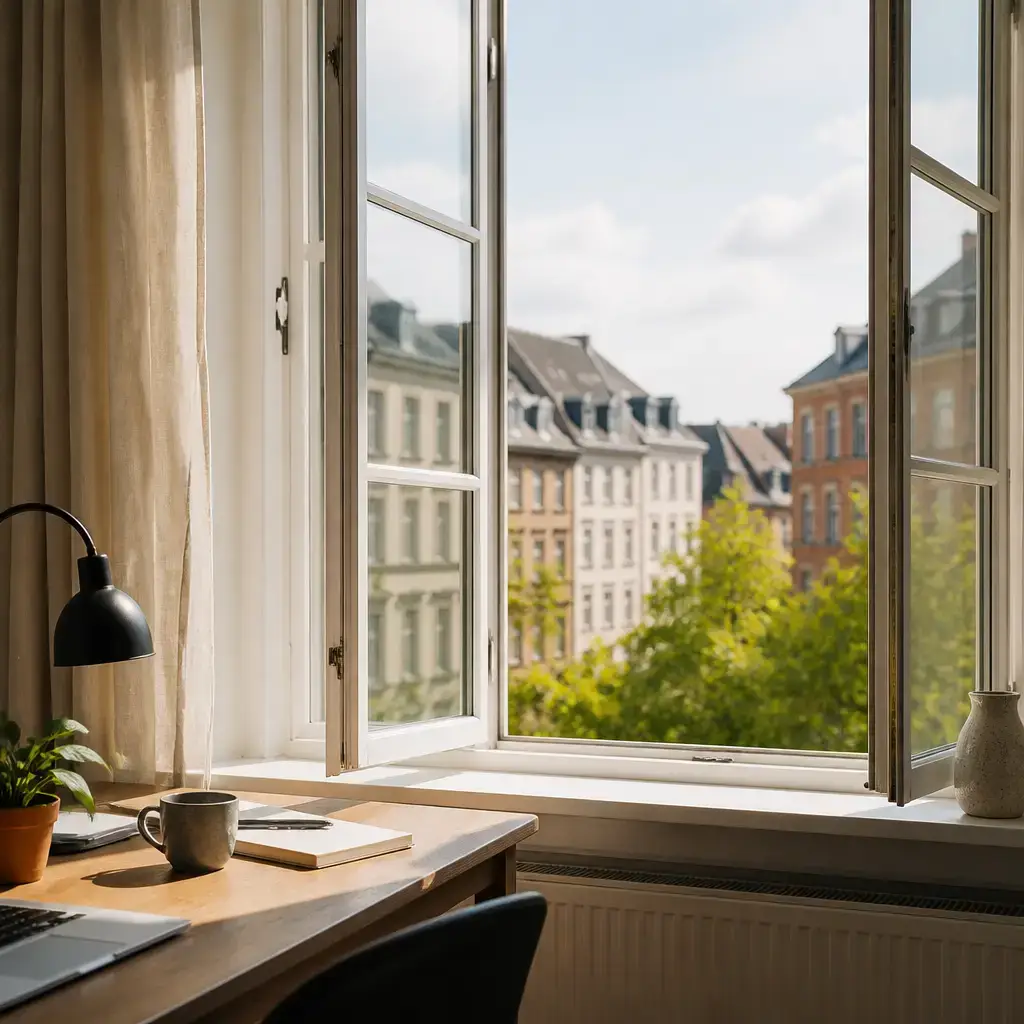
Jeg føler mig træt ved mit skrivebord.
yai FUH-luh my TREHT vay mid SGREE-vuh-bor. I feel tired at my desk.Lad os åbne vinduet et øjeblik.
lah ohs OHB-nuh VIN-uhth ed UR-yuh-bleek. Let's open the window for a moment.Jeg har brug for lidt frisk luft.
yai haw BROO for lid FRESK LOFD. I need some fresh air.Luften udenfor føles kølig.
LOFD-un OO-thun-for FUH-luhs KUH-lee. The air outside feels cool.Kan vi hvile os ved vinduet?
kan vee VEE-luh ohs vay VIN-uhth? Can we rest by the window?Vi kan holde en kort pause her.
vee kan HOL-uh un KORD POW-suh hair. We can take a short break here.Jeg føler mig mindre træt nu.
yai FUH-luh my MEN-druh TREHT noo. I feel less tired now.Lad os snart gå tilbage på arbejde.
lah ohs snart goh tuh-BYE-luh poh AH-bye-duh. Let's go back to work soon.Sentence explanations
Jeg føler mig træt ved mit skrivebord.
I feel tired at my desk.
- Jeg
- I
- føler mig
- feel
- træt
- tired
- ved
- at; by
- mit
- my
- skrivebord
- desk
More detail
Jeg is the first-person singular subject pronoun, “I.” It identifies the speaker as the person experiencing the state. A reusable contrast is jeg “I” versus du “you,” but the form in this sentence is specifically jeg. føler mig expresses “feel” in this sentence. føler is the present-tense form of føle “to feel,” and mig is the first-person singular reflexive pronoun, referring back to jeg. Together, jeg føler mig + adjective is a useful pattern for describing how the speaker feels: Jeg føler mig rolig. — “I feel calm.” The reflexive pronoun changes with the experiencer: for example, Hun føler sig træt. — “She feels tired.” træt means “tired” here. It is an adjective describing the speaker’s state, placed after the reflexive feeling construction. Its basic form is træt; a useful comparison is mere træt “more tired.” Example: Jeg er træt. — “I am tired.” ved means “at” here, introducing the location of the desk. It is a location word, not part of the feeling expression itself. Example: Hun sidder ved døren. — “She is sitting by the door.” mit means “my” before the noun skrivebord. Danish possessive forms include min with common-gender singular nouns, mit with neuter singular nouns, and mine with plural nouns. Skrivebord is neuter singular, as shown by et skrivebord, so the matching possessive is mit. skrivebord means “desk.” It is a noun that can also refer to a writing or work desk. In the compound, skrive relates to “write” and bord means “table,” but the full word is the ordinary noun for a desk; it should be learned as skrivebord. Together, Jeg føler mig træt means “I feel tired,” and ved mit skrivebord adds the location “at my desk.” The complete utterance therefore means “I feel tired at my desk.”
Lad os åbne vinduet et øjeblik.
Let's open the window for a moment.
- Lad os
- let's
- åbne
- open
- vinduet
- the window
- et øjeblik
- for a moment
More detail
Lad os is the Danish construction for a suggestion involving the speaker and at least one other person: “let’s.” Lad is the imperative of lade (“let”); with os (“us”), it introduces the action that follows. The suggestion is not expressed with a separate Danish word meaning “we should” here. åbne means “to open.” In this construction it is the infinitive after Lad os, so the pattern is Lad os + infinitive: Lad os vente. — “Let’s wait.” The form åbne is also used as the infinitive in other contexts; for example, Jeg vil åbne døren. means “I will open the door.” vinduet means “the window” here. Its base form is vindue (“window”), and vinduet is the singular definite form, formed with the ending -t. The ending belongs to the noun, not to åbne. An indefinite singular form is et vindue (“a window”), while vinduet refers to a specific window in the situation. et øjeblik means “a moment.” In this sentence, the phrase expresses a short duration: “for a moment.” Øjeblik is a neuter noun, which is why the indefinite article is et; the article does not by itself assert a numerical count here. The same noun can occur in et øjeblik (“a moment”) and in the definite form øjeblikket (“the moment”). Together, Lad os åbne vinduet gives the suggestion “Let’s open the window,” and et øjeblik limits the action to a brief time. The complete utterance therefore means: “Let’s open the window for a moment.”
Jeg har brug for lidt frisk luft.
I need some fresh air.
- Jeg
- I
- har brug for
- need
- lidt
- some; a little
- frisk
- fresh
- luft
- air
More detail
Jeg means “I” here, the first-person singular subject pronoun. It identifies the speaker as the person who needs something. In Danish, the subject pronoun does not change because the following noun is singular or plural. har brug for is a fixed construction meaning “need” or “have need for.” Its literal parts are har (“have”), brug (“use” or “need”), and for (“for”), but learners should reuse the whole pattern rather than translate each part separately. The same construction can take a noun phrase or a pronoun: Jeg har brug for hjælp. — “I need help.” lidt means “some” or “a little” when referring to an uncountable amount. It presents the amount as limited without specifying an exact quantity. Compare lidt vand (“a little water”) with mange flasker (“many bottles”), where the latter refers to countable items. frisk is the adjective “fresh.” In this sentence it describes luft, giving the phrase the meaning “fresh air.” The adjective is in its basic form here; Danish adjectives can take other forms in other noun phrases, so this form should not be treated as an English-style fixed ending. luft means “air.” Here it is a mass noun, so no exact number of separate items is asserted. Danish can use a bare noun in a phrase such as frisk luft when talking about air as a substance. Example: Vi åbner vinduet for frisk luft. — “We are opening the window for fresh air.” Together, Jeg har brug for (“I need”) + lidt frisk luft (“some fresh air”) produces the complete meaning: “I need some fresh air.” The utterance states the speaker’s present need, without specifying how much air or describing a particular piece of air.
Luften udenfor føles kølig.
The air outside feels cool.
- Luften
- the air
- udenfor
- outside
- føles
- feels
- kølig
- cool
More detail
Luften is the definite form of luft (“air”): luft = air, luften = the air. The ending -en marks a definite singular noun here; it does not mean “one air.” Example: Luften er frisk. — “The air is fresh.” udenfor is an adverb meaning “outside.” It specifies where the air is located: the air outside. It can also stand independently, as in Det er koldt udenfor. — “It is cold outside.” føles is the present-tense form of føle (“to feel”). With a thing as subject, føles describes how that thing feels to someone: Stolen føles hård. — “The chair feels hard.” This is different from føler, which normally means that a person or other experiencer feels something: Jeg føler kulden. — “I feel the cold.” kølig means “cool” in the sense of slightly cold or pleasantly cool. It is an adjective used here after føles to describe the air. Its basic form is kølig; related forms include køligt with a neuter singular noun and kølige with a plural or definite noun, for example et køligt rum (“a cool room”) and de kølige rum (“the cool rooms”). Kold means “cold” and is generally stronger than kølig. Together, Luften udenfor means “the air outside,” føles says how that air is experienced, and kølig supplies the description. The complete utterance therefore means: “The air outside feels cool.”
Kan vi hvile os ved vinduet?
Can we rest by the window?
- Kan vi
- can we
- hvile os
- rest
- ved
- by; near
- vinduet
- the window
More detail
Kan vi is the question opening “can we”. kan is the present-tense form of kunne, “can / be able to”; it does not change for the subject: jeg kan, vi kan. vi means “we” and is the subject here. In a question, the verb comes before the subject: Kan vi ...? Compare the statement Vi kan ... (“We can ...”). hvile os means “rest”. hvile is the infinitive “to rest”. os is the reflexive object form used with a first-person plural subject, so vi ... os expresses that the group rests itself or takes rest. The same pattern can be reused with other verbs, for example Vi sætter os — “We sit down,” literally using os for the group. ved is a preposition meaning “by” or “near” in this location pattern. It introduces the place associated with the resting: ved vinduet means “by the window”. vinduet means “the window”. Its base form is vindue (“window”), and the ending -t marks the definite singular form: et vindue (“a window”) becomes vinduet (“the window”). The form of the definite ending depends on the noun’s grammatical gender and number; here vindue is a neuter singular noun. Together, Kan vi + hvile os + ved vinduet produces the question “Can we rest by the window?” It asks whether the group is able or permitted to rest in that location, without stating that they actually do so.
Vi kan holde en kort pause her.
We can take a short break here.
- Vi kan
- we can
- holde
- take; hold
- kort
- short
- pause
- break
- her
- here
More detail
Vi kan means “we can” here. Vi is the first-person plural pronoun “we”; unlike singular jeg (“I”), it refers to more than one speaker or participant. Kan is the present-tense form of kunne (“can, be able to”) and does not change for person or number: jeg kan, du kan, and vi kan all use kan. A modal such as kan is followed by an infinitive without at: Vi kan hvile means “We can rest.” holde is the infinitive of holde. Its basic meanings include “hold” and, in combinations such as holde en pause, “take a break.” The meaning here is the established combination, not simply physically holding something. After kan, the infinitive is used: Vi kan holde en pause — “We can take a break.” kort means “short” in this sentence and describes the length or duration of pause. It is the common-gender singular form used with en pause; the neuter form is kort as well, while plural and definite forms can be korte, as in korte pauser (“short breaks”) and den korte pause (“the short break”). The adjective agrees with the noun phrase rather than with kan or holde. pause is the noun “break,” specifically a period of stopping an activity or resting. It is an en noun: en pause is “a break,” and its definite form is pausen, “the break.” Example: Vi tager en pause. — “We take a break.” her is the place adverb “here.” It points to the relevant location in the current situation; the sentence does not specify that location further. Example: Vi kan sidde her. — “We can sit here.” Together, Vi kan holde gives “we can take,” en kort pause gives “a short break,” and her adds the location “here.” The complete utterance therefore means “We can take a short break here.”
Jeg føler mig mindre træt nu.
I feel less tired now.
- Jeg
- I
- føler
- feel
- mig
- myself
- mindre
- less
- træt
- tired
- nu
- now
More detail
Jeg is the Danish first-person singular subject pronoun: “I.” It is used for the person experiencing or doing something. For example, Jeg arbejder. means “I work.” føler is the present-tense form of føle, “to feel.” In this sentence it describes the speaker’s current state. Danish present tense commonly uses the same form for different subjects, so føler does not show a separate first-person ending here. mig is the first-person singular object/reflexive pronoun, “me/myself.” With Jeg føler mig ..., the subject and the person experiencing the state are the same: “I feel ...” A useful contrast is Jeg føler ham. — “I feel him,” where ham refers to someone else. mindre means “less” here. It is the comparative form related to lidt, “little/a little,” and contrasts with mere, “more.” It can modify an adjective or another description: Jeg er mindre træt. means “I am less tired.” træt is the adjective “tired.” In føler mig træt, it describes the speaker’s state. The form træt is used here after mig; Danish adjective forms can change in other environments, for example et træt barn (“a tired child”) and trætte børn (“tired children”). nu means “now,” locating the feeling at the present time. It can also appear elsewhere in a Danish sentence, but here it comes at the end and specifies when the speaker feels less tired. Together, Jeg føler mig gives “I feel,” mindre træt gives “less tired,” and nu adds “now.” The complete meaning is “I feel less tired now.”
Lad os snart gå tilbage på arbejde.
Let's go back to work soon.
- Lad os
- let’s
- snart
- soon
- gå tilbage
- go back
- arbejde
- work
More detail
Lad os is the Danish way to make a suggestion meaning “let’s …”. Literally, it contains the imperative lad of lade (“let/allow”) and the pronoun os (“us”), but together they introduce an action for the speaker and others. The following verb remains in the infinitive: Lad os vente. — “Let’s wait.” snart means “soon”, placing the suggested action in the near future. It is an adverb and does not change form. For example, Vi ses snart. means “See you soon.” gå tilbage means “go back” or “return”. gå is the infinitive of “to go”; its present form is går, as in Vi går tilbage. — “We are going back.” tilbage specifies movement back to an earlier place or situation. The two words form a useful verb-plus-adverb combination here, while gå itself is the word carrying the verb inflection. arbejde means “work”. In på arbejde, it is part of the common expression meaning “at work” or, with movement verbs such as gå, “to work/to the workplace”. arbejde can also be a verb meaning “to work”; as a noun in this expression, it is not marked with an article. For example, Hun er på arbejde. means “She is at work.” Together, Lad os introduces the suggestion, gå tilbage supplies the proposed movement, på arbejde identifies the destination or activity, and snart places it soon: “Let’s go back to work soon.”
Grammar Points
lad os + infinitiv
Lad os åbne vinduet.
lah ohs OHB-nuh VIN-uhth.Let us open the window.
After “lad os”, use the infinitive without “at”. This structure is used to make a suggestion.
Danish Vocabulary
et øjeblik
Jeg føler mig træt.
Jeg har brug for lidt frisk luft.
Lad os åbne vinduet.
Jeg føler mig træt.
- Gender
- neuter
mit skrivebord
Lad os åbne vinduet.
- Gender
- neuter
mit skrivebord
Jeg føler mig træt.
ved mit skrivebord
- Gender
- neuter
åbne vinduet
åbne vinduet
Quiz
Word Order
Arrange the words in the correct order.
Let's open the window for a moment.
Show Answer
Lad os åbne vinduet et øjeblik.The air outside feels cool.
Show Answer
Luften udenfor føles kølig.Can we rest by the window?
Show Answer
Kan vi hvile os ved vinduet?Spelling
Tap the letters to spell the word.
desk
Show Answer
skrivebordto feel
Show Answer
følerto open
Show Answer
åbnetired