10 minutes free every day
Continue audio lessons in the app
Word explanations appear automatically in sync with the audio.
No login required · synced translations · playback with the screen locked
Choose your learning language and open this lesson in the app.

About This Lesson
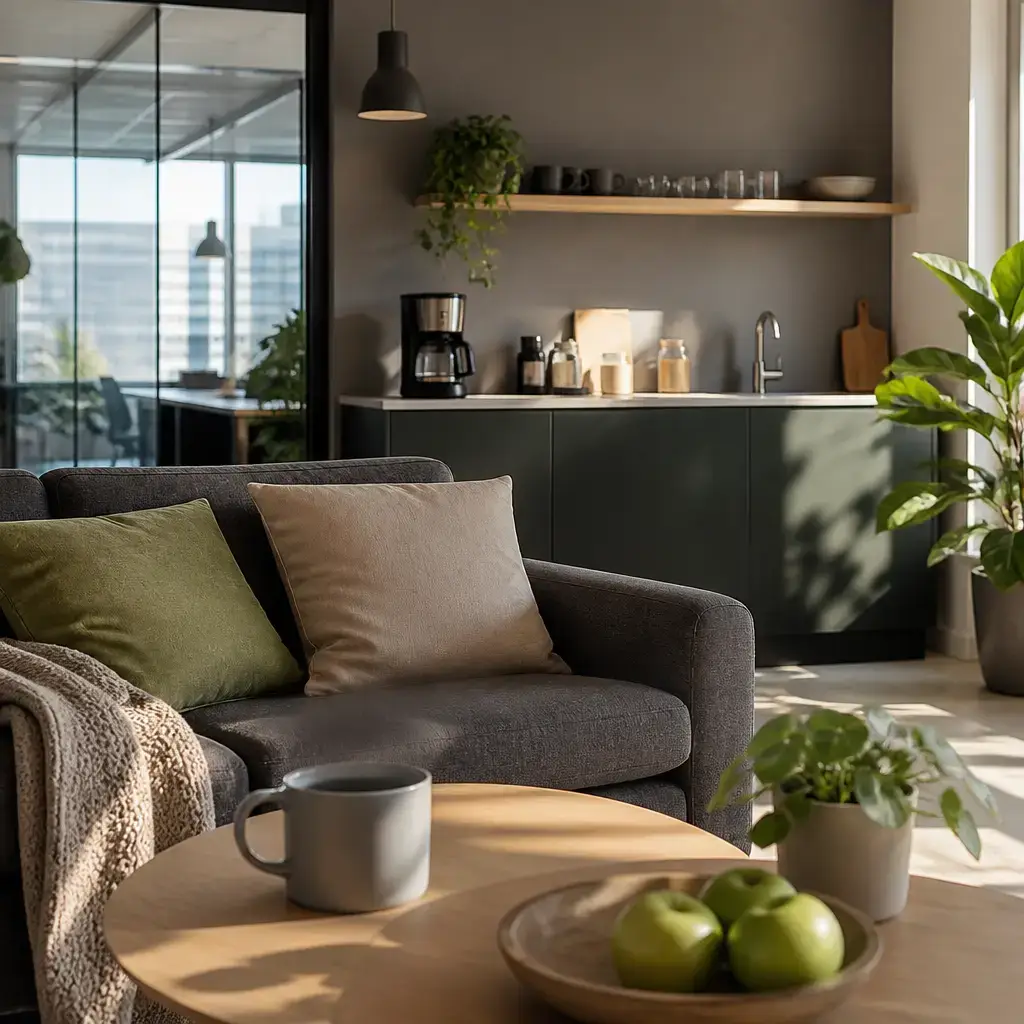
Use Resting on the sofa during a break to practice Danish conversation, pronunciation, vocabulary, grammar, and quizzes.
Dialogue
Jeg har brug for en kort pause.
YAI ha BROO foh en KOHT POW-suh. I need a short break.Lad os sætte os i sofaen.
LAH ohs SED-uh ohs ee SOH-fah-en. Let's sit on the sofa.Må jeg hente noget kaffe?
Moh yai HEN-duh NOH-uh KAH-fuh? Can I get some coffee?Der er kaffe i køkkenet.
DAIR air KAH-fuh ee KUR-guh-neth. There is coffee in the kitchen.Jeg henter noget, efter jeg har strakt mig lidt.
YAI HEN-duh NOH-uh, EF-tuh yai ha STREHGD mai LEHD. I'll get some after I stretch a little.Det hjælper at strække sig, når man er træt.
Deh YEL-puh eh STREH-guh sigh, NOR man air TREH(D). Stretching helps when you feel tired.Dette rum er stille.
DEH-də ROHM air STEE-luh. This room is quiet.Vi kan hvile her lidt.
VEE kan VEE-luh hair LEHD. We can rest here for a while.Sentence explanations
Jeg har brug for en kort pause.
I need a short break.
- Jeg
- I
- har brug for
- need
- en
- a
- kort
- short
- pause
- break
More detail
Jeg means “I” here: it is the first-person singular subject pronoun. It is used when the speaker presents themself as the person who has the need. har brug for is a reusable Danish construction meaning “need” or “have need for.” The form har is the present-tense form of have; the whole construction, rather than har alone, expresses the need. For example: Jeg har brug for hjælp. — “I need help.” en is the indefinite article used here with the singular noun pause. It marks an unspecified pause; it does not by itself assert a numeric count. Danish also has et as the other singular indefinite article, and the choice is determined by the noun’s grammatical gender. kort means “short” in this sentence and describes pause. Its base form is kort; useful comparison forms are kortere “shorter” and kortest “shortest.” In this noun phrase, kort appears before the noun: en kort pause. pause is the noun “break” or “pause.” In this sentence it is singular and indefinite, as shown by en pause. The phrase can be reused with another suitable noun, for example en kort tur — “a short trip.” Together, Jeg har brug for identifies the speaker as the person with the need, and en kort pause identifies what is needed: an unspecified break that is short in duration. The complete utterance therefore means “I need a short break.”
Lad os sætte os i sofaen.
Let's sit on the sofa.
- Lad os
- let's
- sætte os
- sit down
- sofaen
- the sofa
More detail
Lad os is the reusable Danish pattern for making a suggestion: lad os + infinitive means “let’s …”. Here lad is the imperative of lade (“let/allow”), and os means “us”. The pattern does not itself state how many people are present; it presents an action for the speaker and others. Example: Lad os gå. — “Let’s go.” sætte os means “sit down” here. The verb is sætte, while os is the reflexive object referring back to the people included in the suggestion. Danish distinguishes sætte sig (“sit down,” a change of position) from sidde (“be sitting,” a resulting state). With os, the reflexive form is sætte os. Example: Vi sætter os her. — “We sit down here.” sofaen is the noun sofa with the definite ending -en, meaning “the sofa.” The preposition i is separate and expresses the location in the fixed sentence; together, i sofaen is translated here as “on the sofa.” The ending belongs to the noun, not to the preposition. Example: Katten ligger i sofaen. — “The cat is lying on the sofa.” Together, Lad os introduces the suggestion, sætte os names the action, and i sofaen gives its location: “Let’s sit down on the sofa.”
Må jeg hente noget kaffe?
Can I get some coffee?
- Må jeg
- May I…?
- hente
- get
- noget
- some
- kaffe
- coffee
More detail
Må jeg combines må, the present form of måtte, with jeg, “I.” In this question, må asks for permission: “may I…?” A useful reusable pattern is Må jeg + infinitive?, as in Må jeg åbne vinduet? — “May I open the window?” The modal må is followed by the infinitive without at. hente means “get” in the sense of fetching or obtaining something. It is an infinitive, and it remains in this form after må; the form is not marked for the subject here. For example, Jeg vil hente vand. means “I want to get some water.” noget means “some” here, referring to an unspecified amount. It is not an article and does not by itself assert a specific quantity. In other contexts, noget can also mean “something,” but the fixed translation and the following substance noun support the amount meaning here. For example, Vil du have noget te? means “Would you like some tea?” kaffe means “coffee.” In this utterance it is used as a substance noun without a determiner, while noget indicates an unspecified amount. The form kaffe is unchanged in this phrase; the sentence does not specify a cup, serving, or exact amount. Together, Må jeg hente noget kaffe? follows the reusable pattern “May I get some coffee?” The question asks permission for the speaker to fetch an unspecified amount of coffee. The preceding and following context is compatible with this reading: the group is sitting down, and coffee is available in the kitchen. This is a natural, polite everyday request.
Der er kaffe i køkkenet.
There is coffee in the kitchen.
- Der er
- there is / there are
- kaffe
- coffee
- i
- in
- køkkenet
- the kitchen
More detail
Der er is the Danish existential pattern meaning “there is” or “there are.” Der functions here as an introductory, non-referential subject, while er is the present-tense form of være (“to be”). The choice between singular and plural is shown by the noun phrase that follows: Der er en bog means “There is a book,” while Der er to bøger means “There are two books.” kaffe means “coffee.” In this sentence it is an uncountable substance noun, so it appears without an article: Der er kaffe means “There is coffee.” A countable serving can be expressed differently, for example Der er en kop kaffe means “There is a cup of coffee.” i is the preposition “in.” It introduces the place where something is located, as in Bogen er i tasken — “The book is in the bag.” køkkenet means “the kitchen.” Its base form is køkken (“kitchen”); the ending -et marks the singular definite form, “the kitchen.” Danish often attaches the definite article as a suffix rather than placing a separate word before the noun. For example, et hus is “a house,” while huset is “the house.” Together, Der er presents something as existing or being present, kaffe identifies what is present, and i køkkenet gives its location. The complete utterance therefore means: “There is coffee in the kitchen.”
Jeg henter noget, efter jeg har strakt mig lidt.
I'll get some after I stretch a little.
- Jeg
- I
- henter
- get; fetch
- noget
- some; something
- efter
- after
- jeg har
- I have
- strakt
- stretched
- mig
- myself
- lidt
- a little
More detail
Jeg means “I” here: it is the first-person singular subject. The same pronoun is used regardless of the speaker’s gender. Example: Jeg kommer. — “I am coming.” henter is the present-tense form of hente, “to get” or “to fetch.” It describes the speaker’s intended action in this sentence. Example: Jeg henter vand. — “I’ll get water.” Danish present tense can describe a near-future action when the context makes that timing clear. noget is an indefinite pronoun meaning “some” or “something.” Here the fixed translation supports the quantity-neutral meaning “some,” without stating an exact amount. Example: Jeg vil have noget. — “I want something.” efter means “after” and introduces the event that must happen first. The pattern efter + clause is reusable: efter jeg kommer means “after I come.” jeg har is the first-person singular form of have used as a perfect-tense auxiliary: literally “I have.” In this construction, it helps place the completed stretching before the getting. The subject jeg is repeated because the subordinate clause has its own subject. strakt is the past participle of strække, “to stretch.” The relevant verb is strække, not strakt; strakt combines with har in the perfect construction har strakt. Example: Jeg har strakt benene. — “I have stretched my legs.” mig is the reflexive pronoun “myself” here. With the reflexive verb pattern strække sig, the reflexive form refers back to the clause’s subject: jeg ... mig means that the speaker stretches themself. The form changes with the subject in other persons, for example han strækker sig — “he stretches.” lidt means “a little” and limits the amount of stretching. It is an adverb here, modifying the stretching rather than naming a thing. Example: Vent lidt. — “Wait a little.” Together, Jeg henter noget means “I’ll get some,” and efter jeg har strakt mig lidt means “after I stretch a little.” The complete utterance therefore means: “I’ll get some after I stretch a little.”
Det hjælper at strække sig, når man er træt.
Stretching helps when you feel tired.
- Det hjælper
- it helps
- strække sig
- to stretch
- når
- when
- man
- you
- er
- are
- træt
- tired
More detail
Det hjælper is the main clause: “it helps.” Here Det is a formal subject, not a specifically identified thing, and hjælper is the present-tense form of hjælpe (“to help”). Danish commonly uses this pattern when an activity or situation is described as beneficial: Det hjælper at ... = “It helps to ...” or “... helps.” strække sig means “to stretch.” strække is the infinitive; sig is the reflexive form used because the stretching is directed at the person doing it. In the sentence, at strække sig is an infinitive clause functioning as the activity that helps. Example: Det er godt at strække sig. — “It is good to stretch.” når introduces a time or condition clause meaning “when.” It connects the activity with the situation in which it is useful. Example: Jeg går en tur, når jeg har tid. — “I go for a walk when I have time.” man is an impersonal or general pronoun, often translated as “one,” “you,” or “people” depending on context. Here the fixed translation supports the general “you,” not a specifically identified individual. Danish man refers generally to people and takes the third-person singular form of the verb. er is the present-tense form of være, “to be.” It is used with man here: man er. The same present form also occurs with other singular subjects, such as hun er (“she is”), while the subject determines who is being described. træt is the adjective “tired.” It describes the state of the general person referred to by man. In this sentence it has the common singular form; Danish adjectives can change in other grammatical environments, but this sentence does not require a different form. Example: Jeg er træt. — “I am tired.” Together, Det hjælper presents a helpful effect, at strække sig names the activity, and når man er træt specifies the situation: “Stretching helps when you feel tired.”
Dette rum er stille.
This room is quiet.
- Dette
- this
- rum
- room
- er
- is
- stille
- quiet
More detail
Dette means “this” here and points to one nearby thing. It is the neuter singular form used with a neuter noun such as rum; compare denne with a common-gender singular noun and disse with plural nouns. Example: Dette hus er stort. — “This house is big.” rum means “room.” Its base form is singular; the indefinite singular form is et rum, while the definite singular form is rummet (“the room”). Example: Et rum kan være lille. — “A room can be small.” er is the present-tense form of være, “to be.” It is used with singular and plural subjects, rather than changing for the subject: jeg er (“I am”), vi er (“we are”). Example: Vi er her. — “We are here.” stille means “quiet” in this sentence. It is an adjective describing the room. The form stille is used here after er; Danish also uses stille before a neuter noun in et stille rum. Example: Huset er stille. — “The house is quiet.” Together, Dette rum means “this room,” er links that subject to its description, and stille describes it as quiet. The complete meaning is “This room is quiet.”
Vi kan hvile her lidt.
We can rest here for a while.
- Vi kan
- we can
- hvile
- rest
- her
- here
- lidt
- for a while
More detail
Vi kan means “we can” here. vi is the first-person plural pronoun, used for the speaker together with one or more other people. kan is the present-tense form of kunne (“can/be able to”). With a following infinitive, kan expresses ability or possibility: Vi kan hvile = “We can rest.” hvile means “to rest.” It is the infinitive form, used after the modal verb kan; Danish modal verbs are followed by the infinitive without an infinitive marker equivalent to English “to.” Example: Vi kan vente. — “We can wait.” her means “here,” referring to the place relevant in the situation. It is an adverb and does not change form for number or gender. Its contrasting location word is der (“there”): Vi hviler her. — “We are resting here.” lidt means “a little” and, in this sentence, contributes the duration “for a while.” It is an adverb modifying the resting activity, not a noun naming a measured amount. Example: Vi bliver her lidt. — “We will stay here for a while.” Together, Vi kan + hvile gives the possibility “we can rest”; her specifies the place, and lidt specifies a short duration. The complete utterance therefore means: “We can rest here for a while.”
Grammar Points
at sætte sig
Vi sætter os.
VEE SED-uh ohs.We sit down.
Reflexive verbs use a pronoun that matches the subject: vi → os.
Der er + noun
Der er kaffe.
DAIR air KAH-fuh.There is coffee.
Use “der er” to say that something exists or is present.
Danish Vocabulary
- Gender
- neuter
- Gender
- common
- Gender
- common
Quiz
Word Order
Arrange the words in the correct order.
Let's sit on the sofa.
Show Answer
Lad os sætte os i sofaen.Can I get some coffee?
Show Answer
Må jeg hente noget kaffe?There is coffee in the kitchen.
Show Answer
Der er kaffe i køkkenet.Spelling
Tap the letters to spell the word.
short
Show Answer
kortto get; to fetch
Show Answer
hentersofa
Show Answer
sofaenbreak