10 minutes free every day
Continue audio lessons in the app
Word explanations appear automatically in sync with the audio.
No login required · synced translations · playback with the screen locked
Choose your learning language and open this lesson in the app.

About This Lesson
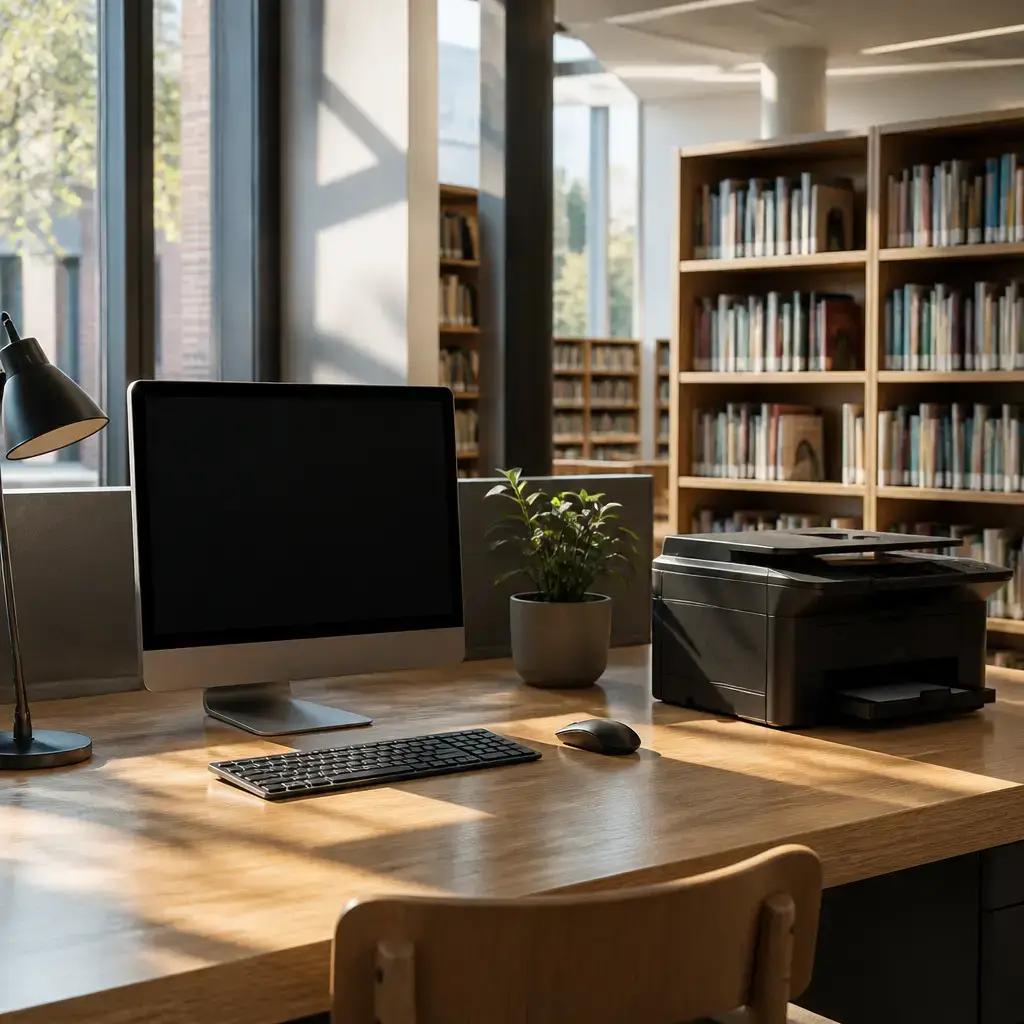
Use Using a computer and printer quietly to practice Danish conversation, pronunciation, vocabulary, grammar, and quizzes.
Dialogue
Må jeg bruge denne computer?
maw yai BROO-uh DEN-uh kom-PYOO-tuh? Can I use this computer?Den computer er ledig.
den kom-PYOO-tuh air LAY-thee. That computer is free.Skærmen er meget lys.
SGAIR-men air MAY-eth LYOOS. The screen is very bright.Du kan skrue ned for lysstyrken her.
doo kan skroo NAYTH fohr LYOOS-stur-guhn hair. You can lower the brightness here.Må jeg også bruge printeren?
maw yai AW-soh BROO-uh PREN-tuh-ren? Can I use the printer too?Du kan bruge printeren ved skrivebordet.
doo kan BROO-uh PREN-tuh-ren vayth SGREE-vuh-bor-duh. You can use the printer near the desk.Jeg vil bruge hovedtelefoner, hvis jeg afspiller lyd.
yai vil BROO-uh HOH-eth-teh-luh-FOH-nuh, vis yai OW-sbel-uh LYOOTH. I'll use headphones if I play any audio.Så vil der være stille i rummet.
soh vil dair VAIR-uh STIL-uh ee ROOM-uhd. That will keep the room quiet.Sentence explanations
Må jeg bruge denne computer?
Can I use this computer?
- Må jeg
- Can I? / May I?
- bruge
- use
- denne
- this
- computer
- computer
More detail
Må jeg means “Can I?” here: it asks for permission. Må is the present-tense form of måtte, a modal verb that can express permission, while jeg means “I.” After this modal, Danish uses an infinitive without at: Må jeg komme? means “May I come?” bruge means “use.” It is the infinitive form, and it follows the modal må directly. The same form can be reused after other modal verbs, for example Jeg kan bruge computeren means “I can use the computer.” denne means “this” and specifies one nearby or otherwise identified common-gender noun. It agrees with computer, which is a common-gender noun (en computer). Danish contrasts denne for singular common-gender nouns, dette for singular neuter nouns, and disse for plural nouns. In the phrase denne computer, the noun remains in its ordinary non-definite form; the demonstrative supplies the definiteness. computer means “computer.” Its common-gender pattern is en computer (an indefinite singular form) and computeren (the definite singular form). With denne, Danish normally uses denne computer, not denne computeren. Together, Må jeg bruge denne computer? forms a permission question: “Can I use this computer?” Må jeg asks whether the speaker is allowed to do something, bruge names the action, and denne computer identifies the object of that action.
Den computer er ledig.
That computer is free.
- Den
- that
- computer
- computer
- er
- is
- ledig
- free; available
More detail
Den is the Danish singular common-gender form meaning “that” here. It can point to a specific noun at some distance or already identifiable in context; with computer, it agrees with the noun’s common-gender form. Danish also has det for singular neuter nouns and de for plural nouns. computer means “computer.” It is a common-gender noun, which is why the form used with it is den computer. er is the present-tense form of være, “to be.” The same form is used with different subjects in the present: jeg er means “I am,” while de er means “they are.” ledig means “free” in the sense of available or not currently in use here. Its form changes with noun agreement in other contexts: ledig with a common-gender singular noun, ledigt with a neuter singular noun, and ledige in plural or definite adjective phrases. For example, Pladsen er ledig. means “The seat is available.” Together, Den computer identifies a particular computer, er links it to a description, and ledig says that it is available. The whole utterance therefore means “That computer is free,” matching the fixed translation. In this context, “free” means available to use, rather than having no cost.
Skærmen er meget lys.
The screen is very bright.
- Skærmen
- the screen
- meget
- very
- lys
- bright
More detail
Skærmen means “the screen” here. It is the definite singular form of skærm (“screen”): skærm is indefinite singular, while skærmen marks a specific screen. Danish commonly forms this definite singular with an ending attached to the noun. Example: En skærm — “a screen”; Skærmen — “the screen.” meget strengthens the adjective that follows, meaning “very.” It is a useful general intensifier: meget lys means “very bright.” Example: Det er meget koldt. — “It is very cold.” lys means “bright” in this sentence. It is the common-gender singular form of the adjective, agreeing with the common-gender noun skærmen. The same adjective has other forms: lyst with a neuter singular noun and lyse in plural or definite adjective phrases. Example: Et lyst rum — “a bright room”; Lyse skærme — “bright screens.” Together, Skærmen identifies a particular screen, er links it to its description, and meget lys describes its brightness. The complete meaning is: “The screen is very bright.”
Du kan skrue ned for lysstyrken her.
You can lower the brightness here.
- Du kan
- you can
- skrue ned for
- lower / turn down
- lysstyrken
- the brightness
- her
- here
More detail
Du kan combines the subject du (“you”) with kan, the present-tense form of kunne (“can; be able to”). In this sentence, it expresses that the addressee has the option or ability to lower the brightness. After a modal such as kan, the following verb appears in the infinitive: kan skrue, not a finite form. Example: Du kan åbne døren. — “You can open the door.” skrue ned for is a reusable Danish expression meaning “to turn down” or “to lower” something, especially a setting such as brightness or volume. The verb is the infinitive skrue; ned specifies a downward reduction, and for introduces the thing being reduced. With a different object, the same pattern can be used in skrue ned for lyden — “turn down the sound.” This is a construction, not a claim that every use of skrue has the meaning “lower.” lysstyrken means “the brightness” here. Its base form is the noun lysstyrke, “brightness,” and lysstyrken is its definite singular form: lysstyrke → lysstyrken. The definite form presents the brightness setting as identifiable in the situation. The noun, rather than skrue, carries this definiteness marking. Example: Jeg justerer lysstyrken. — “I adjust the brightness.” her means “here” and locates the relevant action at the current place or interface location. It does not change form for the grammatical features of another word. Example: Vent her. — “Wait here.” Together, Du kan + skrue ned for + lysstyrken + her gives: “You can lower the brightness here.” The word order places the modal before the infinitive construction, followed by the object whose setting is reduced and then the location. The sentence is a straightforward, neutral way to point out an available control or adjustment.
Må jeg også bruge printeren?
Can I use the printer too?
- Må jeg
- Can I?
- også
- too
- bruge
- use
- printeren
- the printer
More detail
Må jeg means “Can I?” here: må is the modal verb for permission, followed by jeg (“I”). In a question, the modal comes before the subject: Må jeg ...? Compare the reusable pattern Må jeg + infinitive? — “May/Can I ...?” Example: Må jeg sidde her? — “Can I sit here?” også means “too” or “also.” It adds this action to something already relevant, without changing who performs it. Example: Jeg vil også prøve. — “I want to try too.” bruge means “use.” This is the infinitive form, and it follows the modal må: må bruge — “may/can use.” Danish modal verbs are followed by an infinitive without an infinitive marker such as English “to.” Example: Må jeg bruge telefonen? — “Can I use the phone?” printeren means “the printer.” printer is the noun “printer,” and the ending -en marks the definite singular form: printer — “a printer” or “printer” in an indefinite reference; printeren — “the printer.” The ending belongs to the noun, not to bruge. Example: Printeren står her. — “The printer is here.” Together, Må jeg + også + bruge printeren forms the question “Can I use the printer too?” The question asks for permission for the speaker to use the specific printer, while også adds this request to the surrounding situation.
Du kan bruge printeren ved skrivebordet.
You can use the printer near the desk.
- Du kan
- you can
- bruge
- use
- printeren
- the printer
- ved
- near; by
- skrivebordet
- the desk
More detail
Du kan means “you can.” Du is the second-person singular pronoun, while kan is the modal verb meaning “can” here. Kan has the same form with different subjects, and a modal verb is followed by an infinitive without at. bruge means “use.” It is the infinitive form, so it follows kan: Du kan bruge ... means “You can use ...”. Example: Jeg kan bruge computeren. — “I can use the computer.” printeren means “the printer.” Printer is the noun’s indefinite form, and printeren is its definite singular form, marked by the ending -en. The word identifies the printer as a specific one in the situation. ved means “by” or “near” in this sentence. It introduces the location of the printer relative to another object. skrivebordet means “the desk.” Skrivebord is the indefinite form, and skrivebordet is the definite singular form, marked by -et. Together, ved skrivebordet specifies which printer is meant: the one near the desk. The complete pattern is Du kan + infinitive + definite noun + location phrase: Du kan bruge printeren ved skrivebordet. — “You can use the printer near the desk.”
Jeg vil bruge hovedtelefoner, hvis jeg afspiller lyd.
I'll use headphones if I play any audio.
- Jeg vil
- I will
- bruge
- use
- hovedtelefoner
- headphones
- hvis
- if
- afspiller
- play (audio)
- lyd
- audio
More detail
Jeg vil means “I will” here. Jeg is the first-person singular subject “I”, and vil is the present-tense form of ville used here to express the speaker’s intention or planned action. After vil, the next verb stays in the infinitive: Jeg vil bruge = “I will use.” bruge means “use.” It is the infinitive form; compare jeg bruger = “I use” or “I am using” in the present. Example: Jeg vil bruge printeren. — “I will use the printer.” hovedtelefoner means “headphones.” This is a plural noun. The sentence does not specify a number beyond the plural form; it refers to headphones as the equipment to be used. hvis introduces a condition and means “if.” The pattern hvis + clause presents the condition for the main clause. Example: Jeg bliver hjemme, hvis det regner. — “I will stay home if it rains.” afspiller means “play” in the sense of playing audio. It is the present-tense form of afspille; Danish present-tense verbs generally do not change according to the subject, so jeg afspiller uses the same form as, for example, han afspiller. Example: Jeg afspiller en sang. — “I play a song.” lyd means “audio” or “sound.” In this sentence it refers to audio being played, rather than to a particular named recording. afspille lyd is therefore “play audio.” Together, Jeg vil bruge hovedtelefoner says “I will use headphones,” and hvis jeg afspiller lyd supplies the condition “if I play any audio.” The complete utterance means: “I’ll use headphones if I play any audio.”
Så vil der være stille i rummet.
That will keep the room quiet.
- Så
- so
- vil
- will
- der
- there
- være
- be; exist
- stille
- quiet
- rummet
- the room
More detail
Så means “so” here and links this sentence to the preceding condition or action as its result. It can also mean “then” when marking a consequence in sequence. vil is the present-tense form of ville. With an infinitive, as in vil være, it expresses a future result here: “will be.” ville can also express “would” in other contexts, so the surrounding meaning determines the reading. der is a formal, non-referential subject used in the Danish existential pattern der vil være .... It does not identify a particular place or participant; the actual location is supplied by i rummet. være is the infinitive of “to be.” After vil, Danish uses the infinitive: vil være = “will be.” stille is an adjective meaning “quiet” or “silent.” In være stille, it describes the state that will exist rather than naming an action. For example, Børnene er stille. means “The children are quiet.” rummet means “the room.” Its base form is rum; the ending -et marks the definite singular form for this noun. The preposition i means “in,” so i rummet means “in the room.” Together, der vil være stille i rummet literally presents a future situation in which quiet will exist in the room. With Så, the sentence means “So there will be quiet in the room,” naturally rendered by the fixed translation as “That will keep the room quiet.”
Grammar Points
Hvis ..., så ...
Hvis jeg afspiller lyd, så er rummet stille.
vis yai OW-sbel-uh LYOOTH, soh air ROOM-uhd STIL-uh.If I play sound, the room is quiet.
Danish uses hvis for “if” and often så for “then” in the result clause.
Bestemt form: -en eller -et
Skærmen er meget lys. Rummet er stille.
SGAIR-men air MAY-eth LYOOS. ROOM-uhd air STIL-uh.The screen is very bright. The room is quiet.
Danish adds -en or -et to nouns when referring to a specific thing.
Danish Vocabulary
- Gender
- common
- Gender
- common
- Gender
- common
- Gender
- common
- Gender
- common
Quiz
Word Order
Arrange the words in the correct order.
Can I use this computer?
Show Answer
Må jeg bruge denne computer?That computer is free.
Show Answer
Den computer er ledig.The screen is very bright.
Show Answer
Skærmen er meget lys.Spelling
Tap the letters to spell the word.
free; available
Show Answer
ledigthis
Show Answer
dennecomputer
Show Answer
computeruse