10 minutes free every day
Continue audio lessons in the app
Word explanations appear automatically in sync with the audio.
No login required · synced translations · playback with the screen locked
Choose your learning language and open this lesson in the app.

About This Lesson
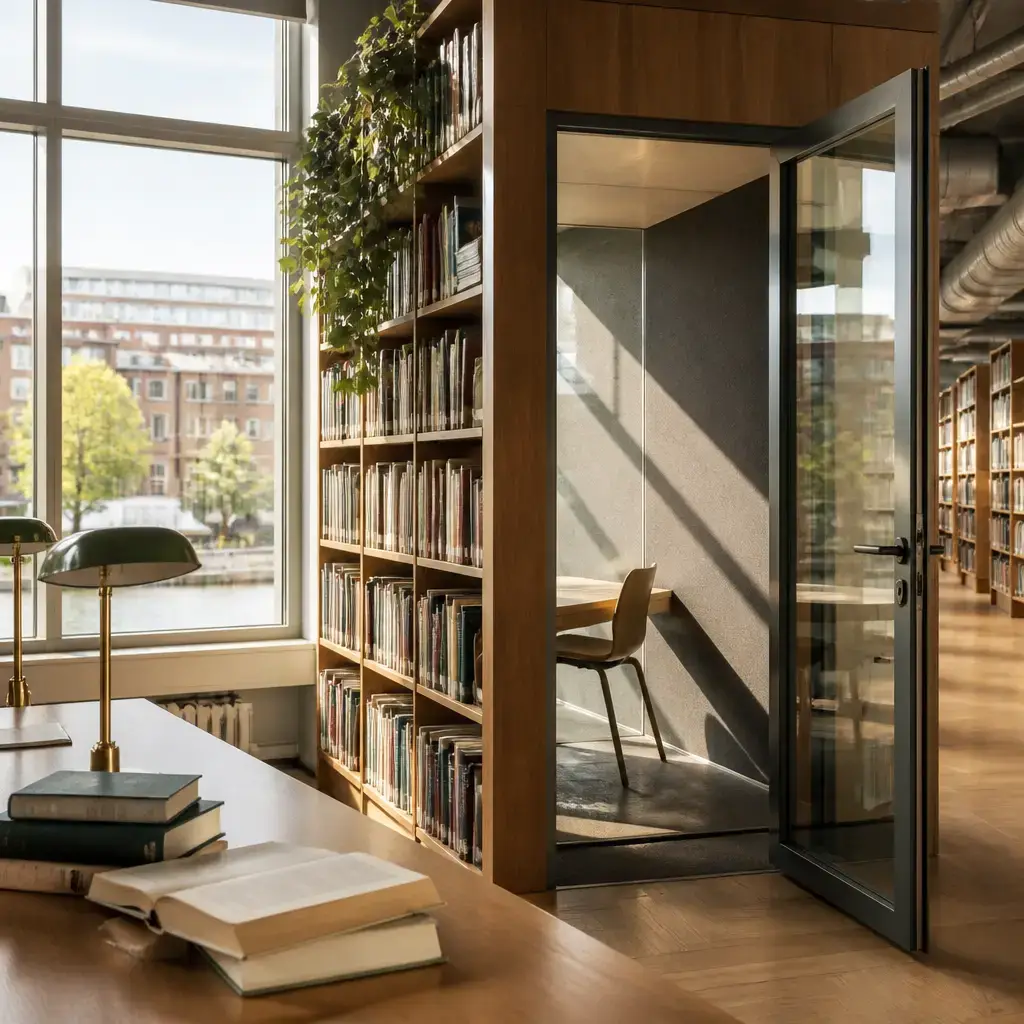
Use Asking for a study room to practice Danish conversation, pronunciation, vocabulary, grammar, and quizzes.
Dialogue
Er der et ledigt studierum?
air dair et LAY-thee stoo-THEE-uh-room? Is a study room available?Der er et ledigt nu.
dair air et LAY-thee noo. One is open now.Må jeg læse derinde?
moh yai LAY-suh DAIR-eh-nuh? Can I read in there?Du kan bruge det til at læse og lukke døren.
doo kan BROO-uh deh tehl uh LAY-suh oh LOH-guh DOH-en. You can use it for reading and close the door.Bliver der stille derinde?
BLEE-uh dair STEL-uh DAIR-eh-nuh? Will it stay quiet?Væggene holder det meste af støjen ude.
VEG-uh-nuh HULL-uh deh MES-tuh uh STOY-en OO-theh. The walls block most of the noise.Det her rum passer mig.
deh hair ROHM PAS-uh my. This room works for me.Efterlad det rent til andre.
EF-tuh-LAYTH deh REHN tehl AN-druh. Please leave it clean for other people.Sentence explanations
Er der et ledigt studierum?
Is a study room available?
- Er der
- Is there …?
- ledigt
- available; free
- studierum
- study room
More detail
Er der is a common Danish way to ask whether something exists or is present: “Is there …?” Here, er is the present-tense form of være (“to be”), and der is the existential placeholder. This construction does not identify a person; it introduces the thing being asked about. Example: Er der en café her? — “Is there a café here?” ledigt means “available” or “free” here. Its base form is ledig. The observed form is the neuter singular form, agreeing with studierum, which is a neuter noun marked by et. The useful pattern is ledig with a common-gender singular noun, ledigt with a neuter singular noun, and ledige with plural nouns. Example: Værelset er ledigt. — “The room is available.” studierum is a compound noun meaning “study room.” The first part relates to studying, while the whole compound names a room intended for study; it is not necessary to treat the parts as separate English-style words when reusing it. With the indefinite neuter article, it appears as et studierum. Example: Jeg bruger et studierum. — “I use a study room.” Together, Er der introduces an existence question, et studierum names the thing being asked about, and ledigt describes its current availability. The whole utterance therefore means: “Is a study room available?”
Der er et ledigt nu.
One is open now.
- Der er
- there is / there are
- et
- a / an
- ledigt
- available; vacant
- nu
- now
More detail
Der er is the Danish existential construction meaning “there is” or “there are.” It introduces something that exists or is available; the form er is the present tense of være (“to be”). Example: Der er kaffe. — “There is coffee.” et is the indefinite article used with a neuter singular noun. It means “a/an,” but it does not by itself assert a numeric count. The noun after it may be stated or omitted when it is understood from context. Example: et rum — “a room.” ledigt means “available” or “vacant” here. It is the neuter singular form of the adjective ledig: en ledig stol (“an available chair”), et ledigt rum (“an available room”), and ledige rum (“available rooms”). The -t ending agrees with the neuter singular noun understood after et; it belongs to the adjective ledig, not to the noun. nu means “now” and places the availability at the present time. Example: Rummet er ledigt nu. — “The room is available now.” Together, Der er et ledigt says that an available one exists. The noun is omitted because the preceding question has already established the type of thing being discussed: a study room. Thus the complete utterance means “One is open now,” or more explicitly in this context, “There is an available study room now.”
Må jeg læse derinde?
Can I read in there?
- Må jeg
- Can I
- læse
- read
- derinde
- in there
More detail
Må jeg is a reusable permission-question pattern: “May/Am I allowed to …?” Må is the present form of the modal verb må; it does not change for person or number. Jeg means “I” and is the subject. After a modal such as må, Danish places the other verb in its infinitive form without at. For example, Må jeg komme ind? means “May I come in?” læse means “to read” here. It is the infinitive required after må, rather than a separately marked present-tense form. The same verb can be used with other subjects: Hun læser means “She reads,” while hun må læse means “she may/is allowed to read.” derinde is one locative adverb meaning “in there” or “inside there.” It identifies the location of the reading without independently naming what the place is or what object the location refers to. The location meaning is different from the more general der (“there”); derinde specifically presents the place as inside. Together, Må jeg + læse + derinde forms a question asking for permission to read in the indicated interior location: “Can I read in there?” In this utterance, må supplies the permission question, læse names the activity, and derinde specifies where it would happen.
Du kan bruge det til at læse og lukke døren.
You can use it for reading and close the door.
- Du kan
- you can
- bruge
- use
- det
- it
- til at
- to (before an infinitive)
- læse
- read
- lukke
- close
- døren
- the door
More detail
Du kan means “you can.” Du is the subject “you,” and kan is the present-tense form of kunne (“can, be able to”). After this modal verb, Danish normally uses an infinitive without at: Du kan læse = “You can read.” bruge is the infinitive of bruge (“use”). Here it follows kan, so it stays in the infinitive rather than taking a present-tense ending. A reusable pattern is kan + infinitive: Jeg kan bruge det = “I can use it.” det is a neuter singular pronoun meaning “it” here. Its grammatical form is neuter singular; the supplied sentence does not uniquely identify what “it” refers to, so its specific referent should not be inferred from the nearby words alone. til at introduces the purpose of using something: bruge det til at ... means “use it to ...” In this pattern, til is followed by at plus an infinitive. This differs from the modal pattern above: kan bruge has no at, while the purpose phrase has til at. læse is the infinitive “read.” In til at læse, it expresses the activity that the object can be used for. Example: Jeg bruger lampen til at læse. — “I use the lamp for reading.” lukke is the infinitive “close” or “shut.” It is coordinated with læse by the conjunction og (“and”), so both infinitives belong to the purpose phrase: til at læse og lukke .... døren means “the door.” It is the definite form of the noun dør (“door”): en dør = “a door,” døren = “the door.” The definite ending is attached to the noun itself. Together, Du kan bruge det says “You can use it.” The purpose construction til at læse og lukke døren adds what the use is for: “to read and close the door.” Thus the complete utterance means: “You can use it to read and close the door.”
Bliver der stille derinde?
Will it stay quiet?
- Bliver
- will stay
- stille
- quiet
- derinde
- in there
More detail
Bliver is the present-tense form of blive. Its core meanings include “become” and, in a context like this, “stay/remain.” Here the fixed translation selects the “stay/remain” meaning. Danish present tense can refer to a future situation when the context does so; the form itself is not a special future form. Example: Hun bliver hjemme. — “She stays at home.” stille means “quiet” here. It is an adjective used after bliver to describe the resulting or continuing state. In Danish, stille has the same visible form in examples such as et stille rum (“a quiet room”) and stille rum (“quiet rooms”), so this word does not show a distinct ending for those forms here. The adjective is separate from bliver: bliver expresses the state or change of state, while stille names the state. derinde is an adverb meaning “in there” or “inside.” It places the quiet situation in an interior location. Example: Det er varmt derinde. — “It is warm in there.” Together, Bliver ... stille asks whether the situation will continue as quiet, and derinde specifies where. Danish uses der in this question as an existential or introductory element; it does not mean that a particular previously mentioned noun is the location. The word order Bliver der ...? is a question pattern with the finite verb first. The whole utterance therefore means: “Will it stay quiet in there?”
Væggene holder det meste af støjen ude.
The walls block most of the noise.
- Væggene
- the walls
- holder … ude
- keeps ... out
- det meste af
- most of
- støjen
- the noise
More detail
Væggene means “the walls.” It is the definite plural of væg (“wall”): en væg = “a wall,” vægge = “walls,” and væggene = “the walls.” The form identifies multiple walls as a definite group; it does not itself specify how many. holder ... ude is a useful Danish pattern meaning “keeps ... out” or “blocks ... from getting in.” holder is the present tense of holde (“to hold” or “keep”). With ude (“out”), the construction describes preventing something from entering. The two parts are separated here because det meste af støjen is placed between them. A reusable pattern is X holder Y ude — “X keeps Y out.” det meste af means “most of.” meste is the superlative form in the meget–mere–mest comparison chain, used here in the neuter singular expression det meste (“the greatest part / most”). af introduces the larger whole from which most is taken. For example, Det meste af vandet er væk. means “Most of the water is gone.” støjen means “the noise.” It is the definite singular of støj (“noise”): støj can mean noise in general, while støjen refers to the relevant noise as a definite mass. The noun is not plural here; the definite ending marks it as “the noise.” Together, Væggene is the subject, and holder ... ude says what the walls do. det meste af støjen is what they keep out: “The walls block most of the noise.”
Det her rum passer mig.
This room works for me.
- Det her
- this
- rum
- room
- passer
- works; suits
- mig
- me
More detail
Det her means “this” in the fixed sentence and points to a nearby or contextually salient thing. Its form agrees with the neuter noun rum: Danish uses det her with neuter singular nouns, den her with common-gender singular nouns, and de her with plural nouns. Example: Det her hus er stort. — “This house is big.” rum is the noun “room.” Its base form is also rum; the noun is neuter, as shown by et rum. In Danish, the plural is also rum, so context or an accompanying form identifies the number. Example: Et rum — “a room”; to rum — “two rooms.” passer is the present-tense form of passe. With a person as its object, passe can mean “to suit” or “to work for” someone. Danish present-tense verbs do not change for the subject’s person or number, so passer can occur with different subjects. Example: Tiden passer mig. — “The time works for me.” mig is the first-person singular object form corresponding to the subject form jeg (“I”). It identifies the person for whom something suits or works. Example: Det passer mig. — “That suits me.” Together, Det her rum is the subject, “this room,” passer says that it suits or works, and mig identifies the person affected: “This room works for me.”
Efterlad det rent til andre.
Please leave it clean for other people.
- Efterlad
- leave
- det
- it
- rent
- clean
- andre
- other people
More detail
Efterlad is the imperative of efterlade, “to leave” something behind or in a particular condition. It addresses the listener directly: Efterlad det ... means “Leave it ...”. This contrasts with forlade, which commonly means leaving a place or person. det is the neuter singular object pronoun “it”. In the supplied context, it can refer back to the room mentioned previously. Danish uses det with neuter singular nouns and den with common-gender singular nouns; de is plural. rent means “clean” here. It is the neuter singular form of the adjective ren, agreeing with det: det er rent means “it is clean”. The common-gender singular form is ren, and the plural form is rene. Here, rent describes the condition in which the object is to be left. andre means “other people” here. It is the plural form of anden (“other”), used substantively with the noun “people” understood. Example: Andre bruger rummet means “Other people use the room.” til is the preposition “for” in this sentence. Together, til andre means “for other people”. The utterance assembles as Efterlad (“leave”) + det (“it”) + rent (“clean”) + til andre (“for other people”): “Please leave it clean for other people.”
Grammar Points
døren
døren
DOH-enthe door
The ending -en marks a common-gender noun as definite, meaning “the door.”
Danish Vocabulary
kan bruge det
Er der et ledigt studierum?
læse derinde
- Gender
- common
lukke døren
Væggene holder det meste af støjen ude
- Gender
- neuter
et ledigt studierum
lukke døren
Må jeg læse derinde?
det meste af støjen
Bliver der stille derinde?
- Gender
- neuter
et ledigt studierum
- Gender
- common
Væggene holder støjen ude
Quiz
Word Order
Arrange the words in the correct order.
Is a study room available?
Show Answer
Er der et ledigt studierum?One is open now.
Show Answer
Der er et ledigt nu.Can I read in there?
Show Answer
Må jeg læse derinde?Spelling
Tap the letters to spell the word.
quiet
Show Answer
stillein there
Show Answer
derindethe door
Show Answer
dørenclose; shut