10 minutes free every day
Continue audio lessons in the app
Word explanations appear automatically in sync with the audio.
No login required · synced translations · playback with the screen locked
Choose your learning language and open this lesson in the app.

About This Lesson
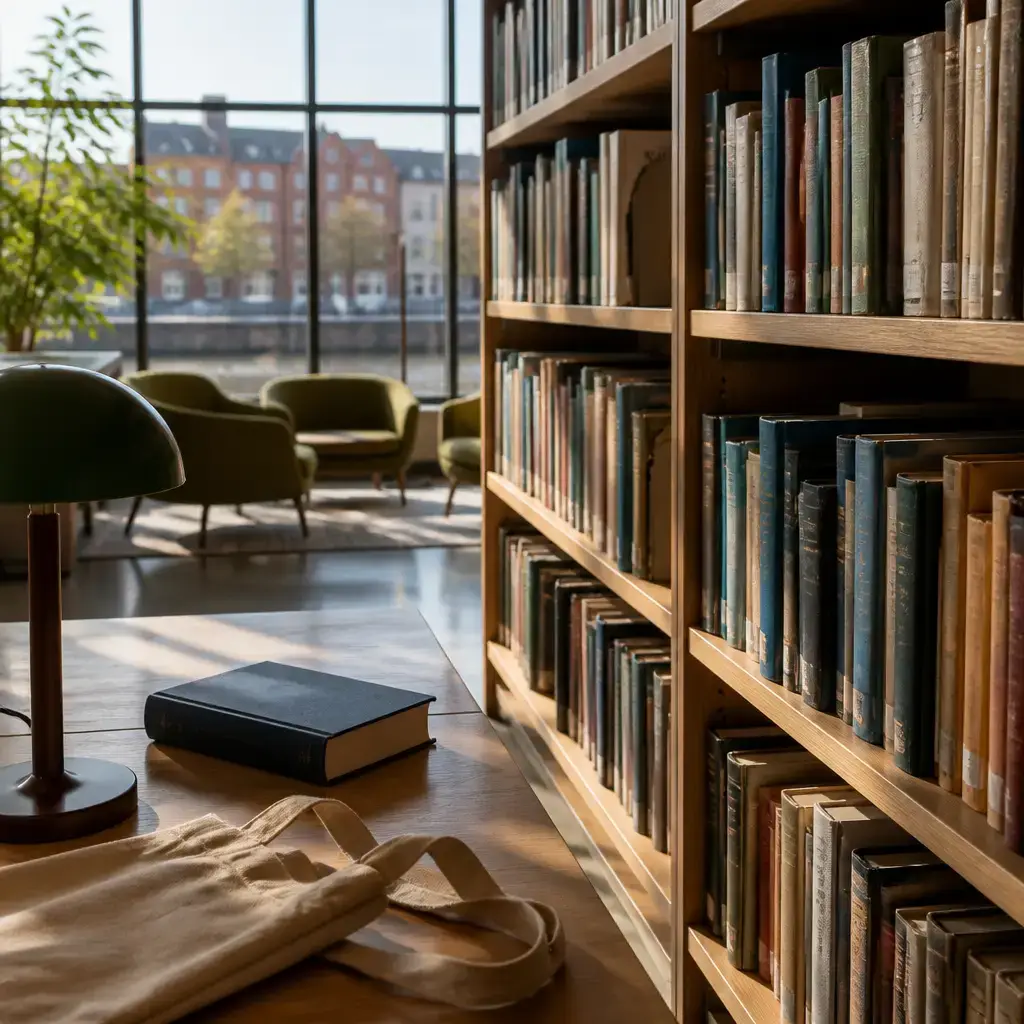
Use Find a Book on a Library Shelf to practice Danish conversation, pronunciation, vocabulary, grammar, and quizzes.
Dialogue
Hvor kan jeg finde denne bog?
VOHR kan yai FEN-uh DEN-uh BOHG? Where can I find this book?Den burde stå på en af disse hylder.
den BOO-uh STOH poh en av DEE-suh HÜL-uh. It should be on one of these shelves.Hvilken hylde skal jeg se på først?
VEL-kuhn HÜL-uh skal yai SAY poh FURST? Which shelf should I check first?Prøv den nederste hylde nær enden.
PRURV den NAY-uh-stuh HÜL-uh NAIR EN-uhn. Try the lower shelf near the end.Jeg kan se omslaget nu.
yai kan SAY OM-slay-uh NOO. I can see the cover now.Træk den forsigtigt ud, så de andre bliver på plads.
TREHG den fuh-SIG-duh OODH, soh dee AN-druh BLEE-uh poh PLASS. Pull it out carefully so the others stay in place.Det er den rigtige bog.
deh AIR den RIG-dee-guh BOHG. This is the right book.Du kan læse den ved det bord.
DOO kan LAY-suh den VEH deh BOHRD. You can read it at that table.Sentence explanations
Hvor kan jeg finde denne bog?
Where can I find this book?
- Hvor
- where
- kan jeg
- can I
- finde
- find
- denne
- this
- bog
- book
More detail
Hvor means “where” here and asks about a location. It is a question word; compare hvor with hvornår (“when”) and hvordan (“how”). Example: Hvor bor du? — “Where do you live?” kan jeg combines kan (“can”) with jeg (“I”). kan is the present-tense form of kunne and expresses ability or possibility here. In a question, Danish places the finite verb before the subject: Kan jeg komme? — “Can I come?” The form jeg is the first-person singular pronoun “I”; it does not change for grammatical gender. finde means “find” in its infinitive form. It follows the modal kan, so the modal carries the tense while finde remains infinitive: Jeg kan finde bogen. — “I can find the book.” The infinitive marker at is normally used in other infinitive constructions, as in Jeg prøver at finde bogen — “I am trying to find the book”; it is not used after kan. denne means “this” and points to one nearby or contextually identified common-gender noun. Its form agrees with the noun: denne with a common-gender singular noun, dette with a neuter singular noun, and disse with a plural noun. Example: denne stol — “this chair”; dette bord — “this table.” bog means “book.” It is a common-gender noun: en bog (“a book”), with the definite form bogen (“the book”). In denne bog, the demonstrative identifies one particular book, while bog remains in its indefinite-form shape after the demonstrative. Together, Hvor kan jeg finde denne bog? forms a question with the pattern Hvor + finite modal + subject + infinitive + demonstrative + noun: “Where can I find this book?” The location question comes first, kan jeg finde asks about the possibility of finding it, and denne bog identifies the book being sought.
Den burde stå på en af disse hylder.
It should be on one of these shelves.
- Den
- it
- burde
- should
- stå
- be located / stand
- på
- on
- en af
- one of
- disse
- these
- hylder
- shelves
More detail
Den is the subject pronoun. In this exchange, it refers to the book from the preceding question: “It.” Danish den is used for a singular common-gender referent; it does not itself mean “book.” burde expresses what is expected or considered the right possibility here: “should.” It is the past form of bør, but burde commonly expresses present advice or expectation as well. A useful pattern is burde + infinitive: Du burde ringe. — “You should call.” stå is the infinitive of står and means “stand” or, as here, “be located.” After the modal burde, the infinitive is used without at: burde stå. In a location statement, stå can describe where an object is placed; it does not necessarily claim that the object is physically upright. på means “on” and introduces the location. The phrase stå på can therefore mean “be on” when the object’s location is being described. en af is the reusable construction “one of.” Here, en is part of that construction and the sentence does assert selection of one shelf from a group; it is not merely an indefinite article before the noun. disse means “these.” It is the plural demonstrative used for things presented as near or otherwise associated with the speaker’s current focus. Together with the following noun, it identifies the relevant group as “these …”. hylder is the plural of hylde, “shelf.” The plural form is used because the construction refers to a group of shelves. Danish also has the definite plural hylderne, “the shelves”; here, disse hylder expresses “these shelves” instead. Putting the parts together, Den burde stå says “It should be located,” and på en af disse hylder says “on one of these shelves.” The complete meaning is: “It should be on one of these shelves.”
Hvilken hylde skal jeg se på først?
Which shelf should I check first?
- Hvilken
- which
- hylde
- shelf
- skal jeg
- should I
- se på
- check
- først
- first
More detail
Hvilken means “which” when it determines one singular common-gender noun. Danish contrasts hvilken (singular common gender), hvilket (singular neuter), and hvilke (plural). Example: Hvilken bog vil du læse? — “Which book do you want to read?” hylde means “shelf.” It is a common-gender noun: en hylde is “a shelf,” hylden is “the shelf,” and hylder is “shelves.” Here the noun is singular because hvilken asks which one shelf is intended. skal jeg combines skal with the subject pronoun jeg. Skal is the form used with jeg and the other subjects in the present tense; the following verb remains in the infinitive. In this question, skal jeg asks what action the speaker ought to or is expected to take, giving the intended meaning “should I.” Example: Skal jeg vente her? — “Should I wait here?” se på is a reusable verb construction meaning “look at” or, in this context, “check.” The verb se is “see/look,” while på is part of the construction that directs the looking toward something. After skal, se stays in its infinitive form: skal jeg se på ... (“should I look at/check ...”). Example: Jeg ser på hylden. — “I am looking at the shelf.” først means “first.” It marks the first action or item in an order. Example: Læs dette først. — “Read this first.” Together, Hvilken hylde asks the listener to identify one shelf, skal jeg se på asks whether that is the shelf the speaker should check, and først places this checking before any later checking. The whole utterance therefore means “Which shelf should I check first?”
Prøv den nederste hylde nær enden.
Try the lower shelf near the end.
- Prøv
- try
- nederste
- lower; bottommost
- hylde
- shelf
- nær enden
- near the end
More detail
Prøv is the imperative of prøve, “to try.” Danish commonly forms this imperative by using the verb stem without the final -e: prøve → prøv. Example: Prøv igen. — “Try again.” nederste means “lowest” or “bottommost” here, rendered as “lower” in the fixed translation. It is the attributive definite-superlative form of nederst: nederst → nederste. In den nederste hylde, the form identifies one particular shelf as the lowest one in the relevant arrangement. The form nederste itself does not change for grammatical gender or number in this phrase. hylde means “shelf.” It is a common-gender noun: en hylde is “a shelf,” and hylden is “the shelf.” Example: Hylden er tom. — “The shelf is empty.” nær enden means “near the end.” nær is a preposition meaning “near,” and enden is the definite singular of ende, “end”: en ende → enden. The definite form presents the end as an identifiable location in the situation. Example: Bogen ligger nær enden. — “The book is near the end.” The word den between Prøv and nederste is the definite article used with this singular common-gender noun phrase. den nederste hylde forms “the lower shelf,” while nær enden adds its location. Together, Prøv den nederste hylde nær enden. means “Try the lower shelf near the end.” It is a direct instruction to try that shelf.
Jeg kan se omslaget nu.
I can see the cover now.
- Jeg kan
- I can
- se
- see
- omslaget
- the cover
- nu
- now
More detail
Jeg kan means “I can” here. Jeg is the first-person singular pronoun “I”. kan is the present form of kunne, “can/be able to”. With a following verb, Danish commonly uses kan + infinitive without at: Jeg kan se = “I can see.” se means “see”. Its base form is se, and after the modal kan it remains in the infinitive: kan se, not a conjugated present form. Example: Jeg kan høre. — “I can hear.” omslaget means “the cover” in this sentence. The noun is omslag; omslaget is its singular definite form, formed with the ending -et. The indefinite form is et omslag, while omslaget refers to a specific cover in the situation. Example: Jeg åbner omslaget. — “I open the cover.” nu means “now” and places the seeing at the present moment. It is an adverb and does not change form. Together, Jeg kan se omslaget nu. means “I can see the cover now.” The structure is Jeg + kan + infinitive se + definite noun omslaget + time adverb nu.
Træk den forsigtigt ud, så de andre bliver på plads.
Pull it out carefully so the others stay in place.
- Træk
- pull
- den
- it
- forsigtigt
- carefully
- ud
- out
- så
- so that
- de andre
- the others
- bliver
- stay
- på plads
- in place
More detail
Træk is the imperative of trække (“to pull”). The imperative gives a direct instruction and has no written subject here. Useful forms are trække (infinitive), trækker (present), and trak (past). In this sentence, træk ... ud is the reusable pattern “pull ... out”; the particle ud appears later because the object comes between the verb and particle. Den is the Danish third-person singular object pronoun meaning “it” here. It is used for a common-gender noun; det is the corresponding form used for a neuter noun. The fixed sentence and translation support the meaning “it,” but they do not identify the noun more specifically. Forsigtigt is an adverb meaning “carefully” or “gently.” It describes how the pulling is to be done. The related adjective is forsigtig (“careful”); forsigtigt is the form used adverbially here. Ud means “out” and marks movement from an inside or contained position toward the outside. Together with trække, trække ... ud means “pull ... out.” Example: Hun trækker stolen ud. — “She pulls the chair out.” Så introduces the result or purpose intended by the instruction: “so that.” It connects the pulling action with the following clause. Example: Gør det langsomt, så døren ikke larmer. — “Do it slowly so that the door does not make noise.” De andre means “the others.” De is the plural form of the third-person pronoun, and andre is the plural form of anden (“other”). This phrase refers to the other members of an understood group; the sentence does not identify that group explicitly. Bliver is the present-tense form of blive. Here it means “stay” or “remain,” not “become,” because it describes the others continuing in their position. Compare De bliver her. — “They stay here.” In other contexts, blive can also mean “become,” as in Hun bliver glad. — “She becomes happy.” På plads is a common phrase meaning “in place” or “where it belongs.” It describes the position that the others continue to occupy. The preposition på literally means “on,” but in this fixed expression the natural meaning is “in place.” The whole utterance is built as Træk den forsigtigt ud (“Pull it out carefully”) plus så de andre bliver på plads (“so that the others stay in place”). The imperative requests careful outward movement of den, while the så-clause states the intended result: the other members of the relevant group remain in their positions. Together: “Pull it out carefully so the others stay in place.”
Det er den rigtige bog.
This is the right book.
- Det
- this
- er
- is
- den
- the
- rigtige
- right; correct
- bog
- book
More detail
Det means “this” here and functions as a neuter singular demonstrative pronoun. It points to what is being identified, while the noun named afterward is bog. Danish also has den for common-gender singular reference, but the choice of det here is tied to this demonstrative form and its grammatical use, not simply to the fact that the sentence contains a singular noun. er is the present-tense form of være, “to be.” Danish verbs do not change for person or number in the present tense: the same er can occur with different subjects. Example: De er her. — “They are here.” den is the definite singular article for a common-gender noun. In this sentence it belongs with rigtige bog, forming “the right book”; it is not the pronoun “it” in this particular phrase. A useful contrast is en bog — “a book” — versus den bog — “the book.” rigtige means “right” in the sense of correct or appropriate. Its base form is rigtig; rigtige is the form used before a definite noun and also in plural contexts. Here the definite form is required by den ... bog. This meaning is different from the directional sense of “right,” which Danish can express with højre. bog means “book.” It is a common-gender noun: en bog is “a book,” and bogen is “the book.” The form bog after den is the indefinite-looking noun form inside the definite noun phrase den rigtige bog; definiteness is marked by the article here. Together, Det er identifies something as “This is,” and den rigtige bog supplies its identification: “the right book.” The complete utterance is therefore “This is the right book.”
Du kan læse den ved det bord.
You can read it at that table.
- Du kan
- you can
- læse
- read
- den
- it
- ved
- at
- det
- that
- bord
- table
More detail
Du kan means “you can.” Du is the subject pronoun “you,” and kan is the present form of kunne, “can/be able to.” Danish modal kan is followed by a bare infinitive, without an extra infinitive marker: Du kan læse = “You can read.” læse is the infinitive “to read.” It stays in this form after kan; for example, Jeg kan læse means “I can read.” den is the singular common-gender object pronoun “it” here. Its exact referent is supplied by the fixed context and translation, but the form itself does not identify a noun by name. Danish also uses det as the neuter singular counterpart in relevant uses; these forms are grammatical forms, not interchangeable choices in every context. ved is a preposition meaning “at” in this location phrase. In this sentence, it places the action at a location. det means “that” before the noun bord. Here it is the neuter singular demonstrative, agreeing with bord, which is a neuter noun: et bord = “a table.” This is different from den above: there, den is an object pronoun; here, det modifies a noun. bord means “table.” Its basic form is bord; useful forms include et bord “a table,” bordet “the table,” and borde “tables.” In det bord, the demonstrative is followed by the noun in its non-definite form. Together, ved det bord means “at that table.” The full structure is Du kan + læse + den + ved det bord: “You can read it at that table.”
Grammar Points
Imperativ: prøv / træk
Prøv først. Træk forsigtigt.
PRURV FERST. TREHG fuh-SIG-duh.Try first. Pull gently.
I dansk dannes imperativ ofte ved at bruge verbets stamme uden personligt pronomen.
Bestemt form: omslag → omslaget
Omslaget bliver på plads.
OM-slay-uh BLEE-uh poh PLASS.The cover stays in place.
Et bestemt navneord får ofte endelsen -et eller -en, svarende til “the” på engelsk.
Danish Vocabulary
- Gender
- common
Hvor kan jeg finde denne bog?
Hvor kan jeg finde denne bog?
Hvor kan jeg finde denne bog?
Hvilken hylde skal jeg se på først?
- Gender
- common
Hvilken hylde skal jeg se på først?
Hvor kan jeg finde denne bog?
- Gender
- common
Den burde stå på en af disse hylder.
Prøv den nederste hylde nær enden.
Prøv den nederste hylde nær enden.
Prøv den nederste hylde nær enden.
Hvilken hylde skal jeg se på først?
Den burde stå på en af disse hylder.
Quiz
Word Order
Arrange the words in the correct order.
Where can I find this book?
Show Answer
Hvor kan jeg finde denne bog?Try the lower shelf near the end.
Show Answer
Prøv den nederste hylde nær enden.I can see the cover now.
Show Answer
Jeg kan se omslaget nu.Spelling
Tap the letters to spell the word.
shelf
Show Answer
hylderfirst
Show Answer
førstthis
Show Answer
dennewhich