10 minutes free every day
Continue audio lessons in the app
Word explanations appear automatically in sync with the audio.
No login required · synced translations · playback with the screen locked
Choose your learning language and open this lesson in the app.

About This Lesson
Use Borrowing small tools to practice Danish conversation, pronunciation, vocabulary, grammar, and quizzes.
Dialogue
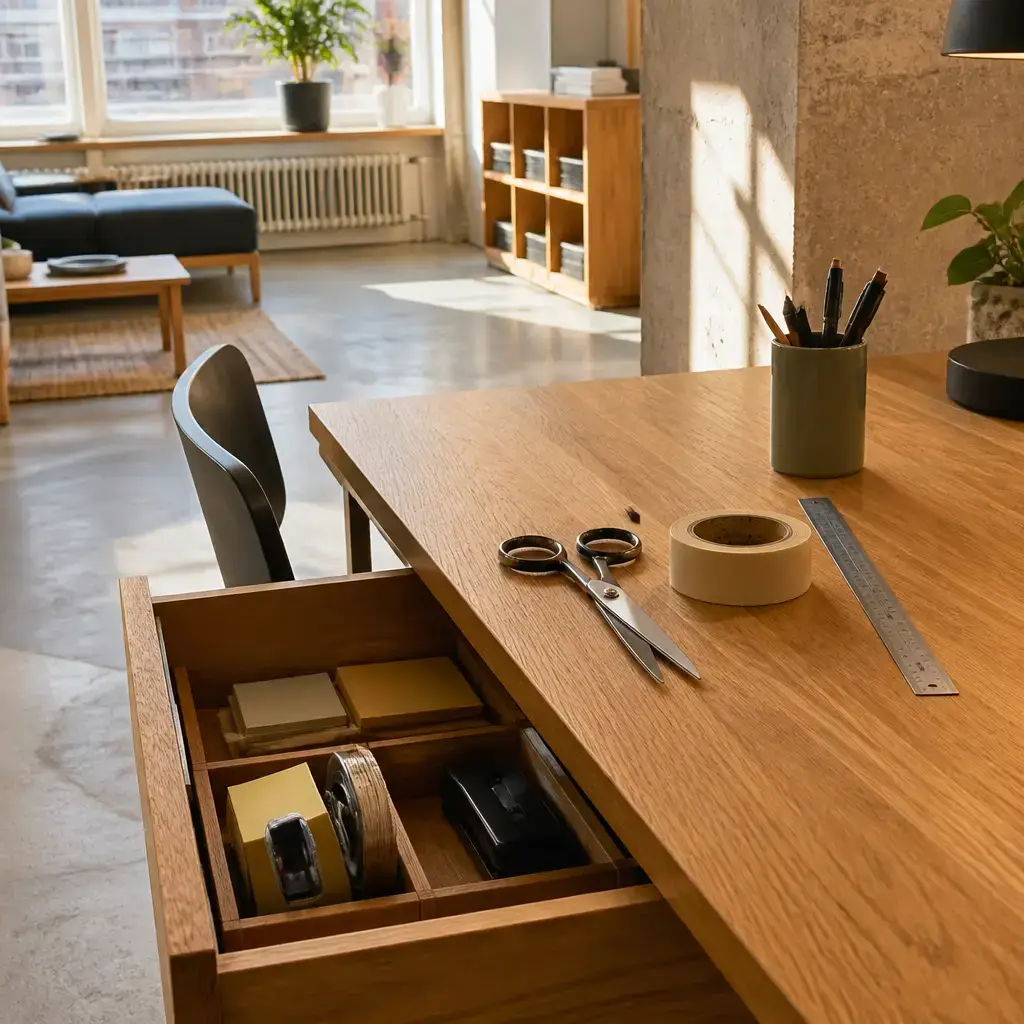
Må jeg bruge saksen?
maw yai BROO-uh SAHKS-un Can I use the scissors?Tag dem her, og hold bladene nedad.
TAY dem hair, aw HUL BLEH-thnuh NAY-thath Take these and keep the blades pointed down.Jeg skal også bruge noget tape.
yai skal AW-suh BROO-uh NOH-th TAY-buh I also need some tape.Tapen er i skuffen.
TAY-bun air ee SGOO-fun The tape is in the drawer.Har du også en lineal?
har doo AW-suh un lee-NAY-al Do you have a ruler too?Ja, den er på mit skrivebord.
yeh, den air paw mit SGREE-vuh-bor Yes, it is on my desk.Du kan tage den derfra.
doo kan TAY-yuh den DAIR-frah You can take it from there.Jeg giver det hele tilbage, når jeg er færdig.
yai KEE-vuh deh HAY-luh tuh-BEH-yuh, nawr yai air FAIR-dee I will return everything when I finish.Læg linealen øverst, så jeg kan finde den senere.
LAY lee-NAY-al-un UR-vust, saw yai kan FEN-uh den seh-NAY-air-uh Leave the ruler on top so I can find it later.Sentence explanations
Må jeg bruge saksen?
Can I use the scissors?
- Må jeg
- Can I
- bruge
- use
- saksen
- the scissors
More detail
Må jeg asks for permission: “May/Can I …?” Må is the present-tense form of måtte, used here as a modal meaning that the speaker asks whether they are allowed to do something. Jeg means “I.” After this modal, the next verb appears in the infinitive without at. bruge means “use.” It is the infinitive form, so it stays unchanged after må: Må jeg bruge …? = “Can I use …?” The same verb can be reused with other objects, for example: Må jeg bruge telefonen? — “Can I use the phone?” saksen means “the scissors.” The base noun is saks; saksen is its definite singular form, marked by the ending -en. In Danish, saks refers to a tool with two blades even though English normally uses the plural word “scissors.” Together, Må jeg + infinitive bruge + definite object saksen produces: “Can I use the scissors?” The question asks whether the speaker is permitted to use the particular scissors referred to in the situation. As a reusable pattern, Må jeg + infinitive + object? asks permission to perform an action.
Tag dem her, og hold bladene nedad.
Take these and keep the blades pointed down.
- Tag
- take
- dem her
- these
- hold
- keep
- bladene
- the blades
- nedad
- downward
More detail
Tag is the imperative of tage, “to take.” The imperative gives a direct instruction and normally has the same form for singular and plural addressees. Example: Tag bogen. — “Take the book.” dem her means “these” here. dem is the object form of the third-person plural pronoun, and her adds the meaning “here,” making the reference demonstrative and near the speaker. The fixed translation identifies the items as “these,” but does not specify exactly which items they are. Example: Jeg tager dem her. — “I’ll take these.” hold is the imperative of holde, “to hold” or “to keep.” In this sentence it instructs the listener to maintain a position, rather than merely hold something temporarily. Example: Hold døren åben. — “Keep the door open.” bladene means “the blades.” The noun is blad; its plural is blade, and its definite plural is bladene. Danish marks definiteness here by the ending -ene, rather than by a separate word before the noun. Example: Bladene er skarpe. — “The blades are sharp.” nedad means “downward” and describes direction or orientation. It tells the listener which way the blades should point. Example: Pil spidsen nedad. — “Point the tip downward.” The sentence has two coordinated imperatives: Tag dem her (“Take these”) and hold bladene nedad (“keep the blades pointed down”). The conjunction og joins the two instructions. Together, they give the instruction to take the indicated items and keep the blades oriented downward.
Jeg skal også bruge noget tape.
I also need some tape.
- Jeg
- I
- Jeg skal
- I need to
- også
- also
- bruge
- use; need here
- noget
- some
- tape
- tape
More detail
Jeg is the first-person singular pronoun, meaning “I.” It is the form used when the speaker is the subject. For example, Jeg kommer means “I am coming.” Jeg skal combines the subject Jeg with skal, the present form of skulle. Skal can express obligation, a planned action, or—when combined with a verb such as bruge—a present need or intended requirement. Here, Jeg skal bruge means “I need,” not simply “I will use.” også means “also” and adds this need to something already understood in the situation. Its position after Jeg skal gives the sentence the meaning “I also need …”. bruge is the infinitive of bruge, “to use.” After the modal verb skal, Danish uses the infinitive without an infinitive marker: skal bruge. In this construction, bruge contributes the idea of needing something for use. For example, Jeg skal bruge en pen means “I need a pen.” noget means “some” in the sense of an unspecified amount of a non-count substance or material. It does not by itself state a precise quantity. Compare noget tape, “some tape,” with en rulle tape, “a roll of tape,” where the latter names a unit. tape is the noun “tape.” The word can be used for the material without specifying how much. In the following context, Tapen is the definite form, “the tape”; the ending -en marks the noun as definite in that form. Together, Jeg skal bruge expresses “I need,” også adds “also,” and noget tape specifies an unspecified amount of tape. The complete utterance therefore means “I also need some tape.”
Tapen er i skuffen.
The tape is in the drawer.
- Tapen
- the tape
- er
- is
- i
- in
- skuffen
- the drawer
More detail
Tapen means “the tape” here. It is the noun tape with the definite singular ending -en: en tape (“a tape”) → tapen (“the tape”). The ending marks a specific common-gender singular noun; it does not itself mean “one.” er is the present-tense form of være, “to be.” It is used with all subjects in the present tense, so it does not change for singular versus plural: Jeg er (“I am”), den er (“it is”), de er (“they are”). i means “in” and introduces the place where something is located. In this sentence it describes location inside a container or space. skuffen means “the drawer.” It is the definite singular form of skuffe: en skuffe (“a drawer”) → skuffen (“the drawer”). As with tapen, -en marks a specific common-gender singular noun. Together, Tapen er i skuffen. follows the reusable pattern [definite noun] + er + i + [definite place noun]: “The tape is in the drawer.”
Har du også en lineal?
Do you have a ruler too?
- Har
- have
- du
- you
- også
- too; also
- en
- a; an
- lineal
- ruler
More detail
Har is the present-tense form of have (“to have”). In a yes/no question, Danish commonly places the finite verb before the subject: Har du ...? means “Do you have ...?” The same form har is used with different subjects in the present tense. du means “you” and is the subject of the question. It is the ordinary singular or plural second-person pronoun; the form itself does not mark whether “you” refers to one person or more than one. også means “too” or “also”. Here it adds the ruler to something already under discussion: “a ruler too.” Its position after du is natural in this question. Example: Jeg har også en bog. — “I also have a book.” en is the indefinite article used with an en-word. It introduces lineal as a non-specific item; it does not by itself assert a numerical count. Danish indefinite articles include en and et, and the correct choice depends on the noun’s grammatical gender. lineal means “ruler,” the measuring instrument. It is an en-word, so the indefinite form is en lineal. The definite form is linealen, meaning “the ruler.” Together, Har du forms the reusable yes/no question pattern “Do you have ...?”, også adds “too,” and en lineal supplies the item being asked about. The complete utterance means: “Do you have a ruler too?”
Ja, den er på mit skrivebord.
Yes, it is on my desk.
- Ja
- yes
- den
- it
- er
- is
- på
- on
- mit
- my
- skrivebord
- desk
More detail
Ja means “yes” and confirms the preceding question. It can introduce an affirmative statement: Ja, jeg har den. — “Yes, I have it.” den means “it” here. It is the singular common-gender form used when referring back to a common-gender noun. Danish also has det for a neuter singular referent and de for plural referents. In this exchange, the preceding question supplies a likely referent, en lineal (“a ruler”); the form itself marks common gender and singular number, not the noun’s identity. Here den is the subject of er. er is the present-tense form of være, “to be”: være → er. It connects the subject with its location. For example, Bogen er her. means “The book is here.” på means “on” in this location pattern. With a surface such as a desk, it indicates that something is located on that surface. The preposition does not change to agree with the noun. mit means “my” before a neuter singular noun. The possessive paradigm is min with a common-gender singular noun, mit with a neuter singular noun, and mine with a plural noun. Here mit agrees with skrivebord, which is neuter: et skrivebord. skrivebord means “desk.” It is a neuter noun, so its indefinite article is et: et skrivebord. Its definite form is skrivebordet, “the desk.” Together, den er means “it is,” and på mit skrivebord gives the location “on my desk.” With the initial confirmation Ja, the complete utterance means: “Yes, it is on my desk.”
Du kan tage den derfra.
You can take it from there.
- Du kan
- you can
- tage
- take
- den
- it
- derfra
- from there
More detail
Du kan combines the pronoun du (“you”) with kan, the present-tense form of kunne (“can; be able to”). Here kan expresses possibility or permission, and it is followed by an infinitive: Du kan tage = “You can take”. The form kan is used with different subjects; the pronoun identifies who has the ability or permission. tage is the infinitive of “take”. After a modal verb such as kan, Danish uses the infinitive without at: Du kan tage ... (“You can take ...”). With at outside this modal pattern, the same verb can occur as at tage (“to take”). den is a common-gender singular pronoun here, corresponding to “it”. The fixed translation identifies it as the thing being taken, and the preceding context supports the same item as being on the speaker’s desk. Danish also uses den as a determiner before a common-gender singular noun, but in this utterance it stands independently as a pronoun. derfra means “from there”. It is a compact place adverb indicating origin or starting point. The element der refers to a place understood from the situation, while fra marks movement or removal away from that place; keep the combined form derfra when reusing this expression. A related contrast is dertil (“to there”), which marks a destination rather than a source. Together, Du kan tage den derfra means “You can take it from there”: Du kan gives the possibility or permission, tage den identifies the action and its object, and derfra specifies the place from which the object can be taken.
Jeg giver det hele tilbage, når jeg er færdig.
I will return everything when I finish.
- giver
- give
- det hele
- everything
- tilbage
- back
- når
- when
- færdig
- finished
More detail
giver is the present-tense form of give (give → giver; past gav; participle givet). Here it is used with tilbage to mean “return” rather than simply “give.” Danish present tense can describe a future action when the context supplies that time reference; the fixed translation therefore gives “will return.” Example: Jeg giver bogen tilbage. — “I return the book.” det hele means “everything” here. det is a neuter singular form meaning “it/that,” while hele adds the idea of the complete whole; together they form a common expression for the entire amount or set. This phrase does not identify what the things are. Example: Hun spiste det hele. — “She ate everything.” tilbage means “back.” With a verb of giving, the pattern give noget tilbage means “return something,” so it indicates that the thing goes back to its previous holder or place. Example: Jeg lægger nøglen tilbage. — “I put the key back.” når introduces a time clause meaning “when.” A useful pattern is når + clause for an event that sets the time of another action. Example: Ring, når du er hjemme. — “Call when you are home.” færdig means “finished” or “done.” In er færdig, it is a predicative adjective after er (“am/is/are”), describing completion. The common forms are færdig for common-gender singular, færdigt for neuter singular, and færdige for plural or definite contexts; the form in the utterance is færdig. Example: Jeg er færdig. — “I am finished.” The sentence begins with Jeg (“I”), followed by giver det hele tilbage: “return everything.” The clause når jeg er færdig gives the time condition, “when I am finished.” Together, the utterance means: “I will return everything when I finish.”
Læg linealen øverst, så jeg kan finde den senere.
Leave the ruler on top so I can find it later.
- Læg
- leave; put
- linealen
- the ruler
- øverst
- on top; at the top
- så jeg kan
- so I can
- finde
- find
- den
- it
- senere
- later
More detail
Læg is the imperative of lægge, meaning “put” or “place” when the object is moved somewhere. Its useful forms are lægge (infinitive), lægger (present), lagde (past), and lagt (past participle). Do not confuse it with ligge, “lie/be situated”: Læg bogen her means “Put the book here,” while Bogen ligger her means “The book is here.” linealen means “the ruler” here. The base noun is lineal, and linealen is its definite singular form: en lineal = “a ruler,” linealen = “the ruler.” The ending -en marks definiteness for this common-gender noun. øverst is an adverb meaning “at the top” or “on top” in this sentence. It describes the place where the ruler should be put. The related adjective is øverste, “topmost” or “uppermost,” as in den øverste hylde, “the top shelf”; øverst itself does not modify a noun directly here. så jeg kan introduces the purpose of the action: “so that I can.” jeg is the first-person singular subject, “I,” and kan is the present form of the modal verb kunne, “can/be able to.” After a modal verb, the next verb normally appears in the infinitive without at, as in jeg kan komme, “I can come.” finde means “find” and is the infinitive of finde; its present form is also finder. In kan finde, it stays in the infinitive because kan carries the tense and modal meaning. Example: Jeg kan finde nøglen means “I can find the key.” den means “it” here. It is a third-person singular object pronoun with the common-gender form, referring in this utterance to the ruler identified by the fixed translation. Danish uses den for a common-gender singular referent and det for a neuter singular referent; the choice follows the grammatical gender of the referent, not the person speaking. senere means “later.” It is an adverb of time and places the finding at a later time than the putting. Example: Jeg læser den senere means “I will read it later”; the exact referent of den depends on the surrounding context. Together, Læg linealen øverst gives the instruction “Put the ruler on top.” så jeg kan finde den senere adds the purpose “so that I can find it later.” The complete utterance therefore means: “Leave the ruler on top so I can find it later.”
Grammar Points
Imperativ: verbets stamme
Tag dem og hold bladene nedad.
TAY dem aw HUL BLEH-thnuh NAY-thathTake them and hold the blades downward.
The Danish imperative usually uses the verb stem without a subject, as in Tag, hold and Læg.
Bestemt form med endelsen -en
Saksen og tapen.
SAHKS-un aw TAY-bunThe scissors and the tape.
Danish often marks a singular definite noun by adding -en to the noun: saks → saksen, tape → tapen.
Danish Vocabulary
hold bladene nedad
Må jeg bruge saksen?
Tag dem her
hold bladene nedad
Læg linealen øverst
hold bladene nedad
noget tape
Jeg skal også bruge noget tape.
Må jeg bruge saksen?
Tapen er i skuffen.
Tag dem her
Tapen er i skuffen.
Quiz
Word Order
Arrange the words in the correct order.
Can I use the scissors?
Show Answer
Må jeg bruge saksen?I also need some tape.
Show Answer
Jeg skal også bruge noget tape.The tape is in the drawer.
Show Answer
Tapen er i skuffen.Spelling
Tap the letters to spell the word.
some
Show Answer
nogetdownward
Show Answer
nedadkeep; hold
Show Answer
holdalso; too