10 minutes free every day
Continue audio lessons in the app
Word explanations appear automatically in sync with the audio.
No login required · synced translations · playback with the screen locked
Choose your learning language and open this lesson in the app.

About This Lesson
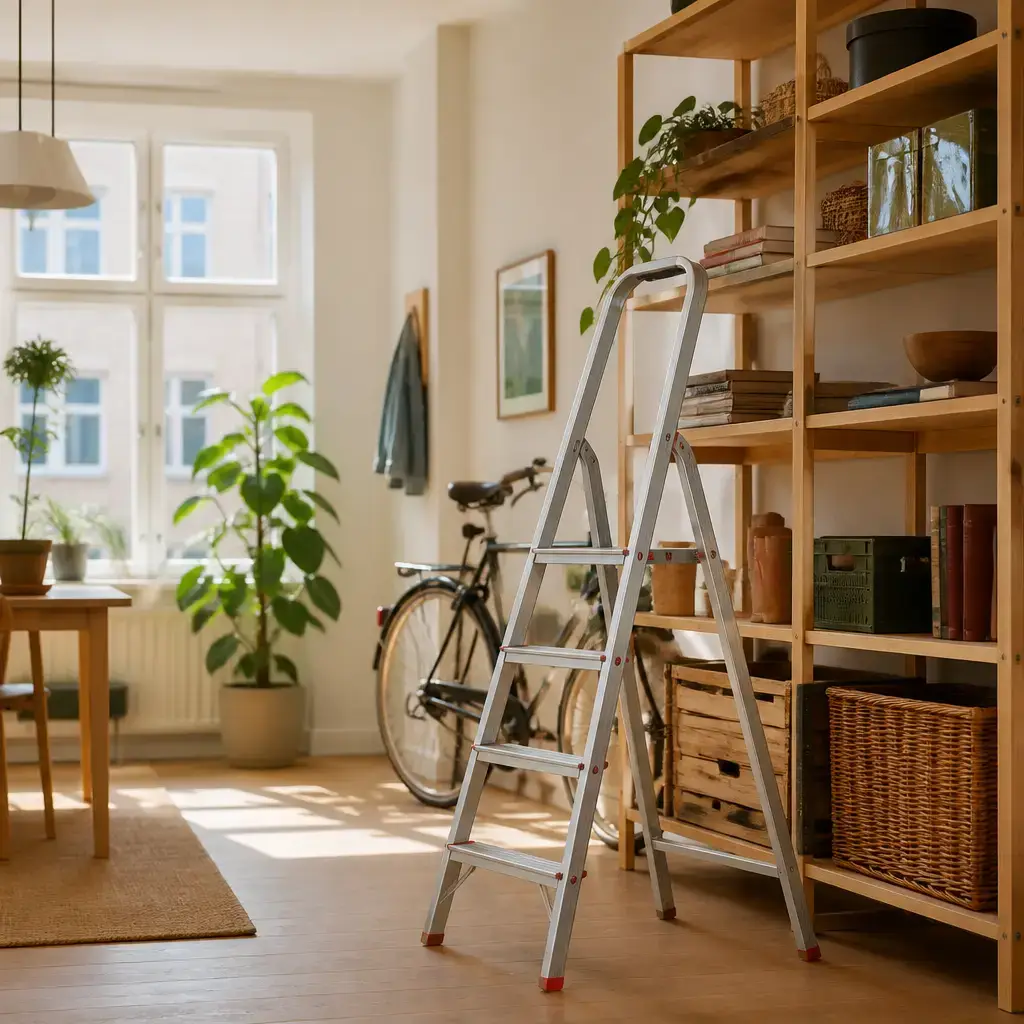
Use Borrowing a ladder safely to practice Danish conversation, pronunciation, vocabulary, grammar, and quizzes.
Dialogue
Må jeg låne din stige?
moh yai LOH-nuh deen STEE-uh Can I borrow your ladder?Ja, men pas godt på den.
yah, men pass goht poh den Sure, but please be careful with it.Jeg skal nå en høj hylde.
yai skal noh en hoy HYÜL-uh I need to reach a high shelf.Jeg kan holde den stabil for dig.
yai kan HOHL-uh den sta-BEEL fohr dai I can hold it steady for you.Det ville hjælpe meget.
deh VEL-uh YEL-buh MAYTH That would help a lot.Stå ikke på det øverste trin.
STAW IK-uh poh deh UR-vuh-stuh TREEN Stay off the top step.Jeg bliver på et lavere trin.
yai BLEE-uh poh et LAY-vuh-ruh TREEN I will stay on a lower step.Tag den tilbage, når du er færdig.
TEH den tah-BEL-uh NAWR doo eh FAIR-dee Bring it back when you finish.Sentence explanations
Må jeg låne din stige?
Can I borrow your ladder?
- Må jeg
- May I
- låne
- borrow
- din
- your
- stige
- ladder
More detail
Må jeg is a common Danish way to ask for permission: “May I …?” or, naturally in English, “Can I …?” Here må is the modal verb meaning that permission is being requested, while jeg means “I.” The same pattern is reusable: Må jeg + verb? — Må jeg komme ind? means “May I come in?” låne means “borrow,” specifically to take something temporarily with the expectation of returning it. It is the infinitive form after the modal må; Danish uses the infinitive without an English-style “to” after this kind of modal. Example: Jeg vil låne bogen. means “I want to borrow the book.” din means “your” and agrees with the singular common-gender noun it describes. It is the form used before a common-gender singular noun; before a neuter singular noun, the corresponding form is dit, and before plural nouns it is dine. The possessive identifies the ladder as belonging to or being associated with the person addressed. stige means “ladder.” In this sentence it is a singular common-gender noun, as shown by din stige. A useful related form is the plural stiger, meaning “ladders.” Together, Må jeg låne din stige? forms a permission question: “Can I borrow your ladder?” The speaker asks whether the person addressed permits the speaker to borrow one particular ladder associated with that person.
Ja, men pas godt på den.
Sure, but please be careful with it.
- Ja
- yes
- pas
- be careful
- godt
- well
- den
- it
- pas godt på den
- be careful with it
More detail
Ja means “yes” or “sure” here. It accepts the request in the preceding sentence. Danish also uses nej for “no.” pas is the imperative form used in the expression passe på, meaning “be careful” or “take care.” The imperative addresses the listener directly. For example: Pas på! — “Be careful!” godt means “well” in this expression. It is an adverb modifying the carefulness expressed by pas på, so pas godt på means “take good care” or “be very careful with.” This is not the adjective use meaning “good” before a noun. den is a singular common-gender object pronoun meaning “it” here. With the supplied context and translation, it refers to the ladder being borrowed. Danish uses den for a common-gender singular referent and det for a neuter singular referent; the choice follows the referent’s grammatical gender, not its physical size. The reusable pattern is pas godt på + object: “be careful with/take good care of + object.” In the fixed sentence, pas godt på den combines the imperative pas with på, the adverb godt, and the pronoun den. Together with Ja, men, the utterance means: “Sure, but please be careful with it.”
Jeg skal nå en høj hylde.
I need to reach a high shelf.
- Jeg skal
- I need to
- nå
- reach
- høj
- high
- hylde
- shelf
More detail
Jeg skal means “I need to” here. Jeg is the first-person singular pronoun “I.” skal is the present form of skulle; with a subject such as jeg, it is followed by an infinitive. In this sentence, skal expresses a need or requirement. The same form can express other meanings in other contexts, such as a plan or obligation, so its exact meaning comes from the surrounding clause. nå means “reach” here. It is the infinitive after skal, so it does not carry a present-tense ending in this construction. Useful forms are nå (infinitive), når (present), nåede (past), and nået (past participle). Example: Jeg når hylden. — “I reach the shelf” or “I make it to the shelf.” høj means “high.” It is the positive form of the adjective. Its basic comparison is høj — højere — højest, meaning “high” — “higher” — “highest.” Here, høj describes hylde and has the form used with this singular common-gender indefinite noun. hylde means “shelf.” It is a common-gender singular indefinite noun: en hylde. Its plural is hylder, and its singular definite form is hylden. Example: En høj hylde — “a high shelf.” Together, Jeg skal nå expresses “I need to reach,” and en høj hylde identifies the object as “a high shelf.” The complete utterance therefore means “I need to reach a high shelf.”
Jeg kan holde den stabil for dig.
I can hold it steady for you.
- Jeg kan
- I can
- holde
- hold; keep
- den
- it
- stabil
- steady
- for dig
- for you
More detail
Jeg kan means “I can” here. Jeg is the first-person singular pronoun “I”. kan is the present form of the modal verb kunne (“can, be able to”). In Danish, a modal such as kan is followed by an infinitive: Jeg kan holde = “I can hold/keep.” holde is the infinitive of holde. In this sentence it means “hold” in the sense of keeping something in a particular condition. The same verb can also mean “keep” in other contexts. After kan, Danish uses the infinitive without an infinitive marker: kan holde. den means “it” here. It is the singular common-gender object pronoun. Its grammatical form tells us its gender and number, but the supplied sentence does not identify a more specific referent for it. stabil means “steady” here. It is the common-gender singular form of the adjective; the neuter form is stabilt, and the plural or definite form is stabile. In holde den stabil, the adjective describes the condition in which den is kept. for dig means “for you.” dig is the object form of the second-person singular pronoun; the subject form is du. The preposition for marks the person who benefits from or is served by the action. Together, kan holde expresses ability, den stabil expresses maintaining “it” in a steady condition, and for dig identifies the beneficiary. The whole utterance therefore means: “I can hold it steady for you.”
Det ville hjælpe meget.
That would help a lot.
- Det ville
- That would
- hjælpe
- help
- meget
- a lot
More detail
Det ville combines det (“that/it”) with ville, the past-tense form of vil used here to express a hypothetical or conditional result: “would.” Det is a neuter singular pronoun/demonstrative form; this sentence does not identify a more specific referent. The construction det ville + infinitive is reusable for “that/it would [verb].” hjælpe is the infinitive “to help.” After the modal ville, Danish uses the infinitive without at: ville hjælpe = “would help.” The same verb can appear in other forms, such as hjælper (“helps/is helping”) and hjalp (“helped”), but hjælpe is the form required after this modal here. meget means “a lot” in this sentence. It is an adverb modifying the extent of hjælpe; it is not an adjective describing a noun here. For example, Det hjælper meget. means “That helps a lot.” Together, Det ville hjælpe meget. means “That would help a lot.” The pattern Det ville + infinitive + meget can be reused for a hypothetical action and its strong degree: Det ville ændre meget. means “That would change a lot.”
Stå ikke på det øverste trin.
Stay off the top step.
- Stå
- stand
- ikke
- not
- på
- on
- det
- the
- øverste
- top
- trin
- step
More detail
Stå is the imperative of stå, “to stand.” In this sentence, the imperative is used in a negative instruction: stå ikke means “do not stand” or, with the following location phrase, “stay off.” ikke is the standard Danish negation, “not.” It normally comes after the imperative here, so stå ikke forms the negative command. The word itself does not carry the command; stå does. på means “on” in this location expression. With a surface such as a step, på describes being on top of it. Together, stå ... på describes standing on something; with negation, stå ikke på ... means not to stand on it. det is the neuter singular definite article used before an adjective: det øverste trin, “the top step.” It is not a separate numeric meaning here. The noun trin is neuter, as shown by the indefinite form et trin. øverste means “top” or “highest” here. It is the attributive superlative form related to øvre (“upper”): øvre → øverste. In det øverste trin, it identifies the step at the highest position, rather than merely describing a step as high. trin means “step.” Its indefinite singular is et trin; its definite singular is trinnet. In this sentence it appears after det øverste, because the definite article is expressed before the adjective in this noun phrase. The chunks combine as stå ikke + på + det øverste trin: “do not stand on the top step.” In natural English, the fixed translation is “Stay off the top step.” This is a negative imperative telling the addressee not to be on that step.
Jeg bliver på et lavere trin.
I will stay on a lower step.
- Jeg
- I
- bliver
- stay
- på
- on
- lavere
- lower
- trin
- step
More detail
Jeg means “I” and is the first-person singular subject pronoun. It identifies the speaker as the participant who stays. Example: Jeg kommer. — “I am coming.” bliver is the present-tense form of blive, used here for “stay” or “remain.” In this sentence it describes the speaker’s future decision or intention in the fixed translation, even though the Danish form itself is present tense. blive can also mean “become” in other contexts, so the surrounding phrase determines the meaning here. Example: Jeg bliver her. — “I will stay here.” på means “on” in this location expression. Danish uses på with a surface or position such as being on a step. Example: Bogen ligger på bordet. — “The book is on the table.” lavere means “lower.” It is the comparative form of lav (“low”): lav → lavere (“lower”) → lavest (“lowest”). Danish comparative adjectives do not take the noun’s gender or number marking in this form. Example: Vi vælger et lavere bord. — “We choose a lower table.” trin means “step” here. It can also refer to a stage or level in other contexts, but the fixed translation supports the physical “step” meaning. The indefinite noun phrase is et trin; et marks the noun as neuter grammatical gender. The indefinite article presents an unspecified step and does not by itself assert a numerical count. Example: Hun står på et trin. — “She is standing on a step.” Together, bliver på expresses remaining in a position, and et lavere trin means “a lower step.” The complete utterance means: “I will stay on a lower step.”
Tag den tilbage, når du er færdig.
Bring it back when you finish.
- Tag
- bring; take
- den
- it
- tilbage
- back
- når
- when
- du er færdig
- you are finished
More detail
Tag is the imperative of tage, “to take.” In this sentence, the fixed translation selects the context-based sense “bring”: Tag ... tilbage tells the listener to return something. The imperative normally has no expressed subject, so the understood subject is “you.” Compare tage (to take) with tager (take/is taking in a present-tense clause). Example: Tag bogen. — “Take the book.” den is the common-gender singular object pronoun, meaning “it” here. It refers to the item that is to be brought back; the supplied sentence does not identify that item more specifically. Danish den can also function as a demonstrative meaning “that one,” but that is not the intended reading here. tilbage is an adverb meaning “back” in this utterance. Together, Tag den tilbage means “Bring it back” rather than merely “Take it.” The construction is reusable with another object: Bring koppen tilbage. — “Bring the cup back.” når introduces a time condition, “when.” It connects the action in the main clause with the time stated in the following clause. Example: Jeg kommer, når du ringer. — “I’ll come when you call.” du er færdig means “you are finished” and supplies the condition after når. du is the second-person singular pronoun “you.” er is the present-tense form of være, “to be,” used with du here. færdig is an adjective meaning “finished” or “done”; it describes the listener’s completed state. In the fixed translation, this is naturally rendered as “when you finish.” Example: Når du er færdig, kan vi gå. — “When you are finished, we can go.” The full structure is Tag den tilbage + når du er færdig: an imperative to bring an item back, followed by the time condition “when you finish.” Thus the complete meaning is “Bring it back when you finish.”
Grammar Points
Pas godt på + pronomen
Pas godt på dig.
PASS GOHT POH DAIBe careful.
The fixed expression pas godt på means “be careful”; dig identifies the person being careful.
når + subjekt + verb
Når jeg bliver færdig
NAWR yai BLEE-uh FAIR-deeWhen I am finished
After når, the subject comes before the verb: når jeg bliver, not når bliver jeg.
Danish Vocabulary
Ja, men pas godt på den.
Jeg kan holde den stabil for dig.
- Gender
- common
Jeg skal nå en høj hylde.
Jeg skal nå en høj hylde.
Jeg skal nå en høj hylde.
Må jeg låne din stige?
Jeg skal nå en høj hylde.
Ja, men pas godt på den.
Ja, men pas godt på den.
Ja, men pas godt på den.
Jeg kan holde den stabil for dig.
- Gender
- common
Må jeg låne din stige?
Quiz
Word Order
Arrange the words in the correct order.
Can I borrow your ladder?
Show Answer
Må jeg låne din stige?Sure, but please be careful with it.
Show Answer
Ja, men pas godt på den.I need to reach a high shelf.
Show Answer
Jeg skal nå en høj hylde.Spelling
Tap the letters to spell the word.
well
Show Answer
godtborrow
Show Answer
låneladder
Show Answer
stigeshelf