10 minutes free every day
Continue audio lessons in the app
Word explanations appear automatically in sync with the audio.
No login required · synced translations · playback with the screen locked
Choose your learning language and open this lesson in the app.

About This Lesson
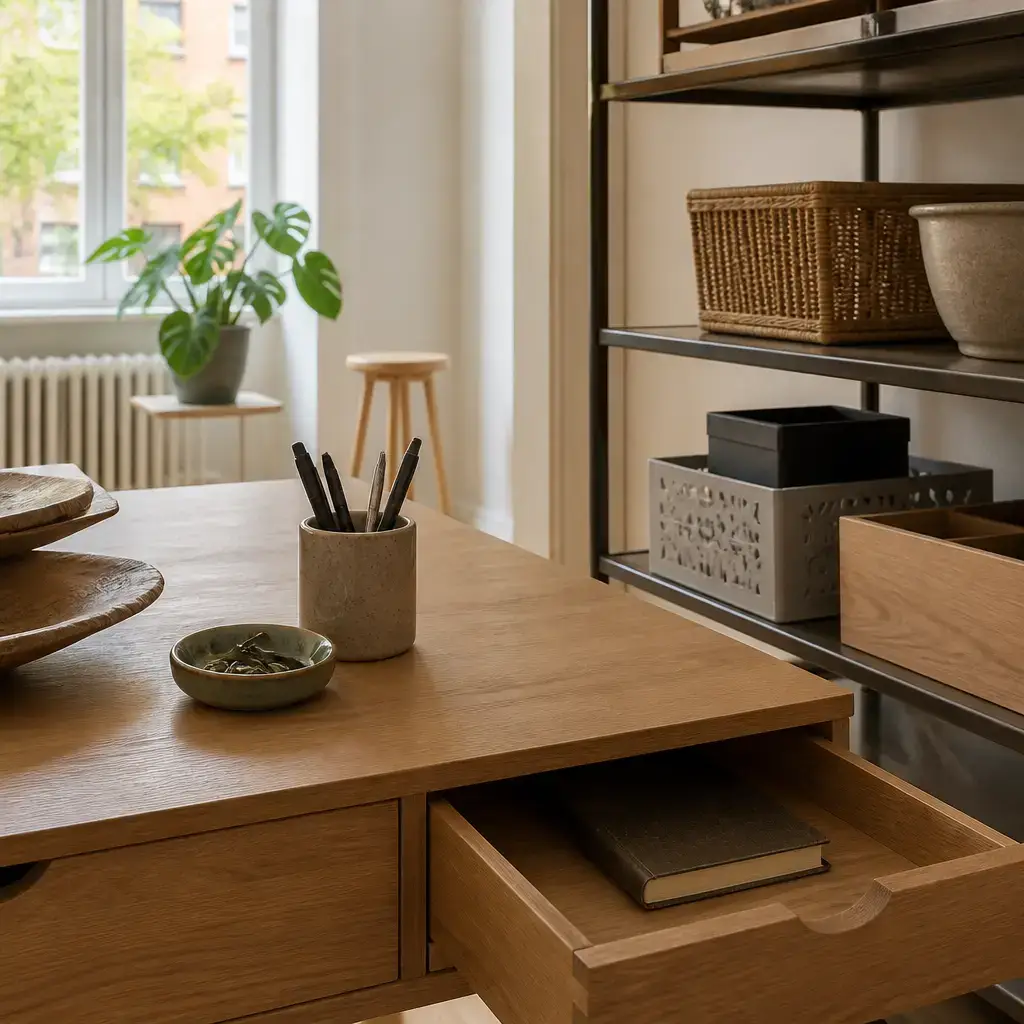
Use Borrowing a pen and notebook to practice Danish conversation, pronunciation, vocabulary, grammar, and quizzes.
Dialogue
Må jeg bruge en kuglepen?
moh yai BROO-uh uhn KOO-luh-payN? Can I use a pen?Tag den sorte fra koppen.
TAY den SOHR-duh frah KOH-buhn. Take the black one from the cup.Jeg skal også bruge en notesbog.
yai skel OH-suh BROO-uh uhn NOH-duhs-boh. I need a notebook too.Der er en gammel notesbog i skuffen.
dair air uhn GAY-muhl NOH-duhs-boh ee SKOO-fuhn. There is an old one in the drawer.Jeg skal bare skrive en kort liste.
yai skel BAH-uh SKREE-wuh uhn KORT LEHS-duh. I only need to write a short list.Tag begge med tilbage, når du er færdig.
TAY BEH-guh mayd tih-LAY-wuh, nohr doo air FAIR-dee. Bring both back when you finish.Jeg lægger dem på dit skrivebord.
yai LEH-guh dem poh dit SKREE-vuh-bohrd. I will put them on your desk.Så er de nemme at finde.
soh air dee NEH-muh uh FEN-uh. That makes them easy to find.Sentence explanations
Må jeg bruge en kuglepen?
Can I use a pen?
- Må jeg
- Can I …?
- bruge
- use
- kuglepen
- pen
More detail
Må jeg is a reusable Danish permission-question pattern: “May/Can I …?” Må is the present form of måtte and expresses permission here, while jeg means “I.” The following verb stays in the infinitive: Må jeg bruge ...? Example: Må jeg komme ind? — “May I come in?” bruge means “use” here. It is the infinitive form; after må, Danish uses the infinitive without an extra infinitive marker. Useful forms include bruger — “use/am using” in the present — and brugte — “used” in the past. Example: Jeg bruger en computer. — “I use a computer.” kuglepen means “ballpoint pen” and is a common compound noun. The indefinite article en before it marks an indefinite noun of the relevant noun class; it does not by itself assert a numerical count. Example: Jeg har en kuglepen. — “I have a ballpoint pen.” Together, Må jeg + infinitive bruge + en kuglepen forms a polite question asking for permission to use a pen: “Can I use a pen?”
Tag den sorte fra koppen.
Take the black one from the cup.
- Tag
- take
- den sorte
- the black one
- fra
- from
- koppen
- the cup
More detail
Tag is the imperative of tage (“to take”). It gives a direct instruction to the implied second-person subject: “Take …”. Compare the present-tense form tager: Du tager den means “You take it,” while Tag den is the command form. den sorte means “the black one.” den is the definite form used here for a singular common-gender referent, and sorte is the definite form of the adjective sort (“black”). Danish can use an adjective this way when the noun is understood but not repeated. The adjective still carries the definite ending: sort → sorte. This phrase identifies the intended item by its color without naming the item again. fra is a preposition meaning “from,” marking the place or source from which something is taken. A useful contrast is i (“in”): Bogen er i koppen means “The book is in the cup,” whereas Tag bogen fra koppen means “Take the book from the cup.” koppen means “the cup.” Its base form is kop (“cup”), and the ending -en marks the common-gender definite singular: en kop (“a cup”) → koppen (“the cup”). The phrase does not assert a number beyond the singular form of this noun. Together, Tag den sorte gives the command “Take the black one,” and fra koppen specifies the source location: “from the cup.” The complete utterance therefore means “Take the black one from the cup.”
Jeg skal også bruge en notesbog.
I need a notebook too.
- Jeg skal
- I must / I am going to
- bruge
- use
- også
- also; too
- notesbog
- notebook
More detail
Jeg skal combines the first-person singular pronoun Jeg (“I”) with skal, the present form of skulle. skal is a modal form: with a following infinitive, it can express necessity or a planned action. Here its necessity meaning becomes clear with bruge: Jeg skal læse can mean “I need to read” or, in another context, “I am going to read.” bruge means “use” in the infinitive. After the modal skal, the following verb stays in the infinitive: skal bruge. In the fixed utterance, skal bruge en notesbog means “need a notebook,” while bruge can also have its more literal meaning “use,” as in Jeg bruger en computer — “I use a computer.” også means “also” or “too.” Here it adds this need to something already relevant, giving the English effect “too.” Its position between skal and bruge does not make it part of either verb; it modifies the statement as a whole. Jeg skal også læse means “I also need to read.” notesbog means “notebook.” It is a compound noun formed from note (“note”) and bog (“book”), with the whole compound naming a notebook. It is a common-gender noun, so its indefinite form is en notesbog (“a notebook”). Its plural is notesbøger (“notebooks”); the noun changes from bog to bøger in that plural form. Together, Jeg skal + også + bruge + en notesbog means “I need a notebook too.” The article en marks the noun phrase as indefinite; it does not by itself state a numerical emphasis.
Der er en gammel notesbog i skuffen.
There is an old one in the drawer.
- Der er
- there is / there are
- gammel
- old
- notesbog
- notebook
- skuffen
- the drawer
More detail
Der er is the Danish existential pattern used to present or locate something: “there is” or “there are.” The item introduced comes after this pattern. Example: Der er en bog på bordet. — “There is a book on the table.” gammel means “old” here. It is the common-gender singular form of the adjective, agreeing with notesbog in en gammel notesbog. The useful forms are gammel with a common-gender singular noun, gammelt with a neuter singular noun, and gamle in plural or definite adjective phrases. Examples: en gammel stol — “an old chair”; et gammelt hus — “an old house.” notesbog means “notebook.” It is a compound noun. Its indefinite singular form is en notesbog, while its definite singular form is notesbogen. In this sentence, the noun is explicitly present even though the fixed English translation uses “one.” The preceding context makes “one” naturally understood as a notebook, but the target sentence does not by itself state that this is the same physical notebook as the one previously mentioned. skuffen means “the drawer.” It is the definite singular form of skuffe (“drawer”): en skuffe → skuffen. Danish commonly marks definiteness on the noun itself rather than with a separate word equivalent to English “the.” The location word i means “in.” Together, i skuffen means “in the drawer.” Combining the parts in source order, Der er introduces en gammel notesbog, “an old notebook,” and i skuffen gives its location. The complete meaning is “There is an old notebook in the drawer.” The fixed translation’s “an old one” is compatible because the context supplies “notebook” as the relevant kind of item.
Jeg skal bare skrive en kort liste.
I only need to write a short list.
- Jeg skal
- I need to
- bare
- only
- skrive
- write
- kort
- short
- liste
- list
More detail
Jeg skal combines the first-person pronoun jeg (“I”) with skal, followed by an infinitive. In this sentence, skal expresses need or obligation: “need to.” Danish skal can express other meanings in other contexts, such as a planned or expected action, so the intended meaning comes from the sentence context. The verb after skal stays in the infinitive: Jeg skal skrive means “I need to write.” bare means “only” here. It limits what the speaker needs to do: the task is only to write the list. It can also mean “just” in other contexts, but “only” is the relevant meaning here. skrive is the infinitive “to write.” Its base form is skrive; after the modal skal, Danish uses this infinitive rather than a separately marked English-style infinitive form. Example: Jeg skal læse. — “I need to read.” kort describes liste and means “short.” In en kort liste, it is the singular indefinite form used before a common-gender noun. The form kort does not show a separate common-gender versus neuter distinction; for example, et kort brev means “a short letter.” In plural or definite forms, the adjective is commonly korte, as in korte lister (“short lists”). liste is the common-gender noun “list.” Its indefinite singular form is en liste; a useful related form is the plural lister (“lists”). The noun is modified by kort, giving en kort liste — “a short list.” Together, Jeg skal + bare + skrive means “I only need to write,” and en kort liste adds the object and its description. The complete utterance therefore means: “I only need to write a short list.”
Tag begge med tilbage, når du er færdig.
Bring both back when you finish.
- Tag
- bring / take
- begge
- both
- med tilbage
- back with you
- når du er færdig
- when you are finished
More detail
Tag is the imperative of tage, “to take.” In this sentence, the intended action is bringing the items back. The imperative addresses one person and gives a reusable instruction: Tag bogen. — “Take the book.” begge means “both” and refers here to two items. It is a quantity word, not a form of the noun. A useful contrast is begge “both,” specifically for two, and alle “all,” which can refer to all members of a group of two or more. med tilbage is a reusable directional combination: med adds the sense of taking something along, and tilbage means “back.” Together here they mean bringing both items back to the relevant place or person. Tilbage can also be used without med, as in Kom tilbage. — “Come back.” når introduces a time clause meaning “when.” The clause after it gives the time at which the instruction applies. For example, Ring, når du er klar. means “Call when you are ready.” du is the singular second-person pronoun, “you.” The form itself does not identify which individual is being addressed. Danish also has the formal pronoun De, but du is the ordinary form used in this kind of direct instruction; it should not be treated as a uniquely informal form in every context. er is the present-tense form of være, “to be,” used here with du in the clause du er færdig. færdig means “finished” or “done.” Here it describes the addressee as finished, without specifying in this sentence what activity has been completed. In du er færdig, this common-gender singular form is used with the singular subject du; Danish adjectives can show other agreement forms in other environments, but the form here does not identify the addressee’s gender. The whole utterance is an instruction: Tag begge med tilbage means “Bring both back,” and når du er færdig specifies when to do it: “when you finish.” Together: “Bring both back when you finish.”
Jeg lægger dem på dit skrivebord.
I will put them on your desk.
- Jeg
- I
- lægger
- put
- dem
- them
- på
- on
- dit
- your
- skrivebord
- desk
More detail
Jeg is the Danish first-person singular subject pronoun: “I.” It identifies the speaker as the one carrying out the action. The corresponding object form is mig, “me.” lægger is the present-tense form of lægge, “to put/place.” Here it describes the speaker’s intended placement, and the fixed translation expresses that intention as “will put.” Danish present tense can refer to a future action when the context makes that intended timing clear; lægger itself is not a separate future form. Example: Jeg lægger bogen her. — “I put the book here.” dem means “them” here and is the object receiving the action. It is the third-person plural object pronoun; the corresponding subject form is de (“they”). In this utterance, it refers to the two items mentioned in the preceding context. på means “on” when something is placed on a surface. It introduces the location of the placement. Example: Koppen står på bordet. — “The cup is on the table.” dit means “your” before a singular neuter noun. Danish possessives agree with the thing possessed, not with the owner: din is used with a singular common-gender noun, while dine is used with a plural noun. Here dit agrees with skrivebord, which is a neuter noun (et skrivebord). skrivebord means “desk.” It is a neuter noun: et skrivebord (“a desk”), with plural skriveborde (“desks”) and definite singular skrivebordet (“the desk”). Together, Jeg lægger gives “I will put,” dem identifies the objects being put, and på dit skrivebord gives their destination, “on your desk.” The complete utterance therefore means “I will put them on your desk.”
Så er de nemme at finde.
That makes them easy to find.
- Så
- then
- er
- are
- de
- they; them
- nemme
- easy
- finde
- find
More detail
Så means “then” here and links this statement to the preceding situation: putting the items on the desk makes them easy to locate. Danish så can also mean “so” in other contexts, but this use points to a consequence. er is the present-tense form of være (“to be”). The same form is used with different subjects in the present: jeg er, de er. de is the subject pronoun “they” here, referring to the items mentioned in the fixed context. Danish distinguishes subject de from object dem: De ligger her means “They are lying here,” while Jeg ser dem means “I see them.” nemme means “easy” in its plural form. The adjective is based on nem; its forms include nem with a common-gender singular noun, nemt with a neuter singular noun, and nemme in the plural. Here nemme agrees with plural de. finde is the infinitive “find.” The pattern at finde means “to find”; at is the infinitive marker, not part of the verb’s base form. Example: Det er svært at finde nøglerne. — “It is difficult to find the keys.” Together, Så er de nemme at finde says that, as a result of the preceding placement, the items are easy for someone to locate: “That makes them easy to find.”
Grammar Points
Bestemt form med endelsen -en
koppen
KOH-buhnthe cup
Danish often marks a singular definite noun with a suffix: kop + -en = koppen.
Danish Vocabulary
- Gender
- common
- Gender
- common
- Gender
- common
- Gender
- common
Quiz
Word Order
Arrange the words in the correct order.
Can I use a pen?
Show Answer
Må jeg bruge en kuglepen?Take the black one from the cup.
Show Answer
Tag den sorte fra koppen.I need a notebook too.
Show Answer
Jeg skal også bruge en notesbog.Spelling
Tap the letters to spell the word.
pen; ballpoint pen
Show Answer
kuglepenthe drawer
Show Answer
skuffenblack
Show Answer
sortenotebook