10 minutes free every day
Continue audio lessons in the app
Word explanations appear automatically in sync with the audio.
No login required · synced translations · playback with the screen locked
Choose your learning language and open this lesson in the app.

About This Lesson
Use Cleaning up spilled water to practice Danish conversation, pronunciation, vocabulary, grammar, and quizzes.
Dialogue
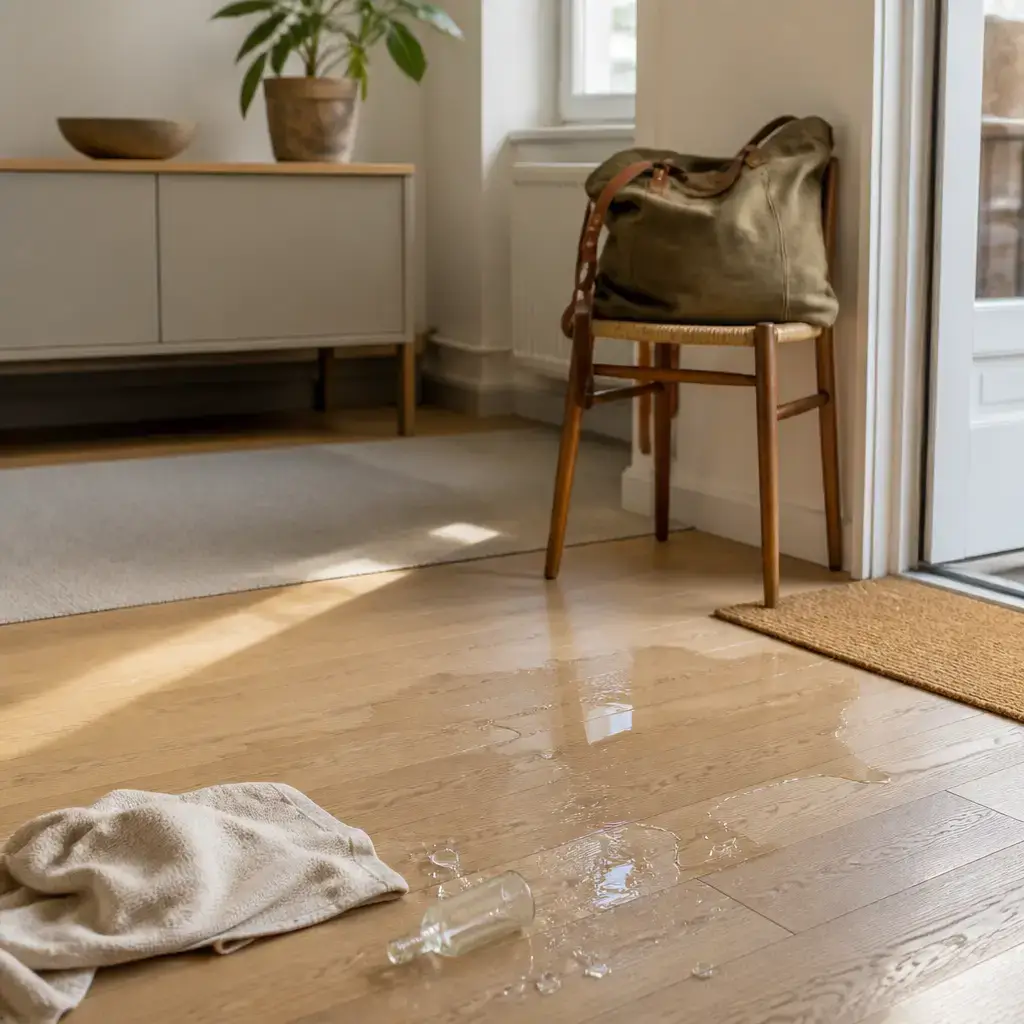
Der er vand på gulvet.
dair air VAN paw GOO-luh There is water on the floor.Det breder sig hen mod døren.
deh BRAY-uh sigh hen mohd DUHR-en It is spreading toward the door.Den lille flaske gik i stykker.
den LIL-uh FLAH-skeh gee' ee STUHK-er The small bottle broke.Jeg henter et tørt håndklæde.
yai HEN-ter ed TURT HAWN-klay-uh I will get a dry towel.Kan du flytte tasken først?
kan doo FLUU-duh TAS-guhn FURST Can you move the bag first?Jeg lægger den på stolen.
yai LEH-ger den paw STOH-luhn I will put it on the chair.Så kan vi gøre gulvet rent.
saw kan vee KUR-uh GOO-luh rent Then we can clean the floor.Tasken holder sig tør der.
TAS-guhn HAWL-er sigh TUR dair The bag will stay dry there.Sentence explanations
Der er vand på gulvet.
There is water on the floor.
- Der er
- there is / there are
- vand
- water
- på
- on
- gulvet
- the floor
More detail
Der er is the Danish existential pattern meaning “there is” or “there are.” Here er is the present-tense form of være (“to be”), while der is a formal subject used to introduce what exists; it is not the English place word “there” in this pattern. The pattern is reusable: Der er + noun. vand means “water.” It is normally a mass noun, so this sentence presents water as an uncounted substance rather than stating a number. The word keeps this form in the sentence; Danish can use a quantity expression when a specific amount matters, for example et glas vand — “a glass of water.” på means “on” here and introduces the surface or location where something is situated. It is a preposition; the choice of preposition depends on the spatial relation, so på is used for being on a surface in this example. gulvet means “the floor.” Its base form is gulv; -et marks the singular definite form, so gulvet means “the floor,” not simply “a floor.” Danish commonly puts this definiteness marking on the noun itself. For example, et gulv means “a floor,” while gulvet means “the floor.” Together, Der er vand introduces the existence of water, and på gulvet specifies its location. The complete utterance therefore means: “There is water on the floor.”
Det breder sig hen mod døren.
It is spreading toward the door.
- breder sig
- spreads
- hen mod
- toward
- døren
- the door
More detail
breder sig means “is spreading” here. The verb is the reflexive expression brede sig, “to spread”; breder is its present-tense form. Danish present-tense verbs do not change for person or number, so breder can occur with different subjects. The sig part refers back to the subject; together, the expression describes something extending over an area. Example: Røgen breder sig. — “The smoke is spreading.” hen mod means “toward” and presents movement or extension in the direction of something. It is a useful directional pattern: hen mod + a noun phrase. Example: Hun går hen mod døren. — “She walks toward the door.” døren means “the door” in this sentence. The base noun is dør, “door”; døren is its singular definite form, formed with the definite ending -en. The ending identifies one specific door in the relevant situation, rather than expressing a quantity. Example: Jeg lukker døren. — “I close the door.” Together, Det breder sig hen mod døren. says that the subject referred to by Det is spreading in the direction of the door: “It is spreading toward the door.”
Den lille flaske gik i stykker.
The small bottle broke.
- Den
- the
- lille
- small
- flaske
- bottle
- gik i stykker
- broke
More detail
Den is the definite article used here with a singular common-gender noun in an adjective–noun phrase. The noun flaske has the indefinite form en flaske “a bottle” and the definite form flasken “the bottle” when it stands without an adjective. With the adjective included, definiteness is marked by den: den lille flaske means “the small bottle.” For a neuter noun in the same kind of phrase, the corresponding form is det. lille means “small” here. It is the singular form of the adjective; the plural form is små, as in the example små flasker “small bottles.” In this phrase, lille has the same written form used in the definite adjective phrase; it does not change visibly to an additional -e form. flaske means “bottle.” Its common-gender indefinite form is en flaske, and its plural is flasker. In den lille flaske, the adjective describes this noun and the phrase is definite. gik i stykker is the past-tense form of the construction gå i stykker, meaning “break” or “become broken.” Although gik is also the past form of gå “go,” in this construction it does not mean that the bottle went somewhere. Here it presents the breaking as having happened in the past. Together, den lille flaske is the subject “the small bottle,” and gik i stykker says that it broke. The complete meaning is “The small bottle broke.”
Jeg henter et tørt håndklæde.
I will get a dry towel.
- Jeg
- I
- henter
- get; fetch
- tørt
- dry
- håndklæde
- towel
More detail
Jeg means “I” here: the speaker is the person who will get the towel. It is the Danish first-person singular subject pronoun. A useful contrast is du, “you” when addressing one person. Example: Jeg kommer. — “I am coming.” henter is the present-tense form of hente, “to get” or “to fetch.” In this sentence, the present form refers to a planned or intended future action, as shown by the fixed translation “I will get.” The subject Jeg tells us who performs the action. Example: Jeg henter tasken. — “I will get the bag.” tørt means “dry” here. Its base form is tør; the observed form tørt agrees with the neuter singular noun håndklæde, introduced by et. This is an adjective inflection: tør with a common-gender singular noun, but tørt with a neuter singular noun. Example: et tørt håndklæde — “a dry towel.” håndklæde means “towel.” It is a neuter noun, so its indefinite singular form uses et: et håndklæde, “a towel.” Its plural is håndklæder, “towels.” Example: Jeg bruger et håndklæde. — “I use a towel.” Together, Jeg henter identifies the speaker as the person carrying out the getting, while et tørt håndklæde identifies the object as a dry towel. The indefinite article et introduces the noun phrase; here it does not by itself assert a numerical count. The complete utterance means “I will get a dry towel.”
Kan du flytte tasken først?
Can you move the bag first?
- Kan du
- Can you
- flytte
- move
- tasken
- the bag
- først
- first
More detail
Kan du combines the present form kan of kunne (“can/be able to”) with the subject pronoun du (“you”). In this yes/no question, the verb comes before the subject: Kan du ...? is a reusable pattern for asking whether someone can or is willing to do something. Kan du åbne vinduet? means “Can you open the window?” flytte is the infinitive of flytte, “to move.” After the modal kan, Danish uses the infinitive without at: kan flytte means “can move.” The present form is flytter, as in Jeg flytter stolen (“I am moving the chair”). tasken means “the bag” here. Its base form is taske; tasken is the definite singular form, marked by the ending -en. For example, en taske means “a bag,” while tasken means “the bag.” først means “first,” indicating that the moving should happen before the other relevant actions. It can also be contrasted with sidst (“last”): Flyt tasken først means “Move the bag first,” while Flyt tasken sidst means “Move the bag last.” Together, Kan du + flytte forms a request framed as a question, tasken identifies the object as the bag, and først specifies the order. The complete utterance therefore means “Can you move the bag first?”
Jeg lægger den på stolen.
I will put it on the chair.
- Jeg
- I
- lægger
- put / place
- den
- it
- på
- on
- stolen
- the chair
More detail
Jeg means “I” here, the first-person singular subject. It identifies the person carrying out the action. In Danish, the subject pronoun is jeg; for example, Jeg kommer means “I am coming.” lægger is the present-tense form of lægge, “to put” or “to place.” The present form can describe an action happening now or a planned/immediate action; in this sentence, the fixed translation and context give it the intended future meaning “will put.” Do not confuse it with ligger, which means “lies/is located”: Jeg lægger bogen på bordet means “I put the book on the table,” while Bogen ligger på bordet means “The book is on the table.” den is a singular common-gender pronoun meaning “it” in this use. It is the object being put, and the supplied context identifies that object as the bag mentioned previously. Danish uses den for a common-gender singular referent; a neuter singular referent uses det instead. på means “on” and marks the surface or position involved in the placement. The reusable pattern is lægge noget på noget, “put something on something.” stolen means “the chair.” Its base noun is stol, “chair”; the ending -en makes it definite singular: en stol = “a chair,” stolen = “the chair.” This form names the surface or place where the object will be put. Together, Jeg lægger den gives “I will put it,” and på stolen specifies the destination or surface, “on the chair.” The complete utterance therefore means “I will put it on the chair.”
Så kan vi gøre gulvet rent.
Then we can clean the floor.
- Så
- then
- kan vi
- we can
- gøre
- do; make
- gulvet
- the floor
- rent
- clean
More detail
Så means “then” here, marking the action as the next step in a sequence. Danish så can also mean “so” in other contexts, but the fixed translation supports the time-sequence meaning here. kan vi contains kan, the present-tense form of kunne (“can; be able to”), followed by vi (“we”). Kan is a modal verb, so the following verb appears in the infinitive without at: vi kan gøre = “we can clean/do.” Because Så comes first, Danish places the finite verb before the subject: Så kan vi .... Compare the neutral order Vi kan ... (“We can ...”). gøre is the infinitive of gøre (“do; make”). In this utterance, gøre ... rent means “make ... clean,” so it is more specifically understood as “clean” here. After the modal kan, the infinitive is used directly: kan gøre, not kan at gøre. gulvet means “the floor.” Its base form is gulv; the ending -et marks the definite form, “the floor.” The noun is the object of gøre. Example: Jeg vasker gulvet. — “I wash the floor.” rent means “clean” here. It is the form of the adjective ren used with the neuter singular noun gulvet in this object-plus-description construction: gøre gulvet rent = “make the floor clean.” The adjective describes the resulting state of the floor, rather than functioning as a separate object. Example: Hun gør bordet rent. — “She cleans the table.” Together, gøre gulvet rent literally presents the action as making the floor clean. The initial Så places this action next in the sequence, and kan vi expresses ability or possibility. The whole utterance therefore means: “Then we can clean the floor.”
Tasken holder sig tør der.
The bag will stay dry there.
- Tasken
- the bag
- holder sig
- stays; remains
- tør
- dry
- der
- there
More detail
Tasken means “the bag” here. It is the definite singular form of taske (“bag”): taske = a bag, tasken = the bag. The initial capital letter is required here because it begins the sentence. holder sig is the reusable Danish reflexive pattern “stays/remains” when describing a subject’s continuing state. holder is the present-tense form of holde (“to hold/keep”), and sig is the reflexive form used with a third-person subject. In this construction, holde sig + adjective means “stay/remain + adjective.” Example: Hun holder sig rolig. — “She stays calm.” tør means “dry” in this sentence and describes the bag’s resulting or continuing condition. The adjective’s base form is tør; useful forms include tørt with a neuter singular noun and tørre in the plural or definite contexts where that form is required. With the common-gender singular tasken, the form here is tør. Example: Håndklædet er tørt. — “The towel is dry.” der means “there,” indicating the place where the bag will remain dry. It is a place adverb, not part of the reflexive construction. Together, Tasken holder sig tør says that the bag remains dry, and der places that state there. The complete intended meaning is: “The bag will stay dry there.” Danish uses the present form holder here; the English future wording is supplied by the intended context and does not mean that a separate Danish future auxiliary appears in the sentence.
Grammar Points
holde sig + adjektiv
holder sig tør
HAWL-er sigh TURstays dry
The reflexive sig is part of the expression: literally “holds itself dry,” meaning “stays dry.”
gå i stykker
gik i stykker
gee' ee STUHK-erbroke / was broken
Danish uses i stykker for something that breaks or becomes broken; it is not translated word for word.
Danish Vocabulary
Det breder sig hen mod døren.
- Gender
- common
Det breder sig hen mod døren.
- Gender
- common
Den lille flaske gik i stykker.
Kan du flytte tasken først?
- Gender
- common
Der er vand på gulvet.
Den lille flaske gik i stykker.
Det breder sig hen mod døren.
Jeg henter et tørt håndklæde.
- Gender
- neuter
Jeg henter et tørt håndklæde.
Den lille flaske gik i stykker.
- Gender
- neuter
Jeg henter et tørt håndklæde.
- Gender
- neuter
Der er vand på gulvet.
Quiz
Word Order
Arrange the words in the correct order.
There is water on the floor.
Show Answer
Der er vand på gulvet.It is spreading toward the door.
Show Answer
Det breder sig hen mod døren.The small bottle broke.
Show Answer
Den lille flaske gik i stykker.Spelling
Tap the letters to spell the word.
floor
Show Answer
gulvetget; fetch
Show Answer
henterwater
Show Answer
vandbottle