10 minutes free every day
Continue audio lessons in the app
Word explanations appear automatically in sync with the audio.
No login required · synced translations · playback with the screen locked
Choose your learning language and open this lesson in the app.

About This Lesson
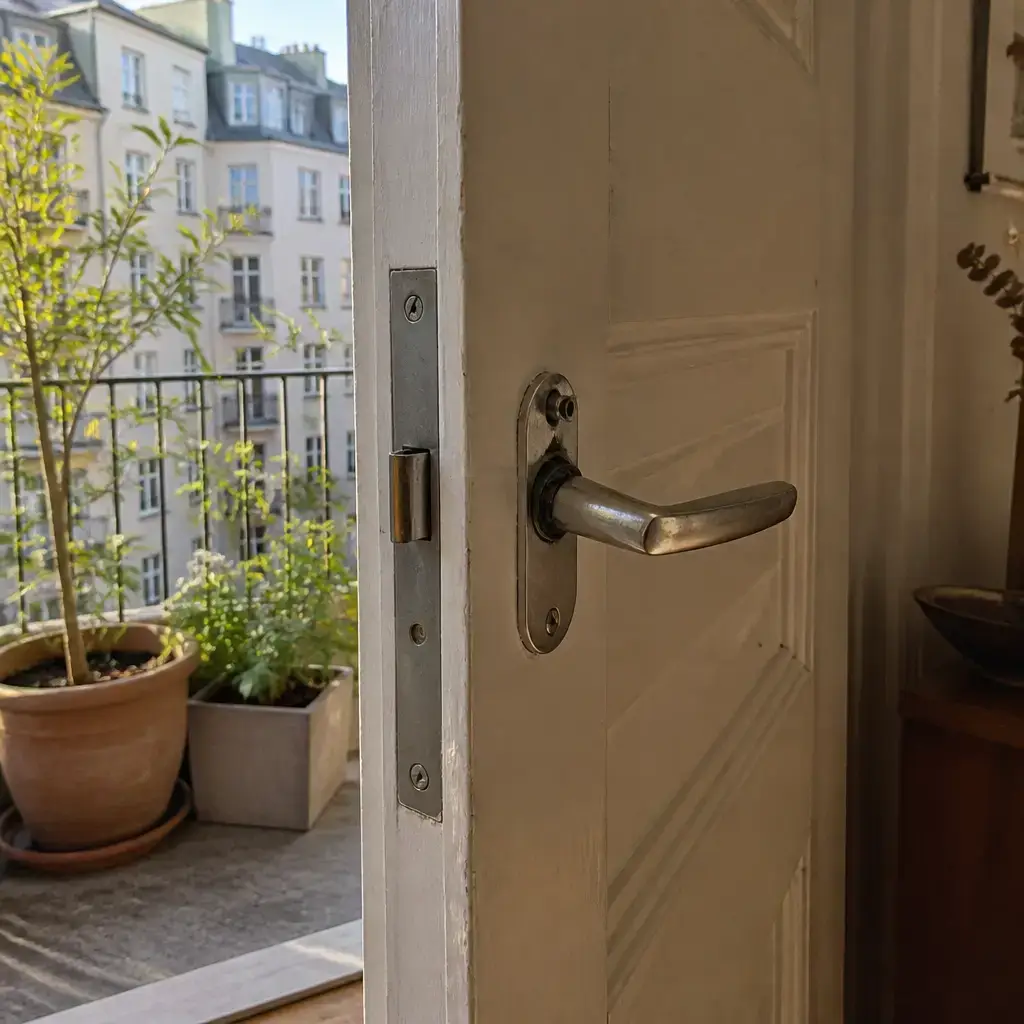
Use A Stuck Door and a Loose Handle to practice Danish conversation, pronunciation, vocabulary, grammar, and quizzes.
Dialogue
Døren sidder fast.
DUH-uhn SEE-thuh FAST The door is stuck.Prøv at trække i håndtaget.
PRUHV at TREK-uh ee HAWN-teh-th Try pulling the handle.Jeg trak i håndtaget, men døren er stadig lukket.
YAI TRAHK ee HAWN-teh-th, men DUH-uhn air STAY-thee LOO-guth I pulled it, but it stays closed.Skub langsomt tæt på kanten.
SKOOB LAHNG-sohmt TET poh KAN-den Push near the edge slowly.Døren åbnede lidt.
DUH-uhn AWB-nuh-thuh lit It opened a little.Håndtaget føles løst.
HAWN-teh-thuhth FUH-luhs LUHST The handle feels loose.Skal vi holde op med at bruge denne dør?
SKAL vee HOL-uh AWP meh at BROO-uh DEN-uh DUH-uh Should we stop using this door?Vi kan reparere håndtaget, før nogen sidder fast igen.
VEE kan reh-pah-REH-uh HAWN-teh-thuhth, FUHR NOH-wun SEE-thuh FAST ee-GEHN We can fix the handle before anyone gets stuck again.Sentence explanations
Døren sidder fast.
The door is stuck.
- Døren
- the door
- sidder fast
- is stuck
More detail
Døren is the definite singular form of dør, “door”: dør = a door, while døren = the door. Danish commonly marks definiteness by an ending rather than a separate word before the noun. The -en ending belongs to the noun and is used here with this common-gender noun. sidder fast is a reusable Danish expression meaning that something is stuck or cannot move freely. sidder is the present-tense form of sidde; although sidde often means “sit,” in this expression it describes an object remaining fixed in place. fast contributes the idea of being firmly fixed. For example: Skuffen sidder fast. — “The drawer is stuck.” Together, Døren identifies the door, and sidder fast says that it is stuck. The complete meaning is: “The door is stuck.”
Prøv at trække i håndtaget.
Try pulling the handle.
- Prøv
- try
- trække
- pull
- håndtaget
- the handle
More detail
Prøv is the imperative of prøve, “to try.” The imperative addresses the listener directly and normally has no written subject. A very useful Danish pattern is prøv at + infinitive: “try to …” or, as here, “try …-ing.” Example: Prøv at åbne vinduet. — “Try opening the window.” trække is the infinitive “to pull.” Its present form is trækker, and its past form is trak; the context’s trak means “pulled.” In this sentence, the infinitive follows at after prøv. With the object phrase, Danish uses trække i for pulling on or at something: trække i håndtaget means “pull the handle.” håndtaget means “the handle.” The base noun is håndtag; the ending -et marks definite singular for this noun, so håndtaget refers to one specific handle. Danish definite forms depend on the noun’s grammatical form; this ending is part of the noun form, not an article standing separately before it. Example: Jeg holder i håndtaget. — “I am holding the handle.” Together, Prøv at trække i håndtaget forms an imperative suggestion: “Try pulling the handle.” Prøv supplies the direct instruction to try, at trække names the action to try, and i håndtaget identifies what the pulling is directed at.
Jeg trak i håndtaget, men døren er stadig lukket.
I pulled it, but it stays closed.
- trak
- pulled
- i
- in / on
- håndtaget
- the handle
- men
- but
- døren
- the door
- er
- is
- stadig
- still
- lukket
- closed
More detail
trak is the past form of trække, “to pull.” Danish verbs do not change for the subject’s person or number, so trak can be used with jeg (“I”) as here. Present trækker means “pulls/am pulling,” while past trak places the pulling before the current situation. i is a preposition meaning “in” or “on” in this expression. The construction trække i [something] means “pull [something],” often with the idea of pulling it by or on a part such as a handle. In the supplied context, i håndtaget identifies the handle involved in the pulling. håndtaget means “the handle” here. Its base noun is håndtag, “handle.” The ending -et marks the definite singular form of this neuter noun: et håndtag → håndtaget. In i håndtaget, the noun is the object of the preposition. men means “but” and links two clauses with a contrast. The first clause reports the pulling; the second gives the continuing result concerning the door. døren means “the door.” Its base noun is dør; the definite singular form is døren, using -en: en dør → døren. The form is the subject of the second clause here. er is the present form of være, “to be.” It is used with subjects of any person and number, including døren. In er lukket, it connects the door with its current state. stadig means “still.” It marks a state that continues up to the relevant present point. For example, Døren er stadig åben. means “The door is still open.” lukket means “closed” here. It is related to the verb lukke, “to close,” and functions here as a state description after er. er lukket says that the door is closed; stadig adds that this state continues. It does not by itself say who closed the door. A useful contrast is åben, “open.” The whole utterance is assembled as Jeg trak i håndtaget (“I pulled it” / “I pulled the handle”) followed by men døren er stadig lukket (“but the door is still closed”). The supplied context identifies the handle as what is being pulled. Thus the sentence reports a past pulling action and contrasts it with the door’s continuing present state: “I pulled it, but it stays closed.”
Skub langsomt tæt på kanten.
Push near the edge slowly.
- Skub
- push
- langsomt
- slowly
- tæt på
- near
- kanten
- the edge
More detail
Skub is the imperative of skubbe, “to push.” It gives a direct instruction without stating the subject: the addressee is understood as the person who should push. Compare Skub døren. — “Push the door.” The object can be added after the verb when needed. langsomt means “slowly” here and describes how the pushing should happen. It is an adverb, so it modifies the action rather than naming a thing. Example: Gå langsomt. — “Walk slowly.” tæt på is a reusable Danish expression meaning “near” or “close to.” Tæt contributes the idea of closeness, while på is the preposition used in this expression. Example: Hun står tæt på vinduet. — “She is standing close to the window.” kanten means “the edge.” Its base form is kant, “edge,” and kanten is the definite singular form, corresponding to “the edge.” Danish commonly marks definiteness on the noun itself: en kant means “an edge,” while kanten means “the edge.” Example: Bogen ligger ved kanten. — “The book is by the edge.” Together, Skub langsomt tæt på kanten. gives the instruction “Push slowly near the edge.” The imperative Skub supplies the action, langsomt specifies its manner, and tæt på kanten specifies the location relative to the edge. The sentence does not state an explicit subject; Danish imperative instructions can leave the addressee understood.
Døren åbnede lidt.
It opened a little.
- Døren
- the door
- åbnede
- opened
- lidt
- a little
More detail
Døren means “the door” here. It is the definite singular form of dør (“door”): en dør = “a door,” døren = “the door.” The ending -en marks definiteness for this common-gender noun; it does not itself indicate a numeric count. åbnede means “opened” here. It is the past-tense form of åbne (“to open”). Danish åbne can describe something opening by itself as well as someone opening something; in this sentence, the door is the subject and no separate opener is stated. Example: Hun åbnede døren. — “She opened the door.” lidt means “a little” and limits the extent of the opening. It is an adverb here, so it does not change to agree with Døren. The same word can also modify an amount in other contexts, as in lidt vand — “a little water.” Together, the subject Døren, the past-tense verb åbnede, and the extent adverb lidt produce: “The door opened a little.” The sentence states a small amount of opening, without stating who or what caused it.
Håndtaget føles løst.
The handle feels loose.
- Håndtaget
- the handle
- føles
- feels
- løst
- loose
More detail
Håndtaget means “the handle” here. It is the definite singular form of håndtag (“handle”): et håndtag is “a handle,” while håndtaget is “the handle.” The ending -et marks the neuter noun in the definite singular; it is not a separate word. Example: Jeg tog fat i håndtaget. — “I grabbed the handle.” føles means “feels” in the sense of giving a particular sensory impression. It is the present-tense form used with the third-person subject håndtaget; the construction X føles + adjective describes how X seems when experienced by touch or another sense. Example: Stoffet føles blødt. — “The fabric feels soft.” løst means “loose” here. Its base form is løs; løst is the neuter singular form, agreeing with the neuter noun håndtaget. With a common-gender singular noun, the corresponding form is løs, and in the plural or definite form the adjective is generally løse: en løs skrue, et løst håndtag, løse skruer — “a loose screw,” “a loose handle,” “loose screws.” Together, Håndtaget føles løst. says that the handle gives the impression of being loose: “The handle feels loose.”
Skal vi holde op med at bruge denne dør?
Should we stop using this door?
- Skal vi
- should we
- holde op med
- stop doing
- bruge
- use
- denne
- this
- dør
- door
More detail
Skal vi combines the modal verb skal with the pronoun vi (“we”). In this question, skal expresses a proposal or question about what the speakers ought to do: “should we…?” In other contexts, skal can also express planned or expected future action, so its meaning depends on the surrounding clause. holde op med is a reusable construction meaning “stop” or “cease.” With an action, use the pattern holde op med at + infinitive: holde op med at bruge means “stop using.” The verb holde is in the infinitive here because it follows the modal skal; the fixed expression itself contributes the stopping meaning. bruge is the infinitive “use.” Its present-tense form is bruger, as in the example Vi bruger døren — “We use the door.” In the fixed sentence, bruge names the action that should stop. denne means “this” and points to one nearby or contextually identified common-gender singular noun. Danish contrasts it with dette for a singular neuter noun and disse for plural nouns. The form itself does not identify why this door is being discussed. dør means “door.” It is a common-gender noun: en dør is “a door,” and døren is “the door.” Here it appears after the demonstrative in the combination denne dør, “this door.” Together, Skal vi asks for a shared decision, while holde op med at bruge denne dør specifies the proposed action: stopping the use of this door. The complete meaning is “Should we stop using this door?”
Vi kan reparere håndtaget, før nogen sidder fast igen.
We can fix the handle before anyone gets stuck again.
- Vi kan
- we can
- reparere
- fix; repair
- håndtaget
- the handle
- før
- before
- nogen
- anyone
- sidder fast
- is stuck
- igen
- again
More detail
Vi kan means “we can”: vi is the first-person plural pronoun “we,” and kan is the present-tense form of kunne (“can/be able to”). After a modal such as kan, Danish normally uses the infinitive without at: Vi kan reparere = “We can repair.” reparere means “to repair” or “to fix.” It is an infinitive here because it follows the modal kan. Example: Jeg kan reparere cyklen. — “I can repair the bicycle.” håndtaget means “the handle.” The base noun is et håndtag (“a handle”); its singular definite form is håndtaget, formed with the definite ending -et. The ending belongs to the noun, not to the verb or the preceding modal. før introduces a clause meaning “before.” It connects the repair with the later situation: reparere håndtaget, før ... = “repair the handle before ...”. nogen means “anyone” in this negative-free context. It is an indefinite pronoun referring to an unspecified person. Example: Hvis nogen ringer, svarer jeg. — “If anyone calls, I will answer.” sidder fast is a fixed expression meaning “is stuck” or, in this context, “gets stuck.” sidder is the present form of sidde (“sit”), while fast contributes the sense of being unable to move; together they express the stuck state rather than simply ordinary sitting. Danish present tense can be used in the subordinate clause after før for a future situation: før nogen sidder fast = “before anyone gets stuck.” igen means “again.” It shows that the situation of getting stuck is recurring: sidder fast igen = “gets stuck again.” Together, Vi kan reparere håndtaget says “We can fix the handle.” The clause før nogen sidder fast igen adds the time condition “before anyone gets stuck again.” The complete utterance therefore means: “We can fix the handle before anyone gets stuck again.”
Grammar Points
føles + adjektiv
Døren føles lidt løs.
DUH-uhn FUH-luhs lit LUHSThe door feels a little loose.
Efter føles bruger dansk et adjektiv, ikke et adverbium: Døren føles lidt løs.
Prøv at + infinitiv
Prøv at skubbe.
PRUHV at SKOOB-uhTry to push.
Efter imperativet Prøv står at + infinitiv: Prøv at skubbe.
Danish Vocabulary
- Gender
- common
- Gender
- neuter
- Gender
- common
Quiz
Word Order
Arrange the words in the correct order.
The door is stuck.
Show Answer
Døren sidder fast.Try pulling the handle.
Show Answer
Prøv at trække i håndtaget.Push near the edge slowly.
Show Answer
Skub langsomt tæt på kanten.Spelling
Tap the letters to spell the word.
pull
Show Answer
trækkepush
Show Answer
Skubtry
Show Answer
Prøvhandle