10 minutes free every day
Continue audio lessons in the app
Word explanations appear automatically in sync with the audio.
No login required · synced translations · playback with the screen locked
Choose your learning language and open this lesson in the app.

About This Lesson
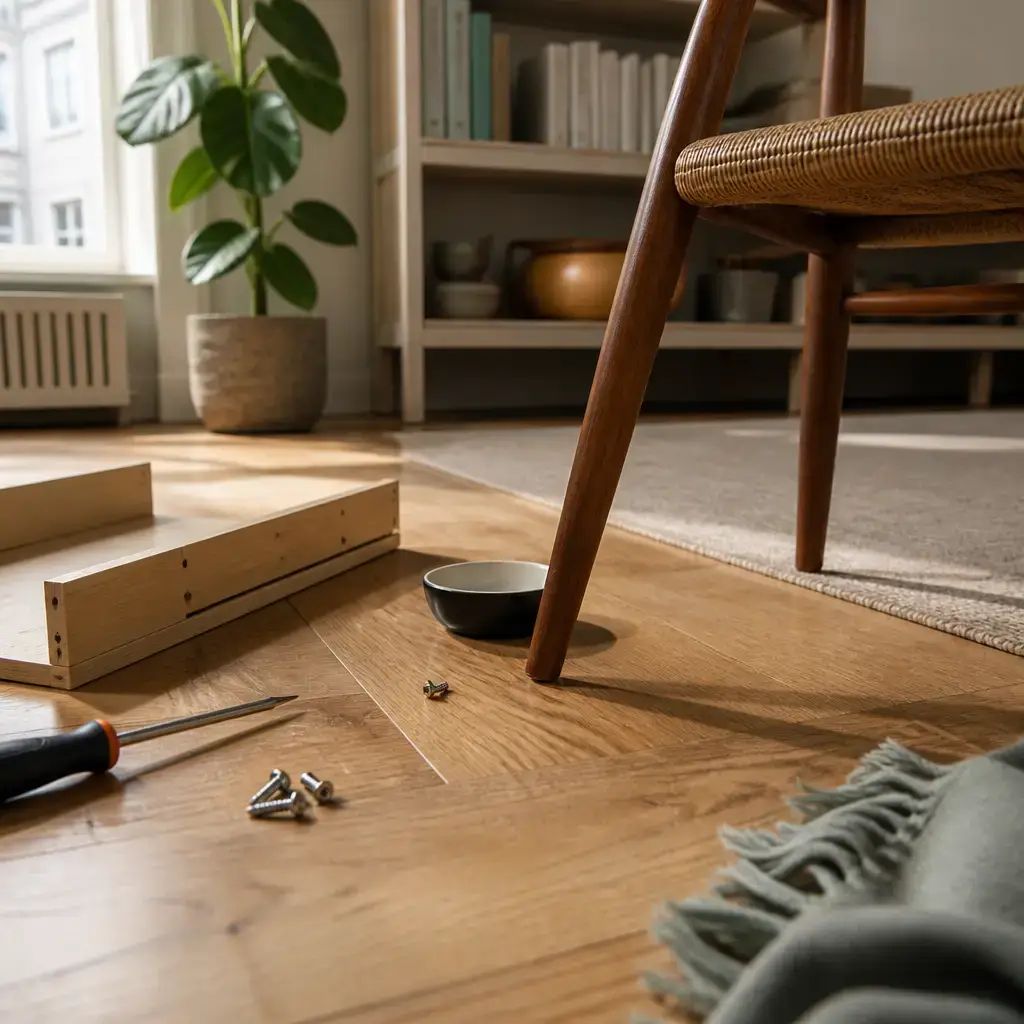
Use Finding a small screw to practice Danish conversation, pronunciation, vocabulary, grammar, and quizzes.
Dialogue
Jeg har mistet en lille skrue.
yai har MIS-duh en LIL-uh SKROO-uh I lost a small screw.Tjek under stolen.
CHEK UN-uh STOH-len Check under the chair.Den lå ved stolebenet.
den loh veh STOH-luh-BEH-neth It was by the chair leg.Saml den forsigtigt op.
SAML den fer-SIGT-ehd op Pick it up carefully.Den er meget lille.
den air MY-eth LIL-uh It is tiny.Hold den i håndfladen, så den ikke ruller væk igen.
HOHL den ee HON-fleh-den, soh den IK-uh ROL-uh vayk uh-GEN Hold it in your palm so it does not roll away again.Vi skal bruge den til at reparere hylden.
vee sgal BROO-uh den til ehd reh-pah-RAIR-uh HÜL-en We need it to fix the shelf.Så kan vi blive færdige med at reparere den.
soh kan vee BLEE-vuh FAIR-dee-eh meh ehd reh-pah-RAIR-uh den Then we can finish fixing it.Sentence explanations
Jeg har mistet en lille skrue.
I lost a small screw.
- Jeg
- I
- har mistet
- have lost
- lille
- small
- skrue
- screw
More detail
Jeg means “I” here: the speaker is the person who lost the screw. Danish personal pronouns include jeg (“I”), du (“you”), and han/hun (“he”/“she”). Example: Jeg kommer. — “I am coming.” har mistet expresses the completed event “have lost.” har is the present-tense form of have (“to have”), and mistet is the past participle of miste (“to lose”). Danish commonly forms the perfect with har + a past participle: Jeg har set den. — “I have seen it.” In this sentence, the fixed English translation presents the same completed event as “I lost.” lille means “small” and describes skrue. With an indefinite singular common-gender noun such as en skrue, the adjective is lille; with plural nouns it is små, as in små skruer (“small screws”). Example: en lille bog — “a small book.” skrue means “screw,” the object that was lost. It is a common-gender noun: en skrue; its definite singular form is skruen (“the screw”), and its plural is skruer (“screws”). Together, Jeg har mistet means “I have lost,” and en lille skrue means “a small screw.” The full utterance therefore means “I lost a small screw.”
Tjek under stolen.
Check under the chair.
- Tjek
- check
- under
- under
- stolen
- the chair
More detail
Tjek is the imperative of tjekke, meaning “to check.” The imperative gives a direct instruction; the person being addressed is understood rather than stated. Compare Tjek døren. — “Check the door.” under is a preposition meaning “under” or “beneath.” It introduces the location being checked here. For example, Katten er under bordet. means “The cat is under the table.” stolen means “the chair.” It is the definite singular form of stol (“chair”): stol = “a chair” in an indefinite singular use, while stolen = “the chair.” The ending -en marks definiteness for this noun; it is not a separate word. The fixed translation identifies the referent as a chair. Together, Tjek gives the instruction, and under stolen specifies the location: “under the chair.” The complete utterance means “Check under the chair.”
Den lå ved stolebenet.
It was by the chair leg.
- Den
- it
- lå
- was lying
- ved
- by; near
- stolebenet
- chair leg
More detail
Den is the Danish common-gender singular pronoun meaning “it” here. It refers to the item already in focus, but the sentence itself does not identify that item by name. Danish uses den for a common-gender singular noun; the corresponding neuter singular form is det. This is a pronoun, not the definite article before a noun. lå is the past tense of ligge, “to lie” or “be lying.” The form describes the item’s location as an existing position in the past: it was lying by the chair leg. Compare present ligger “is lying” and past lå “was lying.” For example: Bogen lå på bordet. — “The book was lying on the table.” ved is a preposition meaning “by” or “near.” It places something close to a reference point. For example: Hun står ved døren. — “She is standing by the door.” stolebenet means “the chair leg.” It is the definite singular form of stoleben (“chair leg”): stoleben + -et → stolebenet. The compound contains stol (“chair”) and ben (“leg”); the linking -e- in stoleben is part of the compound form, not a separate word. Ben is a neuter noun: et ben means “a leg,” while benet means “the leg.” Together, Den lå says “It was lying,” ved adds the location “by,” and stolebenet identifies that location as “the chair leg.” The complete utterance therefore means: “It was by the chair leg.”
Saml den forsigtigt op.
Pick it up carefully.
- Saml … op
- pick up
- den
- it
- forsigtigt
- carefully
More detail
Saml ... op is a reusable Danish pattern meaning “pick up”. Saml is the imperative of samle (“to collect; to gather”), so it gives a direct instruction. Op is a particle that adds the upward/away-from-the-surface part of the action. The two parts are separated here by the object, but they work together as saml [something] op. Den is a singular pronoun for a common-gender referent and is the object being picked up. In this context, the fixed translation identifies it as the item already mentioned in the surrounding text. Danish also uses den as a determiner before a common-gender noun, but here it stands alone as a pronoun. Forsigtigt is an adverb meaning “carefully” or “gently”. It describes how the picking-up should be done. Compare the adjective forsigtig (“careful”) with the adverbial form forsigtigt: Hun løfter glasset forsigtigt. — “She lifts the glass carefully.” Together, Saml den forsigtigt op means “Pick it up carefully.” The imperative saml addresses the listener directly; den names the object, forsigtigt specifies the manner, and op completes the “pick up” construction.
Den er meget lille.
It is tiny.
- Den
- it
- er
- is
- meget
- very
- lille
- small
More detail
Den is the Danish third-person singular pronoun used here for “it.” In this context it refers to the same item mentioned in the surrounding utterances. Danish distinguishes den for a common-gender singular referent from det for a neuter-gender singular referent; both can correspond to English “it.” er is the present-tense form of være, “to be.” A reusable pattern is den/det er + adjective, meaning “it is + adjective.” Example: Det er varmt. — “It is warm.” meget means “very” here and strengthens the following adjective. It is placed before the adjective: meget lille means “very small,” not merely “small.” lille means “small” here. Its base form is lille; useful comparison forms are mindre (“smaller”) and mindst (“smallest”). In Danish, lille has the same form with singular common-gender and neuter-gender nouns, while the plural form is små. Example: Koppen er lille. — “The cup is small.” Together, Den er meget lille forms the pattern pronoun + present form of “be” + intensifier + adjective: “It is very small.” In the fixed translation, the intensity is rendered naturally as “tiny.”
Hold den i håndfladen, så den ikke ruller væk igen.
Hold it in your palm so it does not roll away again.
- Hold
- hold; keep
- den
- it
- i håndfladen
- in the palm
- så
- so that
- ikke
- not
- ruller væk
- rolls away
- igen
- again
More detail
Hold is the imperative of holde (“to hold” or “to keep”). The imperative addresses the listener directly and gives an instruction. For example: Hold døren åben. — “Keep the door open.” den means “it” here and is the object of Hold. It is a singular common-gender pronoun; its specific referent is the small object established by the surrounding context. Danish object pronouns can differ from subject pronouns: den is used for a common-gender singular thing in this object position. i håndfladen means “in the palm of the hand.” håndfladen is the definite form of the noun håndflade (“palm of the hand”): en håndflade → håndfladen. The preposition i places the object inside or within the palm. For example: Hun har nøglen i håndfladen. — “She has the key in her palm.” så introduces the intended result or purpose of the instruction, approximately “so that.” In this sentence, it connects holding the object in the palm with preventing it from rolling away. ikke negates the following situation. Here it makes the rolling-away event negative: the object should not roll away. ruller væk means “rolls away.” ruller is the present-tense form of rulle (“to roll”); in this clause, the subject is the same object referred to by den. væk adds movement away from the relevant location. For example: Bolden ruller væk. — “The ball rolls away.” igen means “again,” indicating that the rolling away is to be prevented from happening another time. It does not itself specify how many earlier occasions there were. Together, Hold den i håndfladen gives the instruction “Hold it in your palm.” The purpose clause så den ikke ruller væk igen says “so that it does not roll away again.” The complete utterance therefore means: “Hold it in your palm so it does not roll away again.”
Vi skal bruge den til at reparere hylden.
We need it to fix the shelf.
- Vi skal
- we must / are to
- bruge
- use
- den
- it
- til at
- to
- reparere
- repair
- hylden
- the shelf
More detail
Vi skal contains vi, the first-person plural pronoun “we,” and skal, the present form of the modal verb skulle. Skal has the same present form with different subjects, so it is not a special form only for vi. Here, with the following infinitive, it expresses necessity; together with bruge, it gives “we need to use.” Depending on context, skal can also express a planned or expected action: Jeg skal gå can mean “I need to go” or “I am going to go.” bruge is the infinitive “to use.” After skal, Danish places the infinitive directly after the modal, without an equivalent of English “to”: Vi skal bruge ... means “We need to use ...”. den means “it” here and functions as the object of bruge. In this use, it is the singular common-gender object pronoun; the neuter counterpart is det, and the plural object form is dem. The sentence and fixed translation do not identify the specific referent of den. til at introduces a purpose or intended action before an infinitive. The reusable pattern is bruge [something] til at [verb], meaning “use [something] to [verb].” Example: Jeg bruger en kniv til at skære brødet means “I use a knife to cut the bread.” reparere is the infinitive “to repair.” It follows at in til at reparere, giving the purpose “to repair.” hylden means “the shelf.” Its base form is hylde, “shelf”; the ending -en marks the definite singular form: en hylde = “a shelf,” while hylden = “the shelf.” The noun, not reparere, carries this ending. Together, Vi skal bruge den means “We need to use it,” and til at reparere hylden gives the purpose “to repair the shelf.” The complete utterance therefore means “We need to use it to fix the shelf.”
Så kan vi blive færdige med at reparere den.
Then we can finish fixing it.
- Så
- then
- kan vi
- we can
- blive
- become; get
- færdige
- finished
- reparere
- repair; fix
- den
- it
More detail
Så means “then” here. It links this statement to a preceding situation and presents the result or next step. Example: Så går vi. — “Then we’ll go.” kan vi combines the modal verb kan with the subject pronoun vi. kan is the present-tense form of kunne (“can; be able to”), and vi means “we.” In a main-clause question or statement, kan can be followed by the subject: Kan vi begynde? — “Can we begin?” After kan, the next verb normally appears in the infinitive without at, as in Vi kan reparere den — “We can repair it.” blive is the infinitive of blive, meaning “become” or “get.” In blive færdige med ..., it forms the reusable pattern “finish/get finished with ...”: Vi bliver færdige med arbejdet. — “We finish the work.” The infinitive is required here because it follows the modal kan. færdige means “finished” in this sentence. It is the plural form of the adjective færdig (“finished”), agreeing with the plural subject vi. The singular form is færdig: Jeg er færdig. — “I am finished.” The plural form is færdige: Vi er færdige. — “We are finished.” reparere is the infinitive “to repair; to fix.” The construction med at reparere means “with repairing” or, more naturally in English, “with fixing.” After med, Danish uses at plus an infinitive when naming the activity: Hun er færdig med at læse. — “She is finished reading.” Here reparere is also selected because it follows at. den is a singular definite object pronoun, translated here as “it.” Its exact referent is not identified by this utterance alone, but its grammatical role is clear: it is the thing being repaired. The same form can also function as a determiner before a noun, as in den gamle stol (“the old chair”); in this sentence it stands alone as a pronoun. Together, kan vi gives “we can,” and blive færdige med at reparere den gives “finish fixing it.” With Så at the beginning, the complete meaning is: “Then we can finish fixing it.”
Grammar Points
til at + infinitiv
til at reparere hylden
til ehd reh-pah-RAIR-uh HÜL-ento repair the shelf
Use til at before an infinitive to express purpose: what something is used for.
så ... ikke
så den ikke ruller væk igen
soh den IK-uh ROL-uh vayk uh-GENso it does not roll away again
Use så ... ikke to express a negative result or purpose: so that something does not happen.
Danish Vocabulary
- Gender
- common
- Gender
- common
- Gender
- common
- Gender
- neuter
Quiz
Word Order
Arrange the words in the correct order.
I lost a small screw.
Show Answer
Jeg har mistet en lille skrue.Check under the chair.
Show Answer
Tjek under stolen.It was by the chair leg.
Show Answer
Den lå ved stolebenet.Spelling
Tap the letters to spell the word.
screw
Show Answer
skruechair
Show Answer
stolenunder
Show Answer
undersmall