10 minutes free every day
Continue audio lessons in the app
Word explanations appear automatically in sync with the audio.
No login required · synced translations · playback with the screen locked
Choose your learning language and open this lesson in the app.

About This Lesson
Use Cleaning a Small Stain to practice Danish conversation, pronunciation, vocabulary, grammar, and quizzes.
Dialogue
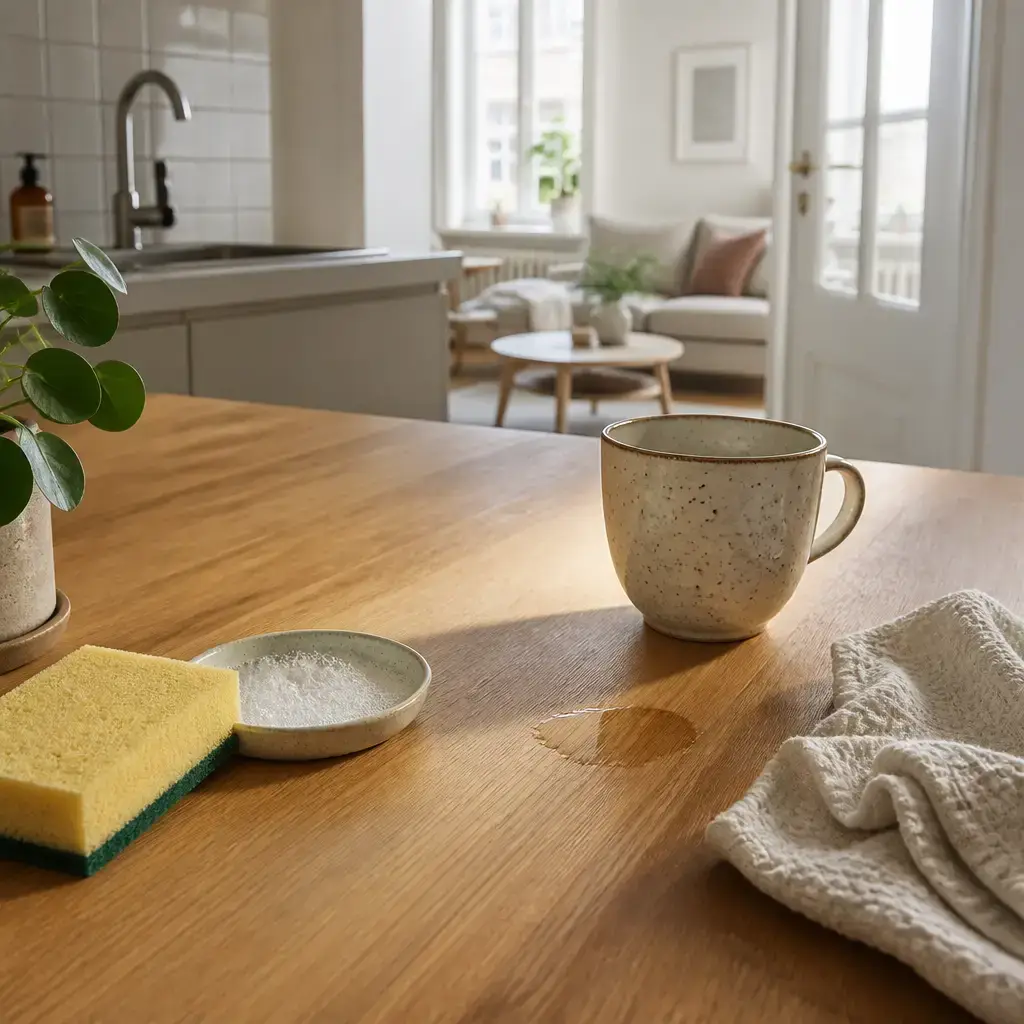
Der er en plet på bordet.
dair air un PLAYD poh BOR-thuh There is a stain on the table.Jeg kan se den nær koppen.
yai kan SAY den nair KAW-buhn I can see it near the cup.Har vi en ren svamp?
hah vee un RAYN SVAHM? Do we have a clean sponge?Svampen er ved vasken.
SVAHM-buhn air VAY VAHS-guhn The sponge is by the sink.Skal jeg bruge lidt sæbe?
skel yai BROO-uh leth SEH-buh? Should I use some soap?Kom lidt sæbe på svampen.
KAWM leth SEH-buh paw SVAHM-buhn Put a little soap on the sponge.Pletten er næsten væk.
PLEH-dun air NEH-stun VEHK The stain is almost gone.Bordet ser rent ud.
BOR-thuh sair RENT oo-th The table looks clean.Sentence explanations
Der er en plet på bordet.
There is a stain on the table.
- Der er
- there is
- plet
- stain
- på
- on
- bordet
- the table
More detail
Der er is a reusable Danish existential construction meaning that something exists or is present in a place. It corresponds to “there is” here. For more than one item, Danish commonly uses Der er as well: Der er to stole. — “There are two chairs.” The construction itself does not identify the item; the noun phrase after it does. plet means “stain” here. Its base form is plet, and the indefinite singular form in this sentence is en plet. Danish uses en with this noun; the article is part of the noun phrase, not a claim that the sentence counts or emphasizes one stain. Example: Jeg ser en plet. — “I see a stain.” på is a preposition meaning “on” in this use. It introduces the surface or location where something is situated. Example: Bogen ligger på bordet. — “The book is on the table.” bordet means “the table.” Its base form is bord; the ending -et marks the definite singular form: bord — “table,” bordet — “the table.” The form here is definite because the sentence refers to a particular table in the intended meaning. Example: Bordet er stort. — “The table is large.” Together, Der er en plet states that a stain is present, and på bordet locates it on the table. The whole utterance means: “There is a stain on the table.”
Jeg kan se den nær koppen.
I can see it near the cup.
- Jeg kan
- I can
- se
- see
- den
- it
- nær
- near
- koppen
- the cup
More detail
Jeg kan: kan is the present form of kunne, “to be able to/can.” It does not change for person or number: jeg kan, du kan, and de kan. After this modal, Danish uses the infinitive without at. se: Here se is the infinitive “see,” selected after kan. The present form is ser, as in Jeg ser den (“I see it”), but Jeg kan se den keeps the infinitive after the modal. den: This is a singular common-gender object pronoun, meaning “it” here. The supplied material does not uniquely identify what it refers to. den contrasts with det, which is used for a singular neuter-gender referent; the choice follows the referent’s grammatical gender, not simply its distance from another noun. nær: This preposition means “near” and introduces the location of the object. A reusable pattern is X er nær Y (“X is near Y”). koppen: This means “the cup.” Its base noun is kop; koppen marks singular definite form with the suffix -en. An indefinite cup is en kop, while “the cup” is koppen. Together, Jeg kan se den means “I can see it,” and nær koppen specifies that it is near the cup. The complete utterance is “I can see it near the cup.”
Har vi en ren svamp?
Do we have a clean sponge?
- Har vi
- do we have
- ren
- clean
- svamp
- sponge
More detail
Har vi combines har, the present-tense form of have, with vi, “we.” In a Danish yes/no question, the finite verb comes before the subject: Har vi ...? means “Do we have ...?” The same pattern is reusable with another subject: Har du en nøgle? — “Do you have a key?” ren means “clean” here. It is an adjective describing the sponge. With the common-gender singular noun phrase en ren svamp, the adjective has the form ren; with a neuter noun, Danish commonly uses rent, as in et rent glas — “a clean glass.” svamp means “sponge” here. Its indefinite singular form is en svamp, while the definite singular form is svampen, “the sponge.” The noun is therefore presented as an unspecified sponge in this question, not as a particular sponge identified by the wording itself. Together, en ren svamp means “a clean sponge”: en is the indefinite article, ren describes the noun, and svamp names it. The word order Har vi en ren svamp? places the verb first because the whole utterance is a yes/no question. The complete meaning is “Do we have a clean sponge?”
Svampen er ved vasken.
The sponge is by the sink.
- Svampen
- the sponge
- er
- is
- ved
- by
- vasken
- the sink
More detail
Svampen means “the sponge” here. It is the definite singular form of svamp (“sponge”): en svamp → svampen. Danish commonly marks definiteness by attaching the article ending to the noun, rather than using a separate word before it. Example: Bogen means “the book,” from en bog. er is the present-tense form of være (“to be”). It is used with singular and plural subjects; the subject determines the meaning, not a special present-tense ending on er. Example: Børnene er hjemme. — “The children are at home.” ved is a preposition meaning “by” or “near” in this location pattern. It introduces the place where the sponge is located. Example: Koppen står ved vinduet. — “The cup is by the window.” vasken means “the sink” here. It is the definite singular form of vask (“sink”): en vask → vasken. The ending -en marks the definite form for this common-gender noun. Example: Håndklædet er ved vasken. — “The towel is by the sink.” Together, Svampen er ved vasken. states that the sponge is located by the sink: “The sponge is by the sink.”
Skal jeg bruge lidt sæbe?
Should I use some soap?
- Skal jeg
- Should I
- bruge
- use
- lidt
- some / a little
- sæbe
- soap
More detail
Skal jeg is a reusable way to ask whether the speaker ought to do something: “Should I …?” In this question, skal is the present form of skulle, used for obligation, intention, or a proposed action. jeg means “I”; it identifies the speaker. Danish questions commonly place the finite verb before the subject: Skal jeg ...? Compare the reusable pattern Skal du ...? — “Should you ...?” bruge means “use” here. It is the infinitive of bruger (“use” in the present tense). After the modal verb skal, Danish uses the infinitive: skal bruge, not the present form bruger. Example: Jeg skal bruge vand. — “I need to use water.” lidt expresses a small amount of something, here “some” or “a little.” It is commonly used with mass or uncountable substances. It is different from få, which is used for a small number of countable items. Example: Jeg vil have lidt vand. — “I would like a little water.” sæbe means “soap.” It is a noun used here for the substance, without asserting a particular number of soap items. Example: Der er sæbe ved vasken. — “There is soap by the sink.” Together, Skal jeg bruge lidt sæbe? follows the pattern Skal jeg + infinitive verb + amount word + noun. The sentence asks whether the speaker should use a small amount of soap: “Should I use some soap?”
Kom lidt sæbe på svampen.
Put a little soap on the sponge.
- Kom
- put
- lidt
- a little
- sæbe
- soap
- på
- on/onto
- svampen
- the sponge
More detail
Kom is the imperative of komme (“to come”). In komme ... på with something being placed on a surface, it means “put/apply ... on,” as it does here; the imperative addresses the listener directly. The same verb can also mean “come” in other contexts, so the surrounding construction determines the meaning. lidt means “a little” or “some” with an uncountable substance. It does not itself state an exact quantity. In this sentence it limits the amount of sæbe. sæbe means “soap.” It is used here as a mass noun, referring to soap as a substance rather than to a counted individual item. A useful pattern is lidt + mass noun, as in lidt vand (“a little water”). på means “on” or “onto.” With a placement action, it marks the surface receiving something: kom sæbe på ... means “put soap onto ...”. svampen means “the sponge.” The base noun is svamp; its common-gender definite singular form is svampen, formed with the definite ending -en. The ending marks a specific sponge in this utterance; it is not a separate word meaning “the.” Together, Kom lidt sæbe på svampen forms a direct imperative: kom gives the instruction, lidt sæbe identifies the amount and substance, and på svampen identifies where it should go. The whole utterance therefore means “Put a little soap on the sponge.”
Pletten er næsten væk.
The stain is almost gone.
- Pletten
- the stain
- er
- is
- næsten væk
- almost gone
More detail
Pletten means “the stain” here. The base noun is plet (“stain”); pletten is its definite singular form, meaning “the stain.” Danish commonly marks definiteness by an ending on the noun: en plet is “a stain,” while pletten is “the stain.” er is the present-tense form of at være (“to be”). It is used with a singular subject such as pletten; the same present form also occurs with plural subjects, so the form itself does not mark singular versus plural here. næsten væk is a reusable combination meaning “almost gone.” næsten means “almost” and limits the degree of væk (“gone/away”); the stain is not described as completely gone. In another sentence, Maden er næsten væk means “The food is almost gone.” Together, Pletten er næsten væk literally structures the meaning as “The stain is almost gone”: the definite subject pletten is described with er plus the state næsten væk. This is a neutral, everyday way to say that very little of the stain remains.
Bordet ser rent ud.
The table looks clean.
- Bordet
- the table
- ser … ud
- looks / appears
- rent
- clean
More detail
Bordet means “the table.” The base noun is bord (“table”); -et marks the definite singular form of this neuter noun. For an indefinite singular, use et bord (“a table”); for definite plural, bordene (“the tables”). ser ... ud is a reusable Danish pattern meaning “looks” or “appears.” ser is the present form of se (“to see”), and ud completes the appearance construction here. The two parts are separated because the adjective comes between them. For example: Huset ser stort ud. — “The house looks big.” rent means “clean” here. It is the neuter singular form of the adjective ren; it agrees with the neuter noun bord. The common forms are ren with an en-word, rent with an et-word, and rene in the plural or definite form. Comparison is renere (“cleaner”) and renest (“cleanest”). For example: Bordet er rent. — “The table is clean.” Together, Bordet identifies the definite table, ser ... ud says how it appears, and rent supplies the appearance. The complete meaning is “The table looks clean.”
Grammar Points
se rent ud
Bordet ser rent ud.
sair RENT oo-thThe table looks clean.
I dansk står adjektivet i udtrykket se ... ud før ud: ser rent ud betyder “looks clean”.
Kom + sted
Kom nær vasken.
KAWM nair VAHS-guhnCome near the sink.
Kom er bydeform af komme og bruges til en direkte opfordring eller instruktion.
Danish Vocabulary
- Gender
- neuter
Der er en plet på bordet.
Skal jeg bruge lidt sæbe?
Har vi en ren svamp?
Kom lidt sæbe på svampen.
- Gender
- common
Jeg kan se den nær koppen.
- Gender
- common
Der er en plet på bordet.
- Gender
- common
Har vi en ren svamp?
Jeg kan se den nær koppen.
- Gender
- common
Svampen er ved vasken.
- Gender
- common
Skal jeg bruge lidt sæbe?
- Gender
- common
Svampen er ved vasken.
Der er en plet på bordet.
Quiz
Word Order
Arrange the words in the correct order.
There is a stain on the table.
Show Answer
Der er en plet på bordet.I can see it near the cup.
Show Answer
Jeg kan se den nær koppen.Do we have a clean sponge?
Show Answer
Har vi en ren svamp?Spelling
Tap the letters to spell the word.
table
Show Answer
bordetsoap
Show Answer
sæbecup
Show Answer
koppenstain