10 minutes free every day
Continue audio lessons in the app
Word explanations appear automatically in sync with the audio.
No login required · synced translations · playback with the screen locked
Choose your learning language and open this lesson in the app.

About This Lesson
Use Getting ready for rain to practice Danish conversation, pronunciation, vocabulary, grammar, and quizzes.
Dialogue
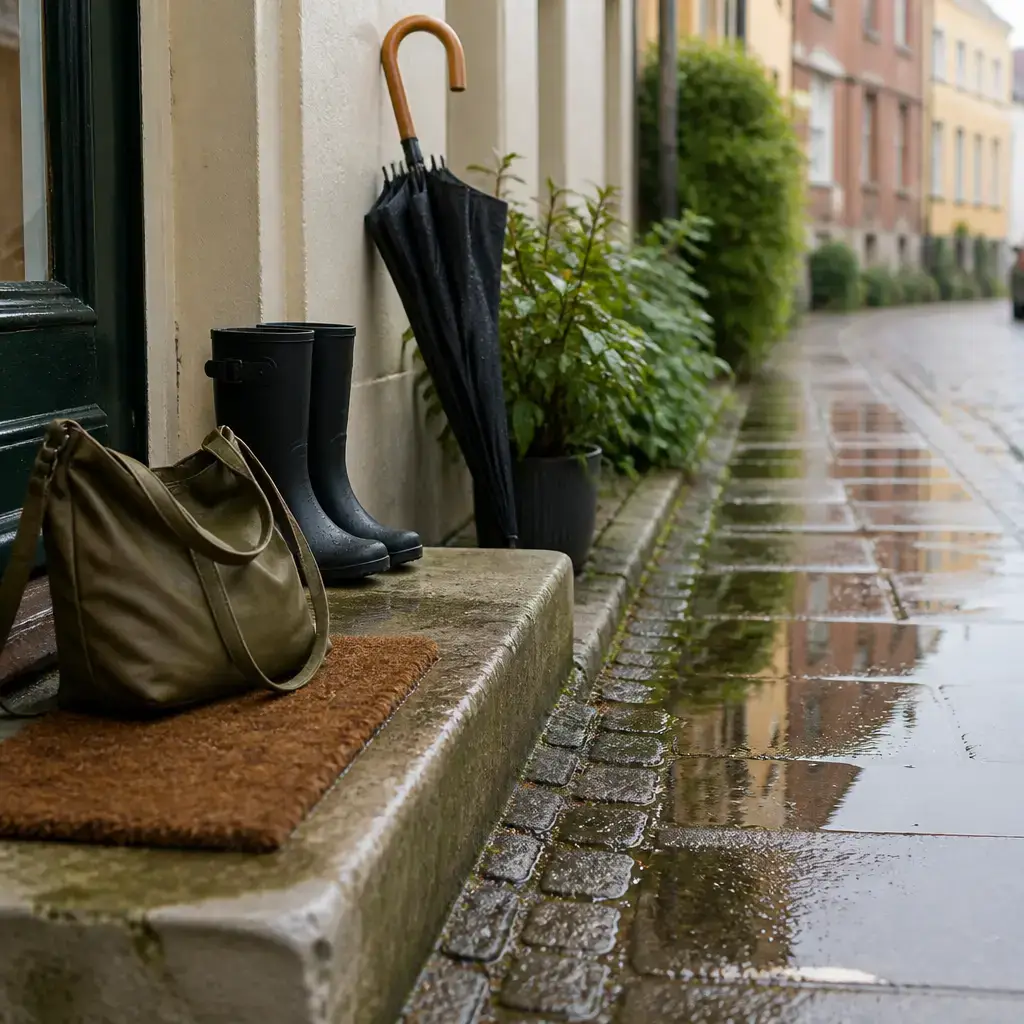
Det regner udenfor.
deh RENG-nuh OO-thn-FOHR It is raining outside.Tag dine støvler på, før du går.
TEH DEE-nuh STURV-luh POH, FUH doo GOH Wear your boots before you leave.Der er vandpytter på stien.
dair air VAHN-pud-uh POH STEE-uhn There are puddles on the path.Gå langsomt uden om dem.
GOH LANG-somd OO-thn OHM dem Step around them slowly.Min taske bliver måske våd.
men TAS-guh BLEE-uh MAWS-guh VOH My bag might get wet.Hold den under din frakke.
HOLL den ON-uh deen FRAH-guh Keep it under your coat.Jeg bør også tage en paraply med.
YAI BUH AW-suh TAH uhn pah-rah-PLOO meh I should take an umbrella too.Det vil hjælpe dig med at holde dig tør.
deh vel YEL-buh DAI meh ehd HOLL-uh DAI TUH That will help keep you dry.Sentence explanations
Det regner udenfor.
It is raining outside.
- regner
- is raining
- udenfor
- outside
More detail
regner is the present-tense form of regne, “to rain.” Danish uses the impersonal subject det with weather verbs: Det regner means “It is raining,” where det does not refer to a particular person or thing. The same present form can describe rain happening now or a general current condition. udenfor is an adverb meaning “outside.” It identifies the location of the raining, rather than describing a person or object. Compare indenfor, “inside,” when the location is indoors. Together, Det regner udenfor. means “It is raining outside.”
Tag dine støvler på, før du går.
Wear your boots before you leave.
- Tag … på
- put on
- dine
- your
- støvler
- boots
- før
- before
- går
- go / leave
More detail
Tag … på is the command meaning “put on” or “wear.” Tag is the imperative of tage (“to take”), while på is the particle that completes this clothing-related construction. Danish commonly uses the pattern tage + clothing + på: for example, Tag jakken på. means “Put on the jacket.” In the fixed sentence, the command is directed at the listener. dine means “your” before a plural noun. Its base possessive form is din with a common-gender singular noun, dit with a neuter singular noun, and dine with a plural noun. Here it agrees with støvler, not with the person who owns them. støvler means “boots.” It is the plural form of støvle (“boot”): en støvle is “a boot,” and støvler is “boots.” With dine, the phrase dine støvler means “your boots.” før introduces a time relation and means “before.” It connects the command with the later event: first put on the boots, and then the event in the following clause occurs. A reusable pattern is før + clause, as in Vask hænderne, før du spiser. — “Wash your hands before you eat.” går is the present-tense form of gå (“to go” or “to walk”) with du (“you”). In this sentence, the fixed translation shows that it means “leave,” so før du går means “before you leave.” The form går is used with du; Danish present tense does not add a separate person ending here. For example, Du går hjem. means “You go home” or “You are going home.” Together, Tag dine støvler på means “Put on your boots,” and før du går adds “before you leave.” The whole utterance is therefore: “Wear your boots before you leave.”
Der er vandpytter på stien.
There are puddles on the path.
- Der er
- there is / there are
- vandpytter
- puddles
- på
- on
- stien
- the path
More detail
Der er is the Danish existential construction meaning “there is” or “there are.” Here, er is the present form of være (“to be”), while der functions as the introductory element in this construction. The form is the same with a singular or plural thing: Der er en sten. — “There is a stone.” Der er sten. — “There are stones.” vandpytter means “puddles” here. Its base form is vandpyt (“puddle”), and vandpytter is the plural indefinite form. The plural ending -er is part of the noun’s inflection; it is not a separate word. Example: Jeg ser vandpytter. — “I see puddles.” på means “on” in this sentence and introduces the location of the puddles. Example: Bogen ligger på bordet. — “The book is on the table.” stien means “the path.” Its base form is sti (“path”), and stien is the singular definite form, marked by the ending -en. Thus en sti means “a path,” while stien means “the path.” Example: Jeg går på stien. — “I walk on the path.” Together, Der er presents something as existing or being located, vandpytter identifies what exists, and på stien gives its location: “There are puddles on the path.”
Gå langsomt uden om dem.
Step around them slowly.
- Gå
- go; walk
- langsomt
- slowly
- uden om
- around; avoiding
- dem
- them
More detail
Gå is the form used for a direct instruction: “go” or “walk.” Danish uses the same visible form gå as the infinitive after at, as in at gå (“to go/walk”), while the imperative can stand alone as Gå! (“Go!/Walk!”). Example: Gå forsigtigt. — “Walk carefully.” langsomt tells how the walking should happen: “slowly.” It is the adverbial form related to the adjective langsom (“slow”); the -t form is used here to modify an action rather than a noun. Example: Hun går langsomt. — “She walks slowly.” uden om is a two-word prepositional construction meaning “around” an obstacle or “by going around” it. It presents the route as avoiding or going around something, rather than passing through it. Example: Gå uden om hullet. — “Go around the hole.” dem means “them” here and is the object form of the third-person plural pronoun. Compare subject de (“they”) with object dem (“them”): De ser dem. — “They see them.” The fixed translation and the preceding context support dem as referring to the obstacles being avoided, namely the puddles mentioned on the path. Danish also distinguishes singular object forms such as den and det, but dem is plural. Together, Gå gives the instruction, uden om dem specifies the route around the obstacles, and langsomt specifies the manner. The whole utterance means “Step around them slowly,” addressing someone directly. It is a concise, ordinary imperative instruction.
Min taske bliver måske våd.
My bag might get wet.
- Min
- my
- taske
- bag
- bliver
- gets; becomes
- måske
- maybe
- våd
- wet
More detail
Min means “my” here and is the possessive form used with a singular common-gender noun. Danish contrasts min with mit before a singular neuter noun and mine before plural nouns. For example, min bog means “my book,” while mit hus means “my house.” taske means “bag.” Its base form is the singular indefinite form; the definite singular is tasken, and the plural is tasker (definite plural taskerne). The noun is a common-gender noun, which is why the phrase uses min, not mit. bliver is the present-tense form of blive. In this sentence, blive means “become” or “get,” describing a change into a state. The pattern blive + adjective is reusable: Hun bliver træt means “She gets tired.” Here, bliver combines with våd to express becoming wet. måske means “maybe” or “possibly.” It signals uncertainty about the event. Its position before våd does not make the wetness uncertain as a separate fact; it makes the whole possibility that the bag becomes wet uncertain. våd means “wet.” It is an adjective. Its forms are våd with a common-gender singular noun, vådt with a neuter singular noun, and våde with plural or definite noun phrases. For example, Huset bliver vådt means “The house gets wet.” Together, Min taske means “my bag,” bliver våd means “gets wet,” and måske marks this as a possibility. The whole utterance therefore means: “My bag might get wet.”
Hold den under din frakke.
Keep it under your coat.
- Hold
- keep
- den
- it
- under
- under
- din
- your
- frakke
- coat
More detail
Hold is the imperative of holde, “to hold” or “keep.” It gives a direct instruction; the form does not mark whether one or more people are being addressed. Example: Hold døren! — “Hold the door!” den is a singular common-gender object pronoun meaning “it.” The fixed texts do not uniquely identify what den refers to, so this explanation does not assign it a specific referent. Danish also uses det for a singular neuter referent and dem for plural referents. Example: Jeg ser den. — “I see it.” under means “under” and introduces the location. Example: Bogen ligger under bordet. — “The book is under the table.” din means “your” when addressing one person. Its form agrees with the noun it determines: din with a common-gender singular noun, dit with a neuter singular noun, and dine with a plural noun. Here, din is used because frakke is common gender and singular. Example: din stol — “your chair,” but dit hus — “your house.” frakke means “coat.” It is a common-gender noun: en frakke means “a coat,” and frakken means “the coat.” After the possessive din, the noun appears without the definite ending: din frakke, “your coat.” Together, Hold den gives the instruction “Keep it,” and under din frakke specifies the location: “under your coat.” The complete utterance is “Keep it under your coat.”
Jeg bør også tage en paraply med.
I should take an umbrella too.
- Jeg bør
- I should
- også
- also; too
- tage … med
- take along
- en paraply
- an umbrella
More detail
Jeg bør means “I should.” Jeg is the first-person singular pronoun “I”. bør is the present-tense modal form of burde, used here for advice or a recommendation. It is followed by an infinitive: Jeg bør tage ... = “I should take ...”. også means “also” or “too”. In this sentence it adds this action to something already relevant: “I should take an umbrella too.” Its position after Jeg bør places the addition before the main action, but English can put “too” at the end. tage ... med is a separable pattern meaning “take along” or “bring with one”. The parts are separated here because en paraply comes between them: tage en paraply med. The verb tage is the infinitive after the modal bør; med contributes the sense that the umbrella is taken along. en paraply means “an umbrella”. paraply is the noun “umbrella”; its indefinite singular form uses en. Here en introduces an unspecified singular umbrella, but the article itself does not state a numeric count as a separate claim. The definite form is paraplyen when referring to a specific umbrella. Together, Jeg bør + også + tage en paraply med produces: “I should take an umbrella too.” The speaker presents taking an umbrella along as an advisable additional action.
Det vil hjælpe dig med at holde dig tør.
That will help keep you dry.
- Det
- that
- vil hjælpe
- will help
- dig
- you
- med at holde
- with keeping
- dig
- yourself
- tør
- dry
More detail
Det means “that” here and functions as the subject. Danish uses this form for a singular neuter pronoun; the sentence does not by itself identify exactly what “that” refers to. Do not confuse it with den, another singular form used with common-gender nouns. vil hjælpe means “will help” here. vil is the present form of ville, used with a future or predictive meaning; it does not change for person or number. hjælpe is the infinitive after this modal. ville can also mean “want” in other contexts, but that is not the meaning here. The first dig is the second-person singular object form, “you.” The subject form is du, while dig is used after a verb or preposition as an object. In vil hjælpe dig, it marks the person receiving the help. med at holde is a reusable pattern meaning “with keeping” or “in keeping.” holde is the infinitive/base form of “keep” or “hold,” and at marks the infinitive here. A useful pattern is hjælpe nogen med at + infinitive, meaning “help someone to do something.” Example: Hun hjælper mig med at lære dansk. — “She helps me learn Danish.” The second dig is the reflexive object of holde: the person being helped keeps themself dry. Danish uses dig for both an ordinary second-person object and a second-person reflexive object; third person uses sig for the corresponding reflexive role. tør is the adjective “dry,” describing the person in this construction. Danish adjectives agree with the noun or pronoun they describe: tør is the common-gender singular form, tørt is the neuter singular form, and tørre is used with plural or definite nouns. In holde dig tør, the observed form is tør. Danish also has a different verb written tør, meaning “dare”; that is not the meaning here. Together, Det vil hjælpe dig means “That will help you,” and med at holde dig tør specifies what the help accomplishes: “with keeping yourself dry.” The complete meaning is “That will help keep you dry.”
Grammar Points
Imperativ: verbets stamme
Tag dine støvler.
TEH DEE-nuh STURV-luhTake your boots.
Danish commands often use the verb stem alone: Tag, Gå, Hold.
bliver + adjektiv
Min taske bliver våd.
men TAS-guh BLEE-uh VOHMy bag gets wet.
bliver + adjective describes a change of state, similar to “gets” in English.
Danish Vocabulary
Quiz
Word Order
Arrange the words in the correct order.
It is raining outside.
Show Answer
Det regner udenfor.There are puddles on the path.
Show Answer
Der er vandpytter på stien.Step around them slowly.
Show Answer
Gå langsomt uden om dem.Spelling
Tap the letters to spell the word.
the path
Show Answer
stienoutside
Show Answer
udenforis raining
Show Answer
regneryour