10 minutes free every day
Continue audio lessons in the app
Word explanations appear automatically in sync with the audio.
No login required · synced translations · playback with the screen locked
Choose your learning language and open this lesson in the app.

About This Lesson
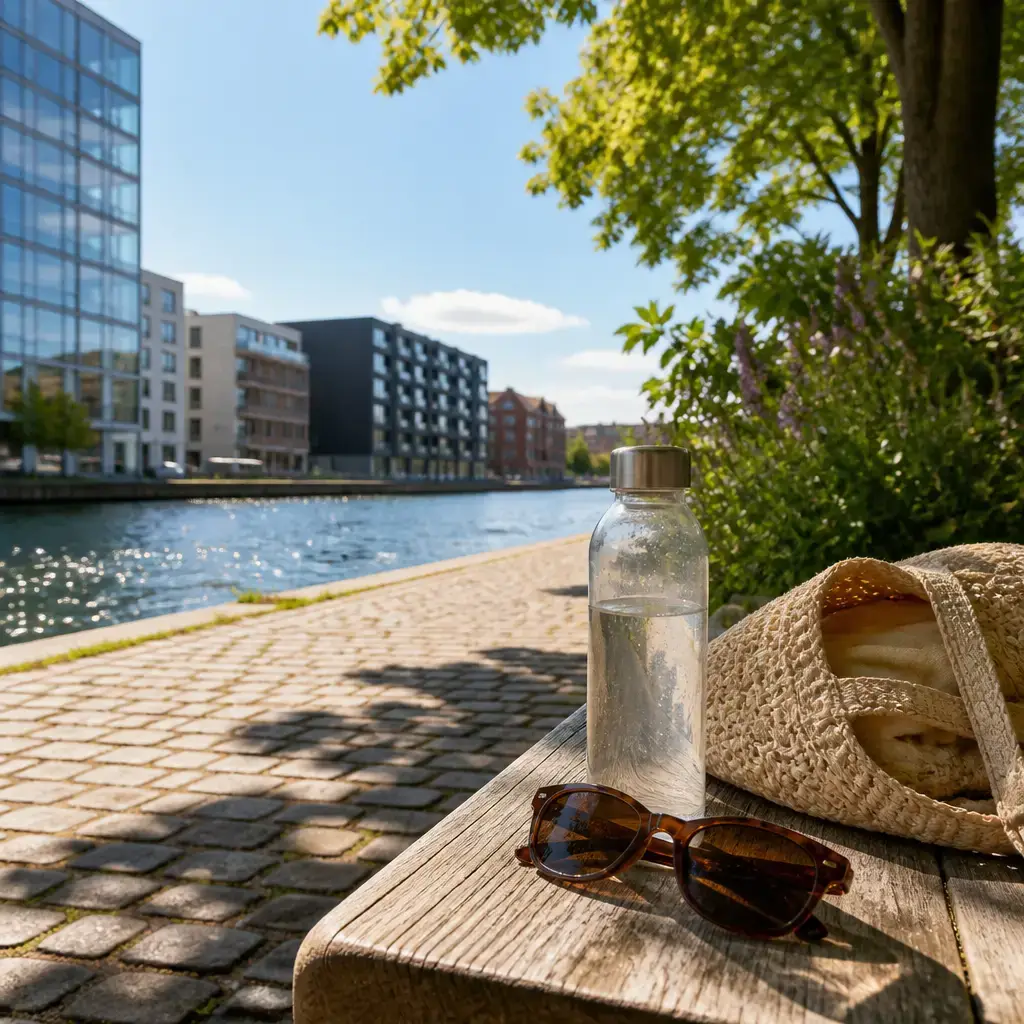
Use Preparing for a Sunny Walk to practice Danish conversation, pronunciation, vocabulary, grammar, and quizzes.
Dialogue
Solen skinner udenfor.
SOHL-en SGEH-ner OO-en-FOHR. It's sunny outside.Tag dine solbriller med.
TEH DEE-neh SOHL-bril-er meth. Bring your sunglasses.Er det for varmt til en gåtur?
Air deh foh VAHMD tehl en GOH-toor? Is it too hot for a walk?Det er varmt, men vi kan stadig gå.
Deh air VAHMD, men vee kan STEH-thee goh. It's warm, but we can still go.Vi kan blive i skyggen.
Vee kan BLEE-vuh ee SKYOO-en. We can stay in the shade.Træerne bør holde os kølige.
TREH-air-neh buhr HOL-eh ohs KUR-lee-eh. The trees should keep us cool.Jeg tager en flaske vand med.
YAI TEH-air en FLES-guh van meth. I'll bring a bottle of water.Den bliver god at have med på gåturen.
Den BLEE-vuh goh eh HEH-vuh meth poh GOH-toor-en. It'll come in handy during the walk.Sentence explanations
Solen skinner udenfor.
It's sunny outside.
- Solen
- the sun
- skinner
- shines; is shining
- udenfor
- outside
More detail
Solen means “the sun” here. It is the definite singular form of sol (“sun”): en sol means “a sun,” while solen means “the sun.” Danish commonly marks definiteness by adding an ending to the noun, rather than always using a separate word before it. Example: Månen er lys. — “The moon is bright.” skinner means “shines” or “is shining” here. It is the present-tense form of skinne (“to shine”): solen skinner means “the sun shines/is shining.” The present form can describe what is happening now or a current general condition. Example: Lampen skinner. — “The lamp is shining.” udenfor means “outside.” It is an adverb indicating location. It can be used on its own to state where something is happening: Hun venter udenfor. — “She is waiting outside.” Together, Solen skinner udenfor. literally combines “the sun,” “is shining,” and “outside.” In natural English, the fixed meaning is “It’s sunny outside.”
Tag dine solbriller med.
Bring your sunglasses.
- Tag
- bring; take
- dine
- your (plural)
- solbriller
- sunglasses
- med
- along; with
More detail
Tag is the imperative form of tage, “to take” or “to bring.” In this sentence, the fixed translation selects the meaning “bring.” Danish commonly uses the bare imperative form for a direct instruction: Tag ... = “Bring/Take ...”. For example, Tag en jakke med. means “Bring a jacket along.” dine means “your” before a plural noun. It agrees with the possessed item’s number: compare din bog (“your book”) with dine bøger (“your books”). Here it is plural because solbriller is plural. solbriller means “sunglasses.” It is a plural noun referring to the eyewear as a pair. The word is a compound built from sol (“sun”) and briller (“glasses”), but the complete form solbriller is the word used here. med means “along” or “with” in this position. It completes the reusable pattern tage ... med / Tag ... med, meaning “take/bring ... along.” For example, Tag telefonen med. means “Bring the phone along.” Together, Tag gives the direct instruction, dine solbriller identifies the item as “your sunglasses,” and med adds the idea of bringing them along. The complete utterance therefore means “Bring your sunglasses.”
Er det for varmt til en gåtur?
Is it too hot for a walk?
- Er det
- is it
- for varmt
- too hot
- gåtur
- walk
More detail
Er det is the question pattern “is it …?” Here er is the present-tense form of være (“to be”). Danish commonly places the verb before the subject in a yes/no question: Er det ...? (“Is it ...?”). In this sentence, det is the impersonal subject used for the weather or general conditions; the supplied translation supports that reading. for varmt means “too hot.” for means “too” when a degree is excessive. varmt is the neuter singular form of the adjective varm (“hot, warm”), agreeing with neuter det in this construction. Compare varm in a common-gender context and varmt in a neuter context; the adjective form is determined by the noun or subject it describes, not by for. gåtur means “walk” as an activity or outing. It is a compound noun, built from gå (“walk/go”) and tur (“trip, outing”), but gåtur functions as one noun here. The indefinite article en marks this noun as common gender and introduces an unspecified walk; it does not by itself assert a numerical count. The chunk til en gåtur means “for a walk.” In this use, til connects the degree or suitability expressed by for varmt with the activity being considered. Together, Er det for varmt til en gåtur? asks whether the conditions are excessively hot for taking a walk: “Is it too hot for a walk?”
Det er varmt, men vi kan stadig gå.
It's warm, but we can still go.
- Det er
- it is
- varmt
- warm
- men
- but
- vi kan
- we can
- stadig
- still
- gå
- go
More detail
Det er is the Danish pattern for “it is.” Here det is an impersonal subject referring to the weather situation, not a specific object. er is the present form of være (“to be”); the same form is used with other subjects, such as vi er (“we are”). varmt means “warm” here. It is the neuter singular form of the adjective varm, used with the neuter subject det in this weather expression. Compare varm in en varm dag (“a warm day”) with varmt in det er varmt (“it is warm”). men joins two contrasting statements and means “but.” For example, Det er koldt, men vi går means “It is cold, but we are walking.” vi kan means “we can.” vi is the first-person plural pronoun “we.” kan is the present form of the modal verb kunne (“can, be able to”); it does not change to show plural in this form. A modal is followed by an infinitive without at: vi kan gå means “we can go.” stadig means “still,” indicating that the possibility remains despite the warm conditions. For example, Hun arbejder stadig means “She is still working.” gå means “go” here. It is the infinitive form of the verb; after kan, Danish uses this bare infinitive, without at. The same pattern appears in vi kan blive (“we can stay”). Together, Det er varmt says “It is warm,” men introduces a contrast, and vi kan stadig gå says that going remains possible. The complete meaning is: “It’s warm, but we can still go.”
Vi kan blive i skyggen.
We can stay in the shade.
- Vi kan
- we can
- blive
- stay
- skyggen
- the shade
More detail
Vi kan: Vi means “we,” the first-person plural subject pronoun. kan is the present-tense form of kunne, “can/be able to.” In this sentence it expresses that the speakers have the option or ability to stay. Danish modal verbs such as kan are followed by an infinitive without an English-style “to”: Vi kan blive = “We can stay.” blive: Here blive is the infinitive meaning “stay” or “remain.” It can also mean “become” in other contexts, so the surrounding location phrase i skyggen gives the “stay” meaning here. Example: Hun bliver hjemme. — “She stays at home.” skyggen: This is the definite singular form of skygge, “shade” or “shadow”: skygge → skyggen, “the shade/shadow.” The ending -en marks the definite singular form of this common-gender noun. The preceding i means “in,” so i skyggen means “in the shade.” Together, Vi kan blive i skyggen means “We can stay in the shade.” The structure is reusable as subject + kan + infinitive + place: Vi kan blive her. — “We can stay here.”
Træerne bør holde os kølige.
The trees should keep us cool.
- Træerne
- the trees
- bør
- should
- holde
- keep
- os
- us
- kølige
- cool
More detail
Træerne means “the trees.” It is the definite plural form of træ (“tree”): et træ = “a tree,” træer = “trees,” and træerne = “the trees.” The ending -ene marks definite plural in this noun form. bør means “should” here. It is a modal verb expressing a recommendation or expectation, and it is followed by the infinitive without at: bør holde = “should keep.” Unlike ordinary verbs, bør does not show different present-tense forms for different subjects. holde means “keep” in this sentence. It is the infinitive of holde; the same verb can also mean “hold” in other contexts, so its exact meaning comes from the complement here. After a modal such as bør, Danish uses the infinitive: Vi bør hvile. = “We should rest.” os means “us.” It is the object form of the first-person plural pronoun: vi = “we” as subject, but os = “us” as object. In holde os kølige, it is the people being kept cool. kølige means “cool” here. It is the form of the adjective kølig used with a plural referent, namely os: kølig (common gender singular), køligt (neuter singular), kølige (plural or definite contexts). In this pattern, the adjective describes the object after holde: holde nogen kølig/kølige means “keep someone cool.” Together, Træerne bør holde os kølige has the structure “the trees + should + keep + us + cool.” The trees are the subject, bør adds the idea of “should,” and holde os kølige says that they should maintain the people’s cool state. Thus the complete meaning is “The trees should keep us cool.”
Jeg tager en flaske vand med.
I'll bring a bottle of water.
- Jeg
- I
- tager
- bring / take
- flaske
- bottle
- vand
- water
- tager … med
- bring along
More detail
Jeg means “I” and is the first-person singular subject pronoun. It identifies the speaker as the person doing the action. For example, Jeg kommer means “I am coming.” tager is the present form of tage, “to take.” In this sentence, the surrounding construction with med gives it the meaning “bring” rather than simply “take.” Danish present tense can also describe a planned future action, which matches “I’ll bring” here; there is no separate future auxiliary in the Danish sentence. flaske means “bottle.” The phrase en flaske is singular and indefinite: “a bottle.” The article en marks the noun’s grammatical gender and indefiniteness; it does not by itself assert a numerical count beyond the phrase’s singular form. A useful form contrast is en flaske (“a bottle”) and flasken (“the bottle”). vand means “water.” Here it specifies what the bottle contains: en flaske vand, literally “a bottle [of] water.” Because water is treated as a substance here, no separate article appears before vand. The discontinuous pattern tager ... med means “bring/take ... along.” The object can come between the verb and med, as in this sentence: Jeg tager en bog med. — “I’ll bring a book along.” The word med contributes the sense of having the object accompany the speaker. Together, Jeg supplies the subject, tager ... med expresses bringing something along, and en flaske vand names that thing: “I’ll bring a bottle of water.”
Den bliver god at have med på gåturen.
It'll come in handy during the walk.
- Den
- it
- bliver
- becomes; will be
- god
- good; useful
- at have med
- to have along
- gåturen
- the walk
More detail
Den is a singular common-gender pronoun meaning “it” here. The previous context mentions a bottle, so this pronoun can refer back to that item; the sentence itself does not repeat the noun. Danish pronouns must match the noun’s grammatical gender and number, not merely its physical properties. bliver is the present form of blive, “become” or “be.” In this sentence, with god, it gives a future-oriented meaning: “will be” or “will turn out to be.” Danish present forms can refer to a future situation when the context makes that clear. For example: Det bliver sjovt. — “It will be fun.” god is the adjective “good.” Here it is used predicatively after bliver, describing how useful the item will be. Its base form is god; Danish adjectives can take other forms depending on the noun or construction, but this form is appropriate here. at have med is an infinitive construction: at + have (“have”) + med (“along”). Together, it expresses having or taking something along. The following preposition phrase supplies the setting: something can be god at have med “good to have along.” Example: Det er praktisk at have med. — “It is practical to have along.” gåturen means “the walk.” It is the definite singular form of gåtur (“walk” or “walking trip”): gåtur + definite ending -en = gåturen. In på gåturen, på places the situation during or on the walk. Together, Den bliver god at have med says that the item will be useful to take along, and på gåturen specifies that this usefulness applies during the walk. The complete meaning is: “It’ll come in handy during the walk.”
Grammar Points
Bestemt form: sol → solen, skygge → skyggen
Solen skinner udenfor.
SOHL-en SGEH-ner OO-en-FOHR.The sun is shining outside.
The definite form is often made with an ending attached to the noun, unlike English, which usually uses “the” before it.
Danish Vocabulary
Tag dine solbriller med.
Er det for varmt til en gåtur?
- Gender
- common
Er det for varmt til en gåtur?
Det er varmt, men vi kan stadig gå.
Solen skinner udenfor.
- Gender
- common
Solen skinner udenfor.
- Gender
- common
Tag dine solbriller med.
Tag dine solbriller med.
Er det for varmt til en gåtur?
Solen skinner udenfor.
- Gender
- neuter
Er det for varmt til en gåtur?
Det er varmt, men vi kan stadig gå.
Quiz
Word Order
Arrange the words in the correct order.
It's sunny outside.
Show Answer
Solen skinner udenfor.Bring your sunglasses.
Show Answer
Tag dine solbriller med.We can stay in the shade.
Show Answer
Vi kan blive i skyggen.Spelling
Tap the letters to spell the word.
outside
Show Answer
udenforshine
Show Answer
skinnerwarm; hot
Show Answer
varmtsunglass