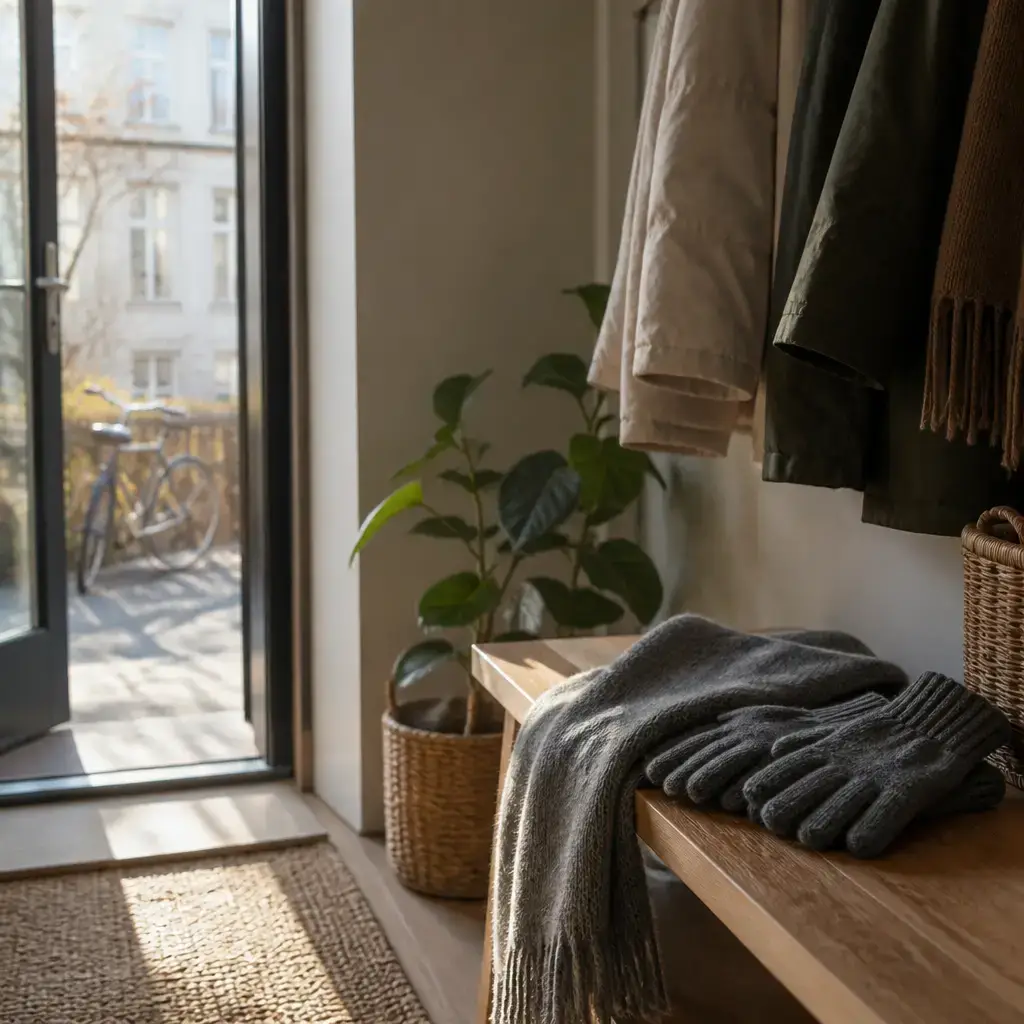
10 minutes free every day
Continue audio lessons in the app
Word explanations appear automatically in sync with the audio.
No login required · synced translations · playback with the screen locked
Choose your learning language and open this lesson in the app.

About This Lesson
Use Getting Ready for Cold Weather to practice Danish conversation, pronunciation, vocabulary, grammar, and quizzes.
Dialogue
Det føles koldt udenfor.
deh FUR-luhs kohlt OO-en-for It feels cold outside.Tag dit tørklæde på.
TAY DEETH TUR-klay-thuh poh Wear your scarf.Skal jeg også have handsker på?
skel yai OH-soh HAY-vuh HANS-kuh poh Do I need gloves too?De holder dine hænder varme.
dee HUL-er DEE-nuh HEN-er VAR-muh They'll keep your hands warm.Hvor er mine handsker?
vohr air MEE-nuh HANS-kuh Where are my gloves?De ligger ved siden af din frakke.
dee LEE-er veh SEE-en eh DEEN FRAH-guh They're next to your coat.Jeg tager dem på, før jeg går.
yai TAY-er dem poh, fur yai GOH-er I'll put them on before I go.Så er du klar til kulden.
soh air doo KLAHR tuhl KOOL-den Then you'll be ready for the cold.Sentence explanations
Det føles koldt udenfor.
It feels cold outside.
- Det
- it
- føles
- feels
- koldt
- cold
- udenfor
- outside
More detail
Det is the subject form used here in the impersonal statement “it feels cold.” It does not identify a particular person or object. In Danish, det is also used in many weather and general-condition expressions: Det regner. — “It is raining.” føles means “feels” here. It is the present-tense form used in this construction, from føle (“to feel”). Compare Det føles varmt. — “It feels warm.” The form føler is also present tense of føle, but it is used with an expressed experiencer, as in Jeg føler mig træt. — “I feel tired.” koldt means “cold” here. Its base form is kold; koldt is the neuter singular form. The form agrees with the neuter singular det in this predicative description. Compare en kold dag — “a cold day” and et koldt rum — “a cold room.” udenfor means “outside” and functions as an adverb, locating the condition. It is written as one word here. Compare Kom udenfor. — “Come outside.” Together, Det føles koldt says that the conditions are experienced as cold, and udenfor specifies that this is outside: “It feels cold outside.”
Tag dit tørklæde på.
Wear your scarf.
- Tag … på
- put on
- dit
- your
- tørklæde
- scarf
More detail
Tag ... på is a reusable Danish pattern meaning “put on” something. Tag is the imperative of tage (“to take”), and på completes the meaning when the object is clothing or another item worn on the body. Because the object comes between the verb and på, keep the pattern as Tag + object + på. Example: Tag jakken på. — “Put on the jacket.” dit means “your” here. It is the possessive form used with a singular neuter noun. The noun tørklæde is neuter (et tørklæde), so Danish uses dit; with a common-gender noun, the corresponding form is din, as in din jakke (“your jacket”). tørklæde means “scarf.” Its indefinite form is et tørklæde, and its definite form is tørklædet (“the scarf”). The possessive dit identifies it as belonging to or being associated with the person addressed; it does not itself state how many scarves there are. Together, Tag + dit tørklæde + på gives the direct instruction “Put on your scarf,” also naturally translated as “Wear your scarf.”
Skal jeg også have handsker på?
Do I need gloves too?
- Skal jeg
- do I need to
- også
- also; too
- have … på
- have or wear on
- handsker
- gloves
More detail
Skal jeg asks whether the speaker is required or expected to do something. skal is the modal verb skulle in the present tense; with a first-person subject in a question, it commonly expresses “should I?” or “do I need to?”. jeg means “I” and is the subject here. The pattern Skal jeg + infinitive ...? is reusable: Skal jeg vente? — “Should I wait?” også means “also” or “too”. It adds this action to something already relevant, rather than changing the question into a different kind of request. have ... på is a useful Danish clothing construction meaning “have ... on” or “wear ...”. The infinitive have follows the modal skal, while på appears after the clothing item. In this construction, the object goes between have and på: have en jakke på — “wear a jacket.” The form have is the infinitive; it is not an inflected form of the noun handsker. handsker means “gloves”. It is the plural of handske, “glove”. The plural form is appropriate because the utterance refers to gloves generally as a pair or set, without stating a numerical quantity. Together, Skal jeg + også + have handsker på forms a question asking whether the speaker needs to wear gloves as well: “Do I need to wear gloves too?”
De holder dine hænder varme.
They'll keep your hands warm.
- De
- they
- holder
- keep
- dine
- your
- hænder
- hands
- varme
- warm
More detail
De means “they” here and is the third-person plural subject pronoun. It does not identify which people they are; that is not specified in the fixed sentence. holder is the present-tense form of holde, “to keep” or “to hold.” In this sentence, holde has the useful pattern holde + object + adjective: “keep something [in a state].” The present form can describe a future arrangement when the context makes that clear, which is why the fixed translation uses “They’ll keep.” dine is the possessive meaning “your” before a plural noun. Danish possessives agree with the thing possessed: din with a common-gender singular noun, dit with a neuter singular noun, and dine with a plural noun. The form does not by itself show whether “you” is one person or more than one. hænder means “hands” here. Its base form is hånd (“hand”), and its plural is hænder; the vowel changes as part of this irregular plural. For example, Mine hænder er kolde means “My hands are cold.” varme means “warm” here and describes the plural noun hænder. The adjective has the useful forms varm (singular common gender), varmt (singular neuter), and varme (plural, and also with definite nouns). In holde hænder varme, varme is the adjective complement describing the hands’ resulting state. Together, De holder dine hænder varme has the pattern subject + holde + possessive noun phrase + adjective: De (“they”) keep dine hænder (“your hands”) varme (“warm”). Thus the whole utterance means “They’ll keep your hands warm.”
Hvor er mine handsker?
Where are my gloves?
- Hvor
- where
- er
- are
- mine
- my
- handsker
- gloves
More detail
Hvor means “where” and asks about a location. It can introduce a location question: Hvor er ...? means “Where is/are ...?” The form stays Hvor; it does not change for the number or gender of the thing being located. er is the present-tense form of være (“to be”). In Danish, er is used with both singular and plural subjects: Hvor er min handske? means “Where is my glove?”, while Hvor er mine handsker? means “Where are my gloves?” mine means “my” before a plural noun. Its form agrees with the noun it accompanies: min is used with a singular common-gender noun, mit with a singular neuter noun, and mine with a plural noun. For example, mine sko means “my shoes.” handsker means “gloves” here. The singular is handske, and handsker is its plural form. The plural is why the sentence uses mine, not min or mit. Together, Hvor er asks for a location, and mine handsker identifies the plural item whose location is being asked about. The complete meaning is “Where are my gloves?”
De ligger ved siden af din frakke.
They're next to your coat.
- De
- they
- ligger
- are located
- ved siden af
- next to
- din
- your
- frakke
- coat
More detail
De means “they” here. It is a third-person plural pronoun; in the surrounding exchange, it can refer to the gloves mentioned in the previous question, while dem in the next sentence continues that plural reference. Danish also has de as a formal “you,” but that is not the reading in this fixed translation. ligger is the present form of ligge, “to lie” or “be located.” Danish verbs do not change for person or number, so the same present form can occur with singular and plural subjects. In this sentence, ligger describes the location of the items rather than an action of moving them. Example: Bogen ligger på bordet. — “The book is on the table.” ved siden af is a reusable prepositional construction meaning “next to” or “beside.” It is followed by the thing used as the reference point: ved siden af døren — “next to the door.” din means “your” before a singular common-gender noun. Its forms are din with a common-gender singular noun, dit with a neuter singular noun, and dine with a plural noun. The form agrees with the possessed noun, not with the person who owns it. frakke means “coat.” It is a common-gender noun: en frakke means “a coat,” and its definite form is frakken, “the coat.” Together, De ligger says that the plural items are located somewhere; ved siden af din frakke specifies the location as next to the listener’s coat. The whole utterance therefore means: “They’re next to your coat.”
Jeg tager dem på, før jeg går.
I'll put them on before I go.
- Jeg
- I
- tager … på
- put on
- dem
- them
- før
- before
- går
- go
More detail
Jeg means “I” here: the speaker is the subject. Danish has different subject pronouns for singular and plural, such as jeg “I” and vi “we”. tager is the present-tense form of tage, “to take”. With på, it forms the reusable pattern tage noget på, “put something on”. The verb form is present tense, but the English translation uses “I’ll put” because the action is understood as upcoming. For example: Jeg tager jakken på. — “I put on the jacket.” dem means “them” as an object pronoun. In this utterance, it refers to the plural items the speaker will put on; their type is not specified in the sentence. Danish uses dem for plural objects; singular object forms include den and det, depending on the noun’s grammatical category. på completes the pattern with tager: tage ... på expresses putting clothing or another wearable item on. The object can occur between the verb and på, as in tager dem på. før means “before” and introduces the time clause før jeg går. går is the present-tense form of gå, “to go” or “to walk”. Here it means “go” in the clause “before I go”. The subject is again jeg; Danish present-tense verbs do not change form for different subjects in the way some languages do. For example: Vi går hjem. — “We go home.” Together, Jeg tager dem på means “I’ll put them on”, and før jeg går means “before I go”. The complete utterance is therefore “I’ll put them on before I go.”
Så er du klar til kulden.
Then you'll be ready for the cold.
- Så
- then
- er du
- you are
- klar
- ready
- kulden
- the cold
More detail
Så means “then” here, linking the statement to the preceding context. It can also mean “so” in other contexts, but “then” is the relevant meaning in this utterance. er du contains er, the present-tense form of være (“to be”), followed by du (“you”). When Så comes first, Danish main-clause word order places the finite verb before the subject: Så er du .... Er has the same form with this singular second-person subject; Danish verbs do not change for person or number here. klar is a predicative adjective meaning “ready”. In this sentence, it is the form used after du er. A useful pattern is være klar til + noun, meaning “be ready for + noun”. Example: Jeg er klar til prøven. — “I am ready for the test.” kulden means “the cold” here. Its base noun is kulde; kulden is its definite singular form, made with the definite suffix -en. The noun is common gender. In klar til kulden, til links “ready” with what the person is ready for. The definite form presents cold as the relevant cold condition in this utterance; it does not by itself assert a numeric count. Together, Så er du klar til kulden. has the pattern Så + finite verb + subject + klar til + noun. It means “Then you'll be ready for the cold.”
Grammar Points
Tag ... på
Tag handsker på.
TAY HANS-kuh pohPut on gloves.
In the imperative, tage på places the object between the verb and på: Tag handsker på.
føles + adjective
Det føles koldt.
deh FUR-luhs kohltIt feels cold.
After det, the adjective uses the neuter form: kold becomes koldt.
Danish Vocabulary
Det føles koldt udenfor.
- Gender
- common
Skal jeg også have handsker på?
De holder dine hænder varme.
Hvor er mine handsker?
- Gender
- common
De holder dine hænder varme.
- Gender
- neuter
Det føles koldt udenfor.
De ligger ved siden af din frakke.
Tag dit tørklæde på.
- Gender
- neuter
Tag dit tørklæde på.
Det føles koldt udenfor.
De holder dine hænder varme.
De ligger ved siden af din frakke.
Quiz
Word Order
Arrange the words in the correct order.
It feels cold outside.
Show Answer
Det føles koldt udenfor.Wear your scarf.
Show Answer
Tag dit tørklæde på.Do I need gloves too?
Show Answer
Skal jeg også have handsker på?Spelling
Tap the letters to spell the word.
keep; hold
Show Answer
holderfeel
Show Answer
følesscarf
Show Answer
tørklædewarm