10 minutes free every day
Continue audio lessons in the app
Word explanations appear automatically in sync with the audio.
No login required · synced translations · playback with the screen locked
Choose your learning language and open this lesson in the app.

About This Lesson
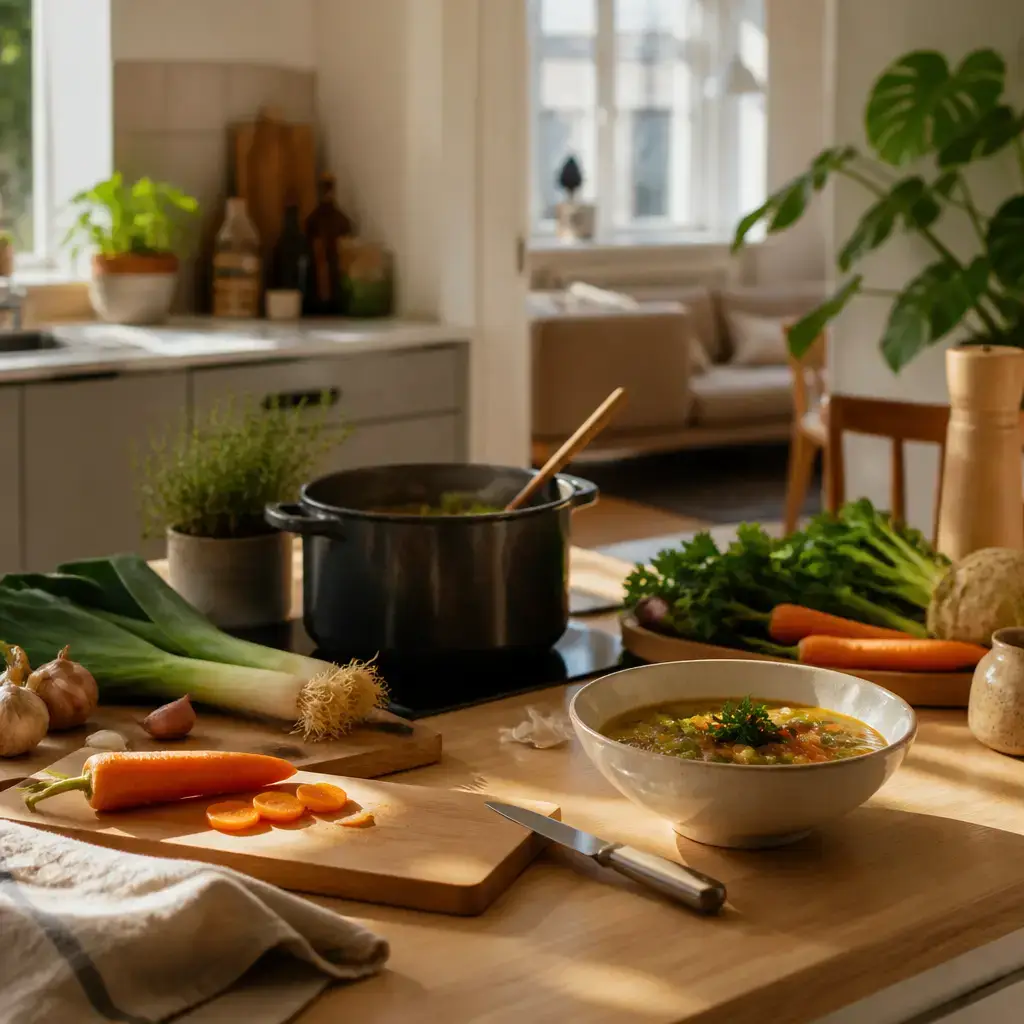
Use Talking about cooking simple soup to practice Danish conversation, pronunciation, vocabulary, grammar, and quizzes.
Dialogue
Er madlavning din hobby?
AIR MATH-lahw-ning deen HOB-bee? Is cooking your hobby?Jeg kan godt lide at lave enkel mad derhjemme.
YIGH kan GOHD LEE-thuh ehd LAY-oo-uh ENG-guhl MATH dair-YEM-uh. I like making simple food at home.Hvad kan du godt lide at lave?
VAH kan doo GOHD LEE-thuh ehd LAY-oo-uh? What do you like to make?Jeg laver ofte en enkel suppe.
YIGH LAY-uh OFF-duh en ENG-guhl SAW-buh. I often make a simple soup.Bruger du en opskrift?
BROO-uh doo en OP-skrehft? Do you use a recipe?Jeg følger en nem opskrift.
YIGH FUR-luh en NAME OP-skrehft. I follow an easy one.Jeg vil gerne prøve den, når den er klar.
YIGH VELL YAIR-nuh PRUR-oo-uh den, NAWR den AIR KLAHR. I would like to try it when it is ready.Jeg gemmer noget suppe til dig.
YIGH GEM-uh NOH-uhth SAW-buh TELL DYE. I will save some soup for you.Sentence explanations
Er madlavning din hobby?
Is cooking your hobby?
- Er
- is
- madlavning
- cooking
- din
- your
- hobby
- hobby
More detail
Er is the present-tense form of være (“to be”). In a yes/no question, Danish commonly places this verb before the subject: Er ...? = “Is ...?” The same form is used with different subjects; for example, Er du hjemme? means “Are you at home?” madlavning is a noun meaning “cooking” as an activity. It can be used as the subject of a sentence, as here. The related everyday expression lave mad means “to cook” or literally “to make food”; for example, Jeg laver mad. means “I am cooking.” This is a different construction from the noun madlavning. din means “your” when it modifies one singular common-gender noun. Here it agrees with hobby, which is a common-gender noun. Compare dit with a singular neuter noun and dine with plural nouns; for example, dit hus means “your house,” while dine bøger means “your books.” The possessive identifies the hobby as belonging to the person addressed; it does not itself state how many hobbies that person has. hobby is a noun meaning “hobby.” In this sentence it is the noun after the possessive phrase din hobby. A useful plural form is hobbyer, meaning “hobbies”; for example, Mine hobbyer er madlavning og læsning. means “My hobbies are cooking and reading.” Together, Er + madlavning + din hobby forms a yes/no question: “Is cooking your hobby?” The sentence asks whether cooking is a hobby of the person addressed. The word order is reusable: Er + subject or noun phrase + the rest of the sentence.
Jeg kan godt lide at lave enkel mad derhjemme.
I like making simple food at home.
- Jeg
- I
- kan godt lide
- like
- at lave
- to make
- enkel
- simple
- mad
- food
- derhjemme
- at home
More detail
Jeg is the first-person singular pronoun, meaning “I.” It identifies the speaker as the person who likes and makes the food. The corresponding plural pronoun is vi, “we,” when the speaker includes others. kan godt lide is the standard Danish construction for “like.” In this present-tense form, kan is the finite form, while lide follows the modal verb without at; godt is part of the natural construction. A reusable pattern is Jeg kan godt lide + noun or Jeg kan godt lide at + verb, for example: Jeg kan godt lide kaffe. — “I like coffee.” at lave means “to make” here. at marks the infinitive, and lave is the infinitive form. After kan godt lide, Danish uses at before another verb: Jeg kan godt lide at læse. — “I like reading.” enkel describes mad as simple or uncomplicated. It is the common-gender singular form; the neuter singular form is enkelt, and plural or definite forms commonly use enkle. The adjective agrees with the noun it describes, not with the nearby verb. mad means “food” in this sentence. It is used here in a general, non-count sense, so no article is needed: Jeg laver mad. — “I cook.” The word can receive a more specific interpretation in another context, but “food” is the supported meaning here. derhjemme is an adverb meaning “at home.” It gives the place where the making happens. For a different location, Danish can use a place expression such as i køkkenet, “in the kitchen.” Together, Jeg kan godt lide expresses the speaker’s liking, at lave names the activity, enkel mad specifies what is made, and derhjemme specifies the location. The complete meaning is: “I like making simple food at home.”
Hvad kan du godt lide at lave?
What do you like to make?
- Hvad
- what
- kan du godt lide
- do you like
- lave
- make
More detail
Hvad means “what” here. It is the question word used when the speaker asks for an unspecified thing or activity. For example: Hvad laver du? — “What are you making/doing?” The exact interpretation comes from the surrounding verb and context. kan du godt lide is the Danish pattern for “you like.” Kan is the present-tense form of kunne, and du is the second-person singular subject. In this fixed expression, godt lide combines with kan to express liking; godt is part of the construction rather than simply meaning “well.” With a different subject, the same pattern changes the subject form: Jeg kan godt lide ... — “I like ...” lave means “make” in this utterance. It is the infinitive form of the verb; after the infinitive marker at, Danish uses at lave. Its present-tense form is laver, as in the contextual sentence Jeg laver ofte en enkel suppe. — “I often make a simple soup.” Example: Hun kan godt lide at lave te. — “She likes making tea.” Together, Hvad asks for the thing, kan du godt lide expresses the addressee’s preference, and at lave names the activity. The word order places the question word first, followed by the finite verb kan and then the subject du; the infinitive phrase comes afterward. Thus the whole utterance means “What do you like to make?” In the supplied context, making simple food is an example of the kind of activity being discussed.
Jeg laver ofte en enkel suppe.
I often make a simple soup.
- Jeg
- I
- laver
- make
- ofte
- often
- en
- an indefinite article
- enkel
- simple
- suppe
- soup
More detail
Jeg means “I” here: it is the first-person singular subject pronoun. Danish subject pronouns include jeg “I,” du “you” (singular), and vi “we.” Example: Jeg laver mad. — “I make food.” laver is the present-tense form of lave, “to make/do.” In this sentence it means “make,” referring to preparing soup. Danish verbs do not change form for the subject’s person or number, so the same present form can occur with jeg, du, or de: De laver suppe. — “They make soup.” ofte means “often” and indicates repeated frequency. It can be reused with many verbs: Jeg læser ofte. — “I often read.” Its position here, between the subject and the verb, gives the sentence the pattern “I often make …”. en is the indefinite article used here with a singular common-gender noun. It introduces an unspecified soup; it does not by itself assert a numeric count. Danish also has et for singular neuter-gender nouns, while plural indefinite nouns normally have no indefinite article. enkel means “simple” here and describes suppe. Its base form is enkel; useful related forms are enkelt with a singular neuter noun and enkle with plural or definite noun phrases. Example: et enkelt måltid — “a simple meal.” suppe is the noun “soup.” It is a common-gender noun, as shown by en suppe; its indefinite plural is supper: Jeg laver supper. — “I make soups.” Together, Jeg laver ofte means “I often make,” and en enkel suppe means “a simple soup.” The complete utterance is therefore “I often make a simple soup.”
Bruger du en opskrift?
Do you use a recipe?
- Bruger
- use
- du
- you
- opskrift
- recipe
More detail
Bruger is the present-tense form of bruge, “to use.” In this question it means “use,” not an imperative. The present-tense form is used for a current or general activity. Example: Jeg bruger en opskrift. — “I use a recipe.” du means “you” for one person. It is the second-person singular pronoun; Danish does not change this form for the addressee’s gender. In a question, placing the verb before du forms the usual verb–subject order: Bruger du ...? — “Do you use ...?” opskrift means “recipe.” The form here is singular and indefinite because it follows the indefinite article en: en opskrift, “a recipe.” Its plural is opskrifter, and its definite singular form is opskriften, “the recipe.” Example: Jeg læser opskriften. — “I read the recipe.” Together, Bruger du asks whether one person uses something, and en opskrift supplies that thing: Bruger du en opskrift? means “Do you use a recipe?” The sentence asks about the use of a recipe without stating which recipe.
Jeg følger en nem opskrift.
I follow an easy one.
- Jeg
- I
- følger
- follow
- nem
- easy
- opskrift
- recipe
More detail
Jeg means “I” and is the first-person singular subject pronoun. It identifies the speaker as the person carrying out the action. Danish subject pronouns include jeg “I”, du “you” (singular), and han/hun “he”/“she”. følger means “follow” here. It is the present-tense form of følge; the same form is used with different singular and plural subjects in the present: jeg følger “I follow”, de følger “they follow”. In this sentence, følger describes the speaker’s action of following instructions, rather than physically following a person. nem means “easy”. It is the base form of the adjective and describes opskrift. Danish adjectives can change form according to the noun phrase; with an indefinite singular common-gender noun, as here, nem is used, while an indefinite singular neuter noun takes nemt, as in the example et nemt spørgsmål — “an easy question”. opskrift means “recipe”. It is a common-gender noun, shown by the indefinite article en in en opskrift. Its plural is opskrifter: to opskrifter means “two recipes”. In the supplied context, the recipe is the thing being followed; the translation’s “one” refers back to that recipe. The chunks combine as Jeg følger en nem opskrift: Jeg is the subject, følger is the present-tense verb, and en nem opskrift is the object. en marks an indefinite singular common-gender noun phrase; it does not by itself assert a numerical count. The complete meaning is “I follow an easy recipe.” The fixed translation says “I follow an easy one,” using “one” to avoid repeating “recipe” after the preceding question about a recipe.
Jeg vil gerne prøve den, når den er klar.
I would like to try it when it is ready.
- Jeg
- I
- vil gerne
- would like
- prøve
- try
- den
- it
- når
- when
- klar
- ready
More detail
Jeg means “I” here: it is the first-person singular subject pronoun. Its object form is mig, as in Hun ser mig — “She sees me.” vil gerne is a common Danish way to express “would like to.” vil is the present form of ville; with gerne, it expresses a willing or desired action rather than simply translating vil by itself. The following verb is in the infinitive without at: Jeg vil gerne lære — “I would like to learn.” prøve means “try” in this sentence. It is the infinitive form, used after the modal expression vil gerne; it does not take an infinitive marker here. For example, Jeg vil prøve igen means “I will try again.” den means “it” here. The fixed translation identifies this object as the thing the speaker wants to try, and the repeated den later refers to that same “it” as the thing that is ready. Den is the pronoun form used for a singular common-gender referent; the corresponding neuter form is det. The form can serve as an object, as in Jeg ser den — “I see it” — or as a subject, as in Den er klar — “It is ready.” når introduces a time clause meaning “when.” It connects an event with the time at which another event holds: Jeg ringer, når jeg er hjemme — “I will call when I am home.” klar means “ready” here and describes the referent of the second den. It is the common-gender singular indefinite form of the adjective; the neuter form is klart, and the plural or definite form is klare. For example, Maden er klar means “The food is ready,” while Maden er klar, når gæsterne kommer means “The food is ready when the guests arrive.” Together, Jeg vil gerne prøve den says “I would like to try it.” The time clause når den er klar adds the condition in time: this trying is to happen when that same thing is ready. Thus the whole utterance means “I would like to try it when it is ready.”
Jeg gemmer noget suppe til dig.
I will save some soup for you.
- Jeg
- I
- gemmer
- save; store
- noget
- some
- suppe
- soup
- til dig
- for you
More detail
Jeg means “I” and is the first-person singular subject pronoun. It identifies the speaker as the one carrying out the action. In Danish, the subject form is jeg; after a preposition, the corresponding second-person form is different, as in dig later in this sentence. gemmer is the present-tense form of gemme, “to save” or “to store.” Here it means keeping soup so it remains available for someone. Danish present tense can also refer to a planned or expected future action when the context supports that reading, which matches “I will save” in the fixed translation. Example: Jeg gemmer brevet. — “I am saving the letter.” noget means “some” here, introducing an unspecified amount of a substance. It does not state an exact quantity. In this use, it combines naturally with a mass noun such as suppe. Example: Jeg vil have noget vand. — “I would like some water.” suppe means “soup.” It is a noun naming the food being saved. The phrase noget suppe means “some soup,” with noget indicating an unspecified amount rather than a particular serving or exact count. til dig means “for you.” til is the preposition “for/to,” and dig is the second-person singular pronoun used after a preposition. The subject counterpart is du: Du får suppen. — “You get the soup.” Together, Jeg gemmer says that the speaker will save or keep something, noget suppe specifies that the thing is an unspecified amount of soup, and til dig gives the intended beneficiary. The whole utterance therefore means: “I will save some soup for you.”
Grammar Points
kan godt lide + navneord
kan godt lide madlavning
kan GOHD LEE-thuh MATH-lahw-ninglike cooking
kan godt lide er et fast dansk udtryk, der betyder “like”. Det står her foran navneordet madlavning.
vil gerne + infinitiv
vil gerne prøve
VELL YAIR-nuh PRUR-oo-uhwould like to try
Efter vil gerne bruges verbets infinitiv, fx prøve. Udtrykket betyder “would like to”.
Danish Vocabulary
Quiz
Word Order
Arrange the words in the correct order.
Is cooking your hobby?
Show Answer
Er madlavning din hobby?I often make a simple soup.
Show Answer
Jeg laver ofte en enkel suppe.Do you use a recipe?
Show Answer
Bruger du en opskrift?Spelling
Tap the letters to spell the word.
hobby
Show Answer
hobbysimple
Show Answer
enkelwhat
Show Answer
hvadoften