10 minutes free every day
Continue audio lessons in the app
Word explanations appear automatically in sync with the audio.
No login required · synced translations · playback with the screen locked
Choose your learning language and open this lesson in the app.

About This Lesson
Use Walking as a hobby to practice Danish conversation, pronunciation, vocabulary, grammar, and quizzes.
Dialogue
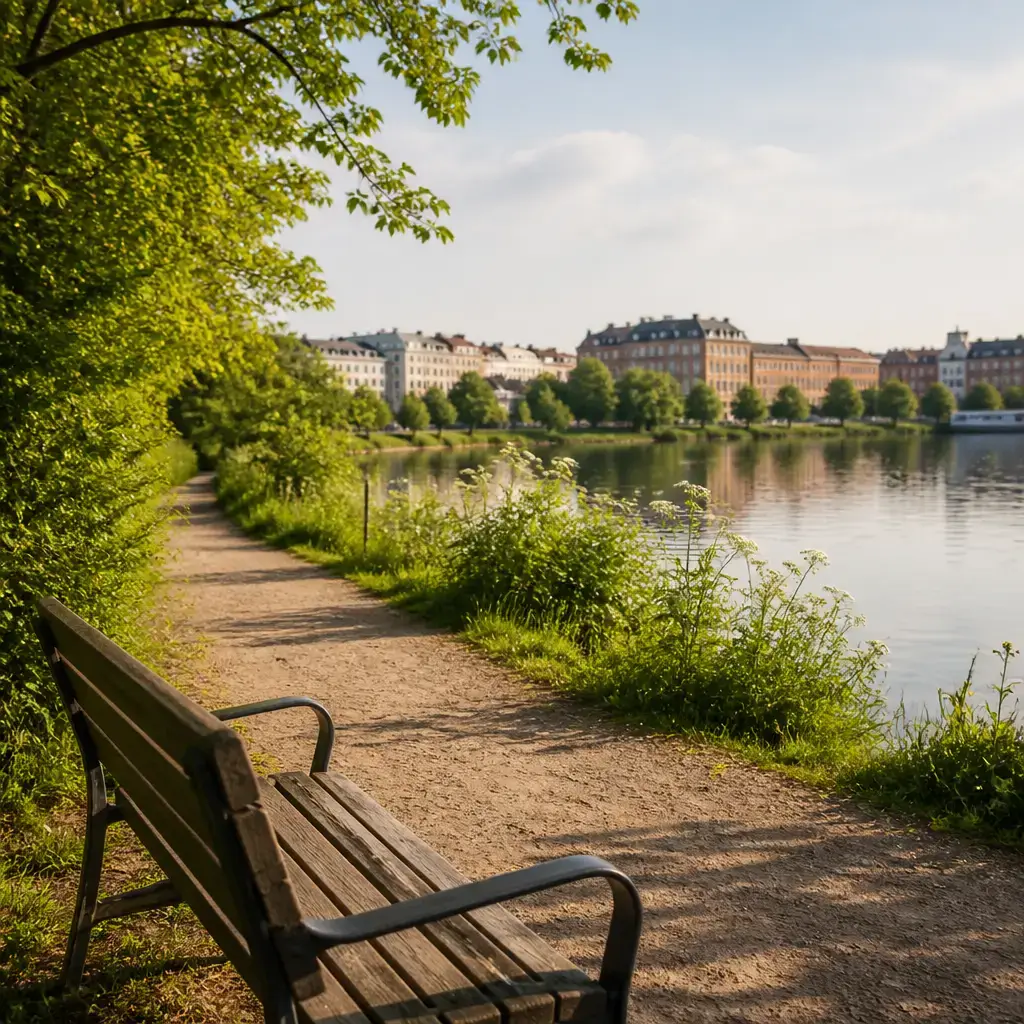
Er gåture din hobby?
air GOH-too-uh deen HUH-bee? Is walking your hobby?Jeg kan godt lide at gå ture i min fritid.
yai ken got LEE-thuh ad GOH TOO-uh ee meen FREE-teeth. I like going for walks in my free time.Hvor plejer du at gå hen?
voh PLY-uh doo ad GOH HEN? Where do you usually go?Jeg går i parken.
yai gawr ee PAR-gen. I walk in the park.Er ruten lang?
air ROO-den LANG? Is the route long?Det er en kort og nem tur.
day air en KORD oh NEHM TOOR. It is a short, easy walk.Det lyder afslappende.
day LOO-thuh uf-SLEH-buh-nuh. That sounds relaxing.Vi kan gå derhen sammen.
vee ken GOH dair-HEN SAM-un. We can go there together.Sentence explanations
Er gåture din hobby?
Is walking your hobby?
- Er
- is
- gåture
- walks; going for walks
- din
- your
- hobby
- hobby
More detail
Er is the present-tense form of være, “to be.” In a yes/no question, Danish places this verb before the subject: Er ...? means “Is ...?” or “Are ...?” depending on the subject. Example: Er hun hjemme? — “Is she at home?” gåture is the plural of the common-gender noun gåtur, meaning “walk” or “going for a walk.” The plural ending is -e: en gåtur → gåture. In this sentence, the plural noun refers generally to going for walks as an activity. Do not confuse it with the separate sequence gå ture in the following sentence: there gå is a verb and ture is a noun, whereas gåture here is one compound noun. din means “your” when addressing one person and the possessed noun is singular and common gender, as in din hobby. Danish possessives agree with the possessed noun: din with a common-gender singular noun, dit with a neuter singular noun, and dine with a plural noun. The form does not indicate the owner’s gender. hobby is a noun meaning “hobby.” It is common gender in Danish: en hobby, so the matching singular possessive is din, not dit. A useful example is Det er min hobby. — “It is my hobby.” Together, Er + gåture forms a yes/no question about the activity, and din hobby identifies whose hobby it is. The complete meaning is: “Is walking your hobby?”
Jeg kan godt lide at gå ture i min fritid.
I like going for walks in my free time.
- Jeg
- I
- kan godt lide
- like
- at gå
- to go; going
- ture
- walks
- min
- my
- fritid
- free time
More detail
Jeg is the first-person singular subject pronoun, “I.” It identifies the speaker as the person who likes the activity. The corresponding plural pronoun is vi, “we.” kan godt lide is the common Danish construction for “like.” In this fixed sentence, kan godt lide functions as one expression meaning that the speaker enjoys the activity. A useful reusable pattern is Jeg kan godt lide + noun or Jeg kan godt lide at + verb: Jeg kan godt lide kaffe means “I like coffee,” while Jeg kan godt lide at læse means “I like reading.” at gå means “to go” or, in this construction, “going.” gå is the base form of the verb; at marks the infinitive. The same infinitive pattern appears after many Danish verbs: at spise means “to eat.” Here, at gå introduces the activity that is liked. ture means “walks” here. It is the plural form of tur, “walk” or “trip”; in the context of gå ture, it refers to going for walks. The compact pattern gå en tur means “go for a walk,” while gå ture presents walking as a repeated or general activity rather than one specific walk. This is also why the translation uses “going for walks.” min means “my.” It is the possessive form used with a singular common-gender noun, as in min fritid. Danish uses mit with a singular neuter noun and mine with a plural noun, so the form must agree with the possessed noun. fritid means “free time.” It is a singular common-gender noun; its definite form is fritiden, “the free time.” The preposition i before min fritid gives the time setting “in my free time.” Together, Jeg kan godt lide at gå ture means “I like going for walks.” Adding i min fritid specifies when this activity takes place: “in my free time.” The whole utterance therefore means, “I like going for walks in my free time.”
Hvor plejer du at gå hen?
Where do you usually go?
- Hvor
- where
- plejer
- usually do; tend to
- du
- you
- gå hen
- go (somewhere)
More detail
Hvor asks about a place or destination: “where”. It can introduce a question about location or movement. Example: Hvor bor du? — “Where do you live?” plejer is the present-tense form of pleje in the habitual construction pleje at + infinitive. Here it means that an action is usual or customary, rather than happening just once. The reusable pattern is jeg plejer at ... — “I usually ...” Example: Jeg plejer at læse om aftenen. — “I usually read in the evening.” du is the second-person singular pronoun “you”. In this question, it is the subject: the person whose usual destination is being asked about. Danish uses du for one informal or neutral “you”; the form itself does not mark gender. gå hen combines gå (“go/walk”) with the directional particle hen, giving the idea of going somewhere or going over to a place. The infinitive gå follows at: at gå. The particle can be separated from the verb in other sentence structures, but together they form a useful movement expression here. Example: Jeg går hen til døren. — “I go over to the door.” The question structure is Hvor + finite verb plejer + subject du + at + infinitive phrase gå hen. Thus Hvor plejer du at gå hen? asks “Where do you usually go?” The habitual meaning comes from plejer at, while gå hen presents the activity as movement toward a place.
Jeg går i parken.
I walk in the park.
- Jeg
- I
- går
- walk
- parken
- the park
More detail
Jeg means “I” and is the first-person singular subject pronoun. It identifies the speaker as the person performing the action. A useful contrast is du, “you” (singular): Du går — “You walk/go.” går is the present-tense form of gå, meaning “to walk” here. gå can also mean “to go” in other contexts; the fixed translation selects the walking sense in this sentence. The present form går is used with several subjects: jeg går — “I walk,” and de går — “they walk.” parken means “the park.” Its noun base is park, and parken is the singular definite form. Danish uses en park for “a park,” while parken means “the park”; the ending -en marks definiteness for this noun. The construction gå i + place can express walking or going in a place. Here, i means “in,” and i parken means “in the park.” Together, Jeg går i parken means “I walk in the park”: the speaker is the walker, and the park is the location.
Er ruten lang?
Is the route long?
- Er
- is
- ruten
- the route
- lang
- long
More detail
Er is the present-tense form of være, “to be.” In this question it comes before the subject, which is the normal verb–subject order for a direct yes/no question in Danish. Compare the statement pattern Ruten er lang (“The route is long”) with the question Er ruten lang? (“Is the route long?”). ruten means “the route.” Its base form is rute (“route”); the ending -en marks the definite singular form for this noun: en rute (“a route”) → ruten (“the route”). This ending is part of the noun form rather than a separate word. lang means “long.” It is the adjective lang in its common-gender singular form, agreeing with the singular noun ruten in this predicative use. A neuter singular noun would generally take langt, while plural forms use lange, for example lange ruter (“long routes”). Together, Er + ruten + lang forms a yes/no question: “Is the route long?” The question asks whether the route has the property of being long; it does not itself state the answer. The reusable pattern is Er + subject + adjective?, as in Er vejen kort? — “Is the road short?”
Det er en kort og nem tur.
It is a short, easy walk.
- Det er
- it is
- en
- a/an
- kort
- short
- og
- and
- nem
- easy
- tur
- walk; trip
More detail
Det er means “it is” here. er is the present-tense form of være (“to be”); the same form is used with different subjects, for example Jeg er klar = “I am ready” and De er klar = “They are ready.” Det is a neuter singular pronoun used here as the subject of the statement; the translation identifies the subject as “it,” without specifying a separate noun. en is the indefinite article used with a common-gender singular noun. It introduces tur as an unspecified singular noun phrase; the article itself does not assert a numerical count. Danish also has et for neuter singular nouns, while plural nouns do not take an indefinite singular article. kort means “short” here and describes tur. Its base adjective is kort; in this use, the common-gender singular form is kort. Compare the neuter singular form kort in et kort svar (“a short answer”) and the plural form korte in korte ture (“short walks/trips”). og connects two descriptions of the same noun. The pattern A og B means “A and B,” as in en lille og rolig by = “a small and quiet town.” nem means “easy” here. It is the common-gender singular form modifying tur; the neuter singular form is nemt, and the plural form is nemme: et nemt spørgsmål = “an easy question,” nemme opgaver = “easy tasks.” tur is a common-gender noun meaning “walk” in this sentence; it can also mean “trip” in other contexts. Its indefinite singular form is en tur, and its plural is ture, as in to ture = “two trips/walks.” The intended sense here is “walk,” as fixed by the translation. Together, en kort og nem tur is “a short and easy walk.” The adjective phrase kort og nem describes tur, and Det er presents that noun phrase as the predicate: “It is a short, easy walk.”
Det lyder afslappende.
That sounds relaxing.
- Det
- it/that
- lyder
- sounds
- afslappende
- relaxing
More detail
Det is the Danish neuter singular pronoun used here for “it” or “that.” In this sentence it points to the situation or activity being discussed, without naming that referent again. Danish also uses det in other constructions, including some impersonal ones, so its grammatical form alone does not identify a specific object. lyder is the present-tense form of lyde, “to sound.” In Danish, this present form does not change for person or number: jeg lyder, du lyder, and det lyder all use lyder. Here lyde describes an impression—how something seems—rather than necessarily a literal sound. Example: Det lyder godt. — “That sounds good.” afslappende means “relaxing,” describing something that produces a relaxed feeling. It is an adjective formed with the Danish present-participle ending -ende; compare afslappet, “relaxed,” which describes the state of a person or thing rather than its relaxing effect. Example: Musikken er afslappende. — “The music is relaxing.” Together, Det lyder afslappende follows the reusable pattern Det lyder + adjective: “It/That sounds + description.” The pronoun presents the topic, lyder expresses the speaker’s impression, and afslappende supplies the description. Thus the complete meaning is “That sounds relaxing.”
Vi kan gå derhen sammen.
We can go there together.
- Vi kan
- we can
- gå
- go
- derhen
- there
- sammen
- together
More detail
Vi kan contains the first-person plural pronoun vi, meaning “we,” and the modal verb kan, meaning “can” here. Vi presents the speaker together with at least one other participant. Kan is the present form of kunne; Danish modal verbs such as kan do not change for person or number. A modal is followed by the other verb in its bare infinitive form. gå means “go” here. It is the infinitive/base form of the verb; after kan, Danish uses gå, not a form marked for person or tense. Example: Vi kan vente. — “We can wait.” derhen means “there” with a directional sense: movement toward that place. It is useful to distinguish this from der, which generally points to a place without itself marking movement toward it. Example: Hun går derhen. — “She goes there.” sammen means “together.” It is an adverb and does not change to agree with the participants. Example: De arbejder sammen. — “They work together.” Together, Vi kan expresses the possibility or ability of “we,” gå derhen expresses moving to that place, and sammen specifies that the participants do so together. The complete utterance means: “We can go there together.”
Grammar Points
lyder + adjektiv
lyder afslappende
LOO-thuh uf-SLEH-buh-nuhsounds relaxing
Efter lyder beskriver et adjektiv, hvordan noget virker eller opleves; afslappende er ikke et adverb her.
gå + derhen
gå derhen
GOH dair-HENgo there
Derhen viser bevægelse mod et sted, mens hvor bruges til at spørge om en placering.
Danish Vocabulary
- Gender
- common
- Gender
- common
- Gender
- common
Jeg kan godt lide at gå ture.
- Gender
- common
- Gender
- common
Quiz
Word Order
Arrange the words in the correct order.
Is walking your hobby?
Show Answer
Er gåture din hobby?Where do you usually go?
Show Answer
Hvor plejer du at gå hen?I walk in the park.
Show Answer
Jeg går i parken.Spelling
Tap the letters to spell the word.
free time
Show Answer
fritidhobby
Show Answer
hobbywhere
Show Answer
hvorusually