10 minutes free every day
Continue audio lessons in the app
Word explanations appear automatically in sync with the audio.
No login required · synced translations · playback with the screen locked
Choose your learning language and open this lesson in the app.

About This Lesson
Use Listening to Music in Free Time to practice Danish conversation, pronunciation, vocabulary, grammar, and quizzes.
Dialogue
Lytter du til musik?
LÜD-uh doo tehl moo-SEEK? Do you listen to music?Jeg lytter i min fritid.
yai LÜD-uh ee men free-TEETH. I listen in my free time.Hvilken slags musik kan du lide?
VIL-kuhn SLEHS moo-SEEK kan doo LEE-thuh? What kind of music do you like?Jeg kan lide langsomme sange.
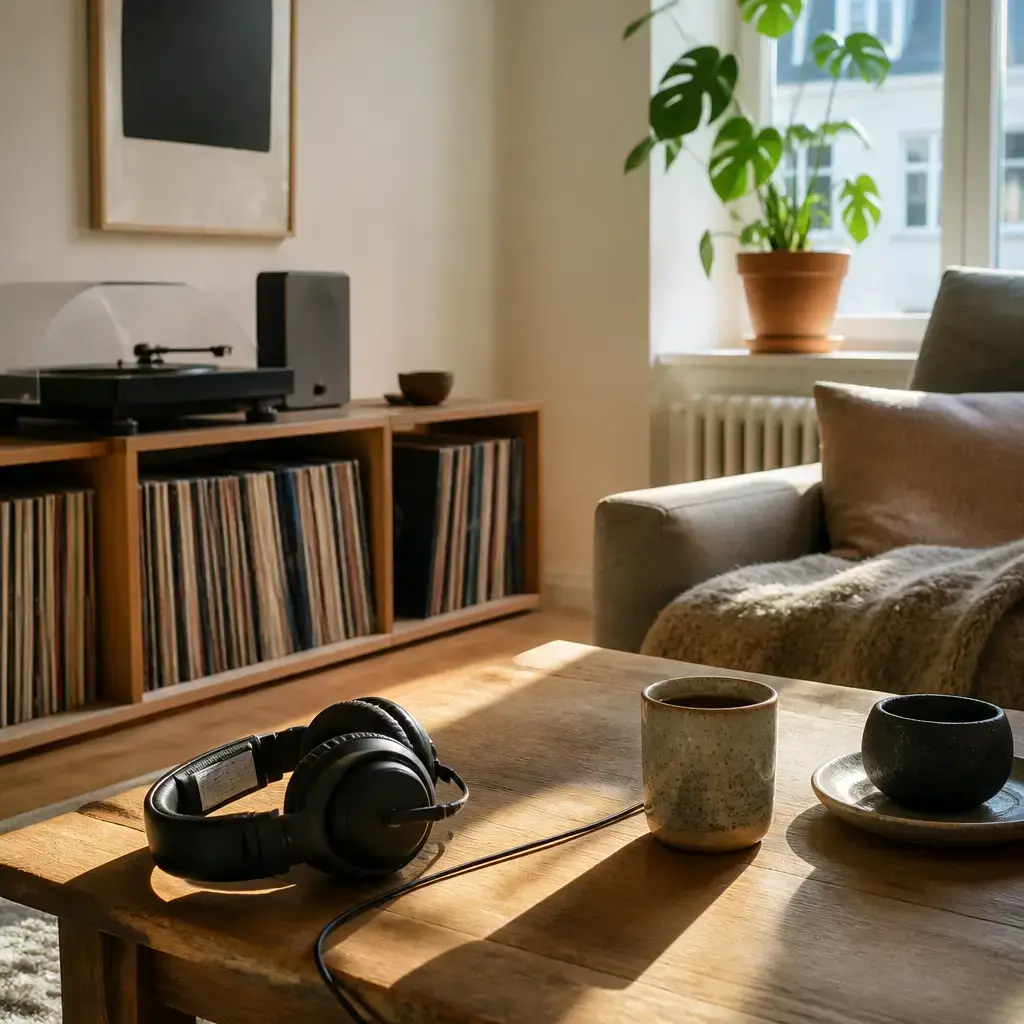
yai kan LEE-thuh LAHNG-saw-muh SENG-uh. I like slow songs.Bruger du høretelefoner?
BROO-uh doo HUR-uh-teh-leh-FOH-nuh? Do you use headphones?Jeg bruger dem, når jeg gerne vil slappe af.
yai BROO-uh dehm, nawr yai YAIR-nuh vehl SLA-buh EH. I use them when I want to relax.Må jeg høre noget?
maw yai HUR-uh NOH-uhth? Can I hear something?Jeg spiller et roligt nummer.
yai SBEH-luh eht ROH-lee NOM-uh. I'll play a quiet track.Sentence explanations
Lytter du til musik?
Do you listen to music?
- Lytter
- listen
- du
- you
- til
- to; at
- musik
- music
More detail
Lytter is the present-tense form of lytte, “to listen.” In a yes/no question, Danish commonly places the finite verb before the subject: Lytter du ...? This is a word-order pattern, not a change in the verb’s meaning. Example: Lytter du? — “Are you listening?” du means “you” and is the singular second-person pronoun. Danish uses this pronoun when addressing one person; it does not mark the formal/informal distinction described by some languages. The corresponding first-person pronoun is jeg, as in the contextual sentence Jeg lytter i min fritid. — “I listen in my free time.” til is the preposition used with lytte when naming what someone listens to: lytte til + something. The combination is therefore reusable as lytte til musik, “listen to music.” musik means “music.” Here it is used without an article for music as a general or uncounted activity/content. Example: Jeg lytter til musik. — “I listen to music.” Together, Lytter du forms the yes/no question “Do you listen,” and til musik specifies what is listened to. The complete utterance means “Do you listen to music?”
Jeg lytter i min fritid.
I listen in my free time.
- Jeg
- I
- lytter
- listen
- i
- in
- min
- my
- fritid
- free time
More detail
Jeg means “I” here, the first-person singular subject pronoun. It is the form used for the speaker as the subject: Jeg lytter. — “I listen.” lytter means “listen” here. It is the present-tense form of lytte (“to listen”); the -r ending marks the present form. Danish present-tense verbs generally use the same form with different subjects: jeg lytter — “I listen” and du lytter — “you listen.” In the supplied preceding question, Lytter du ...? uses the same verb form in a question. i means “in” in this time expression. Danish uses i with a period in which an activity takes place: i min fritid — “in my free time.” min means “my.” It is the possessive form used with a singular common-gender noun such as fritid. Possessives agree with the possessed noun’s grammatical gender and number: min is used with a common-gender singular noun, while mit is used with a neuter singular noun and mine with plural nouns. The form min itself does not mean a numerical quantity. fritid means “free time” or “leisure time.” Its base form is fritid; with the definite suffix, fritiden means “the free time.” After the possessive min, the noun appears in this unmarked form: min fritid, not min fritiden. Together, Jeg lytter gives “I listen,” and i min fritid specifies when: “in my free time.” The complete utterance therefore means “I listen in my free time.”
Hvilken slags musik kan du lide?
What kind of music do you like?
- Hvilken
- which
- slags
- kind; type
- musik
- music
- kan du
- can you
- lide
- like
More detail
Hvilken introduces a choice or identification question: “which”. In Danish, hvilken is used with singular common-gender nouns; the related forms are hvilket with singular neuter nouns and hvilke with plural nouns. Here it forms the reusable pattern hvilken slags + noun, meaning “what kind of + noun”. slags means “kind” or “type”. The combination hvilken slags asks about a category, rather than asking which individual item. Example: Hvilken slags mad kan du lide? — “What kind of food do you like?” musik means “music”. It is a mass noun here, so the question refers to music as a type or activity without asserting a numerical amount. Example: Jeg lytter til musik. — “I listen to music.” kan du is the question-order pattern “can you”. kan is the modal verb whose base form is kunne; du is the second-person singular pronoun “you”. In a Danish yes/no or information question, the verb comes before the subject: Kan du ...? Example: Kan du synge? — “Can you sing?” lide means “like” in this construction. It follows the modal kan, so it appears in its infinitive form without a separate infinitive marker. The reusable pattern kan lide means “like”, while kan can also express ability in other contexts; the intended meaning here is established by the fixed translation. Example: Jeg kan lide langsomme sange. — “I like slow songs.” Together, Hvilken slags musik asks for a type of music, and kan du lide asks which type the listener likes. The whole utterance therefore means “What kind of music do you like?”
Jeg kan lide langsomme sange.
I like slow songs.
- Jeg
- I
- kan lide
- like
- langsomme
- slow
- sange
- songs
More detail
Jeg means “I” here. It is the first-person singular subject pronoun. The related form du means “you” when addressing one person; it is a different person, not a variant of jeg. kan lide is the Danish expression for “like” in this sentence. The form kan is present tense of kunne (“can/be able to”), but together with lide it forms the common pattern kan lide for expressing liking. For example, Jeg kan lide musik. means “I like music.” langsomme means “slow” here and describes sange. Its base form is langsom. In Danish, the adjective is langsom with a common-gender singular indefinite noun, langsomt with a neuter singular indefinite noun, and langsomme with plural nouns or definite noun phrases. Here sange is plural, so langsomme is the matching form. For example, en langsom sang means “a slow song,” while langsomme sange means “slow songs.” sange means “songs.” Its base form is the singular noun sang; sange is its plural form. The noun is indefinite plural here, meaning songs in general rather than a specifically identified set. For example, Jeg hører sange. means “I listen to songs.” Together, Jeg kan lide gives “I like,” and langsomme sange gives “slow songs.” The complete utterance therefore means “I like slow songs.”
Bruger du høretelefoner?
Do you use headphones?
- Bruger
- use
- du
- you
- høretelefoner
- headphones
More detail
Bruger is the present-tense form of bruge, “to use.” In Danish, the present form is generally the same for different subjects: jeg bruger = “I use,” and du bruger = “you use.” Here, bruger expresses the action being asked about. du means “you” and is the singular informal second-person pronoun. It is the subject of the question. In a Danish yes/no question, the verb commonly comes before the subject: Bruger du ...? = “Do you use ...?” høretelefoner means “headphones.” It is the plural form of høretelefon (“headphone”); Danish uses this plural noun here without an article. The compound contains høre (“hear”) and telefon (“telephone”), but the complete word is the ordinary noun for headphones. Together, Bruger du høretelefoner? follows the reusable pattern present-tense verb + subject + noun: “Do you use headphones?” The question asks whether the person addressed uses headphones; it does not itself specify when, how often, or which headphones.
Jeg bruger dem, når jeg gerne vil slappe af.
I use them when I want to relax.
- Jeg
- I
- bruger
- use
- dem
- them
- når
- when
- gerne vil
- want to
- slappe af
- relax
More detail
Jeg is the first-person singular pronoun “I.” It identifies the speaker as the subject. The corresponding object form is mig, as in Hun ser mig (“She sees me”); do not use mig for the subject of this sentence. bruger means “use” here. It is the present-tense form of bruge (“to use”): jeg bruger = “I use.” Danish present-tense verbs generally do not change according to the subject, so the same form can occur with other subjects: De bruger (“They use”). dem is the object form meaning “them.” In this bounded context, it refers to the headphones mentioned in the preceding question. Dem is the third-person plural object pronoun; its form does not mark the gender of the things referred to. Compare the singular object forms ham (“him”) and hende (“her”) with plural dem. når introduces a time clause meaning “when.” It links the main action to the situation in which it occurs. For example, Jeg læser, når jeg har tid means “I read when I have time.” gerne vil expresses wanting or being willing to do something. Vil is the present form of ville, and gerne adds the sense of gladly or with a desire to; together, gerne vil commonly corresponds to “want to” or “would like to.” The modal vil is followed by an infinitive: Jeg vil lære means “I want to learn.” slappe af is the Danish verb construction “to relax.” Slappe is the infinitive, and af is part of the construction, so it should be learned together rather than treated as the ordinary preposition “of/from.” For example, Vi vil slappe af means “We want to relax.” The sentence is built as Jeg bruger dem (“I use them”) + når jeg gerne vil slappe af (“when I want to relax”). Thus the complete meaning is: “I use them when I want to relax.”
Må jeg høre noget?
Can I hear something?
- Må jeg
- May I
- høre
- hear
- noget
- something
More detail
Må jeg combines the modal verb må with the subject pronoun jeg. Here, må asks for permission, so the pattern is Må jeg + infinitive? = “May I …?” or, naturally, “Can I …?” The pronoun jeg means “I” and identifies the person asking. After a modal verb such as må, the following verb appears in the infinitive: Må jeg komme? — “May I come?” høre is the infinitive of “hear.” It can mean receiving a sound or listening to something, depending on context. For example, Jeg kan høre musik. means “I can hear music.” With må jeg, it forms a permission question: Må jeg høre ...? noget means “something” here. It is an indefinite pronoun referring to an unspecified thing or content; the utterance does not identify exactly what is to be heard. In other contexts, noget can also mean “some” before an uncountable substance, but that is not the use in this question. Together, Må jeg høre noget? has the structure May I + hear + something? and means “Can I hear something?” The question asks permission to hear an unspecified thing. In the supplied context, the following sentence says that a quiet track will be played, but the question itself leaves the thing unspecified.
Jeg spiller et roligt nummer.
I'll play a quiet track.
- Jeg
- I
- spiller
- play
- et
- a/an
- roligt
- quiet
- nummer
- track
More detail
Jeg is the first-person singular subject pronoun: “I.” It does not change according to the speaker’s gender. A useful contrast is jeg “I” versus du “you” when the subject changes. spiller is the present-tense form of spille, “to play.” In this sentence it means playing a music track. Danish present tense can also describe an action intended for the immediate situation, so the fixed translation naturally uses “I’ll play,” even though the Danish form is present tense. The same verb can be used for other kinds of playing, depending on its object. et is the indefinite article used with a neuter singular noun. Here it introduces an unspecified singular track, but the article itself need not be understood as an emphasized count of “one.” Danish also has the common-gender indefinite article en, so the article must agree with the noun’s grammatical gender. roligt means “quiet” here. It is the neuter singular form of the adjective rolig, used with the neuter noun nummer: et roligt nummer. With a common-gender singular noun, the corresponding form is normally rolig, as in the example en rolig sang — “a quiet song.” nummer means “track” in this musical context. It is a neuter noun, which is why it takes et and the adjective form roligt. In other contexts, nummer can refer to a number, but “track” is the intended meaning here. Together, et roligt nummer means “a quiet track”: the indefinite article and adjective agree with the neuter singular noun. The complete structure is Jeg + present-tense spiller + object et roligt nummer, meaning “I’ll play a quiet track.”
Grammar Points
Hvilken slags + substantiv
Hvilken slags musik kan du lide?
VIL-kuhn SLEHS moo-SEEK kan doo LEE-thuh?What kind of music do you like?
Hvilken slags means “what kind of” and comes before the noun. In a question, kan comes before du.
Danish Vocabulary
Quiz
Word Order
Arrange the words in the correct order.
Do you listen to music?
Show Answer
Lytter du til musik?I listen in my free time.
Show Answer
Jeg lytter i min fritid.What kind of music do you like?
Show Answer
Hvilken slags musik kan du lide?Spelling
Tap the letters to spell the word.
use
Show Answer
Brugerlisten
Show Answer
lytterslow
Show Answer
langsommefree time